
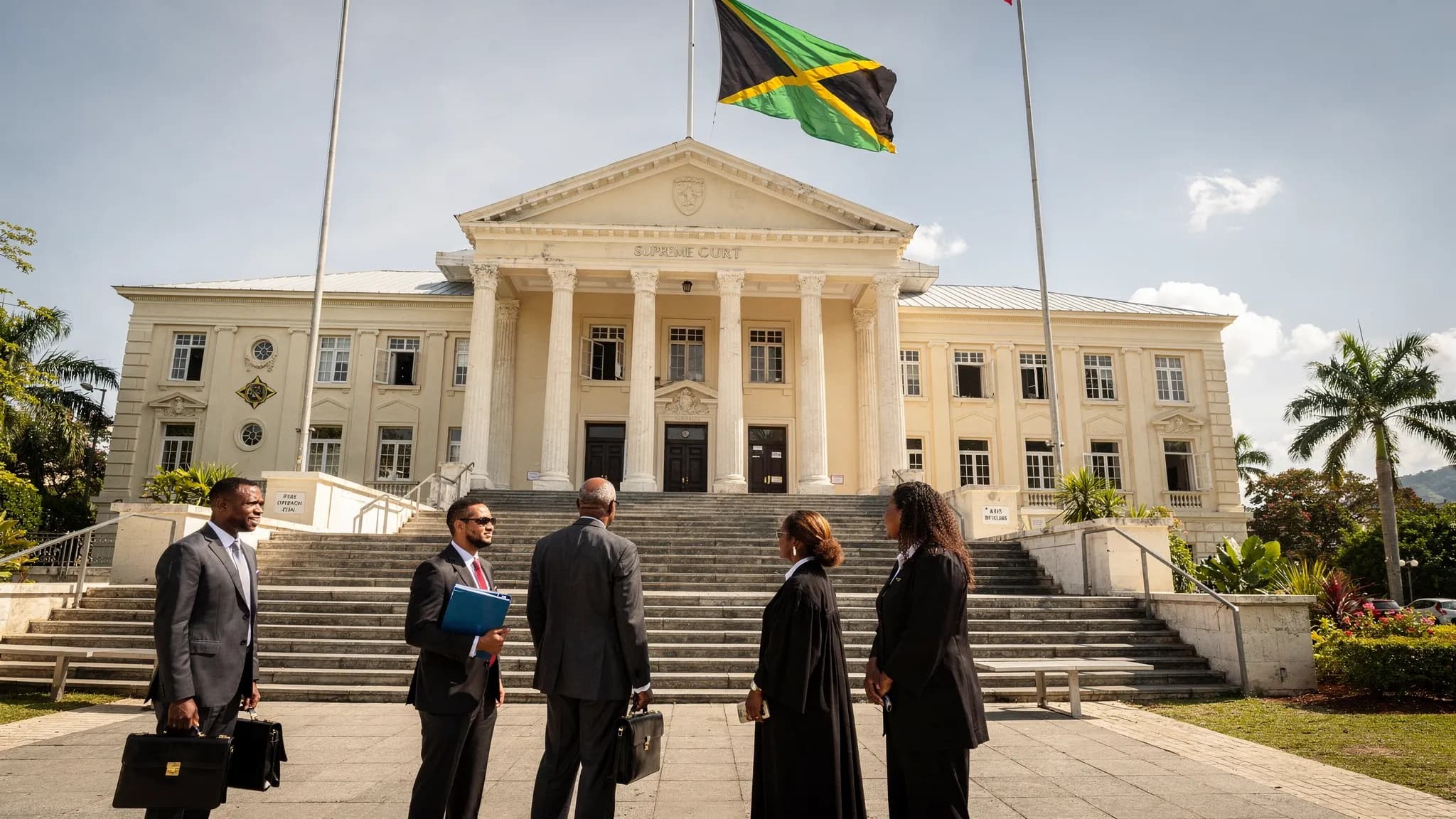
Jamaica’s legal system can feel complex at first glance, especially when a single issue touches more than one set of rules (for example, a business dispute that also involves data privacy or regulatory compliance). This guide breaks down the main areas of law in Jamaica in plain language, with practical examples of when each area matters.
How law works in Jamaica (in one minute)
Jamaica operates primarily within a common law tradition, shaped by:
The Constitution of Jamaica (the country’s supreme law)
Statutes passed by Parliament
Court decisions that interpret and apply the law
Disputes and prosecutions are handled through the court system, including the Parish Courts, the Supreme Court, and the Court of Appeal. For many matters, the final appellate court is the Judicial Committee of the Privy Council.
If you want an official starting point for how justice is administered, the Jamaican Ministry of Justice provides helpful public information on the court system and services: Ministry of Justice (Jamaica).

The main areas of law in Jamaica (simple definitions)
The sections below cover the areas of law most people and businesses encounter. Not every matter fits neatly into one box, but these categories help you identify the right type of legal support.
Constitutional law
Constitutional law deals with fundamental rights and how the state must exercise its powers. It often comes up when someone alleges that a public authority acted unlawfully, unfairly, or in a way that infringes constitutional rights.
Common examples include challenges involving:
Due process and fair treatment
Freedom of expression and assembly
Lawful search and seizure
Criminal law
Criminal law addresses conduct considered offences against the state, prosecuted by the Crown. It covers investigations, charges, bail, trials, sentencing, appeals, and related rights.
Common examples:
Fraud and financial offences
Assault and other personal offences
Cybercrime-related allegations
Civil litigation (disputes between people or organisations)
Civil law generally concerns disputes where one party claims another caused loss or harm. Civil litigation is the process of resolving those disputes in court.
Typical civil matters include:
Contract disputes (unpaid invoices, breached agreements)
Negligence claims
Defamation
Property and ownership disputes
Commercial and business law
Commercial law focuses on business activity, transactions, and the legal frameworks that support them. This is a broad area and frequently overlaps with litigation, regulatory compliance, IP, and data privacy.
Examples:
Structuring companies and commercial contracts
Shareholder and partnership disputes
Supplier and distribution arrangements
Banking and finance (including banking litigation)
Banking and finance law covers lending, security arrangements, enforcement, and disputes involving financial institutions and borrowers.
Common scenarios include:
Debt recovery and enforcement of security
Disputes relating to loan terms, guarantees, or repayment
Claims involving financial misconduct or misrepresentation
Property and real estate law
Property law governs land ownership, leasing, buying and selling property, and disputes about title or boundaries. In Jamaica, real estate transactions often require careful due diligence around title, encumbrances, and proper documentation.
Examples:
Conveyancing (sale and purchase)
Commercial leases
Boundary and title disputes
Development issues and restrictive covenants
Family law
Family law deals with relationships and family responsibilities, including marriage breakdown, children, and financial support.
Common matters include:
Divorce and related applications
Child maintenance and custody issues
Division of property following separation
Employment and labour law
Employment law covers workplace rights and obligations, from hiring to termination, as well as disputes between employers and employees.
Examples:
Termination and redundancy disputes
Disciplinary procedures and workplace investigations
Labour disputes and industrial relations issues
Administrative and public law
Administrative law focuses on how public bodies make decisions, and the fairness and legality of those decisions.
This can include:
Judicial review of decisions by public authorities
Licensing and permitting disputes
Procurement and regulatory decision challenges
Regulatory compliance and risk law
Compliance and risk work helps organisations understand and meet legal and regulatory expectations, reduce exposure, and respond to investigations.
Common focus areas:
Anti-money laundering and counter-terrorist financing controls
Corporate governance and internal investigations
Regulator engagement and remediation planning
Data privacy and cybersecurity
Data privacy covers how organisations collect, use, store, share, and protect personal data. It also connects to cybersecurity, breach response, and vendor management.
In Jamaica, data protection requirements are shaped by local legislation and developing regulatory expectations. Because this area evolves, it is important to assess your obligations based on your sector, the type of data you process, and whether you operate across borders.
For context on Jamaica’s legislative framework and access to laws, you can refer to official sources such as the Jamaica Laws Online repository.
Intellectual property (IP)
Intellectual property law protects creations and brand assets. IP often becomes critical when a business scales, exports, licenses, franchises, or faces copycats.
Common IP categories include:
Trade marks (brand names, logos)
Copyright (creative works)
Patents and industrial designs (where applicable)
For a practical overview of trade mark protection concepts, the World Intellectual Property Organization provides accessible resources: WIPO IP basics.
Competition law and policy
Competition law aims to protect fair market conduct and consumer welfare by addressing anti-competitive agreements, abuse of dominance, and other harmful practices.
Typical situations include:
Distribution and exclusivity arrangements
Allegations of unfair market conduct
Competition-related regulatory engagement
Arbitration and mediation (alternative dispute resolution)
Arbitration and mediation are ways to resolve disputes without a full court trial. They can be particularly valuable in commercial disputes where confidentiality, speed, and technical expertise matter.
Arbitration is often driven by contract clauses, while mediation is commonly used to explore settlement with a neutral facilitator.
Admiralty and shipping law
Admiralty and shipping law deals with maritime commerce and incidents at sea, including shipping operations and maritime disputes.
Examples:
Cargo claims
Charterparty disputes
Vessel arrests and maritime enforcement actions
Marine insurance issues
Immigration and nationality-related matters
While not always front-of-mind, immigration law becomes important for businesses hiring international talent or individuals relocating.
Common needs include:
Work permits and compliance support
Residency or citizenship pathways (where applicable)
Business travel risk management
Tax and customs-related issues
Tax law and customs matters can affect individuals and businesses, particularly in transactions, restructurings, imports, and audits.
Because tax outcomes depend heavily on the facts, documentation, and timing, early advice is often the difference between a smooth process and a costly dispute.
Quick reference table: which area of law applies?
This table helps you map a real-world problem to the most likely legal category.
Situation you are facing | Area of law usually involved | Why it matters |
You were charged with an offence | Criminal law | Protects rights, manages bail, prepares defence, handles trial and appeal strategy |
A supplier breached an agreement | Civil litigation, commercial law | Enforces contracts, claims damages, seeks injunctions where appropriate |
You are buying property or leasing a commercial space | Property and real estate law | Title due diligence, contract drafting, risk allocation, closing documentation |
A regulator is asking questions about your operations | Compliance and risk, administrative law | Manages exposure, ensures proper responses, challenges unlawful decisions if needed |
A former employee claims unfair termination | Employment and labour law | Addresses statutory obligations, evidence, settlement strategy, tribunal or court process |
Your customer data was exposed or mishandled | Data privacy, compliance and risk | Assesses legal duties, breach response, contractual exposure, remediation |
Someone is using your brand name or logo | Intellectual property | Protects goodwill and market position, enables enforcement |
A commercial dispute needs a faster private process | Arbitration and mediation | Can reduce time and preserve relationships where settlement is possible |
A dispute involves a ship, cargo, or maritime enforcement | Admiralty and shipping | Uses specialized rules and remedies that differ from ordinary civil claims |
Why the “right area of law” matters in practice
Choosing the correct legal lens is not just a formality. It affects:
Deadlines (for example, limitation periods and procedural time limits)
Which court or forum should hear the matter
What evidence you need, and how to preserve it
Available remedies, such as damages, injunctions, or specific performance
It also helps you avoid a common pitfall: treating a regulatory issue like a private dispute, or treating a contractual dispute like a purely “commercial” problem when litigation strategy is needed.
When to speak with a lawyer (a practical checklist)
If any of the following are true, you are usually better off getting advice early:
You received a court document, statutory notice, or regulator letter
There is a risk of asset loss, reputational harm, or business interruption
The issue involves cross-border elements (foreign parties, overseas data processing, international shipping)
You suspect the other side is already getting legal advice
You are about to sign something with long-term impact (leases, guarantees, shareholder agreements, settlement terms)
Early advice is often less about “going to court” and more about controlling risk, preserving leverage, and documenting the right facts from day one.

Frequently Asked Questions
What are the main areas of law in Jamaica? The most commonly encountered areas include criminal law, civil litigation, family law, property and real estate, commercial and business law, employment law, administrative/public law, data privacy, intellectual property, arbitration/mediation, competition, and admiralty and shipping.
What is the difference between civil law and criminal law in Jamaica? Criminal law involves offences prosecuted by the state and can result in penalties such as fines or imprisonment. Civil law generally involves disputes between private parties (people or organisations) where remedies usually include damages or court orders like injunctions.
Can one problem involve more than one area of law? Yes. A single dispute can overlap, for example a commercial contract dispute might also involve data privacy obligations, regulatory compliance, and intellectual property issues depending on the facts.
Do I need a lawyer before signing a contract? If the contract involves significant money, long-term obligations, guarantees, exclusivity, confidentiality, or dispute resolution clauses (like arbitration), it is wise to get advice before signing. Fixing a bad contract after a dispute starts is usually more expensive.
Where can I find Jamaican laws online? A reliable starting point is the official repository hosted by the Ministry of Justice: Jamaica Laws Online.
Need help identifying the right legal path?
Henlin Gibson Henlin is a leading law firm in Jamaica with over 15 years of experience, advising clients across key practice areas including commercial litigation, appellate advocacy, arbitration and mediation, compliance and risk, data privacy, intellectual property, admiralty and shipping, banking litigation, and civil litigation.
If you are unsure which area of law applies to your situation, or you need a strategy that balances legal risk with business reality, you can reach the team at Henlin Gibson Henlin.