
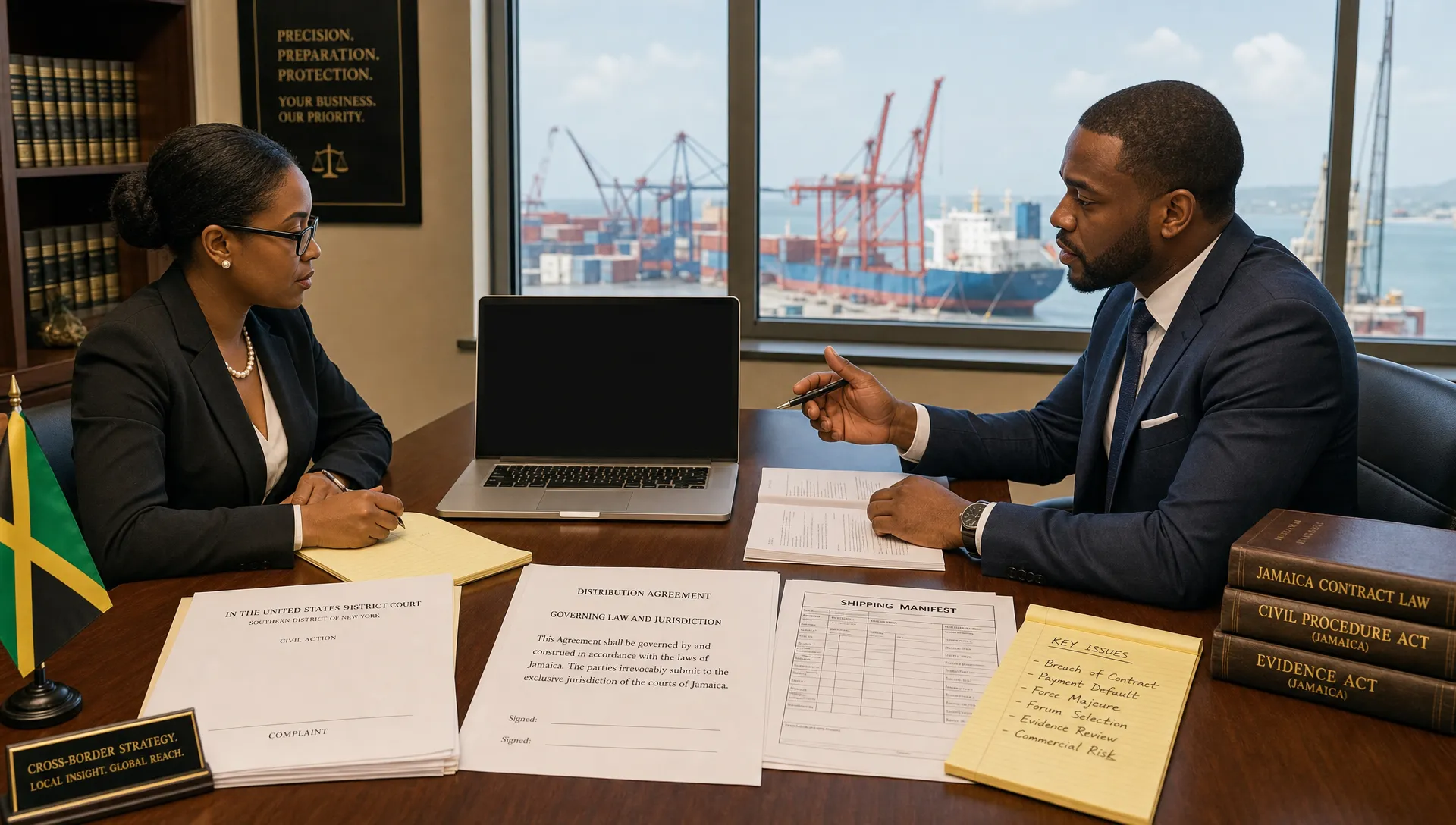
A Jamaican company does not need a New York office, a Delaware subsidiary or a U.S. bank account to end up in a U.S.-linked dispute. A contract may name a U.S. governing law. A key witness may live in Florida. A payment may move through a U.S. correspondent bank. A supplier, distributor, technology platform or customer may start proceedings in a U.S. court before the Jamaican business has finished its internal review.
That is why attorneys in U.S.-linked disputes must think beyond the immediate claim. The right strategy looks at forum, governing law, evidence, privilege, enforcement, regulatory exposure, commercial pressure and settlement timing at the same time.
For Jamaican firms, the main risk is not simply losing a case. It is losing control of the timetable, making avoidable admissions, missing a filing deadline, disclosing protected material or agreeing to a settlement that creates problems in Jamaica later. This guide explains the key issues business owners, directors, in-house teams and financial decision-makers should assess early.
What makes a dispute U.S.-linked?
A dispute is U.S.-linked when some legally important part of the relationship connects to the United States. The link may be obvious, such as a U.S. claimant or defendant. It may also be indirect, such as a contract clause, cloud-hosted records, U.S. dollar transactions, intellectual property registered in the United States or assets located there.
The first step is to identify every possible connection before responding. A narrow view can cause a Jamaican firm to underestimate its exposure or overlook a strategic advantage.
U.S. connection | Why it matters | First question to ask |
U.S. counterparty | May affect jurisdiction, service, negotiation leverage and settlement expectations | Where is the counterparty incorporated and where does it actually operate? |
U.S. court or arbitration clause | May determine where the dispute is heard and what procedure applies | Does the contract choose a forum, a seat of arbitration or governing law? |
U.S.-held documents or witnesses | May affect discovery, subpoenas, privacy and evidence collection | Who controls the documents and where are the witnesses located? |
U.S. assets or payment flows | May affect enforcement and freezing or collection strategy | Where are bank accounts, receivables, inventory, vessels, IP rights or other assets? |
U.S. regulation | May trigger sanctions, export control, anti-bribery, data or sector-specific issues | Does the transaction involve regulated goods, services, persons or payments? |
A practical early review should not assume that the U.S. connection is either decisive or irrelevant. Sometimes it creates exposure. Sometimes it creates leverage. Often, it does both.
Jurisdiction, forum and governing law are separate questions
Many businesses treat jurisdiction, forum and governing law as one issue. They are related, but they are not the same.
A contract may say New York law applies, but that does not always mean a New York court is the only place where the dispute can be heard. A contract may name arbitration in Miami, but Jamaican urgent relief may still need to be considered if assets or evidence are in Jamaica. A U.S. lawsuit may be filed, but the Jamaican party may still have arguments about service, personal jurisdiction, forum non conveniens or the proper scope of the claims.
When a U.S.-linked dispute starts, counsel should separate three questions:
Can the claimant sue in that forum? This involves jurisdiction over the parties, service of process and the connection between the dispute and the forum.
Should the dispute be heard there? This involves contractual forum clauses, convenience, parallel proceedings, witness location, costs and strategic considerations.
What law applies to the merits? This may be decided by the contract, conflict of laws rules or the nature of the claim.
This distinction matters because each question has different deadlines and consequences. A Jamaican firm might preserve a jurisdiction objection but still need to monitor a U.S. filing deadline. It might challenge a U.S. forum while also preparing evidence in case that challenge fails. It might also need Jamaican counsel to evaluate local implications before U.S. counsel makes procedural decisions abroad.
If the dispute is already moving toward litigation, it is useful to understand the broader role that litigation attorneys play in assessing claims, evidence and strategy. In cross-border matters, that role expands to include coordination across legal systems.
Service of process and deadlines can shape the whole case
Service of process is often the first procedural battleground. If a Jamaican company receives U.S. court papers, management should not ignore them, but it also should not assume service was valid or that the response deadline is obvious.
The correct deadline may depend on the type of proceeding, the U.S. court, the method of service, any applicable treaty or procedural rule, and whether an extension can be negotiated or ordered. In some cases, a prompt appearance may be needed to protect the company. In others, appearing without careful advice could affect jurisdiction arguments.
A practical response is to record how the documents were received, preserve the envelope and email headers, identify the date and time of receipt, and send the materials to counsel immediately. Internal discussion should be limited to those who need to know, because broad email chains can create privilege and disclosure issues.
Evidence, discovery and privilege require early discipline
U.S. litigation is known for broad discovery. In U.S. federal civil cases, Federal Rule of Civil Procedure 26 frames the scope and timing of discovery, although state court rules and arbitration rules can differ. For Jamaican firms, the key point is that documents, emails, messages, accounting records, contracts and internal reports may become relevant sooner than expected.
The safest early step is to issue a legal hold. That means instructing relevant staff not to delete, alter, overwrite or discard potentially relevant records. This should cover email accounts, messaging platforms, shared drives, mobile devices, accounting systems, customer files, shipping records and paper documents where relevant.
Privilege also needs careful handling. Jamaican and U.S. privilege rules may not align perfectly. A document that is protected in one forum may face a challenge in another if it was widely circulated or mixed with commercial advice. Before preparing internal chronologies, board papers or witness summaries, firms should ask counsel how to structure the review so that legal advice remains protected as far as possible.
Data protection adds another layer. If records include employee, customer, financial, health or other personal data, cross-border collection and transfer may raise Jamaican data privacy obligations. Redaction, secure transfer methods, confidentiality orders and limited-access review teams may all be relevant. This is especially important where a U.S. discovery request seeks large volumes of emails or customer information.

Enforcement should be considered before anyone sues
A claim is only as valuable as the ability to enforce it. Before spending heavily on litigation, a Jamaican firm should ask where the other side's assets are, what type of judgment or award is likely, and how enforcement would work in the relevant jurisdiction.
If a Jamaican company obtains a judgment, enforcement in the United States will usually depend on U.S. state law and the location of assets. If a U.S. party obtains a judgment and wants to enforce it in Jamaica, Jamaican law will need to be assessed. Foreign court judgments are not automatically treated the same way as domestic judgments. Issues may include whether the foreign judgment is final and conclusive, whether the foreign court had jurisdiction, whether the judgment is for a definite sum, and whether enforcement would offend natural justice or public policy.
Arbitration awards can be different. International arbitral awards may be enforceable under the New York Convention on the Recognition and Enforcement of Foreign Arbitral Awards, subject to applicable local law and recognised grounds for resisting enforcement. For contracts with meaningful cross-border exposure, this is one reason arbitration clauses are often considered carefully at the drafting stage.
The enforcement question also affects settlement. A discount may be commercially sensible if collection is uncertain or slow. On the other hand, if the counterparty has reachable assets, a firm may have more leverage than it first appears.
Arbitration and mediation can reduce risk, but only if planned properly
Many U.S.-linked commercial contracts include arbitration or mediation clauses. These clauses can be valuable, but only if they are clear.
A well-drafted dispute resolution clause should address the seat of arbitration, the rules, the number of arbitrators, language, confidentiality, interim relief, consolidation of related disputes and how notices are served. A clause that simply says disputes will be arbitrated may leave room for costly procedural fights.
Mediation can also be useful, particularly where the parties have an ongoing commercial relationship or where publicity would damage both sides. But mediation should be prepared like a strategic negotiation, not treated as a casual meeting. Counsel should understand the legal merits, insurance position, decision-makers, tax implications, confidentiality concerns and enforcement options before settlement talks begin.
For Jamaican businesses reviewing new contracts, this is part of a wider risk management process. The broader point is that attorneys' legal guidance can reduce business risk before a dispute becomes expensive.
Regulatory exposure may matter as much as the private claim
A U.S.-linked dispute may start as a private commercial disagreement, then reveal regulatory issues. Examples include data privacy, anti-money laundering concerns, sanctions exposure, export controls, anti-bribery rules, competition issues or sector-specific licensing requirements.
For example, a dispute over a terminated distribution agreement may involve customer data, marketing claims and competition concerns. A payment dispute may involve correspondent banking records or sanctions screening. An intellectual property dispute may involve U.S. registrations, online platform takedown procedures and evidence of market confusion.
This does not mean every U.S.-linked dispute becomes a regulatory investigation. It means counsel should screen for regulatory risk before taking aggressive positions in correspondence or pleadings. A statement that helps the private claim may create a regulatory problem if it is inaccurate, incomplete or inconsistent with previous filings.
What Jamaican firms should do in the first 72 hours
The first few days can determine whether the business is on the front foot or reacting under pressure. A disciplined response does not require panic. It requires structure.
Preserve all potentially relevant documents, devices and messages immediately.
Identify all contracts, amendments, purchase orders, invoices, policies and correspondence connected to the dispute.
Record how and when any court papers, demand letters, subpoenas or notices were received.
Notify insurers if the matter may fall under liability, directors and officers, cyber, marine, professional indemnity or other coverage.
Avoid informal admissions, emotional replies or broad internal email commentary about fault.
Map the parties, assets, witnesses, governing law clauses and dispute resolution clauses.
Speak with Jamaican counsel early, and coordinate with U.S. counsel where U.S. procedural advice is required.
The goal is not to decide the whole case in 72 hours. The goal is to preserve options, avoid procedural mistakes and build a reliable factual picture.
How Jamaican and U.S. attorneys should work together
In many matters, the best approach is not Jamaican counsel instead of U.S. counsel, or U.S. counsel instead of Jamaican counsel. It is coordinated counsel, with clear responsibility for each part of the dispute.
Workstream | Jamaican counsel may focus on | U.S. counsel may focus on |
Initial assessment | Jamaican law implications, local facts, local documents, business context and local risk | U.S. claims, court procedure, jurisdiction arguments and filing deadlines |
Evidence | Jamaican data privacy, privilege, witnesses and document preservation | Discovery obligations, subpoenas, protective orders and depositions |
Strategy | Local remedies, enforcement in Jamaica, regulatory exposure and commercial impact | U.S. motions, settlement posture, trial risk and enforcement in U.S. states |
Settlement | Jamaican enforceability, releases, confidentiality and tax or regulatory implications | U.S. release language, dismissal mechanics and court or arbitration approvals |
The coordination should be active, not ceremonial. Counsel should agree on who communicates with the other side, who reviews drafts, who controls privilege protocols, who manages deadlines and who briefs the board.
Before the first consultation, businesses should prepare targeted questions about outcomes, forum, staffing, costs, timing and risk. A useful starting point is this guide on what businesses should ask Jamaican attorneys in a first consultation, especially where the dispute may involve multiple practice areas.
Frequently Asked Questions
Do Jamaican firms always need U.S. attorneys in U.S.-linked disputes? Not always. If the matter only has a light U.S. connection, Jamaican counsel may be able to assess the risk and advise on next steps. If proceedings have been filed in a U.S. court, U.S. procedural advice is usually important, ideally coordinated with Jamaican counsel.
Can a U.S. judgment be enforced in Jamaica? It may be possible, but it is not automatic. Jamaican counsel should assess the type of judgment, whether it is final, the foreign court's jurisdiction, public policy concerns, natural justice issues and the correct local procedure.
What should a Jamaican company do if served with U.S. court papers? Record exactly how and when the papers were received, preserve all related documents, avoid informal responses to the claimant, and contact counsel urgently. Do not assume the deadline is invalid, but do not assume service was valid without advice.
Are arbitration clauses better than court clauses for cross-border contracts? Sometimes, but not always. Arbitration may offer confidentiality, procedural flexibility and potential enforcement advantages, especially under the New York Convention. Court litigation may be preferable where urgent public remedies, precedent or certain enforcement tools are needed.
Can U.S. discovery require documents located in Jamaica? It can become an issue if a Jamaican party is subject to U.S. proceedings or if a U.S. court or tribunal has authority over a party controlling the documents. The response should consider U.S. procedure, Jamaican law, privilege, confidentiality and data protection.
Get advice before the forum controls the strategy
U.S.-linked disputes move quickly, and early decisions can affect jurisdiction, evidence, privilege, cost and enforcement. Jamaican firms should not wait until a deadline is hours away or a counterparty has shaped the narrative.
If your business is facing a cross-border commercial dispute, court filing, arbitration notice, demand letter or enforcement question, Henlin Gibson Henlin can help you assess the Jamaican legal issues and coordinate a practical strategy for the wider dispute.
This article provides general information only and is not legal advice. Specific advice should be taken on the facts of your matter.