
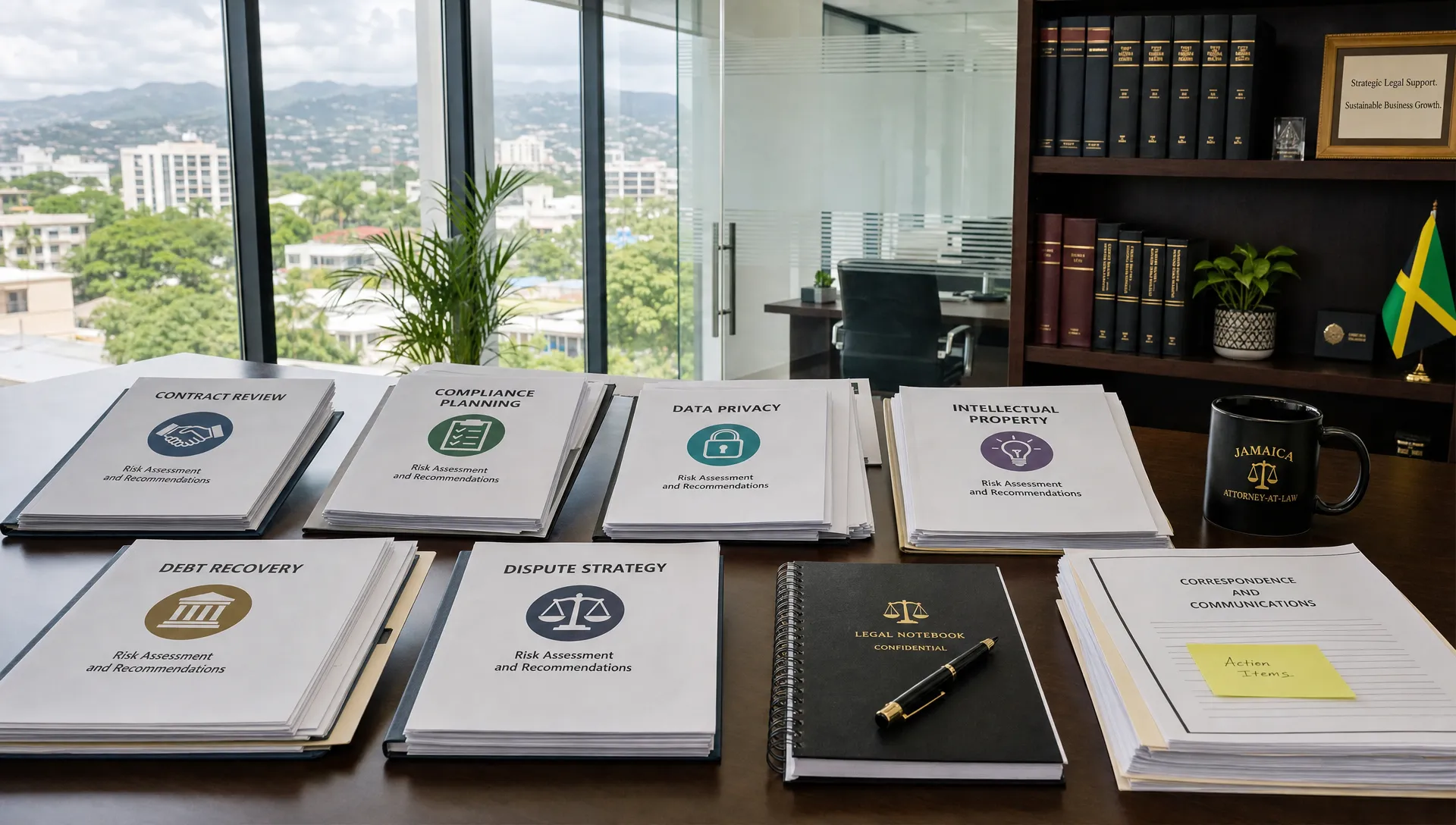
For many businesses, legal support begins only after something has gone wrong: a supplier refuses to pay, a customer threatens a claim, a regulator asks questions, or a contract dispute starts affecting cash flow. By that stage, attorneys can still help, but the options may be narrower and the cost of fixing the issue may be higher.
The attorneys services businesses often need most are not limited to courtroom representation. They include preventive advice, contract support, compliance planning, intellectual property protection, dispute strategy, and guidance on high-risk commercial decisions. For Jamaican businesses, especially those operating across borders, selling online, handling customer data, managing valuable brands, or working in regulated sectors, the right legal input can be a practical business asset.
This guide breaks down the legal services companies commonly need, when each one becomes important, and how to decide what to prioritise before risk turns into a crisis.
Start with the business problem, not the legal label
Business owners and managers do not usually wake up thinking, “I need commercial litigation” or “I need compliance and risk law.” They think in practical terms: “A customer has not paid,” “Our supplier contract is unclear,” “A competitor is copying our brand,” “We are collecting more customer data,” or “A dispute could damage our reputation.”
That is why the best way to approach attorneys services is to connect each service to a business outcome. Legal advice should help you protect revenue, preserve relationships where possible, reduce exposure, negotiate from a stronger position, and make decisions with a clearer understanding of risk.
A growing company may not need every legal service at once. However, most businesses eventually need support in several core areas, especially as contracts, staff, customers, suppliers, lenders, technology, and regulators become more important to operations.
Contract drafting and review
Contracts are often the first line of defence for a business. A well-drafted agreement can clarify obligations, allocate risk, protect payment rights, define remedies, and reduce the chance of disagreement. A poorly drafted contract can do the opposite, creating uncertainty exactly when the business needs clarity.
Common contracts that businesses may need reviewed or drafted include supplier agreements, customer terms, distribution agreements, service contracts, loan or security documents, leases, settlement agreements, confidentiality agreements, and commercial partnership arrangements.
The value of legal review is not simply that an attorney “checks the wording.” It is that the attorney looks at what could go wrong and tests whether the agreement protects the business in those scenarios. For example, what happens if delivery is delayed, a buyer refuses to pay, confidential information is misused, a key supplier terminates suddenly, or the other party operates from another jurisdiction?
Businesses should seek legal support before signing contracts that involve significant money, long-term commitments, personal guarantees, exclusivity, intellectual property rights, data sharing, or unusual termination provisions. If a contract is central to revenue or operations, it is usually worth reviewing properly.
Corporate governance and decision-making support
As businesses grow, informal decision-making becomes riskier. Shareholders, directors, partners, investors, and senior managers may have different expectations about authority, profit distribution, borrowing, expansion, exits, and dispute resolution. Legal support can help convert those expectations into clear rules.
Governance advice may involve reviewing constitutional documents, preparing board or shareholder resolutions, advising on directors’ duties, structuring approval processes, or helping owners manage internal disputes. This is particularly important for family businesses, founder-led companies, professional service firms, joint ventures, and businesses preparing for investment or expansion.
Good governance is not only about compliance. It also helps prevent internal uncertainty from slowing down commercial decisions. When authority is clear, the business can move faster while reducing the risk that a decision is later challenged.
Compliance and risk law
Compliance obligations can arise from industry regulations, consumer protection rules, competition law, data privacy, anti-money laundering requirements, advertising standards, environmental obligations, employment-related duties, or contractual obligations imposed by larger business partners.
For many companies, compliance risk increases gradually. A small business may begin with basic customer transactions, then expand into online sales, credit arrangements, cross-border suppliers, data-driven marketing, regulated products, or public sector contracts. Each step can introduce new obligations.
Attorneys help businesses identify which rules apply, where the greatest risks sit, and how to create practical controls. This might include policy review, staff training support, contract updates, internal reporting processes, risk assessments, or advice after a complaint or regulatory inquiry.
If your business is trying to become more proactive, it may help to understand how law attorneys support businesses through risk, especially when legal issues are connected to operations rather than isolated disputes.
Data privacy and information handling
Data privacy has become one of the most important legal issues for modern businesses. Companies collect personal information through websites, payment systems, customer databases, job applications, loyalty programmes, delivery services, CCTV, email marketing, and vendor platforms.
In Jamaica, the Data Protection Act has made privacy governance more significant for organisations that process personal data. The Office of the Information Commissioner provides information about the data protection framework, and businesses should take their obligations seriously, particularly where they handle sensitive information, large customer databases, or third-party technology providers.
Legal support can help businesses understand what personal data they collect, why they collect it, how long they keep it, who they share it with, and what notices or agreements may be needed. Attorneys may also assist with privacy policies, data processing clauses, breach response planning, cross-border data issues, and risk assessments for new systems.
Data privacy is not only a legal issue. It is also a trust issue. Customers, clients, lenders, partners, and regulators increasingly expect businesses to handle information responsibly.
Business situation | Legal service commonly needed | Why it matters |
Signing major supplier or customer agreements | Contract drafting and review | Reduces ambiguity and strengthens remedies if things go wrong |
Expanding operations or adding investors | Governance and corporate advice | Clarifies authority, duties, approvals, and ownership expectations |
Collecting customer or employee personal data | Data privacy advice | Supports lawful, transparent, and secure information handling |
Launching a brand, product, or creative asset | Intellectual property advice | Protects commercial value and reduces copying or infringement risk |
Facing unpaid invoices or contract breaches | Dispute resolution or litigation | Helps preserve rights, recover losses, and manage commercial pressure |
Operating in a regulated or competitive market | Compliance and risk law | Reduces exposure to complaints, investigations, and penalties |
Intellectual property protection
A business’s intellectual property can be one of its most valuable assets. This includes trade marks, logos, product names, business names, packaging, original content, software, designs, confidential information, trade secrets, and creative works.
Many businesses invest heavily in branding before checking whether they can protect it or whether it conflicts with someone else’s rights. That can create expensive problems later, especially if the business has already spent money on signage, packaging, websites, marketing campaigns, or export plans.
Attorneys can assist with IP searches, registration strategy, licensing, assignment agreements, confidentiality protections, infringement disputes, and enforcement. In Jamaica, the Jamaica Intellectual Property Office is a key public resource for intellectual property registration and information.
IP advice is especially important for manufacturers, creative businesses, technology companies, food and beverage brands, hospitality businesses, exporters, agencies, consultants, and any company whose name or content helps drive customer trust.

Commercial disputes and litigation
Even well-managed businesses can end up in disputes. A customer may refuse to pay. A supplier may breach a contract. A former business partner may misuse confidential information. A competitor may make damaging claims. A lender, landlord, contractor, distributor, or shareholder may take a position that threatens the business.
Commercial litigation support is often needed when negotiation is not enough or when urgent action is required to protect rights. Attorneys can assess the strength of the claim, identify evidence, issue or respond to demand letters, advise on settlement options, prepare court documents, manage procedural deadlines, and represent the business in hearings.
Litigation is not always about “going to war.” Often, strong litigation advice helps a business negotiate more effectively because it understands the legal merits, likely costs, timeframes, and risks. If a dispute has become serious, it is worth understanding what litigation attorneys do and when to hire one before key deadlines or evidence issues are missed.
Businesses should seek legal advice early if a dispute involves significant sums, reputational harm, fraud concerns, urgent injunctions, breach of confidentiality, terminated contracts, regulated activity, or a risk that the other side may file proceedings first.
Debt recovery and banking-related disputes
Cash flow is central to business survival. When customers, borrowers, or counterparties fail to pay, a business may need legal help to recover debts while avoiding missteps that weaken its position.
Debt recovery can involve reviewing the contract or credit terms, confirming the amount owed, sending demand letters, negotiating payment plans, commencing legal proceedings, enforcing judgments, or dealing with security interests. For lenders and borrowers, banking litigation can involve facility agreements, guarantees, securities, enforcement action, restructuring disputes, and contested obligations.
The right approach depends on the debtor’s circumstances, the amount involved, the documents available, and whether the business relationship is worth preserving. Sometimes a carefully structured settlement is commercially better than prolonged proceedings. In other cases, firm legal action is necessary to protect the company’s financial position.
Arbitration, mediation, and negotiated settlement
Not every dispute should end in court. Many commercial agreements include arbitration clauses, and some disputes are better suited to mediation or structured negotiation. These processes can offer privacy, flexibility, subject-matter expertise, and a greater chance of preserving business relationships.
Arbitration can be particularly relevant in cross-border contracts, construction matters, shipping disputes, and high-value commercial agreements. Mediation can be useful where parties need help finding a practical settlement but want to avoid the cost and uncertainty of a full trial.
Attorneys play an important role in these processes. They prepare the case, advise on strategy, evaluate settlement proposals, protect the client from unfair terms, and ensure any agreement is properly documented. A settlement that is vague or incomplete may simply create a new dispute later.
Competition law and market conduct
Businesses that operate in competitive markets should be mindful of how they price, advertise, distribute, collaborate, and deal with competitors. Competition law issues may arise where companies discuss pricing, restrict supply, abuse market power, impose exclusivity, or engage in conduct that affects consumer choice.
Legal advice can help businesses review distribution arrangements, commercial policies, trade association participation, pricing practices, promotional claims, and competitor interactions. This is especially useful before launching aggressive market strategies, exclusive partnerships, or industry collaborations.
Competition law is not only a concern for large corporations. Smaller businesses can also be affected, either as complainants, respondents, suppliers, distributors, or market entrants trying to compete fairly.
Admiralty, shipping, and cross-border commercial support
For businesses involved in shipping, logistics, marine services, import-export activity, insurance, cargo, or port-related transactions, admiralty and shipping expertise can be essential. These matters often involve specialised rules, international contracts, urgent timelines, and multiple jurisdictions.
Legal support may be needed for cargo claims, vessel-related disputes, charterparty issues, maritime liens, insurance matters, arrests or releases of vessels, and cross-border enforcement. Because shipping disputes can move quickly, early legal advice can preserve rights and prevent avoidable losses.
Even businesses that are not “shipping companies” may encounter shipping-related legal issues if they import goods, export products, rely on freight forwarders, or suffer loss from delayed, damaged, or misdelivered cargo.
Appellate services and strategic review
Sometimes a legal matter does not end with the first decision. A business may need advice on whether to appeal, respond to an appeal, seek a stay, or reassess strategy after an unfavourable ruling. Appellate work requires a different type of analysis from trial preparation. It focuses on legal error, procedural fairness, interpretation of law, and whether the record supports the decision made.
Appellate advice is time-sensitive. Businesses should seek guidance quickly after judgment because appeal deadlines can be strict. An attorney can help assess prospects, costs, urgency, and whether an appeal is commercially sensible.
Strategic review is also useful before litigation reaches judgment. Experienced attorneys may identify whether a case is being framed correctly, whether the right forum has been chosen, and whether the evidence supports the desired outcome.
How to prioritise attorneys services for your business
The right legal priorities depend on the size, sector, and risk profile of the business. A start-up may need contracts, IP protection, and data privacy basics. A trading company may need supplier agreements, debt recovery support, and dispute strategy. A regulated business may need compliance advice before launching new products. A company facing a serious claim may need litigation counsel immediately.
A practical starting point is to ask a few focused questions:
Which contracts generate or protect the most revenue?
What legal issue could interrupt operations within the next 12 months?
What customer, employee, or supplier data does the business collect?
Which brand assets, confidential information, or creative works need protection?
Are there disputes, complaints, debts, or regulatory concerns already developing?
If the answers point to several areas at once, prioritise the risks with the greatest financial, operational, or reputational impact. You may also benefit from a broader overview of the key services a law firm can provide for modern businesses before deciding what support to seek first.
Signs your business should speak with an attorney sooner rather than later
Some legal issues can wait for scheduled review. Others should not. Businesses should consider speaking with an attorney promptly when a major contract is being negotiated, a dispute is escalating, a regulator makes contact, confidential information is at risk, personal data may have been compromised, a competitor copies your brand, a lender threatens enforcement, or a court deadline is approaching.
The earlier an attorney is involved, the more room there may be to shape the outcome. Early advice can help preserve evidence, avoid admissions, improve negotiation posture, and prevent a business decision from creating unintended legal consequences.
Frequently Asked Questions
What attorneys services do businesses need most often? Businesses commonly need contract drafting and review, compliance advice, data privacy support, intellectual property protection, dispute resolution, litigation, debt recovery, governance advice, and strategic support for high-risk commercial decisions.
When should a business hire an attorney for a contract? A business should seek legal review before signing contracts involving significant money, long-term obligations, exclusivity, guarantees, intellectual property, data sharing, cross-border issues, or terms that could seriously affect operations.
Is litigation the only option for resolving a business dispute? No. Many disputes can be resolved through negotiation, mediation, arbitration, or settlement. Litigation may be necessary where rights must be enforced, urgent relief is needed, or the other party refuses to resolve the matter commercially.
Why is data privacy legal advice important for businesses in Jamaica? Businesses that collect, store, use, or share personal data may have obligations under Jamaica’s data protection framework. Legal advice helps organisations understand their duties, update policies, manage third-party risks, and respond appropriately to privacy concerns.
How can a business choose which legal service to prioritise? Start with the issue that carries the greatest financial, operational, regulatory, or reputational risk. For many businesses, that means reviewing key contracts, addressing active disputes, protecting valuable IP, and ensuring compliance in areas such as data privacy.
Getting the right legal support before risk escalates
The attorneys services businesses need most are the ones that protect the company’s ability to operate, earn, grow, and respond confidently when problems arise. Contracts, compliance, privacy, IP, disputes, shipping, banking litigation, arbitration, and appeals are not isolated legal categories. They are tools for managing real commercial risk.
Henlin Gibson Henlin provides client-focused legal services across a wide range of business needs, including commercial litigation, data privacy, compliance and risk law, intellectual property, admiralty and shipping, appellate matters, arbitration, mediation, and banking litigation. If your business is facing a legal decision, dispute, or risk that deserves careful attention, consider seeking advice before the issue becomes more difficult to control.