
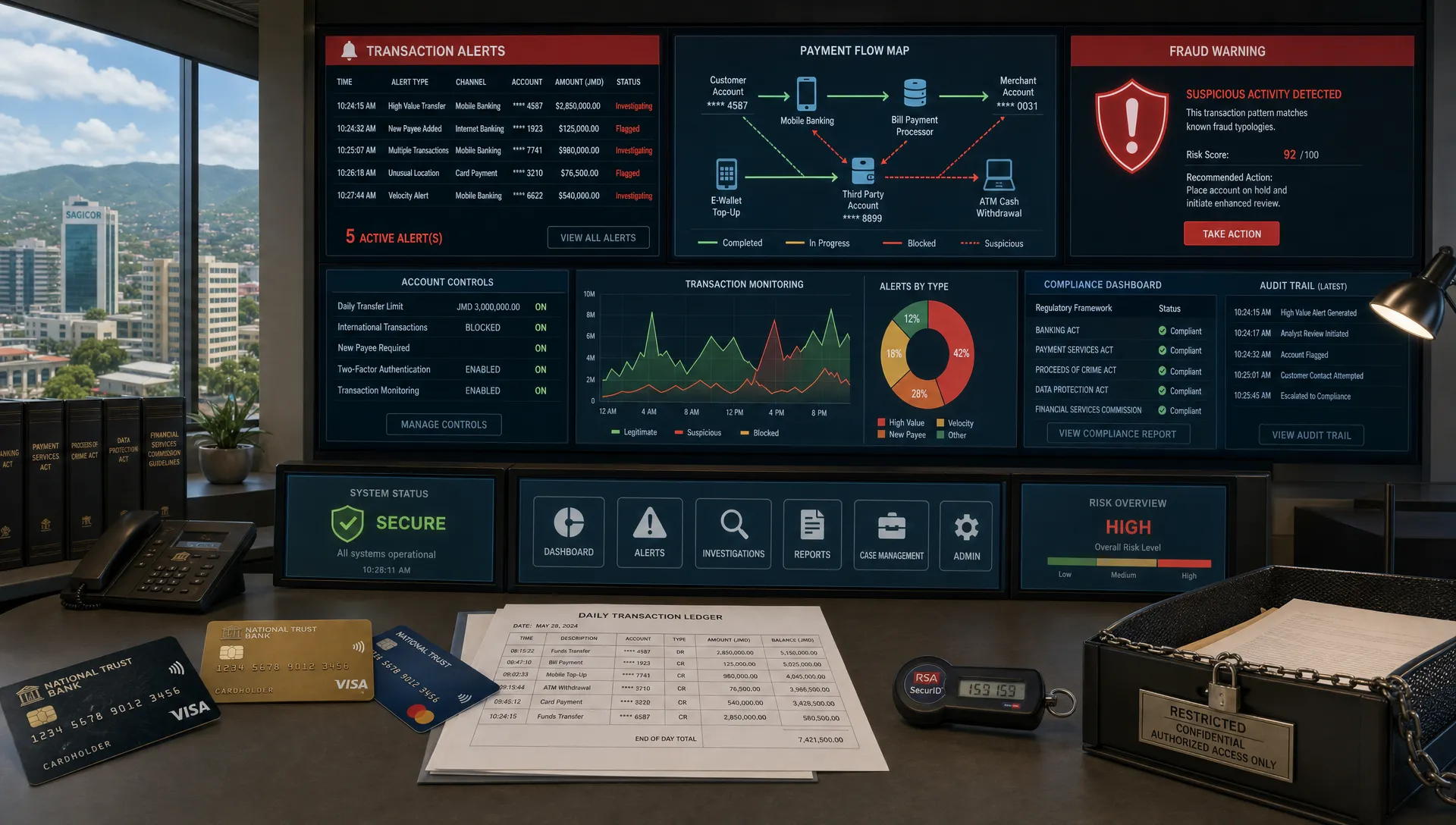
Banking litigation in 2026 is not only a concern for banks. It matters to any business that borrows, lends, accepts electronic payments, manages customer funds, uses merchant services, imports goods, exports services, or relies on financial institutions to keep operations moving.
For Jamaican businesses, the pressure points are shifting. Traditional disputes over loans, guarantees, overdrafts and security are still important. But newer claims are emerging from digital payments, cyber incidents, data protection duties, compliance-driven account restrictions and cross-border finance. The result is a litigation environment where commercial, regulatory, technology and reputational risks are increasingly connected.
Many of these issues overlap with the wider commercial litigation risks companies already face, but banking disputes often move faster because access to money, credit and payment rails can determine whether a business keeps operating. In 2026, early preparation is not just prudent. It may be decisive.
Why banking litigation is becoming more complex in 2026
Banking relationships now sit at the centre of business operations. A single payment failure, suspicious transaction alert, frozen account or disputed loan covenant can affect payroll, suppliers, inventory, tax obligations and customer confidence. That makes banking disputes commercially urgent, even when the legal issues are highly technical.
The shift toward digital finance is a major factor. The Bank of Jamaica’s National Payments System work reflects the importance of safe, efficient payment infrastructure in the economy. As businesses rely more heavily on online banking, card payments, automated transfers, merchant acquiring and fintech-enabled services, the volume of potential dispute points naturally increases.
At the same time, banks and financial institutions are under stronger expectations to manage fraud, money laundering, sanctions risk, cyber resilience and consumer protection. Businesses may find themselves caught between a bank’s regulatory obligations and their own need for uninterrupted access to funds. That tension is likely to drive more disputes in 2026.
1. Digital payment fraud and allocation of loss
Payment fraud is one of the clearest banking litigation trends businesses should watch in 2026. The issue is not only whether fraud occurred. The harder question is often who bears the loss.
A dispute may involve a compromised email account, fraudulent payment instructions, unauthorised transfers, internal employee misconduct, altered supplier details, card-not-present transactions, chargebacks, or social engineering. In each case, the legal analysis may turn on the account mandate, bank terms, internal approval process, transaction alerts, timing of notification and whether either party failed to act with reasonable care.
For businesses, the danger is assuming that a bank will automatically reverse a transaction or absorb the loss. That is not always the case. Banks may argue that the payment was properly authorised under the mandate or that the customer’s own controls failed. Businesses may argue that the bank ignored red flags, failed to follow instructions, breached its duty of care or delayed action after notice of fraud.
The practical lesson is simple: payment controls must be documented before a fraud event occurs. A company should be able to show who had authority, how payment requests were verified, what dual-approval procedures applied, and how quickly the bank was notified once a problem was discovered.
2. KYC, AML and account restriction disputes
Know your customer checks, anti-money laundering controls and sanctions screening are essential parts of modern banking. They are also a growing source of friction between financial institutions and commercial customers.
In 2026, businesses should expect more disputes involving delayed onboarding, requests for beneficial ownership information, enhanced due diligence, account freezes, transaction holds, refused payments or account closures. These disputes can be particularly sensitive because a bank may be limited in what it can disclose when compliance concerns arise.
From a litigation perspective, the business may focus on contract rights, notice obligations, procedural fairness, lost profits, reputational damage or the bank’s handling of documents. The bank may rely on regulatory obligations, risk-based policies and contractual discretion. The facts will matter: what information was requested, how clearly it was requested, whether the business responded, and whether the bank acted proportionately.
Companies can reduce risk by keeping corporate records current, maintaining accurate ownership information, documenting the source of funds for significant transactions and responding quickly to bank compliance queries. Businesses with complex ownership structures, offshore counterparties or high-value cross-border transactions should pay particular attention.
3. Data protection and cyber-related banking claims
Banking litigation is increasingly connected to data. Financial institutions hold sensitive personal and commercial information, while businesses transmit employee, customer, vendor and payment data through banking channels every day.
Jamaica’s Data Protection Act has made privacy governance a more important business issue, and the Office of the Information Commissioner of Jamaica is central to the local data protection framework. A banking-related cyber incident may therefore trigger not only operational disruption, but also regulatory notifications, contractual claims, customer complaints and reputational harm.
The Basel Committee’s principles for operational resilience also reflect a broader international expectation that financial institutions should prepare for and respond to disruptive events. For businesses, this means banking disputes may increasingly involve evidence about incident response, data handling, third-party service providers, access controls and business continuity planning.
A company should not treat privacy as a separate legal silo. If a disputed payment, online banking breach or compromised vendor account involves personal information, the business may need to consider data protection obligations at the same time as recovery action. A practical privacy compliance plan for 2026 can help reduce the risk that a banking incident becomes a wider legal problem.
4. Credit stress, guarantees and security enforcement
Loan disputes remain a core part of banking litigation. In 2026, businesses should watch for claims involving facility defaults, covenant breaches, interest calculations, restructuring negotiations, guarantees, indemnities, debentures, mortgages, priority disputes and enforcement of security.
Credit pressure can expose weaknesses in documents that were signed years earlier. A director may not fully understand the scope of a personal guarantee. A borrower may dispute whether a default was validly triggered. A lender may face allegations that it acted prematurely, unreasonably or inconsistently with prior representations. A business may also challenge fees, penalty-like charges or the interpretation of repayment provisions.
These disputes often become urgent when enforcement action threatens key assets, bank accounts, inventory, real estate or trading relationships. The business should preserve facility letters, amendments, board approvals, correspondence, repayment records and valuation material. If restructuring discussions occur, those communications should be carefully managed to avoid misunderstandings about waiver, variation or forbearance.
2026 trend | Common dispute trigger | Practical business response |
Digital payment fraud | Unauthorised transfers, altered supplier instructions or chargebacks | Maintain dual approvals, verify payment changes and notify the bank immediately |
Compliance restrictions | Account freezes, delayed transactions or onboarding refusals | Keep ownership records updated and respond promptly to due diligence requests |
Data and cyber incidents | Breach of banking data, compromised credentials or vendor failure | Align cyber response, data protection duties and legal preservation steps |
Credit enforcement | Default notices, guarantees, security enforcement or disputed interest | Review facility documents early and document restructuring discussions |
Cross-border finance | Foreign counterparties, trade finance delays or enforcement abroad | Check governing law, jurisdiction clauses and documentary requirements |

5. Trade finance and cross-border banking disputes
Jamaican businesses engaged in importing, exporting, shipping, tourism, professional services or regional commerce may face banking disputes that cross borders. These can include documentary credit issues, delayed international transfers, correspondent banking problems, foreign currency timing, sanctions screening, disputed guarantees and enforcement of overseas judgments or awards.
Trade finance disputes are often document-heavy. A missing certificate, inconsistent invoice, late shipment document or mismatch in beneficiary details can create serious consequences. Where letters of credit or demand guarantees are involved, the independence of the banking obligation may also become central to the dispute.
Businesses should pay close attention to governing law and dispute resolution clauses in facility agreements, supplier contracts and trade finance instruments. A dispute that seems commercial at first may quickly involve questions of jurisdiction, forum, service abroad, interim relief and enforcement strategy.
6. More attention to dispute resolution clauses
In 2026, businesses should not wait until a banking dispute arises to read the dispute resolution clause. The clause may determine whether the matter goes to court, arbitration or another process, and it may affect speed, confidentiality, cost and enforceability.
Banking documents often contain detailed jurisdiction, service and enforcement provisions. Some commercial finance or cross-border agreements may provide for arbitration or mediation. The best route depends on the nature of the dispute, urgency of relief, need for confidentiality, location of assets, and whether the business requires an immediate court order.
For example, a company seeking to stop dissipation of funds or challenge urgent enforcement may need court intervention. A dispute about a complex commercial finance agreement with cross-border elements may be better suited to arbitration if the contract provides for it. Businesses considering their options should understand the practical differences between arbitration and litigation before a dispute escalates.
7. Evidence from systems, logs and automated decisions
Banking litigation in 2026 will depend heavily on digital evidence. Transaction logs, access records, IP data, device information, email headers, call recordings, audit trails, online banking permissions and internal approval histories may be critical.
This creates two risks for businesses. First, relevant evidence may be lost if systems overwrite logs or employees delete messages before a litigation hold is in place. Second, the business may not understand its own evidence well enough to explain what happened.
Automated fraud monitoring and risk scoring can add further complexity. A bank may rely on automated alerts to justify a transaction hold or account review. A customer may challenge whether the decision was reasonable, properly reviewed or consistent with the contract. Even where artificial intelligence is not the central issue, automated systems can shape the factual record.
The lesson is that evidence management must start immediately. Businesses should preserve emails, bank notices, screenshots of transaction histories, internal approvals, user access records, supplier communications and incident response notes. Where a dispute involves technical systems, early expert input may be needed.
Practical steps businesses should take now
The best banking litigation strategy often begins before litigation. Businesses that review their banking arrangements, update controls and preserve evidence are better positioned to negotiate, defend claims or pursue recovery if a dispute arises.
A practical 2026 readiness review should include the following:
Review account mandates, facility letters, guarantees, security documents and merchant service agreements.
Update payment approval procedures, especially for supplier changes and high-value transfers.
Keep beneficial ownership, company records and board authorities current for KYC purposes.
Align cyber incident response with data protection, banking notification and evidence preservation duties.
Train finance teams to recognise social engineering, invoice redirection and urgent payment scams.
Preserve transaction records, emails, call notes and system logs as soon as a dispute appears likely.
Reassess dispute resolution clauses before entering new banking or finance arrangements.
These steps are not merely administrative. They shape the evidence that will later determine whether a business can prove its position. They also show banks, counterparties and courts that the company took risk management seriously.
Businesses should also create a clear escalation path. A finance officer may spot a suspicious payment first, but legal, compliance, IT and senior management may all need to act within hours. Delay can affect recovery prospects, notification obligations and credibility.
When to involve litigation counsel
A business should consider legal advice early where a banking issue threatens cash flow, access to credit, customer funds, collateral, regulatory standing or reputation. Waiting until proceedings are filed may reduce options.
Early counsel can help assess the contract, identify urgent remedies, issue preservation notices, manage communications with the bank, coordinate with forensic or cyber experts, and determine whether negotiation, mediation, arbitration or court proceedings are appropriate. In banking disputes, the first letters and first factual records often matter as much as the pleadings filed later.
This is especially true where the business faces a frozen account, alleged default, demand under a guarantee, suspected internal fraud, compromised online banking credentials, disputed chargebacks, or a cross-border transaction failure. Each scenario requires a careful balance between commercial urgency and legal precision.
Frequently Asked Questions
What is banking litigation? Banking litigation refers to disputes involving banks, borrowers, commercial customers, guarantors, payment providers or financial institutions. It can include loan enforcement, fraud, account restrictions, payment disputes, guarantees, security enforcement and regulatory issues.
Why should non-bank businesses monitor banking litigation trends? Most businesses depend on banks for payments, credit, deposits, merchant services and cross-border transactions. A banking dispute can disrupt operations even if the business is not in the financial sector.
Are digital payment disputes likely to increase in 2026? Yes, digital payment disputes are likely to remain significant as businesses rely more on online banking, card payments and electronic transfers. Fraud, authorisation, notification timing and allocation of loss are key issues to watch.
Can a bank freeze or close a business account for compliance reasons? Banks may have regulatory and contractual reasons to restrict or review accounts, particularly for KYC, anti-money laundering or sanctions concerns. Whether a particular action is lawful or challengeable depends on the documents, facts and applicable law.
What records should a business preserve during a banking dispute? Preserve account statements, facility documents, mandates, emails, notices, payment approvals, supplier instructions, call notes, screenshots, audit logs and incident response records. Early preservation can be critical.
Prepare before a banking dispute becomes a business crisis
Banking litigation trends in 2026 point in one direction: disputes will be more technical, faster moving and more closely tied to compliance, data and operational resilience. Jamaican businesses that review documents, strengthen payment controls and act early when issues arise will be better positioned to protect cash flow and commercial relationships.
If your business is facing a banking dispute or wants to assess its exposure before a problem escalates, Henlin Gibson Henlin can help you consider the legal and strategic issues involved. This article is general information and should not be treated as legal advice for any specific matter.