
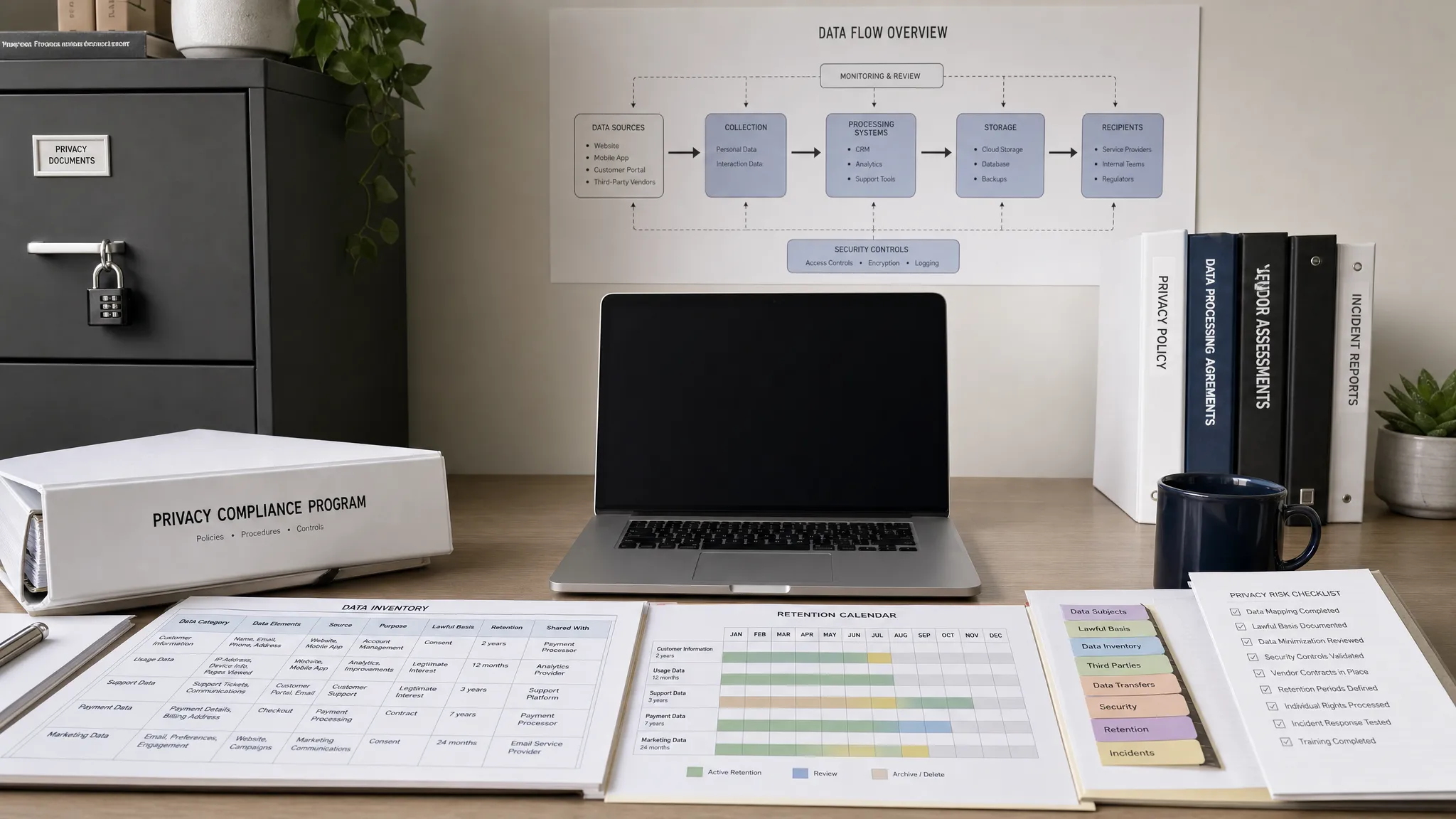
Privacy compliance is often treated as a policy-writing exercise. A business asks for a privacy notice, a consent clause, or a data protection policy, then assumes the risk has been addressed. In practice, a data privacy framework only works when it changes how people collect, use, store, share, secure, and delete personal data every day.
For organisations in Jamaica, the need for a practical framework has become more pressing as data-driven services, remote work, cloud platforms, digital payments, customer analytics, and cross-border transactions become routine. The Data Protection Act, 2020 creates a clear compliance environment, but the real challenge is operational: turning legal duties into repeatable controls that staff can actually follow.
A strong data privacy framework is not just a legal document. It is a governance system that helps an organisation know what personal data it has, why it has it, who can access it, how long it should keep it, and what to do when something goes wrong.
What a data privacy framework should achieve
A workable framework should answer five basic questions:
What personal data does the organisation process?
What legal basis or business justification supports that processing?
What risks arise for individuals and the organisation?
What controls reduce those risks?
What evidence proves the organisation is complying?
That final question is often overlooked. Regulators, courts, business partners, insurers, and customers may not be satisfied with a statement that the organisation “takes privacy seriously.” They may ask for records, policies, risk assessments, contracts, training logs, access controls, incident reports, or board minutes showing that privacy governance is active.
International guidance such as the NIST Privacy Framework also reflects this accountability approach. It encourages organisations to identify privacy risks, govern them, control data processing, communicate transparently, and protect data through appropriate safeguards. Jamaican organisations do not need to copy every international model, but they can use these principles to build a framework that is disciplined and proportionate.
Start with governance, not software
Many privacy programmes begin with technology: encryption, access controls, monitoring tools, or consent platforms. Those tools may be important, but they cannot replace governance.
Governance means assigning responsibility for privacy decisions before problems arise. Senior management should know who owns the privacy programme, who advises on legal compliance, who manages information security, who responds to data subject requests, and who approves high-risk processing activities.
Under Jamaica’s data protection regime, some organisations must appoint a Data Protection Officer. Even where that specific obligation does not apply, a business should still identify a senior privacy lead or internal privacy committee. The point is not merely to name someone. The responsible person must have enough authority, access, and resources to influence how data is handled across departments.
A privacy governance structure should involve legal, compliance, IT, HR, finance, operations, marketing, procurement, and customer service where relevant. Privacy failures often occur between departments, for example when marketing collects data that IT stores, sales exports it, HR reuses it, and procurement shares it with a vendor. A framework should make those handoffs visible.
Map the data before drafting the rules
An organisation cannot protect personal data it has not identified. A data map is the foundation of a reliable privacy programme because it shows where personal data enters the business, where it goes, who uses it, and when it should leave.
A useful data map should cover customer data, employee data, supplier contacts, website users, applicants, CCTV footage, call recordings, financial records, identification documents, health information, biometric data if used, and any other information relating to identifiable individuals.
The exercise should not be limited to databases. Personal data may sit in emails, spreadsheets, paper files, messaging platforms, cloud drives, archived backups, CRM systems, accounting software, security logs, and third-party portals.
Data mapping area | Key questions to answer | Why it matters |
Data category | What type of personal data is collected? | Helps identify sensitive or high-risk information |
Source | Where does the data come from? | Supports transparency and lawful collection |
Purpose | Why is the data being used? | Prevents unnecessary or incompatible processing |
Access | Who can view, change, export, or delete it? | Reduces misuse and insider risk |
Storage location | Is the data stored locally, in the cloud, or overseas? | Highlights transfer and security issues |
Retention period | How long is the data kept? | Supports deletion and minimisation obligations |
Third parties | Who receives or processes the data? | Identifies contract and vendor risks |
This mapping exercise should be repeated when the organisation launches new products, adopts new software, changes vendors, expands into new markets, or begins collecting new categories of personal data.
Translate legal principles into operational controls
Jamaica’s Data Protection Act is built around core data protection standards. Henlin Gibson Henlin has previously published a concise snapshot of Jamaica’s Data Protection Act, including its scope, protected data, processing principles, rights, and the role of the Information Commissioner.
For a framework to work, those principles must become daily controls. Policies should not simply repeat legal language. They should tell staff what to do.
Privacy principle | Practical control | Evidence to keep |
Fair and lawful processing | Use approved collection forms and privacy notices | Copies of notices and approval records |
Purpose limitation | Document each purpose before data is collected | Data inventory and processing register |
Data minimisation | Collect only what is needed for the stated purpose | Form reviews and system field approvals |
Accuracy | Provide correction channels and periodic checks | Rectification logs and update records |
Storage limitation | Set retention schedules and deletion procedures | Retention policy and deletion logs |
Data subject rights | Create a request-handling process | Request register and response records |
Security | Apply access controls and incident procedures | Access logs, security policies, training records |
Transfer safeguards | Review overseas transfers and vendor arrangements | Contract clauses and transfer assessments |
This approach gives management a practical test: if a regulator, client, or court asked how the organisation complies with a particular standard, could the organisation produce evidence?
Build privacy into the data lifecycle
A strong data privacy framework follows personal data from collection to deletion. Each stage creates different legal and operational risks.
Collection and transparency
When collecting personal data, the organisation should be clear about who is collecting it, what it will be used for, whether it will be shared, how long it will be retained, and how individuals can exercise their rights.
Privacy notices should be written for the audience. A notice for employees should not read like a website cookie notice. A notice for patients, students, financial customers, or online shoppers may need different wording depending on the risks and expectations involved.
Consent should also be handled carefully. It is not always the correct basis for processing, and it should not be used casually if the individual has no genuine choice. Where consent is used, the organisation should be able to show when and how it was obtained, what the individual was told, and how consent can be withdrawn.
Internal use and access
Once data is inside the organisation, access should be limited to those who need it for legitimate work. Shared passwords, broad administrator access, uncontrolled spreadsheets, and informal forwarding of customer or employee data can undermine even the best policy.
Access controls should reflect role, seniority, department, and sensitivity of data. For example, payroll information, medical information, disciplinary records, legal files, banking details, and identification documents should not be accessible to everyone in a business simply because they are stored on the same system.
Retention and deletion
A common privacy risk is keeping data “just in case.” That practice increases breach exposure, complicates data subject requests, and may conflict with legal obligations to retain data only for as long as necessary.
A retention schedule should identify the categories of records held, the reason for retaining them, the retention period, and the deletion or anonymisation method. The schedule should also account for legal holds, litigation risk, tax obligations, employment requirements, regulatory investigations, and contractual duties.
Treat vendors as part of the framework
Most organisations now rely on third parties to process personal data. Cloud hosting providers, payroll processors, payment gateways, customer support platforms, marketing agencies, auditors, consultants, delivery providers, and outsourced IT teams may all touch personal data.
The legal and reputational risk does not disappear because a vendor is involved. A data privacy framework should include a vendor review process before personal data is shared. That process should assess the nature of the data, the vendor’s security posture, the location of processing, subcontracting arrangements, breach notification commitments, audit rights, deletion obligations, and confidentiality protections.
Contracts should be tailored to the relationship. A simple supplier contract may not adequately address privacy risk where the vendor is storing customer identification documents, managing employee payroll data, hosting sensitive files, or providing systems that support regulated services.
Where data is transferred outside Jamaica, the organisation should also consider whether the recipient jurisdiction and the contractual safeguards provide appropriate protection. If the organisation handles data involving persons in the European Union or United Kingdom, GDPR or UK GDPR issues may also arise depending on the circumstances. Those questions should be assessed specifically rather than assumed.
Plan for data incidents before they happen
A privacy framework that only works in calm conditions is incomplete. Data incidents require fast decisions under pressure, often with incomplete information. The organisation may need to contain the incident, preserve evidence, assess legal notification duties, communicate internally, manage customers, deal with vendors, and protect privilege.
An incident response plan should define what counts as a suspected privacy incident, who must be notified internally, who leads the investigation, who communicates externally, and when legal advice should be obtained. It should also include practical contact details, escalation steps, and documentation requirements.
Common incidents include misdirected emails, lost devices, unauthorised access to systems, ransomware, employee misuse, accidental publication of personal data, vendor breaches, compromised credentials, and improper disposal of paper files.
The organisation should keep a breach or incident register even where an incident does not ultimately require notification. That record can show that the organisation investigated the matter, assessed the risk, and took proportionate action.
Train staff for realistic scenarios
Privacy training is more effective when it reflects how staff actually work. Generic annual training may help, but employees also need practical guidance for the situations they face.
Customer service teams may need training on verifying identity before discussing account information. HR teams may need guidance on employee medical records, disciplinary files, and recruitment documents. Marketing teams may need instruction on consent, mailing lists, analytics, and profiling. Executives may need briefing on accountability, board oversight, and reputational risk. IT teams may need clear procedures for access reviews, logging, patching, backups, and incident escalation.
Training should also be refreshed when policies change, new systems are introduced, or an incident reveals a weakness. A short, targeted briefing after a near miss may be more valuable than a long annual presentation that staff quickly forget.
Measure whether the framework is working
A data privacy framework should be monitored like any other risk management system. The goal is continuous improvement, not perfection on paper.
Useful privacy metrics include the number of data subject requests received, average response time, unresolved vendor reviews, overdue deletion tasks, staff training completion, access review findings, incident trends, and the number of high-risk projects reviewed before launch.
Metric | What it indicates | How often to review |
Completed data inventory updates | Whether the organisation knows its processing activities | Quarterly or after major changes |
Data subject request response times | Whether rights procedures are functioning | Monthly or quarterly |
Vendor privacy reviews completed | Whether third-party risk is controlled | Before onboarding and periodically |
Staff training completion | Whether employees understand responsibilities | At least annually |
Access review exceptions | Whether permissions are too broad or outdated | Quarterly or semi-annually |
Incident trends | Whether controls are improving or weakening | After each incident and periodically |
Internal audits can also test whether policies match reality. For example, an audit may reveal that retention schedules exist but old files are not deleted, or that vendor contracts include privacy clauses but no one checks whether vendors comply with them.
A practical implementation roadmap
A privacy framework does not need to be built all at once. For many organisations, the better approach is to prioritise the highest risks first, then improve the programme over time.
Phase | Priority actions | Expected outcome |
First 30 days | Assign ownership, identify high-risk data, review urgent gaps | Clear governance and risk visibility |
30 to 60 days | Build data inventory, review notices, assess key vendors | Better control over data flows |
60 to 90 days | Implement rights procedures, retention schedule, incident plan | Operational readiness |
Ongoing | Train staff, audit controls, update contracts, review new projects | Continuous compliance and accountability |
The roadmap should be adjusted for the organisation’s size, sector, and risk profile. A financial institution, healthcare provider, law firm, school, technology company, logistics business, or hotel may each face different privacy exposures. The framework should fit the business rather than copy a generic template.
Common mistakes to avoid
Many privacy programmes fail because they are too legalistic, too technical, or too detached from business operations. A framework is more likely to fail when it relies on downloaded policies, ignores paper records, treats privacy as an IT-only issue, overlooks employee data, fails to review vendors, or has no process for responding to data subject requests.
Another common mistake is waiting for a breach, complaint, transaction, audit, or regulatory inquiry before organising privacy records. By then, the organisation may be trying to reconstruct decisions that should have been documented from the start.
The better approach is to build a framework that is practical enough to maintain. A short policy that staff follow is more valuable than a complex manual that sits unread. A basic data inventory that is regularly updated is better than an ambitious register that is abandoned after launch.
Frequently Asked Questions
What is a data privacy framework? A data privacy framework is a structured system of governance, policies, procedures, contracts, training, security controls, and records that helps an organisation manage personal data lawfully and responsibly.
Does every Jamaican business need a data privacy framework? Any organisation that collects or uses personal data should have privacy controls proportionate to its size, sector, and risk. The more sensitive the data or complex the processing, the more formal the framework should be.
Is a privacy policy enough for compliance? No. A privacy policy is only one part of compliance. Organisations also need internal procedures, data mapping, access controls, vendor management, retention practices, incident response, and evidence that the framework is being followed.
How often should a data privacy framework be reviewed? It should be reviewed at least periodically and whenever there is a major change, such as new software, new vendors, new data categories, new markets, a breach, or regulatory developments.
Should legal counsel be involved in building the framework? Legal advice is valuable when interpreting statutory obligations, reviewing high-risk processing, drafting notices and contracts, handling data subject requests, managing breaches, and assessing cross-border obligations.
Build privacy into the way your organisation operates
A data privacy framework works best when it is practical, documented, and aligned with the organisation’s real operations. It should help people make better decisions before personal data is collected, shared, stored, transferred, or deleted.
Henlin Gibson Henlin advises on data privacy, compliance, risk, commercial disputes, and related legal issues in Jamaica. If your organisation needs help assessing privacy obligations, strengthening governance, reviewing vendor arrangements, or responding to a data incident, contact Henlin Gibson Henlin for tailored legal guidance.