
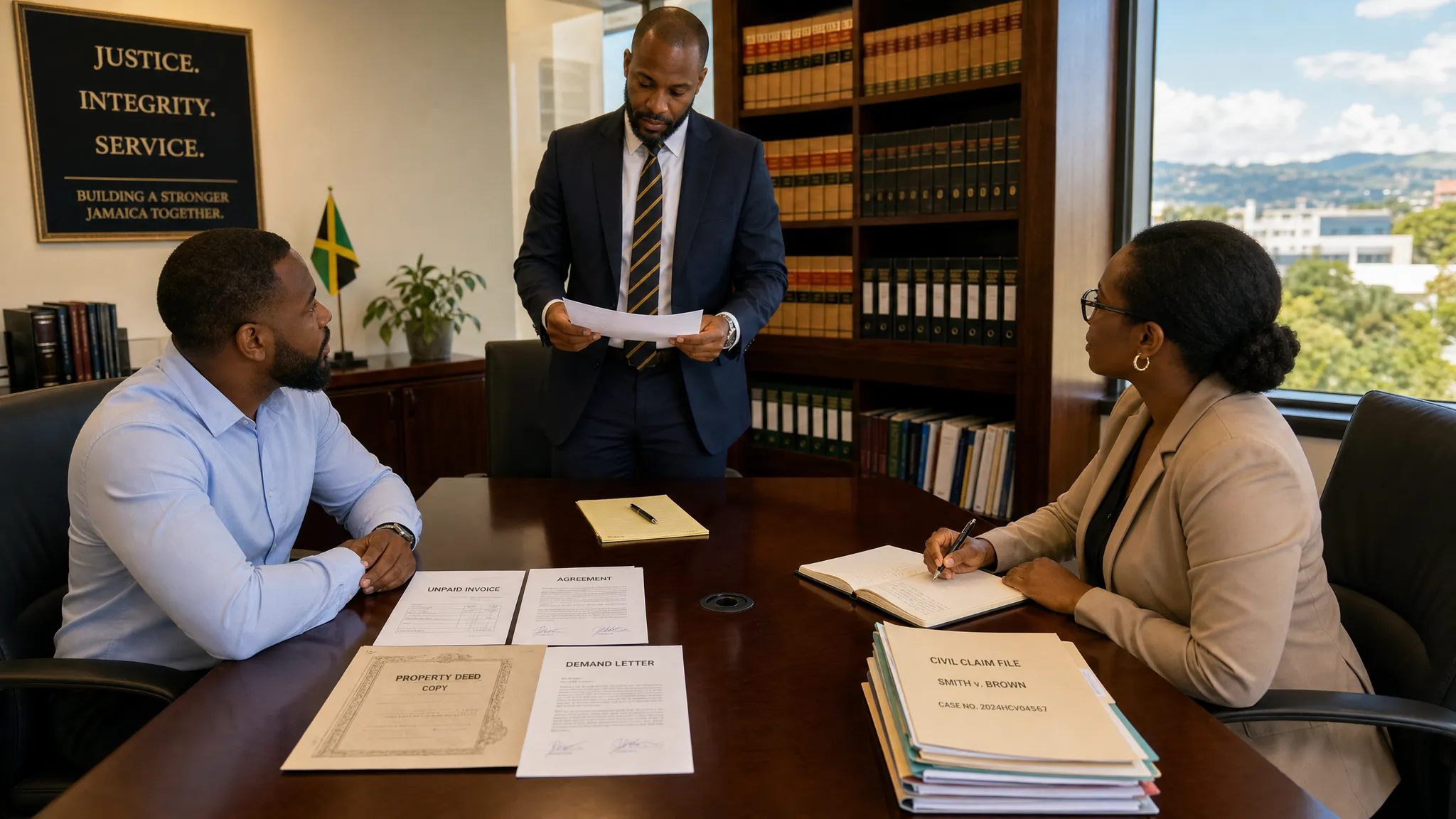
Civil matters often begin with something practical: an unpaid invoice, a broken agreement, a property disagreement, a negligence claim, or a business relationship that has gone wrong. For individuals, the issue may feel personal and urgent. For businesses, it may threaten cash flow, reputation, or operations.
Understanding how civil matters work helps you make better decisions before emotions, deadlines, or costs take control. In Jamaica, civil disputes may be resolved through negotiation, mediation, arbitration, or court proceedings, depending on the nature of the issue, the contract involved, the evidence available, and the outcome being sought.
This guide explains the essentials for businesses and individuals, including what civil matters are, how they differ from criminal matters, what usually happens in a civil case, and when legal advice can make a meaningful difference.
What are civil matters?
Civil matters are legal disputes between private parties, organisations, or sometimes a person and a public authority where the main issue is the enforcement of rights, duties, or obligations. The parties are usually seeking a remedy such as compensation, repayment, an injunction, possession of property, a declaration of rights, or enforcement of an agreement.
A civil matter is not the same as a criminal case. In a criminal case, the State prosecutes an alleged offence and the consequences may include fines, imprisonment, or other criminal penalties. In a civil case, the focus is usually on resolving a dispute between parties and providing an appropriate civil remedy.
Feature | Civil matters | Criminal matters |
Main purpose | Resolve private rights and obligations | Prosecute alleged offences against the State |
Typical parties | Claimant and defendant, or applicant and respondent | The Crown and the accused |
Common outcomes | Damages, injunctions, declarations, possession, repayment, costs | Conviction, acquittal, sentence, fine, imprisonment |
Standard of proof | Generally balance of probabilities | Beyond reasonable doubt |
Examples | Contract disputes, debt claims, negligence, property disputes | Fraud, assault, theft, regulatory offences |
Public information on Jamaica's courts is available through the Jamaican Judiciary, but choosing the right route for a dispute often requires advice based on the specific facts.
Common civil matters for businesses and individuals
Civil matters cover a wide range of problems. Some are straightforward debt recovery claims. Others involve complex evidence, multiple parties, urgent applications, regulatory issues, or cross-border enforcement.
For businesses, civil matters often arise from commercial relationships. A supplier may fail to deliver, a customer may refuse to pay, a shareholder may allege unfair treatment, or a competitor may misuse confidential information. These disputes can affect working capital and commercial relationships long before a trial is considered.
For individuals, civil matters may involve property, inheritance, negligence, employment-related disputes, landlord and tenant issues, or consumer transactions. Even where the claim value appears modest, the consequences can be significant if housing, land, employment, or family assets are involved.
Type of civil matter | Who it may affect | Early question to ask |
Breach of contract | Businesses and individuals | What exactly was promised, and what evidence proves it? |
Debt recovery | Businesses, lenders, service providers | Is the debt documented, due, and collectible? |
Property or land dispute | Owners, occupiers, landlords, tenants | Is the issue ownership, possession, boundary, lease terms, or trespass? |
Negligence claim | Injured persons, professionals, companies | What duty was owed, and what loss flowed from the breach? |
Shareholder or partnership dispute | Companies, directors, investors, partners | What do the governing documents say? |
Intellectual property or confidentiality dispute | Creators, brands, employers, technology businesses | What right is being protected, and has it been registered or documented? |
Employment-related dispute | Employers and workers | Is the correct forum a court, tribunal, or negotiated process? |
Not every civil issue belongs in the same court or forum. Some disputes may be more suitable for mediation, arbitration, a tribunal, or a specific court process. A major part of civil strategy is identifying the correct forum early.
Why early assessment matters
Many civil disputes become harder to resolve because parties wait too long. Delay can create evidential problems, increase costs, weaken negotiating leverage, or allow limitation periods to become an issue. In urgent cases, delay may also make it harder to obtain interim relief.
Early assessment is not only about deciding whether to sue. It is about understanding the legal position, the commercial or personal objective, the risks of escalation, and the available alternatives. A business may prefer a negotiated repayment plan if preserving a customer relationship is important. An individual may need urgent advice if property is being damaged, assets may be dissipated, or a deadline is approaching.
A strong early assessment usually considers the following points:
What legal right or obligation is in dispute
What documents, messages, records, or witnesses support the position
Whether a limitation period or contractual deadline applies
Whether the other party has the ability to satisfy a judgment or settlement
Whether urgent relief, such as an injunction, may be needed
Whether negotiation, mediation, arbitration, or litigation is the better route
For higher-value or complex disputes, early legal advice can also help prevent damaging communications. Emails, letters, WhatsApp messages, internal memos, and public statements may later become evidence.
How civil proceedings usually unfold
Although each case is different, civil proceedings usually follow a structured path. In Jamaica, court procedure is shaped by rules designed to manage cases fairly and efficiently. The court may give directions for pleadings, disclosure, witness statements, expert evidence, mediation, hearings, and trial preparation.
The following table gives a simplified overview. It is not a substitute for advice on a particular matter, because time limits and procedural requirements vary.
Stage | What typically happens | Why it matters |
Initial assessment | The facts, documents, parties, remedies, risks, and forum are reviewed | Helps determine whether the claim or defence is viable |
Pre-action communication | A demand letter, response, or settlement proposal may be sent | May resolve the matter or narrow the issues before court |
Filing a claim or application | Court documents set out the legal basis and relief sought | Defines the case the other side must answer |
Defence and reply | The responding party admits, denies, or explains the allegations | Clarifies what is actually disputed |
Case management | The court gives directions and may encourage settlement steps | Keeps the matter moving and controls procedure |
Disclosure and evidence | Relevant documents, witness statements, and expert evidence may be exchanged | Builds the evidential foundation for trial or settlement |
Trial or final hearing | The court hears evidence and submissions | Determines liability and remedy if the case does not settle |
Judgment and enforcement | The successful party may need to enforce the order | A judgment is valuable only if it can be practically enforced |
Appeal, if available | A party may challenge a decision on recognised grounds | Appeals are not a full retrial and require careful analysis |
A civil case can settle at almost any stage. In many disputes, the strongest strategy is not simply to prepare for trial, but to prepare so well that settlement becomes more realistic.
Remedies in civil matters
The remedy is the practical result a party asks the court or tribunal to grant. Choosing the right remedy is central to the strategy. A person may want payment, but a business may need an order stopping the misuse of confidential information. A property owner may need possession. A contracting party may need performance of a specific obligation.
Common civil remedies include damages, debt repayment, injunctions, declarations, specific performance, possession orders, interest, and costs. In some cases, interim remedies may be sought before trial, especially where waiting could cause serious harm.
Costs also matter. In civil litigation, the court may order one party to contribute to another party's legal costs, but recovery is not automatic in every situation and may not cover all expenses. This is one reason realistic risk assessment is essential before proceedings begin.
Court is not the only option
Many civil matters are resolved without a final trial. Negotiation, mediation, and arbitration can be effective, especially where parties want privacy, speed, flexibility, or a commercially practical solution.
Mediation can help parties explore settlement with the assistance of a neutral mediator. It is often useful where the dispute involves ongoing relationships, reputational concerns, or a need for creative terms that a court may not be able to order. For more on this, see our guide to how law and mediation work together in disputes.
Arbitration may be required by contract or chosen for commercial reasons. It can be particularly relevant in cross-border or specialised disputes, but it is not always cheaper or simpler than litigation. Businesses should review dispute resolution clauses before signing contracts, not only after a disagreement arises. Our article on arbitration or litigation explains the comparison in more detail.

Evidence can decide the outcome
Civil matters are often won or lost on evidence. A party may be convinced that it is right, but the court needs admissible proof. This is especially important in contract disputes, debt claims, negligence matters, and commercial litigation where documents often tell the real story.
Helpful evidence may include signed agreements, invoices, receipts, bank records, photographs, delivery notes, board minutes, emails, text messages, expert reports, call logs, policies, and witness statements. Businesses should also consider how records are stored and who has authority to retrieve them. Individuals should avoid deleting messages, altering documents, or communicating aggressively with the other party once a dispute has emerged.
Evidence management should also respect confidentiality, data protection obligations, and privilege. Internal investigations, employee records, customer data, and commercially sensitive documents should be handled carefully. In some cases, collecting evidence the wrong way can create a separate legal problem.
Special considerations for businesses
For businesses, civil matters are rarely just legal events. They can affect cash flow, customer confidence, supplier relationships, licences, insurance coverage, financing, and management time. A claim may also expose governance weaknesses, unclear contracts, poor recordkeeping, or inadequate internal controls.
Before taking action, a business should identify who has authority to instruct lawyers, approve settlement, sign court documents, and make strategic decisions. Companies should also review whether insurance notice is required, whether board approval is needed, whether there are confidentiality obligations, and whether the dispute may trigger regulatory or data protection considerations.
Civil disputes can also be prevented through better contracting. Clear payment terms, termination clauses, dispute resolution provisions, confidentiality obligations, intellectual property clauses, limitation of liability language, and recordkeeping processes can reduce uncertainty if a relationship breaks down.
Special considerations for individuals
For individuals, civil matters can feel overwhelming because the dispute may affect home, income, reputation, land, family property, or personal safety. It is natural to want a quick response, but urgency should not lead to careless decisions.
Before sending a long message, making a public accusation, withholding payment, changing locks, removing property, or signing a settlement document, it is wise to understand the legal consequences. A short consultation may help clarify whether the matter is urgent, what documents are needed, and whether immediate steps should be taken.
Individuals should also be realistic about remedies. The law may compensate loss, enforce rights, or restrain conduct, but it may not provide every personal or emotional outcome a party wants. Good legal advice helps separate what feels unfair from what can be proved and remedied.
When should you seek legal advice on a civil matter?
You do not always need to wait until a claim is filed. In many civil matters, the best time to seek advice is when the dispute becomes foreseeable. This may be when payment is overdue, a contract is breached, a demand letter arrives, a business partner stops cooperating, property rights are challenged, or serious allegations are made.
Legal advice is especially important where urgent relief may be needed, the other party has hired a lawyer, the claim value is significant, limitation periods may apply, the matter involves land or company assets, or the dispute could affect reputation or regulatory compliance.
A litigation attorney can help assess rights and risks, prepare correspondence, preserve evidence, negotiate settlement, draft court documents, represent you at hearings, and advise on enforcement or appeal. If you want to understand that role more fully, see our guide on what litigation attorneys do and when to hire one.
Practical checklist before a consultation
A productive consultation starts with preparation. You do not need to have every answer, but you should bring enough information for the lawyer to understand the facts, urgency, and objective.
Bring or prepare | Why it helps |
A short timeline of events | Helps identify the key facts and deadlines |
Contracts, invoices, receipts, or title documents | Shows the legal relationship and obligations |
Correspondence and messages | Reveals admissions, demands, promises, and disputes |
Names of parties and witnesses | Helps assess conflicts, evidence, and service issues |
Details of losses or amounts claimed | Supports damages, debt recovery, or settlement evaluation |
Any court papers or demand letters | Allows urgent procedural deadlines to be checked |
Your preferred outcome | Helps align strategy with business or personal priorities |
The lawyer's role is not only to say whether you can bring or defend a claim. It is to help you decide whether you should, how best to proceed, and what risks must be managed along the way.
Frequently Asked Questions
What does civil matter mean in law? A civil matter is a legal dispute about private rights, duties, or obligations. It may involve money, property, contracts, negligence, business relationships, or other non-criminal issues.
Are civil matters always handled in court? No. Many civil matters are resolved through negotiation, mediation, arbitration, or settlement discussions. Court may be necessary where the dispute cannot be resolved or urgent orders are required.
Can a civil matter become criminal? Sometimes the same facts may raise both civil and criminal issues, such as fraud allegations. The civil case and criminal process are separate, with different purposes and standards of proof.
How long does a civil case take in Jamaica? Timing depends on the complexity of the dispute, court availability, evidence, interim applications, settlement efforts, and the conduct of the parties. A lawyer can give a more realistic estimate after reviewing the facts.
What should I do if I receive a demand letter or court document? Do not ignore it. Note the date received, preserve all relevant documents, avoid admissions without advice, and seek legal guidance promptly because response deadlines may apply.
Speak with Henlin Gibson Henlin about civil matters
Civil matters require more than a reaction. They require clear analysis, disciplined evidence management, and a strategy that fits the client's legal, commercial, or personal objectives.
Henlin Gibson Henlin provides client-focused legal services in Jamaica across civil litigation, commercial litigation, arbitration and mediation, appellate matters, compliance, data privacy, intellectual property, and related areas. If you are facing a dispute or want to reduce the risk of one, seek advice early and make informed decisions before positions harden.
To discuss a civil matter with an experienced legal team, visit Henlin Gibson Henlin and take the next step toward practical legal guidance.