
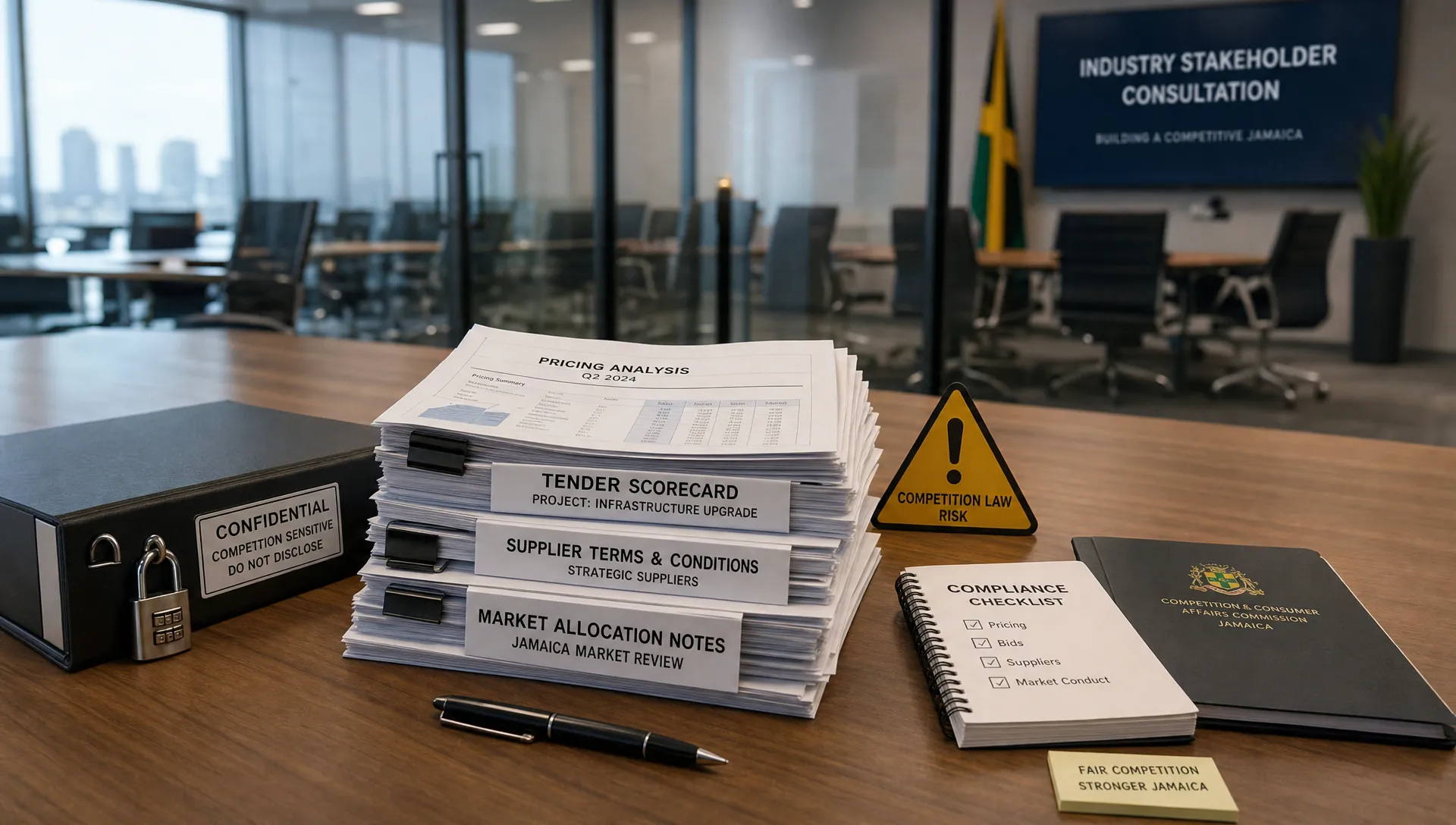
Competition law is not only a concern for multinational corporations or headline-grabbing cartels. For Jamaican companies, everyday commercial decisions about pricing, tenders, suppliers, distributors, trade associations and customer allocation can create serious legal risk if they restrict competition or appear to do so.
Jamaica's Fair Competition Act is designed to protect competitive markets and is administered by the Fair Trading Commission. The law can affect large enterprises, growing local businesses, industry associations, franchise networks, distributors, procurement teams and companies with regional or international partners. A competition issue can also trigger reputational damage, contract disputes, consumer complaints and expensive commercial litigation.
This guide highlights practical competition law red flags for Jamaican companies. It is general information, not legal advice, but it can help directors, in-house counsel, managers and business owners know when to slow down and seek specific guidance.
Why competition law belongs on the boardroom agenda
Competition law is about how businesses behave in the market. It generally targets conduct that harms the competitive process, such as collusion between competitors, bid rigging, market allocation, abuse of market power, and restrictive arrangements that make it harder for rivals to compete.
A common mistake is to treat competition law as a technical issue for lawyers only after a dispute begins. In reality, the most serious risks often start much earlier, in emails, WhatsApp groups, trade association conversations, tender meetings, distribution negotiations or informal conversations with competitors.
For directors and senior managers, the key question is not simply whether the company intended to break the law. Competition authorities and courts may also look at the purpose, effect, market context, documents, pricing behaviour and communications surrounding the conduct. An imprudent email or a poorly managed industry meeting can create a damaging record even where the business believed it was acting commercially.
Red flag 1: discussing prices with competitors
Price discussions between competitors are among the clearest competition law red flags. This does not only mean agreeing on the final retail price. It can include discussions about discounts, margins, fees, surcharges, credit terms, future price increases, promotional timing, tender pricing or minimum rates.
The danger is that a casual exchange can look like coordination. For example, if two competing suppliers discuss plans to raise prices next month, and both later increase prices in a similar way, the conversation may become evidence of anti-competitive coordination. Even if there is no signed agreement, a pattern of communication can create risk.
Jamaican companies should be especially careful in sectors where competitors meet regularly, such as professional services, distribution, construction, logistics, tourism, financial services, manufacturing and industry associations. Employees should understand that competitor pricing information is not harmless simply because it is shared informally.
A safer rule is simple: do not discuss current or future pricing strategy with competitors unless competition counsel has reviewed the context and safeguards.
Red flag 2: bid coordination and tender behaviour
Bid rigging is one of the highest-risk forms of anti-competitive conduct. It can arise in public procurement, private tenders, construction projects, shipping contracts, ICT procurement, supplier panels and other competitive processes.
Common warning signs include cover bids, bid rotation, agreeing that one company will sit out a tender, sharing bid figures before submission, agreeing territories for tenders, or submitting intentionally weak bids to make another bidder look competitive. A company may also be exposed if an agent, consultant or subcontractor facilitates improper coordination among bidders.
Procurement teams should pay close attention to communications around tender deadlines. If an employee says a competitor has agreed not to bid, or that the company should submit a token bid to help preserve a relationship, that is a serious red flag. The same is true where competing firms use the same consultant or subcontractor and competitively sensitive information is not properly ring-fenced.
Tender risk is not limited to government work. Private companies running competitive processes may also bring claims if they believe bidders coordinated unfairly.
Red flag 3: dividing customers, territories or markets
Market sharing can be more subtle than price-fixing, but it can be just as problematic. A market allocation arrangement occurs when competitors agree not to compete for certain customers, regions, product lines, channels or business opportunities.
Examples may include competitors agreeing that one will serve Kingston while another focuses on Montego Bay, that each will stay with its existing customers, or that one business will not target another's key account. These arrangements can reduce choice, preserve margins and prevent customers from receiving the benefit of real competition.
Businesses sometimes justify these discussions as practical cooperation. But if the parties are actual or potential competitors, and the arrangement limits where or for whom they compete, the competition law risk rises sharply.
Red flag | Why it matters | Safer response |
Competitors discuss future prices | May suggest price coordination | Stop the discussion and record the objection |
Bidders agree who should win | May amount to bid rigging | Escalate immediately to legal counsel |
Competitors divide customers or regions | May restrict market competition | Avoid customer or territory allocation agreements |
Distributor contracts fix resale prices | May limit independent pricing | Review pricing clauses before signing |
Dominant firm pressures suppliers to exclude rivals | May amount to exclusionary conduct | Assess market power and business justification |
Trade association shares detailed member data | May facilitate coordination | Use aggregated, historic, anonymised information where appropriate |
Red flag 4: distribution terms that go too far
Distribution, franchise and agency arrangements are essential to many Jamaican businesses. They are not automatically anti-competitive. Suppliers often need legitimate controls to protect brand quality, safety, service standards, intellectual property and customer experience.
The risk arises when restrictions go beyond what is commercially necessary and reduce independent competition. Examples include dictating minimum resale prices, punishing dealers for discounting, requiring exclusive purchasing in a way that forecloses competitors, tying unrelated products together, or imposing territorial limits without proper analysis.
Resale price maintenance is a common danger area. A supplier may recommend a resale price, but pressure, threats, penalties or incentives designed to force a retailer to maintain a minimum price can create risk. Written terms matter, but so do verbal instructions, sales team messages and patterns of enforcement.
Distribution issues can also overlap with advertising, refunds, product claims and customer treatment. Companies that sell directly to the public should consider how competition issues connect with broader consumer law exposure, particularly where pricing, promotions or sales practices may attract complaints.

Red flag 5: misuse of market power
Being successful, large or even dominant is not unlawful by itself. Competition law does not punish a company merely for winning customers, innovating, improving efficiency or negotiating strongly. The concern is abuse of market power.
A company with significant market strength should be cautious about conduct that may exclude rivals or exploit trading partners. Possible red flags include refusing to supply an essential input without a sound business reason, imposing discriminatory terms on equivalent customers, using loyalty rebates to lock up demand, selling below cost to eliminate competitors, or requiring customers to buy one product as a condition of accessing another.
The analysis is highly fact-specific. Market definition, competitive alternatives, barriers to entry, customer dependence and business justification all matter. Conduct that is ordinary for a small player may be risky for a market leader because the market impact is different.
Companies with strong positions in distribution, ports and logistics, utilities-adjacent services, financial services, digital platforms, telecoms-related markets, manufacturing inputs or specialist professional services should review exclusionary strategies carefully before implementation.
Red flag 6: unsafe trade association conduct
Trade associations can serve legitimate purposes. They may support training, standards, policy advocacy, safety, research and industry development. However, because they bring competitors together, they also create competition law risk.
The highest-risk moments are often informal: conversations before a meeting starts, side chats after the agenda, shared WhatsApp groups, private lunches, or email chains circulating commercially sensitive information. Even where the association itself has a lawful purpose, members can create risk if they discuss prices, customers, tenders, output levels, planned expansions or collective responses to suppliers and customers.
Associations should use clear agendas, minutes and competition reminders. If a prohibited topic arises, participants should object, ensure the objection is recorded, leave if necessary and seek legal advice. Silence can be misunderstood, especially if the company later behaves consistently with the improper discussion.
Data sharing also needs care. Aggregated, historic and anonymised industry data is generally less risky than current, detailed, company-specific information. If data could allow competitors to predict each other's pricing or strategy, it should be reviewed before circulation.
Red flag 7: joint ventures, acquisitions and cross-border arrangements
Joint ventures and strategic alliances can be pro-competitive. They may help businesses enter new markets, combine complementary expertise, share risk, improve logistics or deliver projects that neither party could handle alone. But if the parties are competitors, the collaboration must be carefully structured.
A legitimate joint venture should not become a cover for coordinating competition outside the project. The parties should define the scope of cooperation, restrict access to competitively sensitive information, document the business rationale and ensure each party remains free to compete where appropriate.
Jamaica has not historically operated a broad mandatory merger notification system equivalent to some larger jurisdictions, but transactions may still raise competition, sector regulatory, banking, telecoms, utilities, public procurement, corporate and contractual issues. Cross-border deals can add further complexity. Where a Jamaican transaction has a Dutch, European or overseas dispute element, coordinating with local counsel, such as an advocaat in Eindhoven, may help align Jamaican advice with local civil-law and procedural realities.
Because competition law often intersects with corporate, compliance, data, intellectual property, banking and litigation issues, companies may benefit from reviewing the wider law practice areas every business in Jamaica should know before finalising a major commercial arrangement.
Red flag 8: algorithmic pricing and digital coordination
Competition risk is not limited to face-to-face meetings. As Jamaican companies adopt e-commerce tools, pricing software, marketplace platforms, shared logistics systems and data analytics, digital coordination becomes more important.
An algorithm can create risk if it is used to implement an unlawful agreement, monitor competitors, enforce pricing discipline or align market behaviour. A shared pricing tool used by competitors may be especially sensitive if it relies on current commercially sensitive data from multiple businesses.
The same caution applies to online seller groups, supplier portals and industry chat groups. A message such as everyone should increase delivery fees next week can be just as risky online as it would be in a boardroom.
Companies should ask practical questions before adopting digital pricing tools. What data does the tool collect? Who can access it? Does it incorporate competitor data? Can it automatically match or undercut rivals? Is there a human review process? Has legal counsel reviewed the competition implications?
How Jamaican companies can reduce competition law risk
A good competition compliance programme does not need to paralyse commercial activity. It should help the business compete confidently while avoiding conduct that could invite investigation, litigation or reputational harm.
The most effective controls are practical and tailored to the company's market position, sales model and risk profile. A small retailer, a dominant distributor, a bidder on government contracts and a national industry association will not need identical controls.
Key safeguards include:
Train sales, procurement, tendering and senior management teams on competition law basics.
Adopt clear rules for competitor contact, trade association meetings and industry events.
Review tender processes for bid coordination risks, especially where consultants or subcontractors are shared.
Vet distribution, exclusivity, tying, rebate and resale pricing clauses before contracts are signed.
Keep written records of legitimate business reasons for sensitive decisions.
Escalate red flags quickly and preserve documents if a concern arises.
Competition compliance should also connect with wider commercial risk management. A competition issue may lead to contract claims, injunctions, damages arguments, supplier disputes, shareholder pressure or regulatory complaints. Businesses can better anticipate that overlap by understanding the commercial litigation risks Jamaican businesses should watch.
What to do if a red flag has already occurred
If a possible competition law issue has already happened, the worst response is panic-driven cleanup. Deleting messages, editing documents, pressuring employees or creating after-the-fact explanations can make matters worse.
The first step is to preserve relevant documents and stop any potentially problematic conduct. The second is to obtain legal advice quickly, especially before interviewing employees, responding to third parties, engaging with regulators or making admissions. Legal privilege, confidentiality and document preservation should be handled carefully from the outset.
The company should identify what happened, who was involved, what markets or tenders were affected, whether the conduct is continuing, and whether any customers, suppliers or competitors may complain. Depending on the facts, remedial action may include revised policies, contract amendments, training, disciplinary steps, or a structured response to the regulator or affected commercial partners.
Competition issues can also overlap with consumer complaints, particularly where pricing, promotions, market restrictions or sales practices affect end users. If the concern involves customer-facing conduct, it may be useful to consider how consumer law issues can create business risk alongside the competition analysis.
Frequently asked questions
What is competition law in Jamaica? Competition law in Jamaica is mainly concerned with preventing business conduct that restricts, distorts or prevents competition. The Fair Competition Act addresses issues such as anti-competitive agreements, restrictive trade practices and misuse of market power.
Can Jamaican companies talk to competitors at industry events? Yes, but the content of the discussion matters. General policy, training and industry development topics may be legitimate. Prices, margins, tender plans, customers, territories, output levels and future strategy should be avoided unless legal counsel has confirmed that the setting is appropriate.
Is it illegal to be the largest company in a Jamaican market? No. Size or market success is not unlawful by itself. The risk arises where a company with significant market power uses that position to exclude rivals, impose unfair conditions, restrict supply or harm the competitive process.
Are exclusive distribution agreements always anti-competitive? No. Exclusive arrangements can have legitimate business reasons, such as investment protection, brand control or service quality. They become riskier where they foreclose competitors, tie up essential channels, fix resale prices or cannot be justified by the facts.
When should a business seek competition law advice? Seek advice before discussing sensitive topics with competitors, submitting bids where coordination concerns exist, signing restrictive distribution agreements, launching exclusionary pricing strategies, joining a joint venture with a competitor, or responding to a regulator or complaint.
Speak with a Jamaican competition law team
Competition law red flags are easiest to manage before they become investigations, contract disputes or litigation. If your business is reviewing a distribution model, preparing a tender, joining an industry initiative, negotiating a joint venture or responding to a complaint, early advice can help protect both the transaction and the company.
Henlin Gibson Henlin advises clients on commercial litigation, compliance and risk, competition law and related business issues in Jamaica. For guidance tailored to your sector and facts, speak with a legal team before a red flag becomes a dispute.