
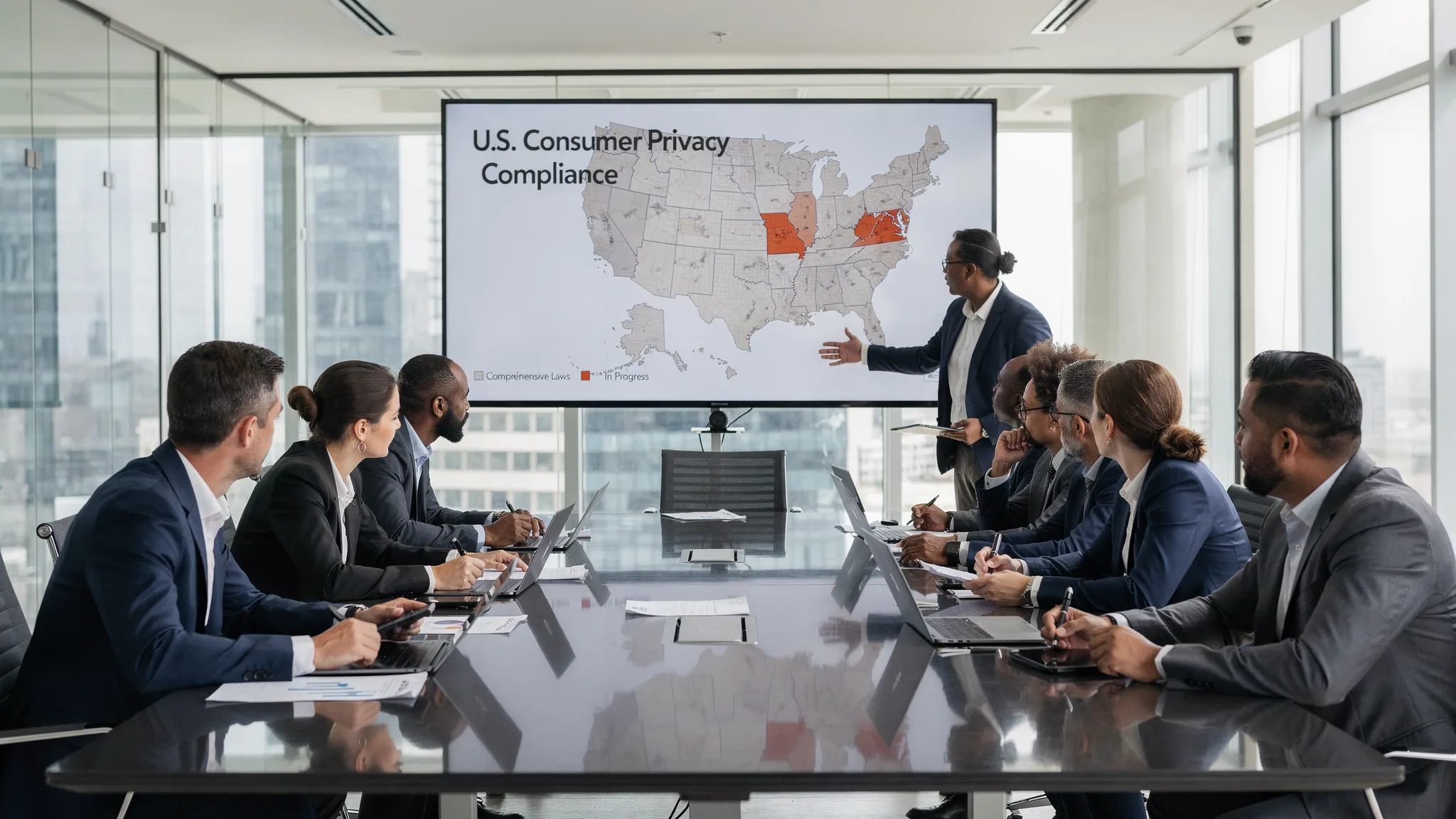
In 2026, “data privacy compliance” in the United States is less about one national statute and more about managing a growing patchwork of state privacy laws, plus long-standing state breach notification rules and sector-specific requirements. For Jamaican businesses with US customers, US subsidiaries, or cloud vendors, the practical question is rarely “Which single law applies?” and more often “Which state rules apply to my data, my customers, and my processing activities?”
This quick guide explains how state privacy laws generally work, which states have comprehensive consumer privacy frameworks (as of our knowledge cutoff), where the biggest differences sit, and how to build a sensible multi-state compliance approach.
First, what “data privacy laws by state” usually means
When people search for “data privacy laws by state,” they are usually looking for one of three categories:
Comprehensive consumer privacy laws (similar in structure to GDPR concepts, but state-specific). These typically grant rights such as access, deletion, correction, and opt-out of targeted advertising.
Sector-specific or issue-specific privacy laws, for example biometric privacy, health data rules not covered by HIPAA, children’s privacy design codes, or data broker registration.
Data breach notification and security requirements, which exist in all US states (even where there is no comprehensive consumer privacy statute).
This article focuses primarily on the first category (comprehensive laws), then flags major sectoral “gotchas” that often create risk.
Note: US privacy laws change quickly through legislation and attorney-general rulemaking. For the most current, jurisdiction-by-jurisdiction status, businesses often use a tracker such as the IAPP US State Privacy Legislation Tracker.
Quick guide (2026): US states with comprehensive consumer privacy laws
The table below summarises states known (as of our knowledge cutoff) to have enacted comprehensive consumer privacy legislation. It is not a substitute for legal advice, and you should confirm current status and effective dates before making implementation decisions.
State | Law (common name) | What to expect (high level) | Common compliance focus |
California | CCPA as amended by CPRA | Broad consumer rights, opt-out rights for “sale” and “sharing,” heightened focus on enforcement | Notice design, “Do Not Sell/Share,” sensitive data handling, service provider contracts |
Virginia | VCDPA | GDPR-like controller/processor model with consumer rights and opt-outs | Data processing agreements, DPIA-style assessments for higher-risk processing |
Colorado | CPA | Consumer rights, opt-outs, and a stronger emphasis on universal opt-out mechanisms | Technical implementation of opt-out signals, profiling and targeted ads governance |
Connecticut | CTDPA | Consumer rights and opt-outs similar to CO and VA models | DSAR workflows, consent for sensitive data where required |
Utah | UCPA | More business-friendly thresholds in structure, consumer rights and opt-outs | Notice and opt-out mechanics, vendor management |
Florida | Florida Digital Bill of Rights | Comprehensive-style framework with narrower applicability (law design differs from CO/VA models) | Scoping analysis (does it apply), governance for targeted advertising and consumer rights |
Texas | Texas Data Privacy and Security Act (TDPSA) | Broad coverage approach and rights/opt-outs, backed by AG enforcement | Data inventory, DSAR handling, vendor contracts and security programme |
Oregon | Oregon Consumer Privacy Act (OCPA) | Consumer rights and opt-outs, including sensitive data considerations | DSAR and opt-out processes, notices and consent strategy |
Montana | Montana Consumer Data Privacy Act | Consumer rights and opt-outs | Scoping, DSAR operations, sensitive data governance |
Indiana | Indiana Consumer Data Protection Act | Consumer rights and opt-outs | Operational readiness and vendor contracting |
Iowa | Iowa Consumer Data Protection Act | Consumer rights and opt-outs | Privacy notice alignment and opt-out handling |
Tennessee | Tennessee Information Protection Act | Consumer rights and opt-outs, with compliance frameworks often emphasised | Mapping to a recognised privacy/security framework, documentation |
Delaware | Delaware Personal Data Privacy Act | Consumer rights and opt-outs | DSAR workflows, targeted advertising controls |
New Jersey | New Jersey Data Privacy Act | Consumer rights and opt-outs | Multi-state harmonisation, vendor governance |
How to use this table in practice
Most organisations do not implement 12 to 15 separate privacy programmes. Instead, they:
Choose a baseline (often the most demanding requirements they are likely to trigger, commonly California plus a Colorado-style opt-out signal approach).
Layer state-specific differences only where the law truly diverges (for example, certain definitions, exemptions, enforcement mechanisms, or rulemaking details).
Keep a “law change log” so privacy notices, contracts, and operational procedures stay current.

The biggest differences between state privacy laws (what trips teams up)
Even where statutes look similar, implementation details vary. These are the differences that most commonly drive cost, engineering time, and legal risk.
1) Applicability thresholds (who is covered)
State laws typically apply based on combinations of:
Revenue and/or volume of personal data processed
Whether you control or process data for targeted advertising
Whether you sell personal data (definitions differ)
Whether you do business in the state and meet a resident-data threshold
A correct scoping analysis is essential. Many organisations either over-build (unnecessary spend) or under-scope (compliance gap) because they assume “if we have a website, it applies everywhere.”
2) “Sale” vs “sharing” vs targeted advertising
In state privacy statutes:
“Sale” can include more than cash transactions. Depending on the state, sharing data for “other valuable consideration” can count.
Some states treat certain ad-tech data flows as targeted advertising requiring opt-out.
California is notable for explicitly addressing “sharing” for cross-context behavioural advertising.
This is why ad-tech mapping (pixels, SDKs, cookie partners, clean rooms, measurement vendors) is often the first deep technical task in state privacy compliance.
3) Sensitive data and consent requirements
Many states treat categories such as precise geolocation, health-related information, biometric identifiers, and children’s data as sensitive and impose stronger controls, often including opt-in consent in some contexts.
Practical takeaway: treat sensitive data as a distinct data class in your inventory and access controls, even if you are not sure which state thresholds you meet this year.
4) Universal opt-out signals
Some states require or strongly encourage recognition of browser or device-based opt-out signals (often described as “universal opt-out mechanisms”). If you rely heavily on targeted advertising, this becomes a key engineering and consent-management issue.
Colorado is commonly referenced in this area, and California also has detailed expectations around opt-out preference signals.
5) Enforcement and private litigation risk
Most comprehensive state privacy laws are enforced by the state attorney general (or a dedicated privacy agency in California). Private rights of action are more limited, but California is often highlighted for private actions related to certain data breaches under specific conditions.
If your risk lens is litigation exposure, you typically look at:
Whether a private right of action exists for certain violations
Whether a cure period is available
The state AG’s enforcement posture and guidance
For California regulatory information, see the California Privacy Protection Agency.
Key sector-specific state privacy laws to watch (even if a “comprehensive” law does not apply)
A common mistake is focusing only on comprehensive state privacy statutes and missing specialised laws that apply regardless of size thresholds.
Topic | Example state laws (non-exhaustive) | Why it matters |
Biometric privacy | Illinois BIPA (notable private litigation), Texas and Washington biometric statutes | Biometrics can trigger heightened consent, retention, and disclosure obligations |
Consumer health data (beyond HIPAA) | Washington My Health My Data Act | Can affect wellness apps, trackers, and some marketing inferences tied to health |
Data security requirements | Massachusetts data security regulations (often referenced in US security programmes) | Prescriptive security elements can influence vendor and encryption standards |
Data breach notification | All 50 states + DC/territories | Notice timelines and content differ, impacting incident response planning |
The compliance implication for many businesses is simple: your privacy programme should not only answer “Do we meet the threshold?”, it must also ask “Do we process a data type (biometric, health, children’s) that triggers special rules?”
A practical multi-state compliance approach (built for 2026)
If you operate across multiple US states, a “single set of controls” model, with state-specific tailoring where necessary, is usually the most efficient approach.
Here is a workflow many organisations adopt:
Build and maintain a data inventory: categories of personal data, purposes, recipients, storage locations, retention periods.
Map disclosure and advertising technologies: cookies, SDKs, pixels, enrichment, data brokers, and CRM integrations.
Publish a clear privacy notice: include categories, purposes, sharing, rights, and how to exercise them.
Create a DSAR process (data subject access requests): intake, identity verification, routing, deadlines, and exceptions.
Implement opt-out mechanisms: targeted advertising opt-out, sale/sharing opt-out where relevant, and consider universal opt-out signals.
Tighten vendor contracts: controller/processor style terms, data processing instructions, security requirements, subprocessor controls.
Document higher-risk processing reviews: particularly for sensitive data and profiling/targeted advertising.
Run an incident response playbook: align security, legal, and communications to meet state breach notification obligations.
For security baselines, many organisations map controls to frameworks like the NIST Privacy Framework alongside security standards already in use.
What Jamaican businesses should know (cross-border reality)
If you are headquartered in Jamaica but interact with US residents, you can still face US state privacy obligations depending on your operations and thresholds. Common real-world scenarios include:
A Jamaican e-commerce brand shipping to US customers and running targeted advertising
A BPO or customer support provider processing US consumer data for a US client
A Jamaican group using US-based SaaS tools (CRM, marketing automation, analytics)
At the same time, you may have domestic obligations under Jamaica’s data protection framework. That means compliance is often two-directional: you need to manage US state requirements while maintaining a defensible Jamaican privacy posture (contracts, governance, security, and incident readiness).
Because the “right” answer depends heavily on data flows and roles (controller vs processor, service provider vs third party), multi-jurisdiction privacy work is typically most effective when legal, technical, and operational teams align early.
Frequently Asked Questions
Do US state privacy laws apply if my business is not located in that state? Yes, many state laws focus on whether you do business in the state and process that state’s residents’ data above certain thresholds, not on where you are incorporated.
Is California the only state I need to worry about? Not in 2026. California is influential, but other states can impose different obligations (for example, around opt-out signals or applicability tests). A harmonised multi-state approach is usually safer.
Do these laws replace state data breach notification rules? No. State breach notification laws are separate and still apply. Your incident response plan should address both security response and notification analysis.
If we comply with GDPR, are we automatically compliant with US state privacy laws? GDPR readiness helps (governance, DSARs, vendor management), but US state laws have unique concepts (such as “sale/sharing” opt-outs and state-specific notice expectations). You typically need a US-specific gap assessment.
Where can I check the latest changes for each state? State attorney general sites and reputable trackers are a good starting point. Many organisations monitor updates via the IAPP tracker and then confirm with legal review.
Need help scoping and implementing a multi-state privacy compliance plan?
Henlin Gibson Henlin advises clients on data privacy, compliance, and risk, including cross-border considerations. If you need help determining which state laws apply to your business, updating privacy notices and contracts, or strengthening incident readiness, you can reach the team via Henlin Gibson Henlin.