
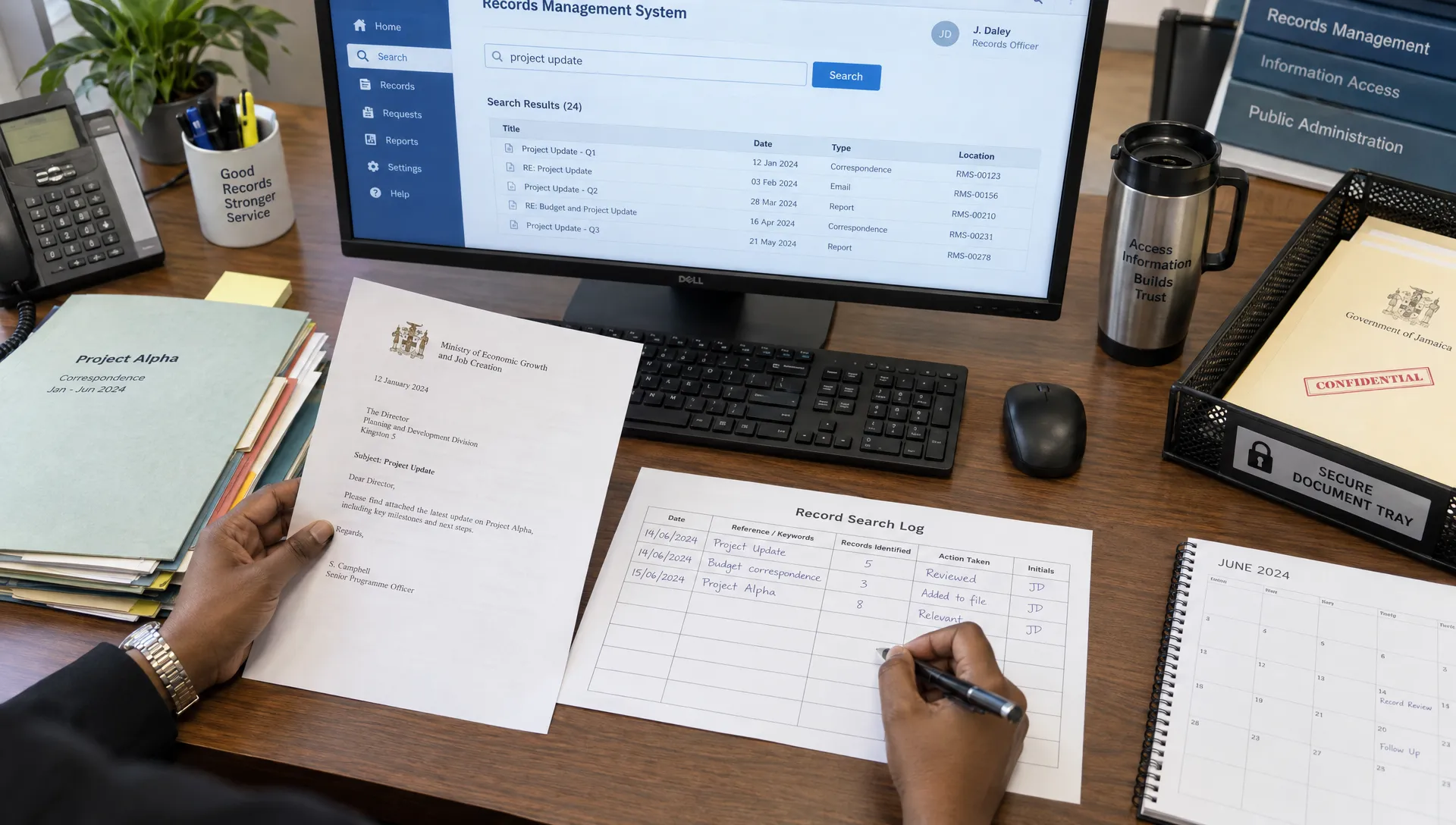
A request for “everything you hold about me” can arrive in an HR inbox, a customer complaint or an email to a branch manager. Handling data subject access requests in Jamaica requires more than forwarding that message to IT. The organisation must recognise the request, verify the requester appropriately, locate relevant personal data and decide what can lawfully be disclosed. It must then deliver a clear, secure response within the applicable deadline.
A documented workflow helps prevent two opposite mistakes: withholding information the individual is entitled to receive and disclosing information that belongs to someone else.
What data subject access requests in Jamaica cover
Jamaica’s Data Protection Act, 2020 gives individuals rights concerning their personal data. The Office of the Information Commissioner oversees the country’s data protection framework.
Broadly, the access right allows an individual to obtain confirmation about whether their personal data is being processed, information about that processing and communication of the personal data in an intelligible form. Relevant information can include the purposes of processing, recipients or classes of recipients and available information about the source of the data. Additional requirements may apply to certain automated decision-making.
Access is a right to personal data, not an unrestricted right to every document mentioning the requester. A document may contain the requester’s information alongside another person’s data, privileged advice or material outside the request’s scope. That requires review, not automatic disclosure or blanket refusal.
Customers, employees, former employees and other individuals may exercise access rights. An organisation should assess the request under the Jamaican framework rather than treating it as an ordinary customer-service enquiry or importing an overseas policy unchanged.
Build a practical access-request workflow
1. Recognise the request and assign responsibility
The individual does not need to quote the Act or use the term “DSAR”. A written request asking for a copy of personal information may engage access rights even if it appears within a longer complaint.
Train staff who receive correspondence to identify these requests and escalate them promptly. If someone asks orally, help them put the request in writing rather than simply dismissing it. A preferred form can improve administration, but staff should not assume that using the organisation’s form is the only valid route.
Assign a case owner, usually the data protection officer or another designated privacy lead. Record the original message, receipt date, relevant business unit and potential response deadline. An internal handover should not restart the clock.
Where your organisation holds the information only as a processor for another organisation, promptly notify the relevant controller and follow lawful instructions. Do not independently disclose a client’s records merely because they are stored on your systems.
2. Verify identity without collecting excessive information
Before releasing personal data, establish that the requester is the individual concerned or an authorised representative. The verification method should reflect the sensitivity of the information and the risk of impersonation.
For an existing customer, verification through an established account or contact channel may be appropriate. A request for employment, financial or health-related records may require stronger checks. Avoid routinely demanding a passport copy where less intrusive verification would adequately establish identity.
Where an attorney, relative or other representative makes the request, check both their identity and their authority to act. Do not assume that a family relationship alone authorises disclosure of an adult’s records.
Record why the checks were sufficient. Retain verification evidence only as long as necessary under your retention policy and applicable obligations. The access process should not create an unnecessary collection of identity documents.
3. Calculate the response deadline at the outset
Build the workflow around the Jamaican Act’s 30-day response period, with prompt handling rather than a last-day search. Confirm how the statutory rules concerning receipt, any prescribed fee and information reasonably required to identify the individual or locate the data apply to the particular request.
Record the basis for calculating the due date. If clarification is needed, request it promptly and do not assume that sending a clarification email automatically suspends the deadline. Similarly, do not demand an administrative fee unless you have confirmed the applicable legal basis and amount.
Avoid using a generic GDPR timetable. As explained in the firm’s comparison of Jamaica’s Data Protection Act and the GDPR, the frameworks should not be treated as interchangeable. GDPR extension rules are not automatically available for a Jamaican request.
Set internal milestones for collecting records, completing legal review and approving disclosure. If a deadline is at risk, escalate immediately and communicate accurately with the requester. An acknowledgement is useful, but it is not a substitute for the substantive response.
4. Search across the organisation, not just the main database
A reliable search begins with the systems and people likely to hold the requester’s personal data. Depending on the organisation, relevant locations may include:
Customer, employee and supplier management systems.
Email accounts, shared drives and paper files.
Business messaging channels and approved mobile applications.
Call recordings, CCTV footage and complaint records.
Service providers holding data on the organisation’s behalf.
Use known identifiers, such as customer numbers, employee numbers, previous names or relevant email addresses. Ask custodians where records are actually kept rather than assuming the official filing system is complete.
An up-to-date data inventory makes this substantially easier. The firm’s guide to building a data protection compliance programme explains the wider governance work that supports these searches.
Keep a search log showing locations checked, search terms, date ranges and responsible staff. Consider archived records and backups with technical and legal input rather than automatically including or excluding them. Ask processors for assistance early enough to meet the response timetable.
Preserve potentially responsive records while the request is being handled. Do not allow routine deletion to remove material needed for the response.
5. Review disclosure record by record
Collection and disclosure are separate stages. Finding a record does not mean that the entire record should be sent.
First, identify the requester’s personal data. Next, assess whether releasing it would disclose another person’s information or engage an applicable restriction or exemption. Depending on the circumstances, redaction, extraction or a carefully prepared explanation may allow access without revealing protected material.
Confidentiality alone is not a complete legal analysis. An internal label such as “confidential” does not automatically defeat access rights. Equally, material should not be disclosed simply because the requester’s name appears somewhere in it.
Refer potentially privileged communications to legal counsel. Legal professional privilege depends on the nature and purpose of the communication, not merely whether a lawyer was copied into an email.
A request made during litigation or an employment dispute still needs an access-rights assessment. The requester’s motive is not, by itself, a substitute for identifying an applicable exemption.
Maintain a decision log for material withheld or redacted, recording the legal basis and reasoning. Apply redactions to disclosure copies and preserve the originals securely.

6. Prepare an intelligible and secure response
A response should explain the outcome, not simply attach an unexplained export. Include the information the Act requires about the processing, together with the personal data being communicated. Explain internal codes or abbreviations where necessary to make the information intelligible.
Choose a format that preserves meaning without unnecessarily exposing unrelated information. Depending on the records, that could involve redacted documents, extracts, a structured report or a combination of formats. A summary should not omit information that the individual is entitled to receive.
Check the final disclosure package for hidden content. Spreadsheet tabs, document comments, tracked changes and file metadata can reveal information that the reviewer intended to withhold. Confirm that electronic redactions actually remove the underlying content rather than merely covering it visually.
Verify the delivery address independently where appropriate. Use a suitably secure transfer method, such as an encrypted attachment with the password communicated separately or an established secure portal. Do not assume that an email address supplied in an unverified request is safe.
7. Close the case with an audit trail
Record what was sent, when it was sent, how it was delivered and who approved the response. Keep a proportionate record of searches, verification, redaction decisions and correspondence.
Where information has been withheld, explain the decision and legal basis to the extent required and permitted. Include relevant information about how the individual can raise concerns or pursue available review or complaint routes.
If no responsive personal data was found, state that clearly and retain evidence of the searches undertaken. A negative response should follow a real search, not an assumption that an old account or former employee file no longer exists.
Example: a former employee requests “my entire file”
Suppose a former employee asks HR for their personnel file, emails about their performance and messages concerning their departure. The request arrives while an employment dispute is developing.
HR should preserve the request and relevant records, notify the case owner and identify custodians. Payroll, the line manager and relevant messaging channels may hold responsive information outside the personnel folder.
The review should distinguish the employee’s personal data from information relating to colleagues. A witness statement or grievance record may require careful treatment of third-party information. Communications involving legal counsel need a privilege assessment rather than automatic inclusion or exclusion.
The organisation should not treat the dispute as a reason to ignore the request. It should also avoid promising an unredacted copy of every employment-related document. The objective is a lawful access response, supported by a clear record of what was searched, disclosed and withheld.
What the case file should contain
A compact case file helps a reviewer understand the handling of the request without reconstructing events from scattered emails.
Record | What it should demonstrate |
Original request and acknowledgement | What was requested and when it was received |
Identity and authority checks | Why disclosure to this person was appropriate |
Deadline calculation | The response date and basis for calculating it |
Search log | Systems, custodians and records examined |
Review and redaction log | Reasons for withholding or limiting disclosure |
Final response and delivery record | What was communicated, when and by which method |
Restrict access to the case file itself. It may contain sensitive personal data, identity-verification material and legal advice. Apply a documented retention period rather than keeping every access-request file indefinitely.
Frequently asked questions
Does an individual have to use our access-request form? Do not reject an otherwise valid written request merely because it does not use your preferred form. A form can help collect useful details, but the organisation must assess the request against the Act’s requirements.
Can we ask someone to narrow a broad request? You can seek useful clarification, including relevant dates, accounts or interactions. Do not use clarification as a delaying tactic or assume that it automatically changes the statutory deadline. Continue work on identifiable parts of the request where appropriate.
Must we disclose every email containing the person’s name? Not necessarily. Review the personal data within the emails, the context and any applicable restrictions. Access may be provided through redacted copies or extracts, but the response must not omit personal data that the individual is entitled to receive.
Can a request be refused because the person is suing the organisation? Litigation does not automatically remove access rights. Assess the request under the Act, including any relevant exemptions and legal professional privilege. Coordinate with litigation counsel so that access handling and litigation obligations are both addressed.
What if the response reveals inaccurate information? Handle the access response and any request for correction as related but distinct issues. Preserve an appropriate audit trail, investigate the accuracy concern and assess the individual’s applicable rights rather than silently changing records during review.
Obtain advice on difficult disclosure decisions
Henlin Gibson Henlin provides data privacy, compliance and dispute-related legal services. If a request involves sensitive employee records, third-party information, privilege or an approaching deadline, seek advice before releasing or withholding material. Contact Henlin Gibson Henlin to discuss the request and the legal issues requiring review.
This article provides general information, not legal advice on a particular request.