
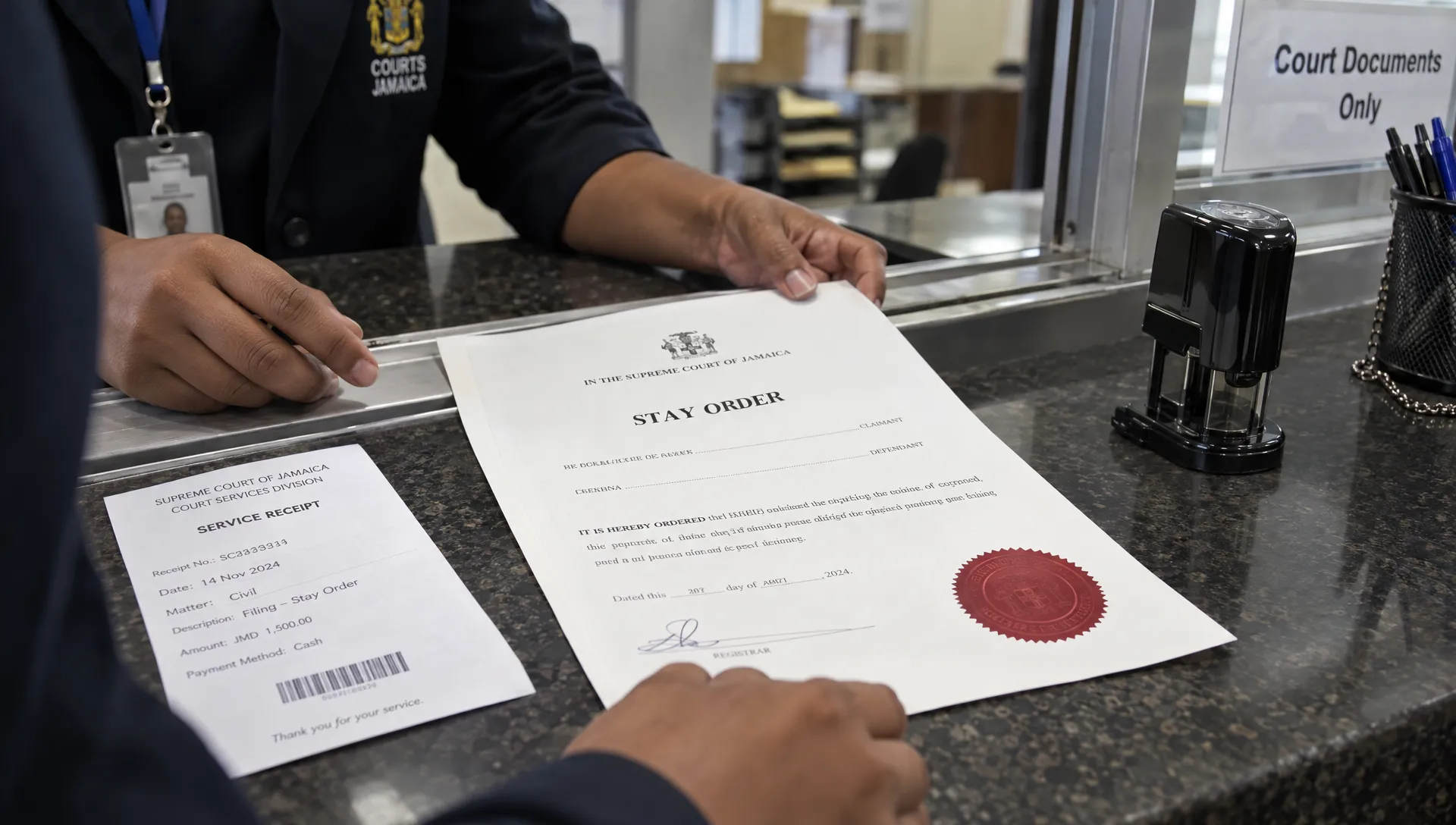
Filing an appeal does not automatically stop a judgment from being enforced in Jamaica. If enforcement could cause serious harm before your appeal is decided, you may need to apply for a stay of execution pending appeal. This is a court order that temporarily suspends enforcement, usually on specified terms.
Timing matters. A judgment creditor may be entitled to pursue enforcement while the appeal is being prepared or heard. A request to the other side to wait is not a substitute for a court order.
This guide explains the main steps, the evidence you should prepare and the issues the court will consider. It focuses on civil proceedings in Jamaica, particularly appeals from Supreme Court decisions, and provides general information rather than advice on a particular case.
What is a stay of execution pending appeal?
A stay temporarily prevents specified enforcement steps under a judgment or order. Depending on its wording, it might suspend enforcement of a money judgment, recovery of possession or another obligation imposed by the court.
A stay does not overturn the judgment. The appeal determines whether the decision should be changed or set aside. The stay addresses what should happen while that challenge is pending.
The court may grant a full stay, suspend only part of the order or impose conditions. It may also grant a short interim stay until a fuller application can be heard.
The wording is critical. An order staying enforcement of a payment obligation does not necessarily suspend every other requirement in the judgment. Nor should you assume it removes a separate freezing order or injunction. If that is your concern, the procedure for responding to a freezing order in Jamaica involves distinct compliance and variation issues.
What must you show to obtain a stay?
The court must consider both parties. The successful party has an interest in enforcing the judgment, while the appellant seeks to avoid consequences that could make a successful appeal ineffective.
A stay of execution pending appeal is discretionary, not an entitlement that follows from filing an appeal.
A real prospect of success on appeal
The court will generally consider whether the proposed appeal has a real prospect of success. It does not conduct the full appeal at the stay hearing, but it needs more than a statement that the judge was wrong.
Identify the particular error being challenged and explain why it matters to the outcome. This might involve the interpretation of a contract, application of a legal principle or treatment of a material issue. Connect those points to the judgment and the grounds of appeal.
The risk of injustice if enforcement proceeds or is delayed
The court also weighs the competing risks. What happens if enforcement proceeds and the appeal later succeeds? Conversely, what happens to the judgment creditor if enforcement is delayed and the appeal fails?
Relevant matters may include whether money could be recovered after a successful appeal, whether property would be transferred or whether enforcement would cause consequences that could not readily be reversed.
Specific evidence is more persuasive than general claims of hardship. Financial pressure alone does not establish that a stay should be granted. The court will also consider whether conditions or security could reduce the risk to the successful party.
How to prepare and file your application
The correct procedure depends on the court, the type of decision and the stage of the appeal. Use the following steps as a preparation framework, not as a substitute for checking the applicable rules.
1. Identify exactly what needs to be suspended
Obtain the judgment or order and establish which paragraphs authorise the enforcement you want stopped. Identify any payment date, possession date or other compliance deadline.
Also establish whether enforcement has already begun. An application made before an enforcement step occurs may raise different issues from one made after assets have been sold or possession has changed. A stay does not necessarily reverse completed enforcement.
Check that an appeal is the appropriate challenge. If the judgment was entered in default, an application to set aside a default judgment in Jamaica may be the relevant route. The two procedures have different purposes and requirements.
2. Protect the appeal deadline
Determine whether permission to appeal is required and identify the applicable filing deadline. Time limits can differ according to the decision and procedural route, so do not assume that every civil appeal follows the same timetable.
An application for a stay of execution pending appeal does not itself extend the time for appealing. Prepare the notice of appeal or permission application alongside the stay application, as appropriate.
If a deadline has already passed, an extension of time may be needed. That is a separate issue and should be addressed expressly.
Check the applicable Civil Procedure Rules, Court of Appeal Rules and relevant practice directions through the Supreme Court of Jamaica and Court of Appeal of Jamaica. Do not rely on filing requirements from another jurisdiction.
3. Choose the correct court and assess urgency
As a practical starting point, consider seeking relief from the court that made the order. Your attorney should confirm whether the applicable rules require that step or permit an application directly to the Court of Appeal.
Where an application is renewed before the appellate court, provide the earlier stay decision and explain what happened below. Do not omit a refusal or unfavourable reasons.
If enforcement is imminent, identify the exact event and date. For example, provide the scheduled possession date or the enforcement document you received. Ask whether a short interim stay is available while the substantive application is arranged.
An urgent application does not automatically justify proceeding without notice. Any request to do so must satisfy the applicable requirements. Where relief is sought without notice, full and frank disclosure is especially important.
4. Prepare a supporting affidavit
Your affidavit should give the court the factual basis for the application. Keep legal submissions separate from factual evidence where possible and identify the source of information that is not within your personal knowledge.
For a stay of execution pending appeal, useful supporting material may include:
The decision being challenged: Exhibit the relevant judgment or order and written reasons, if available.
The appeal documents: Include the filed notice of appeal or relevant permission application and explain the current procedural position.
Evidence of enforcement: Exhibit demands, notices, correspondence or other documents showing what is threatened or underway.
Evidence of likely harm: Explain the specific consequences of enforcement and support them with relevant records.
Repayment concerns: If you say money could not be recovered after a successful appeal, provide a factual basis rather than speculation.
Proposed safeguards: Explain any security, partial payment or other protection you can realistically offer.
For a business, financial evidence might include current accounts, cash-flow information or documents showing the likely operational effect of enforcement. Avoid relying on a director’s unsupported assertion that the company will collapse.
Be candid about facts that weaken your position. The court needs an accurate picture of the risk on both sides.
5. Prepare the application and a precise draft order
The application should identify the relief requested, its grounds and the supporting evidence. In the relevant procedure, this will generally involve a notice of application supported by affidavit evidence. Confirm the required form, filing method, fees and notice period with the applicable rules and registry arrangements.
Provide the judgment, available reasons and appeal documents so the court can understand the dispute without reconstructing it from incomplete papers.
Your draft order should specify which parts of the judgment are stayed, how long the stay lasts and any proposed conditions. If you seek immediate protection until a further hearing, distinguish that interim relief from the stay sought until determination of the appeal.
Avoid an unnecessarily broad request. If only enforcement of a payment obligation needs to be suspended, explain why that relief is sufficient.

6. Serve the documents and prepare for the hearing
Serve the application and evidence as required, unless the court has authorised a different procedure. Retain proof of service and comply with any directions for written submissions or additional documents.
The respondent may challenge the appeal’s prospects, dispute your account of likely harm or argue that a stay would jeopardise recovery. Prepare to address those objections with evidence rather than repeating the grounds of appeal.
At the hearing, be ready to explain why the proposed order fairly protects both parties. The court may ask whether a narrower stay, payment into court or another condition would address the risk.
Money judgments: address repayment and security
Where the judgment requires payment, the court will consider more than the inconvenience of paying before the appeal is heard. An important issue may be whether the appellant could recover the money if the appeal succeeds.
If you allege that the judgment creditor could not repay, explain the basis for that concern. Unsupported assumptions about their financial position are unlikely to carry the same weight as reliable evidence.
The creditor’s position also matters. Delay may create a risk that the appellant’s assets will diminish before the appeal ends. Security can sometimes help address that concern.
A stay of execution pending appeal may therefore be conditional on payment into court, an acceptable guarantee or another form of protection. The availability and suitability of any arrangement depend on the case and the court’s order. Do not assume that offering security guarantees a stay, or that security for the judgment is the same as security for appeal costs.
What happens after the court decides?
Read the operative terms carefully. The practical effect depends on the order actually made, not on what you requested.
Outcome | Practical effect | Immediate action |
Full stay granted | Enforcement covered by the order is suspended for the stated period | Complete the required steps to obtain and serve the order and comply with its terms |
Limited or conditional stay granted | Only specified enforcement is paused, potentially subject to security or another requirement | Identify what remains enforceable and meet every condition by its deadline |
Interim stay granted | Temporary protection applies until the stated date or further order | Prepare for the next hearing and do not assume protection continues indefinitely |
Stay refused | No suspension arises from that application | Obtain advice promptly about further applications and ongoing compliance obligations |
If a stay is refused below, an application to the Court of Appeal may be available, depending on the procedural position. A renewed application does not itself stop enforcement in the meantime.
Continue progressing the appeal even after obtaining a stay. Comply with directions and filing deadlines, and disclose relevant changes if the court requires them. A stay may be varied or discharged in appropriate circumstances.
Common mistakes that weaken an application
Delay can make urgent relief harder to obtain, particularly where the applicant knew about the judgment or threatened enforcement but did not act. Explain any delay honestly and provide a clear chronology.
Other avoidable problems include asking to suspend the wrong obligation, relying on unsupported financial claims and proposing security that cannot actually be provided. Filing the appeal and stay papers without arranging proper service can also undermine the application.
Treat the draft order as a practical document. It should be clear enough for the parties and anyone involved in enforcement to understand what is prohibited, what remains permitted and when the protection ends.
Frequently asked questions
Does filing an appeal automatically stop enforcement in Jamaica? No. An appeal does not ordinarily operate as a stay. You need a court order suspending the relevant enforcement, unless another applicable legal provision has that effect.
Can I apply before receiving the judge’s written reasons? Urgent relief may need to be sought before written reasons are available. Provide the order and available materials, explain what is missing and obtain advice on the appeal and stay requirements. Do not let an appeal deadline pass while waiting for reasons.
Must I pay the judgment amount into court? Not in every case. The court decides whether security or another condition is appropriate. Be prepared to explain what protection you can offer and why it fairly addresses the respondent’s risk.
Does a stay last until every possible appeal is finished? Not necessarily. Its duration depends on the wording of the order. A stay covering one appeal should not be assumed to continue through a further appeal or permission application.
Get advice before enforcement advances
Henlin Gibson Henlin provides appellate and commercial litigation services in Jamaica. If you need advice on a stay application, contact Henlin Gibson Henlin with the judgment, any written reasons, your appeal documents and all enforcement notices. Those materials help establish the correct procedure, urgency and evidence needed.