
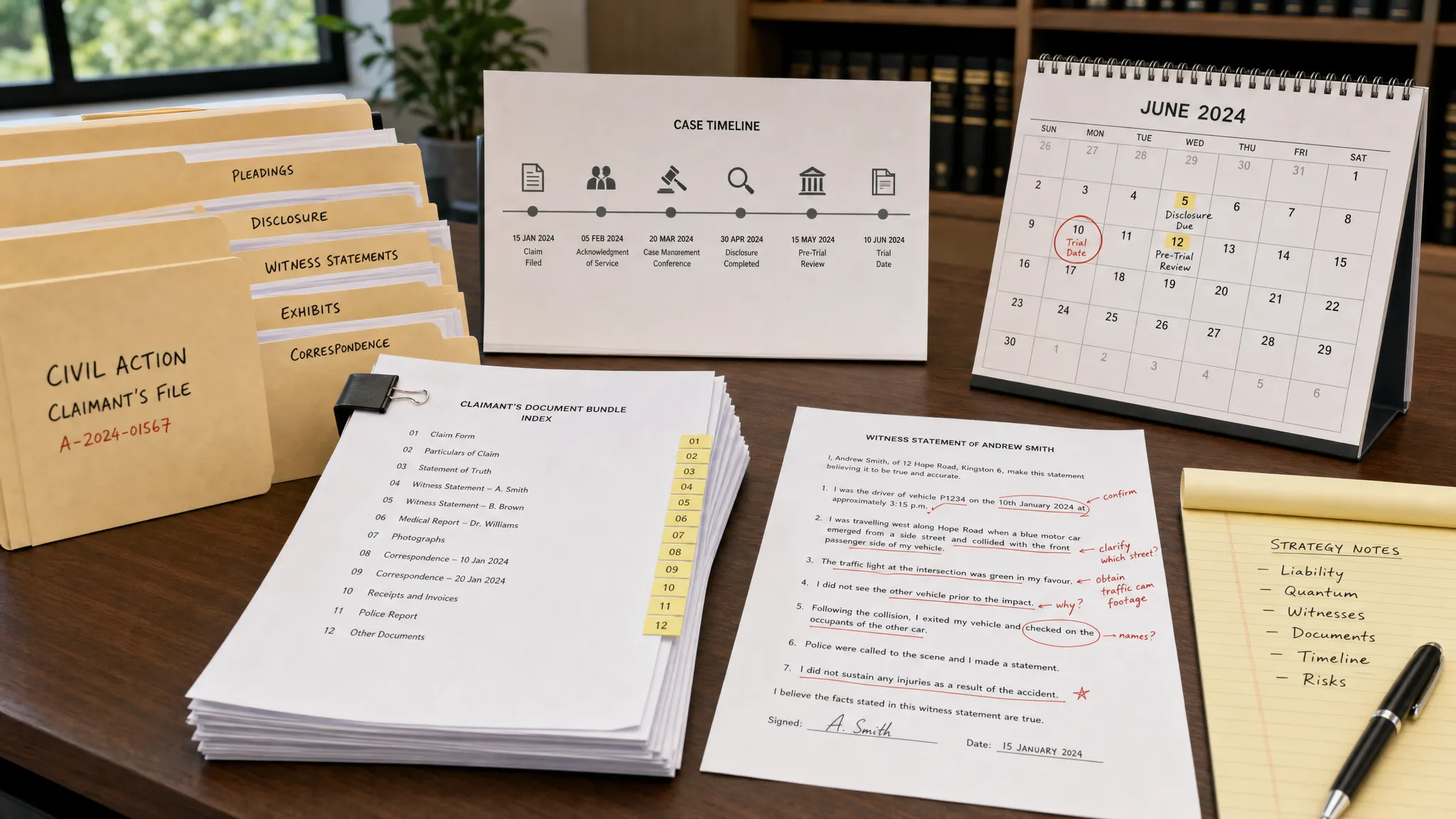
A strong civil case is rarely built at the courthouse door. It is built through early judgement, disciplined evidence-gathering, realistic risk assessment, and a clear understanding of what the client actually needs to achieve.
Whether the dispute involves a contract, debt, property, negligence, employment-related claim, shareholder disagreement, or commercial relationship, the same principle applies: strategy must come before action. Filing too quickly, responding emotionally, or ignoring procedural requirements can weaken even a claim with good facts.
This guide explains how to build a practical strategy for a civil case, with particular attention to clients and businesses operating in Jamaica. It is general information, not legal advice for any specific matter.
What makes a civil case strategy “strong”?
A strong civil case strategy connects four things: the law, the facts, the evidence, and the client’s objective. It does not simply ask, “Can we sue?” or “Can we defend?” It asks whether the chosen legal route is proportionate, enforceable, timely, and commercially sensible.
In civil litigation, the court determines private disputes between parties. The outcome may involve damages, declarations, injunctions, specific performance, recovery of property, costs orders, or other civil remedies. Unlike a criminal case, the dispute is usually driven by the parties, although the court manages the process and expects compliance with procedural rules.
A well-planned strategy should answer these core questions:
Strategic question | Why it matters |
What outcome do we need? | The remedy determines the claim, court, evidence, urgency, and settlement posture. |
What must be proven? | Every claim or defence has legal elements that must be supported by admissible evidence. |
What evidence exists? | Documents, witnesses, digital records, and expert evidence may decide the case. |
What are the risks? | Costs, delay, reputational impact, enforcement, and uncertainty must be weighed early. |
What is the best forum? | The proper court, tribunal, arbitration process, or mediation route can shape the result. |
The strongest approach is not always the most aggressive one. Sometimes the best strategy is urgent court action. Sometimes it is a focused demand letter, early mediation, or a carefully negotiated settlement that preserves business value.
Start with the objective, not the argument
Many disputes begin with frustration: a broken promise, unpaid money, defective performance, reputational harm, or a refusal to comply with an agreement. The first strategic task is to translate that frustration into a legally useful objective.
For example, a business may say it wants to “take the other side to court”. But the real objective may be to recover money quickly, stop misuse of confidential information, preserve a supply relationship, protect assets before they disappear, or set a precedent for future dealings.
This distinction matters because different objectives require different tools. A claim for damages may need proof of loss. An injunction may require urgency and evidence of likely harm. A debt recovery matter may turn on documents and enforcement prospects. A shareholder dispute may require both legal and commercial pressure points.
Before committing to litigation, ask:
What result would solve the problem in practical terms?
Is money enough, or is non-monetary relief required?
How urgent is the harm?
Is the opposing party able to satisfy a judgement or settlement?
Would publicity, delay, or disruption affect the value of the case?
A civil case strategy should be designed around the client’s best achievable outcome, not around proving a point at any cost.
Build a precise factual chronology
Facts are the foundation of any civil case. A lawyer cannot assess prospects properly if the facts are incomplete, disorganised, or filtered through assumptions. One of the most useful early exercises is to create a chronology that records what happened, when it happened, who was involved, and what documents support each event.
This chronology should be neutral at first. It should include helpful facts, harmful facts, uncertain facts, and gaps in the evidence. Weak facts are not to be hidden from your legal team. They must be identified early so they can be addressed, explained, or factored into settlement strategy.
A good chronology often reveals the real issues in dispute. It may show that the claim is not about whether an agreement existed, but about whether a condition was fulfilled. It may show that the key problem is not liability, but proof of loss. It may also reveal limitation concerns, missing documents, or witnesses who should be contacted before memories fade.

Preserve and organise evidence early
Evidence can disappear quickly. Emails are deleted, phones are replaced, staff leave, CCTV footage is overwritten, and informal messages become difficult to retrieve. A strong civil case strategy includes an immediate evidence preservation plan.
Relevant evidence may include contracts, invoices, receipts, letters, WhatsApp messages, emails, bank records, photographs, meeting notes, board minutes, delivery logs, policy documents, call records, or technical reports. In business disputes, accounting records and internal correspondence may be critical. In property or construction disputes, photographs, site records, valuations, and expert assessments may carry significant weight.
Do not alter, delete, backdate, or “improve” records. Doing so can damage credibility and may create serious legal consequences. Preserve the original record where possible, keep copies in a secure location, and record how and when key documents were obtained.
It is also important to separate privileged legal communications from ordinary business documents. If litigation is likely, clients should speak with counsel about how to protect confidential legal advice and manage document circulation within the organisation.
Test the claim or defence against the law
A persuasive story is not enough. A civil case must be matched to a recognised legal cause of action or defence. Each claim has elements that must be proven. Each defence must be properly pleaded and supported.
For instance, a breach of contract claim may require proof of the contract, the relevant term, breach, causation, and loss. A negligence claim may require proof of duty, breach, causation, and damage. A claim for misrepresentation may turn on what was said, whether it induced action, whether it was false, and what loss resulted.
A defence strategy must be just as structured. The defendant may deny the facts, challenge the legal basis of the claim, rely on limitation, raise set-off, argue that loss was not caused by the alleged breach, or contend that the claimant failed to mitigate loss.
This legal testing stage helps avoid three common mistakes: pleading too many weak claims, missing a strong defence, or focusing on moral unfairness rather than legally relevant proof.
Understand the procedural roadmap in Jamaica
Civil litigation in Jamaica is governed by procedural rules and court directions. The Supreme Court of Judicature of Jamaica and other courts operate within a framework that emphasises proper pleadings, case management, disclosure, witness evidence, and compliance with deadlines.
Procedure is not a technical afterthought. It is part of strategy. Missed deadlines, inadequate pleadings, late evidence, or failure to comply with court orders can harm a party’s position. In some cases, procedural missteps can lead to sanctions, adjournments, wasted costs, or even the loss of an opportunity to rely on evidence.
A typical civil case strategy should consider the following stages:
Stage | Strategic focus |
Pre-action assessment | Identify the claim, defence, limitation period, urgency, evidence, and settlement options. |
Letter before action or response | Clarify the dispute, preserve rights, test the other side’s position, and create a record. |
Filing and service | Ensure the correct parties, court, remedies, and procedural requirements are addressed. |
Statements of case | Plead the material facts clearly and avoid vague or unnecessary allegations. |
Case management | Use court directions to narrow issues, manage evidence, and control timing. |
Disclosure | Identify documents that help or hurt the case and comply with disclosure obligations. |
Witness statements | Present direct evidence clearly, consistently, and in admissible form. |
Expert evidence | Use experts only where specialised opinion is necessary and permitted. |
Trial preparation | Prepare bundles, submissions, cross-examination themes, and settlement reassessment. |
Enforcement | Consider from the outset whether any judgement can realistically be collected or implemented. |
The exact path will depend on the court, value, subject matter, urgency, and complexity of the dispute. Some matters may also be suitable for arbitration or mediation rather than a full trial. For more on the role of dispute counsel, see our guide on what litigation attorneys do and when to hire one.
Assess the other side, not just your own case
A civil case is dynamic. Your position may be strong, but the other side’s resources, incentives, and vulnerabilities will shape the strategy.
Consider whether the opposing party is likely to defend aggressively, settle early, delay, counterclaim, damage reputation, dissipate assets, or use the dispute as leverage in a broader commercial relationship. A defendant with limited assets may make a judgement less valuable. A claimant with weak documentation but strong commercial pressure may still create risk.
This does not mean strategy should be driven by fear. It means that litigation planning must account for real-world behaviour. Good strategy anticipates the opponent’s next move and prepares for it.
Calculate risk, cost, and proportionality
Civil litigation can be valuable, but it can also be costly and time-consuming. A strong strategy weighs legal merit against practical consequences. Clients should understand the likely phases of the case, possible applications, evidence costs, expert fees, court timelines, management time, and potential exposure to adverse costs.
A simple risk matrix can help decision-makers compare options:
Factor | Low risk indicator | Higher risk indicator |
Liability | Clear documents and admissions | Conflicting accounts or missing records |
Loss | Loss is documented and quantifiable | Loss depends on estimates or projections |
Witnesses | Available, credible, consistent witnesses | Unavailable or contradictory witnesses |
Procedure | Deadlines are clear and manageable | Limitation, service, or compliance issues exist |
Enforcement | Opponent has identifiable assets | Opponent may be insolvent or hard to enforce against |
Commercial impact | Dispute can be isolated | Dispute affects reputation, operations, or key relationships |
This type of assessment is especially important for companies. A lawsuit may be legally justified but commercially inefficient if it consumes leadership time, affects regulatory relationships, or distracts from core business. Conversely, a firm stance may be necessary where a dispute threatens cash flow, intellectual property, data, assets, or long-term contractual rights.
Treat settlement as strategy, not weakness
Settlement is not a sign that a civil case is weak. It is often a strategic tool for controlling risk. Courts generally encourage parties to narrow disputes and consider alternative dispute resolution where appropriate. Mediation, negotiation, and without prejudice discussions can help parties reach practical outcomes that a court may not be able to order.
The right settlement strategy depends on timing. Early settlement may preserve relationships and reduce costs. Later settlement may become more realistic after disclosure, witness statements, expert reports, or a key interim ruling. In some cases, a carefully timed offer can put pressure on the other side and protect costs arguments.
A good settlement plan should identify the best outcome, acceptable compromise, walk-away point, non-monetary terms, confidentiality requirements, payment security, and enforcement mechanism. The agreement should be drafted carefully so that it resolves the dispute fully and avoids future ambiguity.
Prepare for trial even if settlement is likely
Many civil cases settle, but the strongest settlement position often comes from being ready for trial. If the other side sees that your pleadings are coherent, your documents are organised, your witnesses are credible, and your legal theory is focused, your negotiating position improves.
Trial preparation should begin early. Counsel should identify the issues the judge must decide, the documents that prove each issue, the witnesses needed, and the weaknesses that must be handled honestly. Cross-examination themes should be developed from the evidence, not from speculation. Written submissions should connect the facts to the law in a concise and persuasive way.
Witness preparation is particularly important. Witnesses should understand the process, review their own statements and documents, and be ready to answer questions clearly. They should not be coached to give false or exaggerated evidence. Credibility is one of the most valuable assets in any civil case.
Avoid common mistakes that weaken a civil case
Even strong claims can be undermined by poor decisions before proceedings begin. The following mistakes are especially common:
Waiting too long to seek advice, especially where limitation periods or urgent relief may be relevant.
Sending emotional messages or public accusations that later become evidence.
Failing to preserve digital records, including emails and messaging app communications.
Assuming the court will accept a position without documents or witness proof.
Ignoring the cost, time, and enforcement realities of litigation.
Overlooking mediation or settlement options that could achieve a better practical result.
Choosing a lawyer based only on convenience rather than relevant civil litigation experience.
The earlier these risks are managed, the more options a party usually has.
When should you involve a civil litigation lawyer?
You should consider involving a civil litigation lawyer as soon as a dispute becomes serious, especially if you receive a formal demand, court document, threat of injunction, termination notice, regulatory concern, or claim involving significant money or reputation.
Early legal advice is not only about filing a claim. It can help you preserve evidence, avoid damaging communications, respond properly, assess limitation issues, select the right forum, and decide whether negotiation or mediation should be attempted first.
For businesses, early advice can also protect internal governance. Directors, managers, and employees may need guidance on communications, document retention, confidentiality, data protection, and authority to settle. In complex matters, the legal strategy should align with the organisation’s commercial, operational, and reputational priorities.
Frequently Asked Questions
What is the first step in building a civil case strategy? The first step is to define the practical objective. Once you know whether you need money, urgent relief, performance of an obligation, protection of property, or a negotiated resolution, your lawyer can assess the legal route, evidence, risks, and procedure.
How important is evidence in a civil case? Evidence is central. A party must prove the facts that support its claim or defence. Documents, witness statements, digital records, photographs, financial records, and expert reports may all be important, depending on the dispute.
Can a civil case be settled before trial? Yes. Many civil cases settle before trial through negotiation, mediation, or other resolution processes. Settlement should be approached strategically, with clear terms, proper documentation, and an understanding of the risks of continuing litigation.
Does a strong case always mean going to court? No. A strong case gives a party leverage, but the best outcome may still come through settlement, arbitration, mediation, or a carefully structured commercial agreement. The right approach depends on the facts, urgency, costs, and objectives.
Why does procedure matter in a civil case? Procedure affects timing, evidence, pleadings, disclosure, applications, and trial preparation. Failure to comply with court rules or directions can weaken a case and may lead to costs consequences or other sanctions.
Need a clear strategy for a civil dispute?
A civil case should not be approached as a series of isolated reactions. It requires a plan that connects legal rights with evidence, procedure, cost, risk, and the client’s real-world objectives.
Henlin Gibson Henlin provides client-focused legal services in Jamaica, including civil litigation, commercial litigation, appellate work, arbitration and mediation, banking litigation, compliance, data privacy, intellectual property, and related dispute support. If you are considering a claim, responding to proceedings, or trying to resolve a serious dispute, seek advice early so your options are protected from the start.