
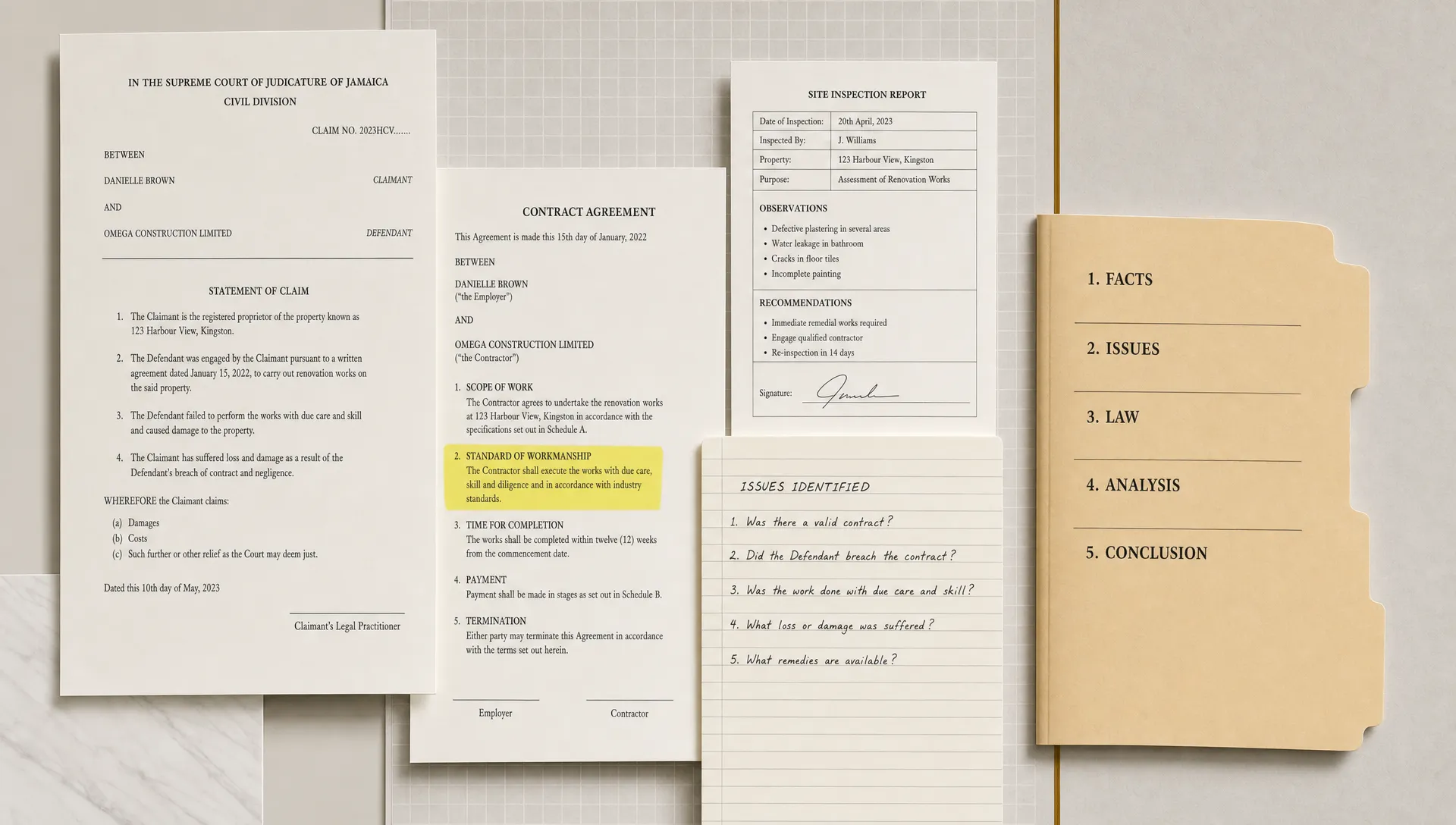
Choosing a lawyer is one of the most important decisions you make when a dispute, transaction, investigation, appeal, or compliance problem becomes serious. The right choice is not simply the lawyer with the strongest reputation, the nearest office, or the quickest appointment. You need a firm lawyer whose experience, judgment, resources, and communication style match the realities of your case.
A firm lawyer is not only an individual advocate. In a well-run law firm, that lawyer is supported by colleagues, research capacity, administrative systems, confidentiality processes, and strategic oversight. That matters because many legal problems are not solved by one clever letter or one court appearance. They often require evidence review, careful pleadings, negotiation, risk assessment, and disciplined follow-through.
This guide explains how to choose the right firm lawyer for your case, with a practical focus on clients in Jamaica and matters that may involve commercial disputes, civil litigation, appeals, intellectual property, data privacy, shipping, banking, compliance, arbitration, or mediation.
Start with the real legal problem, not the label
Many clients begin by saying they need a lawyer for a contract issue, a business dispute, a court matter, or an urgent problem. That is a useful starting point, but it may not be precise enough to choose the right lawyer.
For example, a disagreement over a loan facility may require banking litigation experience, not just general civil litigation. A dispute involving a former distributor may involve contract law, competition concerns, confidential information, and urgent injunctive relief. A data incident may raise privacy, compliance, regulatory, employment, and reputational questions at the same time.
Before choosing a firm lawyer, write down the issue in plain language:
What happened?
Who is involved?
What documents, contracts, correspondence, or court papers exist?
What deadline, hearing date, limitation period, or commercial pressure applies?
What outcome would actually solve the problem?
That last question is often overlooked. Winning in court may not always be the only useful outcome. Depending on the matter, the best result may be preserving a business relationship, stopping harmful conduct quickly, protecting confidential information, recovering money, avoiding regulatory exposure, or creating leverage for settlement.
Match the lawyer's experience to the case type
Legal experience should be relevant, not merely impressive. A lawyer may be excellent in one area but not the best fit for a highly technical dispute in another. Ask whether the firm lawyer has handled matters with similar legal issues, procedural demands, commercial pressure, or industry context.
The table below shows how to think about practice fit when comparing lawyers.
Your issue may involve | Legal capability to look for | Useful question to ask |
Business contract dispute | Commercial litigation and negotiation strategy | Have you handled disputes involving similar commercial relationships? |
Court claim or defence | Civil litigation and procedural experience | What are the first procedural risks we should assess? |
Appeal from a judgment | Appellate advocacy and issue selection | Which points are realistically appealable, and which are weak? |
Bank, borrower, or facility dispute | Banking litigation and financial document analysis | What documents will be central to liability and recovery? |
Data incident or privacy concern | Data privacy, compliance, and risk law | What immediate steps reduce legal and regulatory exposure? |
Brand, copyright, or confidential information issue | Intellectual property and enforcement strategy | What remedies are available, and how quickly can action be taken? |
Vessel, cargo, or maritime dispute | Admiralty and shipping expertise | What jurisdictional or timing issues could affect the claim? |
Dispute suitable for settlement | Arbitration, mediation, or negotiation experience | Is litigation the best forum, or is another route more effective? |
Do not be afraid to ask direct questions. A capable lawyer should be able to explain, without breaching confidentiality, how their background is relevant to your type of matter. They should not need to promise a result to demonstrate competence.
If you are comparing several firms rather than choosing from one shortlist, it may help to use a structured framework for comparing an attorney's law firm with confidence before narrowing your decision.
Verify standing, jurisdiction, and ethical fit
Professional standing matters. In Jamaica, attorneys are regulated within a professional framework, and clients should feel comfortable confirming that a lawyer is properly qualified and in good standing. The General Legal Council is a useful starting point for information about the regulation of the legal profession in Jamaica.
You should also confirm that the lawyer is appropriate for the forum in which your matter will be handled. A dispute in Jamaica may involve the Supreme Court, Parish Court, Court of Appeal, arbitration proceedings, a tribunal, a regulatory body, or negotiations before formal proceedings begin. Some matters may also have cross-border dimensions, especially where international contracts, shipping, foreign companies, intellectual property, or data issues are involved.
Ethical fit is just as important. The lawyer should check for conflicts of interest before accepting instructions. If there is a conflict, the lawyer may be unable to act, even if they have the right expertise. A serious firm will treat conflict checks, confidentiality, and client identity verification as part of professional discipline, not as administrative obstacles.
Look at the firm behind the lawyer
When you choose a firm lawyer, you are choosing both an individual and the professional environment that supports that individual. This is especially important in complex litigation, urgent applications, appeals, and commercial disputes where timing, research, document management, and strategic review can affect the outcome.
Ask who will actually work on the matter. Will a partner lead the strategy? Will associates assist with research, drafting, or evidence preparation? Who will attend court or negotiations? Who will be your day-to-day contact? There is nothing wrong with a team approach, provided responsibilities are clear and the work is properly supervised.
The strength of the firm can also matter when your case requires more than one area of knowledge. For instance, a shareholder dispute may involve commercial litigation, company law, injunctive relief, negotiation, and possibly regulatory considerations. A privacy-related business dispute may require both data protection awareness and litigation judgment. A maritime claim may require fast procedural decisions and technical familiarity with shipping practice.
This is why the question is not just whether a lawyer is bright or experienced. The better question is whether the lawyer and the firm can support the case from first assessment through strategy, execution, and resolution.
Assess strategic judgment, not just confidence
Some clients mistake confidence for strategy. A lawyer who immediately says the case is easy may sound reassuring, but early overconfidence can be a warning sign. Good legal strategy usually begins with careful questions, document review, and a realistic assessment of strengths, weaknesses, costs, evidence, timing, and enforcement.
A strong firm lawyer should be able to explain the path ahead in stages. They may not have all the answers in the first meeting, but they should know which issues need urgent attention and which facts must be confirmed before advice can be final.
For higher-value or complex matters, strategic leadership becomes even more important. Senior lawyers often help shape the theory of the case, identify the strongest issues, and avoid wasting resources on weak points. If that is relevant to your matter, consider how a law firm senior partner shapes case strategy in difficult disputes.
A practical strategy discussion should cover several points: the best possible outcome, the realistic outcome, the main risks, likely timelines, evidence gaps, costs, settlement possibilities, and what the other side may do next. If the lawyer can only speak in generalities, you may need a deeper consultation before committing.

Use the consultation to test communication
The first consultation is not only for the lawyer to assess your case. It is also your opportunity to assess the lawyer. Pay attention to how the conversation feels.
Does the lawyer listen carefully, or do they interrupt before understanding the facts? Do they ask for documents, dates, and names? Do they explain legal concepts clearly? Do they distinguish between what they know, what they need to verify, and what cannot yet be predicted? Do they tell you what the next step should be?
Good communication does not mean the lawyer tells you only what you want to hear. In fact, one sign of a serious lawyer is the willingness to identify weaknesses. If your case has evidential problems, limitation concerns, cost risks, or uncertain prospects, you need to know early.
You should also ask how communication will work after engagement. Some clients want frequent updates. Others prefer communication only when there is a material development. Either approach can work, but expectations should be clear. Misunderstandings about updates, response times, and decision-making authority can damage the lawyer-client relationship even when the legal work is strong.
For a more detailed interview checklist, you may find it useful to review these questions to ask before selecting a law firm.
Understand fees before work begins
Fees should be discussed early and clearly. A client should know how the firm charges, what work is included, what may cause costs to increase, and whether disbursements or third-party expenses may arise. Depending on the matter, costs may include filing fees, process servers, expert reports, transcript costs, travel, or other case-related expenses.
The engagement letter or retainer agreement is important. It should usually identify the client, the scope of work, fee structure, billing arrangements, and any important limitations. Read it carefully. If you do not understand a clause, ask for an explanation before signing.
Be cautious with any lawyer who avoids fee discussions, gives vague assurances, or refuses to define the scope of work. Legal matters can evolve, and no lawyer can always predict total cost with precision at the beginning. Still, a professional firm should be able to explain the basis of billing and the factors that may affect cost.
Also remember that the cheapest lawyer is not always the most economical choice. Poor strategy, missed deadlines, weak drafting, or lack of relevant experience can become far more expensive than a properly managed matter from the outset.
Consider urgency and capacity
Some legal problems allow time for careful comparison. Others require immediate action. Urgent injunctions, freezing concerns, vessel or cargo issues, court deadlines, regulatory notices, and data incidents may demand quick assessment.
If your matter is urgent, ask whether the lawyer has capacity to act within the required timeframe. A respected lawyer who cannot attend to the matter promptly may not be the right fit for that case. Capacity is not only about willingness. It is about having the time, team, and systems to respond properly.
Urgency should not lead you to ignore quality. Even when time is short, you can still ask focused questions: What must be done today? What documents are needed immediately? What deadline controls the next step? What risk arises if action is delayed? What are the options if full information is not yet available?
Watch for red flags
Choosing the wrong lawyer can harm your position, waste money, and create unnecessary stress. Some warning signs are obvious. Others are subtle.
Be careful if a lawyer:
Guarantees a specific outcome before reviewing the facts and documents
Pressures you to sign immediately without explaining the scope of work
Avoids questions about fees, conflicts, or who will handle the matter
Speaks dismissively about deadlines, evidence, or procedural requirements
Cannot explain their relevant experience in a way that connects to your case
Encourages you to hide facts, destroy documents, or mislead another party
Communicates in a way that leaves you more confused after every meeting
A lawyer does not need to be perfect in style to be effective. Some excellent lawyers are direct, careful, or conservative in how they speak. The real concern is not personality. It is whether the lawyer demonstrates competence, integrity, clarity, and disciplined judgment.
Balance local knowledge with broader capability
For legal matters in Jamaica, local knowledge is valuable. Procedure, court practice, professional relationships, commercial realities, and regulatory context can all influence how a case should be handled. A lawyer who understands the local environment may be better able to anticipate practical issues that are not obvious from the documents alone.
At the same time, some matters require broader capability. International contracts, foreign parties, shipping disputes, intellectual property issues, banking claims, and data privacy concerns may require a lawyer who can think beyond a narrow local dispute. The right firm lawyer should understand both the legal forum and the commercial context.
This balance is especially important for businesses, financial institutions, international clients, and individuals whose matters have reputational or cross-border consequences. You want a lawyer who can act locally with precision while understanding how the matter fits into a wider legal and business picture.
Make your final decision with a simple scorecard
After consultations, it can be difficult to compare lawyers objectively. A simple scorecard can help you avoid choosing based only on personality, urgency, or price.
Decision factor | What a strong fit looks like | Your assessment |
Relevant experience | The lawyer has handled similar issues or procedures | Strong, moderate, or weak |
Strategy | The lawyer identifies options, risks, and next steps | Strong, moderate, or weak |
Communication | Advice is clear, direct, and practical | Strong, moderate, or weak |
Firm support | The lawyer has appropriate team and resources | Strong, moderate, or weak |
Fees | Billing structure and scope are explained clearly | Strong, moderate, or weak |
Trust | You are comfortable sharing full and honest instructions | Strong, moderate, or weak |
Trust is not a soft factor. Your lawyer can only advise properly if you are willing to disclose the full story, including facts that may be unfavourable. If you feel unable to be candid, or if the lawyer seems uninterested in difficult facts, the relationship may not be right.
The best choice is usually the lawyer who combines relevant experience, careful strategy, ethical discipline, clear communication, and the capacity to move your matter forward.
Frequently Asked Questions
What is a firm lawyer? A firm lawyer is an attorney who practises within a law firm and is supported by the firm's systems, colleagues, research capacity, and professional processes. In many cases, you benefit from both the individual lawyer's judgment and the wider firm's resources.
Should I choose a lawyer or a law firm first? Choose both together. The individual lawyer's experience and communication style matter, but the firm's practice areas, capacity, supervision, and support can be equally important, especially in complex or urgent matters.
How do I know if a lawyer has the right experience? Ask about similar legal issues, procedures, industries, documents, and forums. The lawyer should be able to explain how their experience connects to your matter without guaranteeing an outcome or disclosing confidential information about other clients.
Is the most expensive lawyer always the best choice? No. Cost should be weighed against experience, strategy, responsiveness, and the complexity of the matter. The goal is not to find the highest or lowest fee, but to find value, clarity, and competence for your specific case.
What should I bring to the first consultation? Bring court documents, contracts, letters, emails, notices, timelines, identification, and any records connected to the dispute or transaction. A short written summary of the facts and your desired outcome can also make the meeting more productive.
Speak with a firm lawyer who fits the matter
The right legal representation can change how confidently you respond to a dispute, manage risk, or pursue a remedy. If your matter involves commercial litigation, data privacy, compliance and risk, intellectual property, admiralty and shipping, appellate work, arbitration, banking litigation, or civil litigation, choosing carefully is essential.
Henlin Gibson Henlin is a leading international law firm in Jamaica with a client-focused approach and experience across a wide range of practice areas. If you need tailored legal guidance, start by identifying your issue, gathering your documents, and speaking with a lawyer whose experience matches the case you need to solve.