
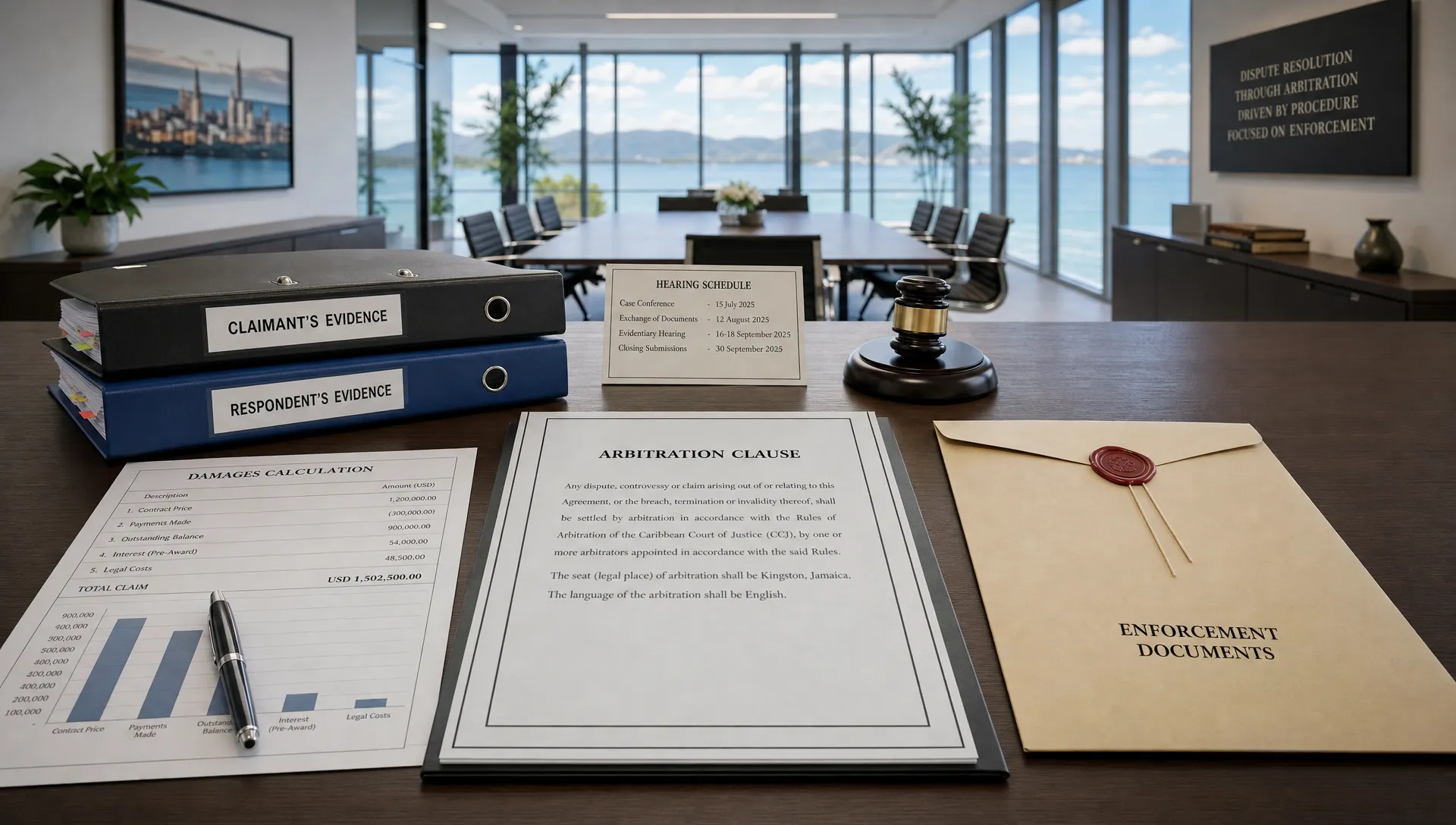
High-value arbitration is not simply a private version of court litigation. It is a strategic process where early choices about forum, evidence, experts, procedure, and enforcement can materially affect the outcome. In commercial disputes involving major contracts, shareholders, infrastructure, banking, intellectual property, admiralty & shipping, or cross-border transactions, preparation should begin before a notice of arbitration is filed or answered.
The goal is not only to “win the hearing.” The goal is to protect the client’s commercial position, reduce procedural surprises, preserve leverage, and ensure that any award can be recognised and enforced where the opposing party’s assets are located.
If your organisation is still deciding whether arbitration is the right route, it may be useful to first review how to compare arbitration and litigation for Jamaican commercial disputes. Once arbitration is chosen or required by contract, the preparation must become focused, disciplined, and evidence-led.
Start with a clear strategic assessment
Before drafting a notice of arbitration or response, the legal team should conduct an early case assessment. This is the stage where counsel, senior decision-makers, and commercial stakeholders identify what the dispute is really about, what is at stake, and what outcome would be commercially acceptable.
In a high-value dispute, the legal answer is only one part of the strategy. A technically strong claim may still be unattractive if enforcement is difficult, evidence is weak, the counterparty is insolvent, or the process threatens an important commercial relationship. Equally, a claim that looks complex at first may become more manageable once the contractual issues, documentary record, and damages model are properly organised.
A strong early assessment should address:
The legal basis of the claim or defence
The contract terms governing arbitration, liability, remedies, and limitation periods
The amount claimed and how it will be proved
The jurisdictions where enforcement may be needed
The business risks of delay, publicity, cost, and disruption
The possibility of settlement, mediation, or commercial restructuring
This exercise should produce more than a general opinion. It should create a decision framework for the arbitration, including the procedural posture, budget, risk range, and negotiation strategy.
Read the arbitration clause before taking any major step
The arbitration agreement is the foundation of the process. In high-value disputes, even small wording differences can affect jurisdiction, tribunal composition, timelines, confidentiality, interim relief, and enforceability.
Counsel should review the clause carefully before issuing correspondence that might affect the client’s position. A premature claim letter, poorly framed notice, or inconsistent court filing can create unnecessary jurisdictional arguments.
Key provisions to examine include:
Clause issue | Why it matters | Preparation question |
Seat of arbitration | Determines the procedural law and supervisory court | Which court can intervene if procedural issues arise? |
Governing law | Determines the substantive law of the contract | Which legal principles decide liability and remedies? |
Rules or institution | Shapes procedure, appointment, fees, and timelines | Is this ICC, LCIA, UNCITRAL, ad hoc, or another framework? |
Number of arbitrators | Affects cost, speed, expertise, and decision-making | Is a sole arbitrator suitable, or is a three-member tribunal required? |
Scope of disputes | Defines what can be arbitrated | Does the clause cover tort, statutory, shareholder, or related party claims? |
Confidentiality | May not be automatic in every respect | What information must be protected from disclosure? |
Interim measures | Determines urgent relief options | Can assets, evidence, or contractual rights be protected early? |
Jamaica’s modern arbitration framework sits within a wider international arbitration environment influenced by instruments such as the UNCITRAL Model Law on International Commercial Arbitration. For cross-border matters, the enforceability of an award under the New York Convention may also be central to the strategy.
Preserve evidence immediately
Evidence preservation is one of the most important early tasks in any high-value arbitration. Once a dispute is likely, parties should avoid routine deletion, careless messaging, or informal document handling that could undermine their credibility.
A legal hold should be issued where appropriate. Relevant contracts, amendments, board papers, emails, payment records, project documents, shipping documents, financial statements, WhatsApp messages, technical reports, and internal approvals may all become important. In commercial disputes, the decisive document is often not the signed contract alone, but the paper trail showing how the parties performed, varied, complained, accepted, or waived obligations over time.
The client team should also identify who controlled the relevant information. In a large organisation, key evidence may sit across finance, operations, compliance, procurement, management, and external advisers. The sooner that information map is created, the less likely the case will be weakened by missing documents or inconsistent accounts.
Preservation must also be practical. Not every document is equally important. A disciplined evidence review separates material evidence from background noise, helping the arbitration team focus on what will actually prove liability, causation, loss, or a defence.
Build the right arbitration team
High-value arbitration requires coordinated roles. The team may include lead counsel, junior counsel, client representatives, industry experts, forensic accountants, technical specialists, e-discovery support, and witnesses of fact. The more complex the dispute, the more important it becomes to define responsibility early.
The client should appoint an internal decision-maker with authority to give instructions, approve strategy, and coordinate documents. Without a clear point of contact, even strong cases can lose momentum through delays, inconsistent instructions, or fragmented communication.
The legal team should also assess whether specialist expertise is needed. For example, a damages expert may be essential in a lost profits claim, while a technical expert may be needed in a construction, shipping, engineering, data, or intellectual property dispute. In high-risk matters, the value of experienced counsel is not limited to advocacy at the hearing. It includes early judgement about forum, procedure, evidence, and settlement leverage. That is why organisations often seek guidance on how expert legal counsel shapes high-risk cases before the dispute escalates.
Develop a case theory, not just a document bundle
A high-value arbitration should be built around a coherent case theory. This is the disciplined explanation of what happened, why the law supports the client’s position, how the evidence proves it, and what remedy should follow.
A good case theory is simple enough for the tribunal to understand, but strong enough to withstand technical challenge. It should answer four questions:
What promise, duty, or legal right was breached?
What facts prove the breach or defence?
What loss or remedy flows from those facts?
Why should the tribunal prefer this account over the other side’s account?
This framework helps the team avoid a common mistake: producing a large volume of documents without a persuasive narrative. Arbitrators must decide issues, not admire archive management. Every pleading, witness statement, expert report, and oral submission should connect back to the issues the tribunal must determine.

Quantify damages early and carefully
In many high-value disputes, liability receives most of the attention while damages are left too late. That is a mistake. A party may prove breach but recover far less than expected if it cannot prove causation, mitigation, or quantum with precision.
Damages preparation should begin near the start of the arbitration. Counsel and experts should identify the correct measure of loss, the assumptions supporting the calculation, and the documents needed to prove it. These may include audited accounts, management reports, invoices, forecasts, market data, loan documents, valuation evidence, or operational records.
The damages model should be tested against likely attacks. The opposing party may argue that losses were caused by market conditions, poor management, third-party conduct, regulatory changes, or failure to mitigate. If those arguments are predictable, the claimant should prepare answers early. A respondent should likewise develop its own damages critique rather than waiting for expert evidence to expose weaknesses.
For settlement purposes, damages analysis should also include a realistic recovery range. A headline claim may be useful for negotiation, but decision-makers need a risk-adjusted view of likely recovery after costs, delay, enforcement risk, and counterclaims.
Choose the tribunal with care
Tribunal selection is one of the most consequential decisions in arbitration. In court litigation, parties do not choose the judge. In arbitration, the parties often have some role in selecting the arbitrator or tribunal, depending on the clause and applicable rules.
The best arbitrator for a high-value dispute is not always the most famous name. Counsel should consider expertise, availability, independence, case management style, language, industry knowledge, and experience with the applicable law or seat. An arbitrator who cannot give the matter sufficient time may delay the process. An arbitrator with the wrong background may struggle with technical evidence or complex commercial context.
Conflicts checks are also essential. A challenge to an arbitrator can disrupt the timetable, increase costs, and damage confidence in the process. Parties should conduct reasonable due diligence before appointment and remain alert to disclosure obligations throughout the case.
Prepare seriously for the first procedural conference
The first procedural conference often sets the tone for the arbitration. It may address pleadings, document production, witness statements, expert reports, confidentiality, hearing dates, interim applications, and the format of the final hearing.
This is not a routine scheduling meeting. In a high-value dispute, the procedural timetable can shape settlement leverage, cost exposure, and the ability to prepare properly. A party that arrives unprepared may agree to deadlines that are unrealistic or fail to request procedural safeguards that later become important.
Before the conference, counsel should have a position on:
Whether preliminary issues should be heard first
Whether document production should follow IBA-style categories or a narrower approach
Whether confidentiality orders are needed
Whether expert evidence should be sequential or concurrent
Whether witness statements should be exchanged in one round or multiple rounds
Whether interim measures or security should be sought
Whether a virtual, hybrid, or in-person hearing is appropriate
The procedural order should support the case strategy, not merely mirror a standard template.
Manage document production strategically
Document production in arbitration is usually more limited than discovery in some court systems, but it can still be decisive. Requests should be targeted, relevant, and proportionate. Overbroad requests can irritate the tribunal and invite equally burdensome counter-requests.
A strong document request identifies a specific category of documents, explains relevance, and connects the request to issues in dispute. For example, in a banking dispute, internal credit approval documents may be relevant to knowledge or reliance. In a shipping dispute, logs, bills of lading, inspection records, and correspondence may be central to causation or breach.
Parties should also prepare for objections based on privilege, confidentiality, burden, or lack of relevance. Privilege review must be handled carefully, especially where multiple jurisdictions, in-house counsel, external advisers, and affiliated companies are involved.
Good document management also affects witness preparation. Witnesses should not be asked to rely on memory alone when contemporaneous documents tell the story more accurately. A witness statement that conflicts with documents can weaken the entire case.
Prepare witnesses and experts without over-coaching
Witness preparation is not about scripting evidence. It is about helping witnesses understand the process, review relevant documents, and give accurate, clear, and honest evidence.
Fact witnesses should be selected because they can assist the tribunal on material issues. Seniority alone is not enough. The best witness may be the person who negotiated the contract, managed performance, approved payments, raised complaints, or handled the disputed transaction.
Counsel should test witness accounts against the documentary record. If a witness has a weak recollection or there are damaging documents, those issues should be confronted early. Surprises at the hearing are rarely helpful.
Expert witnesses require a different approach. Their role is to assist the tribunal within their expertise, not to act as advocates. Experts should receive clear instructions, a reliable factual record, and sufficient time to prepare. Their assumptions should be transparent, and their opinions should be robust enough to withstand cross-examination.
Consider interim measures, security, and enforcement from the outset
In a high-value dispute, winning an award is not enough if the award cannot be enforced. The enforcement strategy should begin early, especially where the counterparty’s assets are outside Jamaica, are mobile, or may be dissipated.
Counsel should consider whether interim measures are needed to preserve assets, protect evidence, maintain contractual rights, or prevent harmful conduct while the arbitration proceeds. Depending on the seat, rules, and circumstances, interim relief may come from the tribunal, an emergency arbitrator, or a court with supportive jurisdiction.
Security for costs or security for the claim may also be relevant in appropriate cases. These applications require careful preparation because tribunals are cautious about measures that may affect a party’s access to justice or the balance between the parties.
Enforcement planning should identify where the opposing party has assets, whether those assets are reachable, and whether local enforcement risks exist. This analysis may influence settlement strategy, timing, and the form of relief requested.
Keep settlement strategy alive
Preparing aggressively for arbitration does not mean ignoring settlement. In fact, the best settlement outcomes often come from strong preparation. When the opposing party sees that the evidence is organised, damages are credible, and the tribunal strategy is serious, the negotiation dynamics may change.
Settlement discussions can occur before arbitration, during procedural phases, after document production, following expert reports, or even during the hearing. Mediation may also be useful where the parties need a commercial solution that a tribunal cannot order, such as revised contract terms, payment restructuring, future supply arrangements, confidentiality protections, or ongoing business cooperation.
For organisations considering a broader range of dispute resolution tools, Henlin Gibson Henlin has also discussed practical dispute resolution strategies legal teams use, including negotiation, mediation, and procedural planning.
Common mistakes to avoid in high-value arbitration
High-value arbitration can be unforgiving. The following mistakes often create avoidable risk:
Mistake | Potential consequence | Better approach |
Waiting too long to preserve evidence | Missing documents or adverse credibility issues | Issue legal holds and map evidence early |
Treating damages as an afterthought | Reduced recovery or weak settlement leverage | Build the quantum case from the start |
Choosing an arbitrator based only on reputation | Delay, cost, or mismatch with the dispute | Assess expertise, availability, independence, and case management style |
Overloading the tribunal with documents | Confusion and loss of focus | Build a clear case theory tied to specific issues |
Ignoring enforcement until the award | Difficulty collecting after success | Identify asset locations and enforcement routes early |
Failing to coordinate internal stakeholders | Slow instructions and inconsistent evidence | Appoint a responsible decision-maker and communication protocol |
Avoiding these mistakes is often as important as making the right legal arguments.
Frequently Asked Questions
When should a party start preparing for arbitration? Preparation should begin as soon as a serious dispute is likely, not only after a notice of arbitration is filed. Early preparation helps preserve evidence, assess risk, protect limitation positions, and shape strategy.
What makes a high-value arbitration different from an ordinary commercial dispute? High-value arbitration usually involves larger financial exposure, more complex evidence, expert testimony, cross-border enforcement issues, reputational risk, and greater procedural cost. These factors require more disciplined planning.
Is arbitration always confidential? Not necessarily. Confidentiality depends on the arbitration agreement, applicable rules, governing law, procedural orders, and any court-related steps. Parties should address confidentiality expressly where it matters.
How important is the choice of arbitrator? It is critical. The tribunal’s expertise, independence, availability, and approach to procedure can significantly affect the efficiency, fairness, and persuasiveness of the process.
Can parties settle during arbitration? Yes. Settlement can occur at any stage. Strong arbitration preparation often improves settlement leverage because both sides better understand the evidence, risk, and likely range of outcomes.
Preparing for a high-value arbitration in Jamaica?
High-value arbitration rewards early preparation, clear strategy, and careful execution. The strongest cases are built before the hearing through evidence preservation, procedural planning, credible damages analysis, effective tribunal selection, and enforcement-focused thinking.
Henlin Gibson Henlin provides client-focused legal services in Jamaica across arbitration & mediation, commercial litigation, banking litigation, intellectual property, compliance, and other complex dispute areas. If your organisation is facing a significant arbitration or evaluating dispute resolution options, seek legal advice early so that your strategy is shaped before critical decisions are made.
This article is for general information only and should not be treated as legal advice for any specific dispute.