
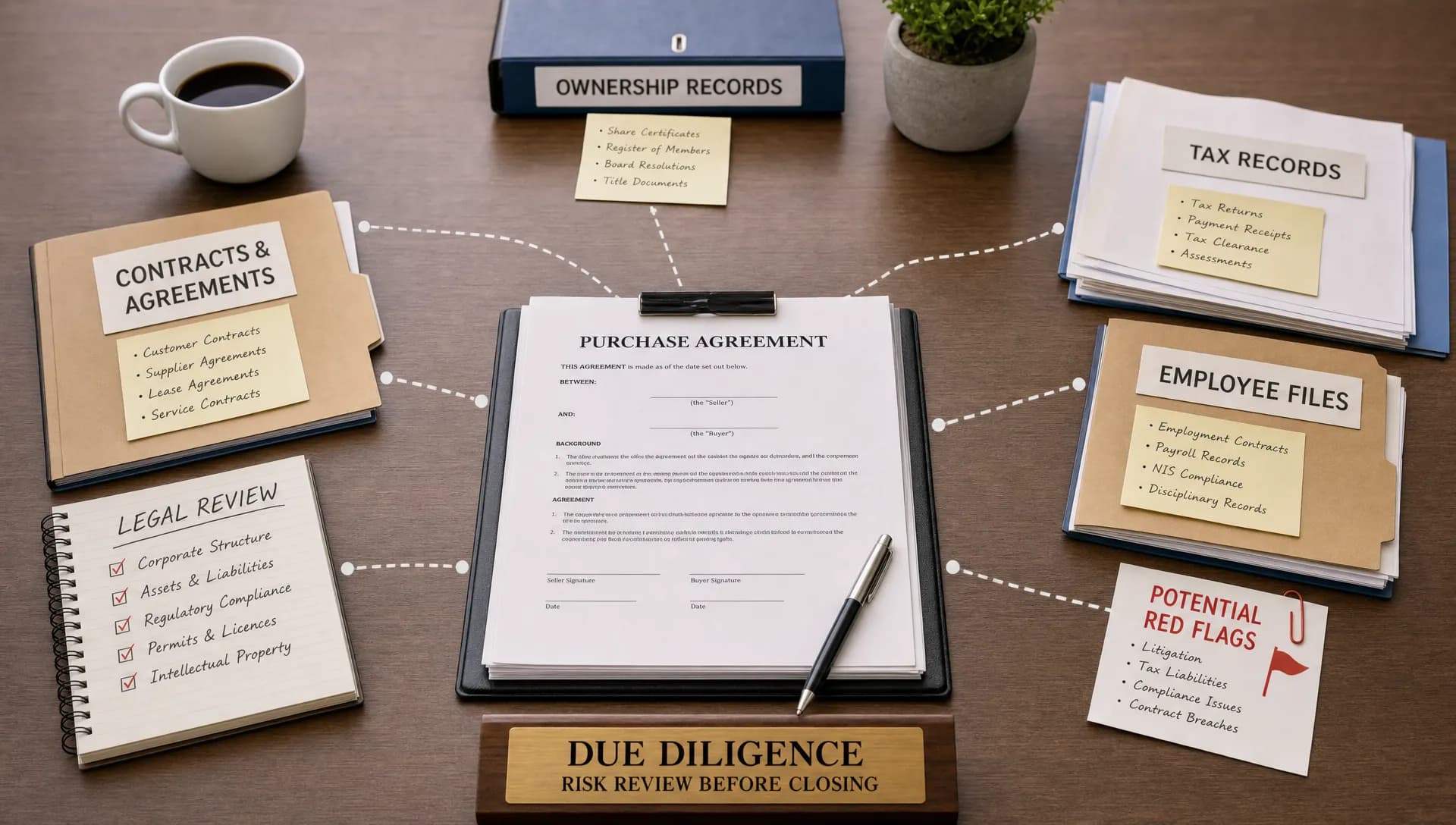
Buying an existing Jamaican business can be faster than building from scratch. You may get customers, staff, supplier relationships, licences, premises and goodwill on day one. You may also inherit tax arrears, employment disputes, weak contracts, data protection gaps or a brand the seller does not fully own.
Legal due diligence before buying a Jamaican business is the process of testing the legal facts behind the deal. It helps a buyer answer three practical questions: what am I buying, what liabilities come with it and what protections should be written into the purchase documents?
It is not a formality to be rushed after the price is agreed. Done early, due diligence can change the structure of the transaction, the purchase price, the conditions to completion and the seller's continuing obligations after closing.
Why legal due diligence matters before you sign
A business may look profitable from management accounts or customer lists, but legal risk often sits outside the numbers. A key contract may terminate if ownership changes. A lease may not be assignable without landlord consent. A founder may have built valuable software without properly assigning intellectual property to the company. A data-rich business may have collected customer information without the governance now expected under Jamaica's Data Protection Act.
The real value of due diligence is not only finding problems. It is deciding which problems are tolerable, which must be fixed before completion and which should be covered by indemnities, price adjustments or walk-away rights.
For Jamaican businesses, buyers should also factor in local filing practices, statutory deductions, sector licences, parish or municipal requirements, employment obligations and litigation culture. If the seller is part of a family group or closely held company, related-party arrangements can be especially important because key assets or customer relationships may sit outside the entity being sold.
Begin with the acquisition structure
The first legal question is whether you are buying shares, assets or some form of business interest. The answer affects almost every diligence workstream.
Deal structure | What the buyer usually acquires | Main legal diligence focus |
Share purchase | Ownership of the company that operates the business | Corporate records, hidden liabilities, tax history, employment obligations, contracts and litigation |
Asset purchase | Selected assets such as stock, equipment, contracts, IP or goodwill | Title to each asset, transfer documents, consent to assign contracts, employee transfer issues and tax treatment |
Partnership or joint venture interest | An interest in an existing business relationship or a new combined venture | Authority, profit sharing, governance, exit rights, deadlock mechanisms and partner liabilities |
A share purchase is often simpler operationally because the company remains the same contracting party. That does not make it lower risk. The buyer takes the company with its history unless the agreement shifts specific liabilities back to the seller.
An asset purchase can be more selective, but each asset and contract must actually be transferable. Consent requirements can slow down completion, especially where banks, landlords, government bodies or major customers are involved.
If you are still deciding what vehicle fits your investment plan, Henlin Gibson Henlin's guide to corporate structures for doing business in Jamaica is a useful starting point.
Check corporate authority and ownership
Corporate diligence confirms that the seller has the legal power to sell and that the target business is properly constituted. For companies, searches and filings at the Companies Office of Jamaica can help verify incorporation details, directors, registered office information and certain filings. The buyer should not rely only on a certificate or a seller's verbal assurance.
Corporate diligence should verify:
The target's incorporation documents, annual filings and good standing position
The current shareholders, directors and authorised signatories
Board and shareholder approvals needed for the sale
Any registered charges, debentures, liens or security interests affecting shares or assets
Restrictions in articles, shareholder agreements or financing documents that could block the transaction
For closely held businesses, the beneficial owner and decision-maker may not be the same person. A buyer should confirm who can bind the company, who must sign the agreement and whether any spouse, estate, trust, lender or minority shareholder has rights that could disrupt the deal.
Review tax, statutory deductions and regulatory status
Tax diligence is central to acquisitions in Jamaica because historic tax liabilities can become an unexpected cost after completion. A Tax Compliance Certificate may be useful evidence of current compliance, but it should not replace a deeper review of filings, assessments, payment history and correspondence with Tax Administration Jamaica.
The review should cover income tax, General Consumption Tax, payroll deductions, National Insurance Scheme contributions, National Housing Trust obligations, HEART/NSTA related obligations where applicable, customs duties and any sector-specific levies. Buyers should also ask whether the business has benefited from incentives, concessions or exemptions that may be lost or clawed back on a change in ownership.
Regulatory status depends on the industry. Financial services, insurance, telecommunications, security services, gaming, cannabis, food services, health care, transport, shipping and tourism can involve special licences or approvals. A licence that is personal to the seller may not automatically transfer to the buyer. Where regulatory approval is needed, it should be treated as a condition to completion, not an afterthought.
Test the contracts that make the business valuable
A business is often worth what its contracts allow it to earn. Customer agreements, supplier contracts, leases, distribution arrangements, franchise documents, financing agreements and service contracts should be reviewed for both value and risk.
The most important clauses are often the ordinary-looking ones: termination rights, assignment restrictions, change-of-control provisions, exclusivity, price variation, service levels, renewal, penalties, governing law, dispute resolution and limitations of liability. In cross-border contracts, currency, tax withholding, delivery risk and foreign dispute forums also deserve attention.
A buyer should identify which contracts are essential to revenue. If one customer accounts for a large share of sales and can terminate on short notice, the purchase price should reflect that risk. If a supplier arrangement is informal or based on personal relationships with the seller, the buyer may need a transition services agreement or a seller introduction process after completion.
Search for litigation, claims and dispute patterns
Litigation diligence is broader than checking whether a lawsuit has been filed. Many commercial disputes begin with demand letters, unpaid invoices, complaints, insurance notices, threatened injunctions or regulatory correspondence. The target's management may consider these routine, but a buyer needs to know whether they point to a recurring problem.
Court searches, debt collection records, board minutes, legal correspondence and settlement agreements can reveal disputes that do not appear in the financial accounts. Buyers should also review whether the business is in breach of consent orders, payment plans or settlement terms.
The nature of the claims matters as much as the amount. A single disputed invoice may be manageable. Repeated customer complaints, shareholder disagreements, employment claims or supplier failures may suggest deeper governance or operational issues. Henlin Gibson Henlin's article on commercial litigation risks Jamaican businesses should watch can help buyers recognise patterns that deserve closer review.
Examine employment and management issues
Employment diligence should cover written contracts, job descriptions, compensation, benefits, leave entitlements, disciplinary matters, redundancy exposure, pensions, work permits and collective arrangements if a union is involved. The buyer should also distinguish true independent contractors from workers who may be treated as employees in substance.
In a share purchase, employees usually remain employed by the same company. In an asset purchase, the buyer should take advice on whether employees will be offered new contracts, whether continuity of employment issues arise and how accrued benefits or termination exposure will be handled.
Management stability is also part of legal risk. If the business depends heavily on one founder, sales director or technical employee, the buyer may need non-solicitation obligations, confidentiality terms or retention arrangements. Those provisions must be carefully drafted so they are commercially useful and legally defensible.
Confirm title to premises, equipment and operating assets
If the business owns land, a title search should confirm ownership, mortgages, caveats, restrictive covenants and other encumbrances. Property tax, planning issues and approvals for the current use should also be checked. If the business occupies leased premises, the lease should be reviewed for term, renewal rights, rent escalation, repair obligations, arrears, security deposits and assignment consent.
Movable assets also need attention. Vehicles, machinery, stock, vessels, IT equipment and specialised tools may be financed, leased or subject to retention of title arrangements. Asset registers should be compared against what is physically present and what is included in the sale agreement.

Protect intellectual property, data and confidential information
Intellectual property can be one of the least visible parts of the deal. A buyer should confirm ownership of trade marks, business names, logos, domain names, copyright material, software, recipes, product designs, marketing content, customer databases and confidential know-how. Searches at the Jamaica Intellectual Property Office can assist with registered rights, but unregistered rights and contractual ownership still require document review.
Particular care is needed where founders, consultants, agencies or developers created branding, software or content for the business. Payment for work does not always mean the company owns all rights. Written assignments, licence terms and contractor agreements should be checked before value is attributed to the IP.
Data protection is now a major due diligence category. Buyers should assess what personal data the business collects, why it collects it, how long it keeps it, where it is stored, who can access it and whether third-party processors are used. Jamaica's Office of the Information Commissioner provides guidance on the Data Protection Act framework, and buyers should review privacy notices, consent practices, breach records, security policies and cross-border data arrangements.
A business with strong customer data but weak compliance may need remediation costs built into the deal. In some cases, the buyer may require specific warranties about data protection compliance and an indemnity for pre-completion breaches.
Look for industry-specific red flags
Every sector has its own diligence questions. A restaurant acquisition may require checks on public health approvals, liquor licences, lease restrictions and employment scheduling. A security company may raise licensing, firearm, insurance and employee vetting issues. A fintech, microfinance or payments business may need financial services regulatory review.
For import, export, logistics or marine businesses, admiralty and shipping issues can be material. Buyers may need to review vessel ownership, charterparties, bills of lading practices, port arrangements, customs compliance, maritime insurance and possible liens. If the business operates in a regulated supply chain, one missing approval can affect both revenue and completion timing.
Competition and consumer issues should not be overlooked. An acquisition that changes market concentration, locks in distributors or includes restrictive arrangements may raise competition law questions. Consumer-facing businesses should also be checked for refund practices, warranty promises, advertising claims and complaints handling.
Common red flags in a Jamaican business acquisition
Not every red flag kills a deal. Some reduce price, some require a pre-closing fix and some need a carefully drafted indemnity. The key is to avoid discovering them after completion.
Red flag | Why it matters | Possible deal response |
Missing corporate filings or unclear ownership | The seller may lack authority or clean title | Require filings, resolutions and ownership evidence before signing or completion |
Tax arrears or unresolved assessments | Historic liabilities may follow the company | Adjust price, require payment before closing or include a tax indemnity |
Key contracts require consent to assign | Revenue may not transfer as expected | Make consent a condition to completion |
Lease cannot be assigned | The buyer may lose the operating location | Negotiate landlord consent or a new lease before closing |
IP created by contractors without assignment | The company may not own what it uses | Obtain assignments or reduce value attributed to IP |
Employee misclassification or accrued benefits | Labour claims may arise after closing | Quantify exposure and allocate responsibility in the agreement |
Data protection gaps | Remediation and breach risk can be costly | Require compliance steps, warranties and specific indemnities |
Undisclosed litigation or demand letters | The business may be facing hidden claims | Conduct further searches and negotiate claim-specific protections |
Non-transferable licence | Operations may pause after completion | Treat regulatory approval as a condition precedent |
Turn due diligence findings into deal protections
A due diligence report should not be a catalogue of problems with no commercial conclusion. It should identify risk level, recommended action and the clause or closing step needed to protect the buyer.
Common protections include conditions precedent, seller warranties, disclosure schedules, indemnities, completion deliverables, purchase price adjustments, retentions, escrow arrangements and post-completion covenants. The right tool depends on the risk. If a licence is essential, a warranty is not enough. The buyer needs the licence or approval before closing. If a tax exposure is uncertain but historic, a tax indemnity may be more useful than a general warranty.
Where the buyer and seller will remain in business together, risk allocation becomes even more delicate. Governance, reserved matters, reporting rights, exit rights and deadlock procedures should be negotiated before goodwill is damaged. For transactions that include continuing co-ownership, the firm's guide on how to manage legal risk in joint ventures is directly relevant.
A practical due diligence timeline
The timetable depends on deal size, sector and how organised the seller is. Even for a small business, buyers should resist signing binding documents before reviewing the minimum legal position.
Stage | Buyer objective | Typical legal work |
Before offer or term sheet | Identify obvious deal breakers | High-level corporate, licence, lease and litigation checks |
After term sheet | Test value and liabilities | Full document request, data room review, Q&A and risk report |
Before signing | Convert findings into contract terms | Warranties, conditions, indemnities, disclosure schedules and completion checklist |
Signing to completion | Satisfy approvals and clean-up items | Consents, filings, releases of security, regulatory approvals and updated searches |
After completion | Secure control and reduce inherited risk | Notices, record updates, compliance remediation and contract management |
A well-run process also controls confidentiality. Buyers should use a non-disclosure agreement, limit data room access and be careful with competitively sensitive information, especially where the buyer is a competitor or potential market participant.
When to involve Jamaican counsel
Jamaican counsel should be involved before the buyer commits to binding terms, not only after a dispute appears. Early advice can help frame the letter of intent, identify approvals, avoid unenforceable protections and keep the closing process realistic.
Cross-border buyers should pay special attention to governing law, foreign exchange, tax residence, overseas financing, beneficial ownership issues and the enforceability of foreign documents in Jamaica. Local counsel can also coordinate with accountants, tax advisers, lenders, valuers and sector consultants so the buyer receives a complete risk picture.
Frequently asked questions
How long does legal due diligence take before buying a Jamaican business? The timeline depends on the size and complexity of the business, the sector and the quality of the seller's records. A simple asset purchase may move quickly, while a regulated business, real estate-heavy transaction or share purchase with historic liabilities can take longer.
Is legal due diligence still needed if I know the seller personally? Yes. A good relationship does not confirm tax compliance, contract transferability, IP ownership, licence status or employment exposure. Due diligence protects both sides by putting facts and responsibilities in writing.
What is the difference between legal and financial due diligence? Financial due diligence tests the numbers, including revenue, margins, cash flow and debt. Legal due diligence tests rights, obligations, ownership, compliance and liabilities. The two should inform each other because legal findings often affect valuation.
Can I buy only the assets and avoid all past liabilities? An asset purchase can reduce some historic exposure, but it does not automatically eliminate every risk. Tax, employment, environmental, contractual, regulatory and successor issues should be reviewed before relying on that assumption.
What documents should a buyer request first? Start with incorporation documents, shareholder records, financial and tax compliance documents, key contracts, leases, licences, employee records, IP documents, insurance policies and any litigation or demand letters. The exact list should be tailored to the business and sector.
This article provides general information only and is not a substitute for legal advice on a specific transaction.
If you are considering an acquisition in Jamaica, early legal review can help you price risk, negotiate stronger protections and avoid preventable disputes. Henlin Gibson Henlin advises businesses on commercial transactions, regulatory issues, disputes, intellectual property, data privacy and related legal services in Jamaica.