
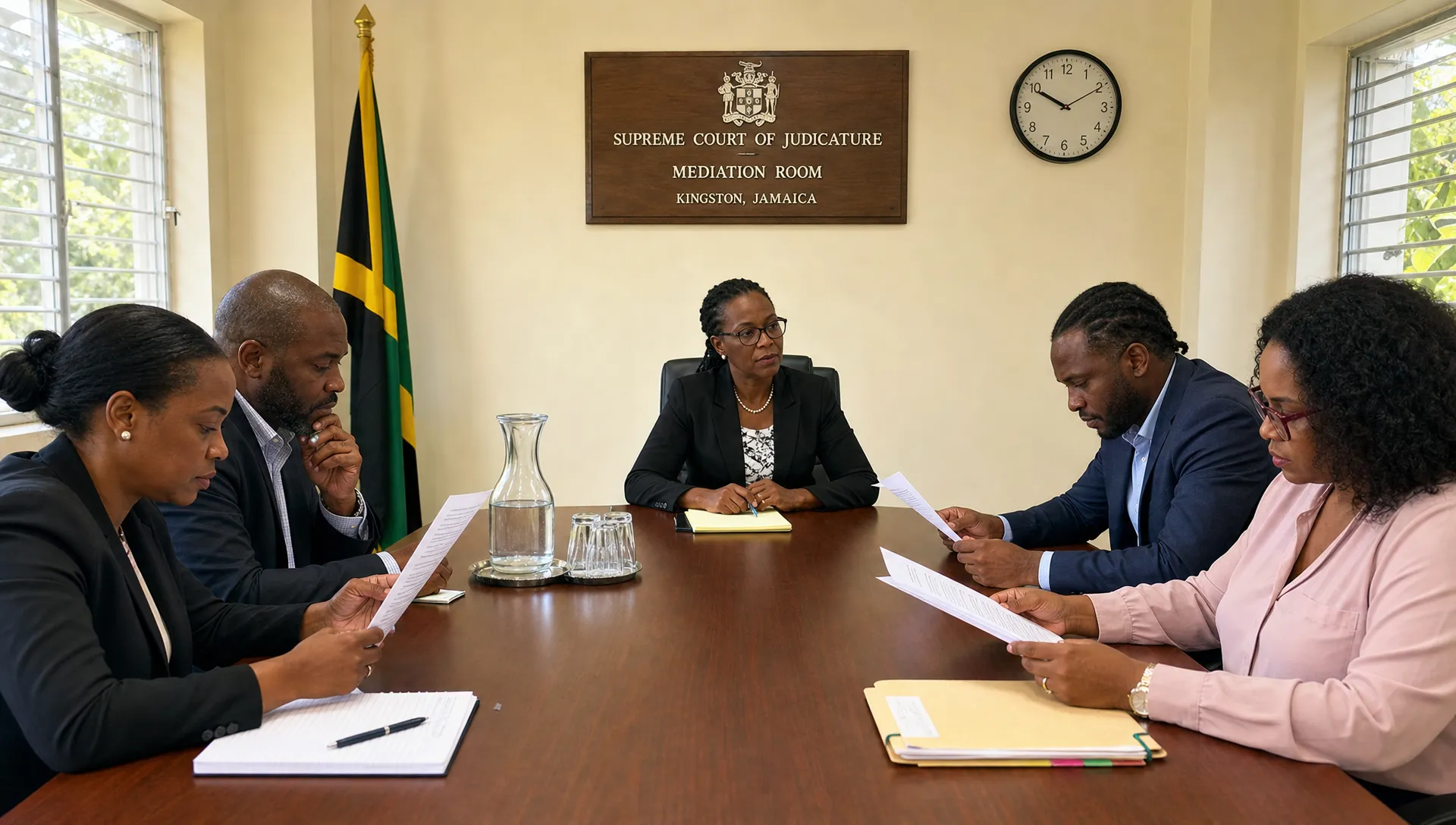
Being told that your matter is going to mediation can feel like a detour, especially if you have already filed or defended a claim. In reality, mandatory mediation in Jamaica is designed to move disputes toward practical resolution before parties spend the full time and cost of trial.
For businesses, property owners, professionals, lenders, insurers, contractors, families in civil disputes, and individuals facing a serious claim, the key point is this: mandatory mediation does not mean you must settle. It means you must take the process seriously, attend as required, prepare properly, and participate with a real opportunity to resolve the dispute.
What mandatory mediation means in Jamaica
Mandatory mediation is a court-connected process where parties are required, by rule or court order, to attempt mediation before the case continues to later stages of litigation. It is commonly used in civil disputes because it can narrow issues, reduce costs, preserve commercial relationships, and help parties avoid the uncertainty of trial.
A mediator is not a judge. The mediator does not decide who is right, award damages, make binding findings of fact, or force either side to accept an offer. The mediator’s role is to help the parties communicate, test the risks of their positions, explore settlement options, and, where possible, document an agreement.
This distinction matters. Many parties arrive at mediation thinking they must either “win” the session or give up their claim. A better approach is to treat mediation as a structured negotiation informed by law, evidence, commercial reality, and risk.
If your matter is already before the court, mediation sits alongside the litigation process. Court deadlines, pleadings, disclosure obligations, applications, and trial preparation may still matter. For a broader explanation of how this fits into the court process, Henlin Gibson Henlin has also covered how the Civil Procedure Rules and mediation interact in Jamaica.
Why courts encourage or require mediation
Civil litigation can be expensive, time-consuming, and unpredictable. Even a strong case can face evidential problems, procedural delays, enforcement challenges, or commercial consequences that a judgment may not fully solve.
Mandatory mediation helps parties address those realities earlier. It gives them a confidential setting to consider whether a negotiated outcome is better than continuing the fight. In many cases, mediation also helps the court by reducing the number of matters that require a full trial or by narrowing the issues that remain.
For a claimant, mediation can create an opportunity to secure payment, performance, an apology, a transfer, revised contractual terms, or another practical remedy sooner than trial. For a defendant, it can offer a way to control exposure, avoid escalating legal costs, protect reputation, and resolve uncertainty.
The process is especially useful where the dispute involves ongoing business relationships, complex facts, technical documents, family-owned companies, property arrangements, construction issues, financial obligations, or reputational concerns.
When parties should expect mediation to happen
The exact timing depends on the type of case, the applicable rules, and the court’s directions. In many civil matters, mediation is most useful after the issues are clear enough for each side to understand the claim and defence, but before the parties have incurred the full cost of trial preparation.
That may be around the case management stage or after pleadings and key documents have clarified what is really in dispute. However, parties should avoid assuming that mediation automatically pauses everything else. Unless the court order or applicable rule says otherwise, litigation obligations may continue.
This is one reason legal advice is important. A party who focuses only on the mediation date may miss a filing deadline, fail to preserve evidence, or make concessions without understanding the consequences. Mediation can be cooperative, but it is still connected to a legal dispute.
What happens before the mediation session
Preparation often determines whether mediation is productive. The parties should expect some or all of the following steps before the session:
Selection or appointment of a mediator, depending on the court’s direction or the parties’ agreement.
Confirmation of the date, time, venue, attendance arrangements, and any mediator’s requirements.
Exchange or delivery of short mediation statements, summaries of the dispute, or key documents.
Internal discussions about settlement authority, acceptable outcomes, risks, costs, and alternatives.
Review of pleadings, correspondence, contracts, invoices, valuations, expert material, photographs, bank records, or other evidence relevant to the dispute.
A party should not treat the mediation statement as a formality. It is often the mediator’s first real understanding of the dispute. A useful statement is clear, factual, realistic, and focused on the issues that must be resolved. It does not need to repeat every allegation in the case, but it should explain what the party wants and why.
Parties should also decide in advance who has authority to settle. A company that sends a representative with no decision-making power may frustrate the process. If board approval, insurer approval, lender approval, or a family decision is needed, that should be addressed before the mediation begins.
Who should attend mandatory mediation
The people who attend should usually include the parties themselves or proper representatives, their attorneys if represented, and anyone whose approval is genuinely needed to reach a binding agreement. In commercial disputes, this may mean a director, manager, principal shareholder, insurer representative, or officer with sufficient settlement authority.
Attendance is not only about physical presence. The person attending must understand the dispute, have access to necessary information, and be able to respond to proposals in real time. Where a party has to say “I need to ask someone else” at every stage, momentum can be lost.
Attorneys play a different role from the mediator. Your lawyer can assess legal merits, explain risk, protect privilege, help frame offers, draft settlement terms, and advise against an agreement that creates hidden problems. The mediator facilitates discussion, but does not provide independent legal advice to either side.
For parties who are unsure how legal rights and negotiated solutions fit together, it may help to read more about how law and mediation work together in disputes.
What happens during the mediation session
Although each mediator has a different style, most mediations follow a recognisable pattern. The mediator may begin with an introduction explaining neutrality, confidentiality, the structure of the session, and the voluntary nature of any settlement.
There may be a joint opening meeting where each side gives a short statement. In some disputes, a joint session is helpful because it allows parties to hear directly from each other. In more sensitive matters, the mediator may move quickly into private meetings, often called caucuses.
In private meetings, each party can speak more openly with the mediator about concerns, priorities, risks, and possible settlement ranges. The mediator may carry messages or proposals between rooms, but should not disclose confidential information from a private session unless authorised to do so.
The discussion may include legal risk, evidential strengths and weaknesses, likely costs, time to trial, commercial pressure, reputational issues, cash flow, future dealings, and the practical difficulty of enforcing any judgment. A good mediation does not ignore the law, but it also recognises that a court order is not always the only useful outcome.

What parties should bring to mediation
Parties should attend with the documents and information needed to make sensible decisions. In a debt claim, that may include invoices, statements of account, payment records, correspondence, and calculations of interest. In a contract dispute, it may include the contract, variations, emails, delivery records, notices, and evidence of loss. In a property dispute, titles, survey plans, valuations, leases, receipts, photographs, and correspondence may be important.
It is also useful to bring a concise chronology. Many disputes become clearer when the major dates are placed in order. This helps the mediator understand how the conflict developed and helps the parties separate emotional issues from legally relevant events.
A realistic settlement plan is equally important. Before mediation, each party should consider its best outcome, acceptable compromise, non-negotiable points, and alternative if no settlement is reached. That alternative is often continued litigation, with all the cost, delay, risk, and uncertainty that comes with it.
Stage | What to expect | How to prepare |
Before mediation | Directions, mediator arrangements, document preparation, and settlement planning | Review pleadings, organise evidence, calculate losses or exposure, and confirm authority |
Opening session | Mediator explains the process and may invite short opening remarks | Keep remarks focused, professional, and connected to the issues |
Private meetings | Mediator explores risks, priorities, and possible options separately with each side | Be candid with your attorney and clear about what can be disclosed |
Negotiation | Offers, counteroffers, apologies, payment terms, or non-monetary solutions may be discussed | Test each proposal against legal risk, cost, time, enforceability, and commercial needs |
Settlement or impasse | Agreement is recorded, or the matter returns to the litigation track | Ensure any settlement terms are precise, authorised, and capable of being performed |
Confidentiality and privilege in mediation
Confidentiality is one of the reasons mediation can work. Parties are usually more willing to explore settlement if they know that genuine compromise discussions will not simply be used against them at trial.
That said, confidentiality should not be treated carelessly. Parties should understand the mediation agreement, the applicable rules, and any exceptions that may apply. For example, issues may arise where disclosure is required by law, where there are threats of harm, where enforcement of a settlement becomes necessary, or where all parties agree to disclosure.
Parties should also be careful about what is put in writing during mediation. Settlement offers, draft terms, and admissions should be handled with legal advice. A casual phrase can create later disagreement about what was agreed or whether an offer was conditional.
What if the case settles?
If the parties reach agreement, the terms should be recorded clearly before everyone leaves or as soon as possible afterwards. A settlement may involve payment, instalment arrangements, delivery of goods, transfer of property, withdrawal of allegations, confidentiality clauses, revised business terms, releases, discontinuance of proceedings, or consent orders.
The most important point is precision. A vague settlement can create a second dispute. If payment is required, the agreement should state the amount, deadline, method, consequences of default, and whether interest or costs are included. If an action must be taken, the agreement should identify who must do it, by when, and what documents are required.
Where court proceedings are already underway, the parties may need to file appropriate documents to reflect the settlement. Depending on the matter, this may include a consent order, notice of discontinuance, or other procedural step. Legal advice is important because a settlement can affect claims against other parties, costs, limitation issues, security interests, tax consequences, confidentiality, and enforcement.
What if mediation does not settle the dispute?
A failed mediation is not always a wasted mediation. Even where no final agreement is reached, parties often leave with a clearer understanding of the opposing case, the documents that matter, the real settlement gap, and the risks of trial.
If mediation does not resolve the dispute, the case usually returns to the court track. The court may give further directions, maintain existing deadlines, or move the matter toward trial. The mediator will not decide the dispute and should not report confidential negotiation details to the court. The court is generally concerned with whether mediation occurred and whether the matter settled, not with the private content of negotiations.
Parties should use the period after an unsuccessful mediation wisely. Offers can continue. Narrow issues can be agreed. Evidence can be strengthened. In some cases, a settlement may happen days or weeks later after parties have had time to reflect.
Common mistakes parties make in mandatory mediation
One of the most common mistakes is arriving unprepared. Mediation is not a casual meeting. If a party does not understand its documents, damages, costs, legal risk, or settlement authority, it may miss a valuable opportunity.
Another mistake is treating mediation as a performance for the mediator. The mediator is not there to be persuaded like a judge. Strong advocacy has its place, but mediation requires listening, testing assumptions, and exploring options that may not be available in a judgment.
Parties also make mistakes by focusing only on the amount of money. In many disputes, timing, confidentiality, payment structure, future business, return of property, correction of records, releases, or public statements may be just as important as the headline figure.
Finally, parties sometimes confuse compromise with weakness. Settlement may be a strategic decision, not a concession that the other side is right. A well-negotiated agreement can protect cash flow, management time, reputation, and certainty.
For a plain-language look at the mechanics of mediation, including typical steps and documents, see this overview of mediation procedure rules.
How to prepare strategically
A good mediation strategy starts with early case assessment. That means identifying the legal issues, the evidence available, the evidence missing, the likely remedies, and the cost of continuing. It also means understanding the human or commercial drivers behind the dispute.
Before attending mediation, parties should ask themselves several practical questions. What must be achieved? What would be acceptable? What would be unacceptable? What happens if the matter does not settle? How long will trial preparation take? What will legal costs look like? What enforcement problems may arise even if judgment is obtained?
Parties should also consider how offers will be presented. An opening offer that is too extreme may damage trust, but an offer that is made without analysis may leave value on the table. The right approach depends on the case, the evidence, the parties’ relationship, and the level of urgency.
In commercial disputes, preparation may also require internal alignment. A business should ensure that finance, operations, management, insurers, and relevant decision-makers understand the mediation objectives. A settlement reached in the room can fail later if key stakeholders were not consulted.
Frequently Asked Questions
Does mandatory mediation mean I have to settle? No. Mandatory mediation generally means you must attend and participate as required. Settlement remains voluntary. A mediator cannot force you to accept terms.
Can I attend mediation without a lawyer? Some parties do attend without counsel, but legal advice is strongly recommended where the dispute involves significant money, property, business interests, court proceedings, or complex rights. A mediator is neutral and cannot advise you as your lawyer.
Is what I say in mediation confidential? Mediation is generally treated as confidential, subject to the applicable rules, the mediation agreement, and limited exceptions. You should still be careful about admissions, written offers, and authority to disclose information from private sessions.
What happens if the other side refuses to participate properly? The court may take non-attendance or unreasonable conduct seriously, depending on the circumstances and the applicable order. You should keep proper records and seek legal advice before asking the court for any relief.
Can mediation happen more than once? Yes. Some disputes settle only after more information is exchanged or after the parties reassess risk. A later mediation or further negotiation may be useful if the first session narrows the issues.
What should a settlement agreement include? It should clearly state the parties, obligations, payment terms, deadlines, releases, confidentiality obligations, treatment of court proceedings, costs, default consequences, and any documents needed to complete the settlement.
Speak with a Jamaica litigation and mediation team
Mandatory mediation in Jamaica is more than a procedural step. Handled well, it can be an opportunity to resolve a dispute on terms that are faster, more practical, and more certain than trial. Handled poorly, it can increase cost and weaken your position.
If you are preparing for mediation, responding to a court direction, or deciding whether settlement is in your best interest, Henlin Gibson Henlin can assist with strategic legal advice, dispute assessment, negotiation preparation, and representation in civil and commercial matters.
This article provides general information only and is not a substitute for legal advice on your specific circumstances.