
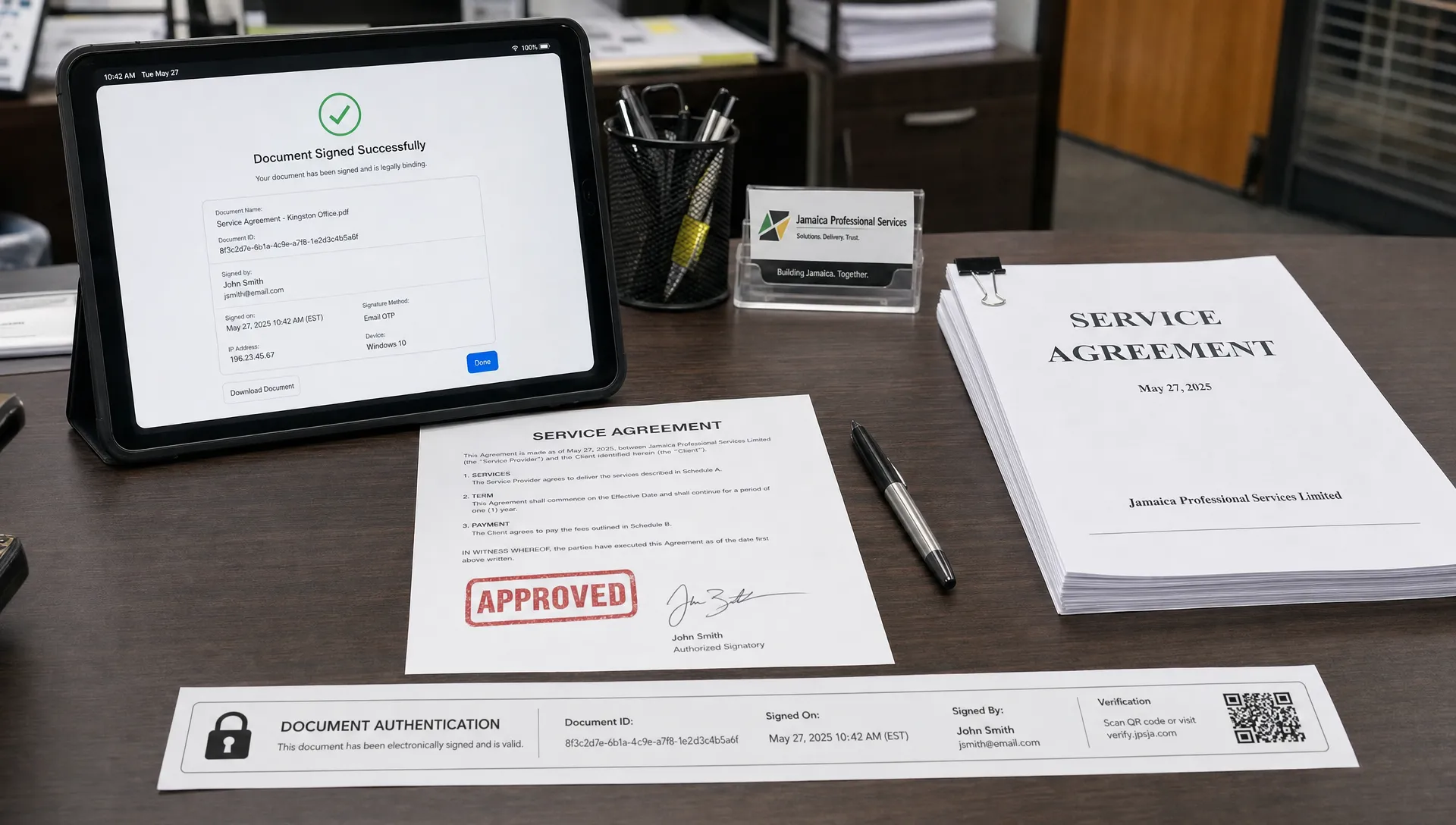
Electronic signing is now routine for supplier agreements, employment documents, customer onboarding, loan paperwork and online sales. But e-signatures in Jamaica are not just a convenience issue. They raise questions about validity, consent, evidence, data protection and whether a particular document still needs wet ink, witnessing or registration before it can safely be relied on.
For Jamaican businesses, the practical question is not simply, “Can we sign this electronically?” A better question is, “Will this signature prove who signed, what they agreed to and that the signed record has not been changed?” That is the standard that matters when a transaction is challenged, an audit is opened or a dispute reaches court.
Are e-signatures in Jamaica legally valid?
Jamaica recognises electronic transactions through its Electronic Transactions Act. In broad terms, the legal effect of a record or signature should not be denied only because it is in electronic form. This gives businesses a statutory basis for using electronic records and electronic signatures in many commercial settings.
The framework follows a functional approach, similar to international e-commerce principles reflected in instruments such as the UNCITRAL Model Law on Electronic Commerce. Instead of asking whether a signature was made with pen and paper, the law looks at whether the method used performs the functions of a signature.
In practice, an electronic signature should help identify the signer and show their approval of the information being signed. It should also be reliable in the circumstances or supported by evidence that it did in fact perform those functions. A typed name at the end of an email may be enough in a low-risk context, but a high-value financing agreement, intellectual property assignment or settlement deed may require stronger authentication.
What counts as an electronic signature?
An electronic signature can take several forms. The law is technology-neutral, which means it does not depend on one specific platform or tool. What matters is the function, not the brand of software used.
Common forms include:
A typed name inserted into a contract
A scanned handwritten signature attached to a PDF
A clickwrap acceptance, such as ticking “I agree” before submitting an online form
A signature created through an e-signature platform with identity checks and an audit trail
A digital signature using cryptographic technology
The more important the transaction, the more careful the business should be about the method chosen. For routine acknowledgements, a simple electronic acceptance may be adequate. For major contracts, corporate approvals, guarantees, cross-border transactions or documents likely to be litigated, a platform that records authentication steps, timestamps and document integrity will usually be safer.
When electronic signing works well
E-signatures in Jamaica are especially useful for commercial documents where the parties clearly intend to transact electronically and no special formality requires a different process. These arrangements are often time-sensitive, repetitive or remote, making electronic execution more efficient than printing, scanning and couriering documents.
Examples commonly suited to electronic signing include service agreements, non-disclosure agreements, supplier contracts, policy acknowledgements, board packs, employment onboarding documents, customer terms and many online business documents. If your business is moving more transactions online, it is also worth reviewing related legal documents such as website terms, privacy notices and customer-facing disclosures. Henlin Gibson Henlin has addressed this wider risk picture in its guide to legal checks before launching an online store.
Electronic signing can also improve transaction management. A well-configured process can reduce lost pages, capture approvals in sequence and create a clear record of who signed and when. That record becomes valuable if a counterparty later says they did not agree to the terms.
When wet ink may still be safer or required
Not every document should be signed electronically without legal review. Some documents are subject to specific formalities, either because of legislation, registry practice, court requirements, notarisation rules, stamping issues or the expectations of banks and public authorities.
Particular care is needed for documents involving land, wills and succession, powers of attorney, deeds, security documents, negotiable instruments, affidavits, statutory declarations, certain court documents and filings that must be lodged with a public body. In some cases, the issue is not whether an electronic signature is conceptually valid. The issue is whether the receiving institution will accept it and whether every connected legal step can be completed electronically.
Document type | Why caution is needed | Practical approach |
Real estate transfers and security documents | Registration, stamping, witnessing and institutional acceptance may affect validity | Confirm requirements before signing |
Wills and estate documents | Formal execution rules are strict | Use wet ink unless advised otherwise |
Powers of attorney | Witnessing, notarisation or registration may be relevant | Obtain document-specific advice |
Affidavits and statutory declarations | Oaths, declarations and court rules may apply | Check court or authority requirements |
High-value commercial contracts | Proof of authority and document integrity may become disputed | Use a robust platform and clear approvals |
This is where legal services are often most valuable. A short review before signing can prevent an expensive dispute about enforceability later. If the document carries major financial, operational or reputational risk, treat the execution method as part of the legal strategy rather than an administrative detail.
Consent and intention matter
A valid electronic process should show that each party agreed to sign electronically. Consent may be express or implied from conduct in some circumstances, but express consent is cleaner. A contract can state that the parties agree to use electronic signatures and that electronically signed counterparts will have the same effect as originals, subject to applicable law.
Intention is equally important. The signature process should make it clear that the person is approving the final version of the document, not merely reviewing a draft. Avoid circulating multiple versions with similar file names, unclear email threads or unsigned attachments that can later create uncertainty.
If a person is signing for a company, authority must also be checked. The legal issue is not only whether the signature is electronic. It is whether the person had authority to bind the company. This is particularly important in corporate law Jamaica contexts, banking litigation, procurement contracts and commercial litigation Jamaica matters where authority is often contested.

Authentication, audit trails and evidence
The strongest e-signature process creates a record that can be explained later. If a dispute arises, the business may need to prove that the document shown in court is the same document that was signed and that the signature belongs to the relevant person.
A useful audit trail may record the signer’s name, email address, IP address, time of access, time of signature, authentication steps, document version and any changes made before completion. This does not make litigation impossible, but it gives the business better evidence than a loose scanned signature pasted into a PDF.
For higher-risk documents, consider whether the platform can lock the signed file, produce a certificate of completion and maintain logs that can be exported. Internal procedures should also define who can send documents for signature, who can approve final versions and where signed records are stored.
This point connects closely to ordinary contracting discipline. Before anyone signs electronically, they should still understand the legal obligations in the document. For a broader pre-signing checklist, see Henlin Gibson Henlin’s article on how to understand the law before you sign anything.
Data protection and privacy considerations
E-signatures in Jamaica often involve personal data. A signature platform may collect names, job titles, email addresses, phone numbers, device information, IP addresses, identity documents and signature images. Under Jamaica’s data protection framework, businesses need to think about why they collect that information, how long they keep it, who can access it and whether it is transferred outside Jamaica.
The Personal Data Protection Act makes privacy compliance a business issue, not only an IT issue. If an organisation uses a foreign e-signature provider, it should review where data is hosted, what security measures apply and what contractual terms govern processing. The business should also ensure that privacy notices accurately describe electronic signing and related verification steps.
A few practical controls help reduce risk. Limit access to signed documents, use multi-factor authentication for administrators, set retention periods and avoid collecting identity documents unless genuinely needed. If your organisation is updating its compliance framework, Henlin Gibson Henlin’s Data Protection Act requirements checklist is a useful companion to this topic.
Cross-border contracts and foreign counterparties
Electronic signing becomes more complex when one party is outside Jamaica. Different countries use different rules for electronic signatures, digital certificates, notarisation and consumer consent. A Jamaican company contracting with a U.S., Canadian, UK, EU or Caribbean counterparty should not assume that one process works everywhere.
The contract should address governing law, jurisdiction, counterpart execution, delivery by email, electronic signature acceptance and dispute resolution. If the document will be used for financing, public procurement, regulatory approval or registration in another country, confirm acceptance rules before execution.
Cross-border transactions also raise practical evidence issues. If litigation or arbitration occurs abroad, the audit trail must be understandable to the foreign tribunal. It should show a reliable signing process and preserve the final signed version in a way that can be verified.
E-signature policy checklist for Jamaican businesses
A written policy helps staff know when electronic signing is permitted and when legal review is required. It also creates consistency, which can be useful if a transaction is later challenged.
At minimum, a business policy should cover:
Which documents may be signed electronically without approval
Which documents require legal review before electronic execution
Approved e-signature platforms and authentication settings
Authority levels for sending, approving and signing documents
Storage location, naming conventions and retention periods
Data protection controls for signature records and identity checks
Procedures for counterparties that refuse electronic signing
The policy should be tailored to the organisation’s risk profile. A fintech, logistics company, professional services firm and real estate developer will not have identical needs. The right approach depends on transaction value, regulatory exposure, industry practice and how often the organisation needs to enforce signed documents.
Common mistakes to avoid
The most common mistake is treating electronic signing as a shortcut around legal review. E-signing changes the method of execution, but it does not fix vague terms, missing authority, unfair clauses or poor risk allocation. A weak contract remains weak even if signed on a sophisticated platform.
Another mistake is using the same method for every document. A typed name may be fine for a low-value confirmation, but inadequate for a guarantee, settlement agreement or document involving sensitive personal data. Businesses should match the signing method to the risk.
Poor recordkeeping is also a recurring problem. If signed documents are scattered across email inboxes, shared drives and platform accounts, the company may struggle to prove the final agreed terms. A central repository with access controls is often as important as the signature tool itself.
Finally, do not ignore counterparties and institutions. If a bank, registry, court office, insurer or regulator will need to rely on the document, check its acceptance requirements early. This is especially important where admiralty & shipping, secured lending, real estate law Jamaica issues or regulated commercial transactions are involved.
When to get legal advice
Legal advice is recommended when the document is high-value, unusual, regulated, cross-border, likely to be filed with an authority or likely to be enforced in court. Advice is also sensible if the signer is acting through an agent, if multiple companies are involved or if the document affects intellectual property law, employment law, consumer rights or data protection obligations.
For businesses, the goal is not to slow down transactions. The goal is to build a signing process that is fast and defensible. When the right documents are signed electronically in the right way, e-signatures in Jamaica can reduce friction without weakening legal protection.
Frequently Asked Questions
Are e-signatures legally binding in Jamaica? Yes, many electronic signatures can be legally effective in Jamaica, provided the method identifies the signer, shows their intention to approve the document and satisfies any applicable legal requirements. Some documents still require special handling or wet ink.
Can a contract be signed by email? In many commercial contexts, yes. An exchange of emails can help form or evidence a contract if the usual requirements are met, including offer, acceptance, consideration, intention and authority. The risk is evidential, so clarity and recordkeeping matter.
Is a scanned signature the same as an electronic signature? A scanned handwritten signature can function as an electronic signature, but it may be easier to challenge than a platform-based signature with authentication and an audit trail. Use stronger methods for higher-risk documents.
Do all Jamaican businesses need an e-signature policy? Any business that signs contracts electronically on a regular basis should have at least a simple policy. It helps staff choose the right signing method, preserve evidence and avoid using e-signatures where extra formalities apply.
What should I check before using an overseas e-signature platform? Check data hosting, security features, audit trail quality, exportability of records, privacy terms, cross-border data transfer issues and whether the platform is suitable for the types of documents your business signs.
Make electronic signing faster and safer
E-signatures can help Jamaican businesses move quickly, but speed should not come at the cost of enforceability. The right process depends on the document, the parties, the level of risk and any formal requirements that still apply.
Henlin Gibson Henlin advises clients across commercial transactions, dispute resolution, data privacy, compliance and related practice areas. If your organisation is adopting electronic signing or reviewing a high-value document, tailored legal guidance can help ensure the process is both efficient and defensible.