
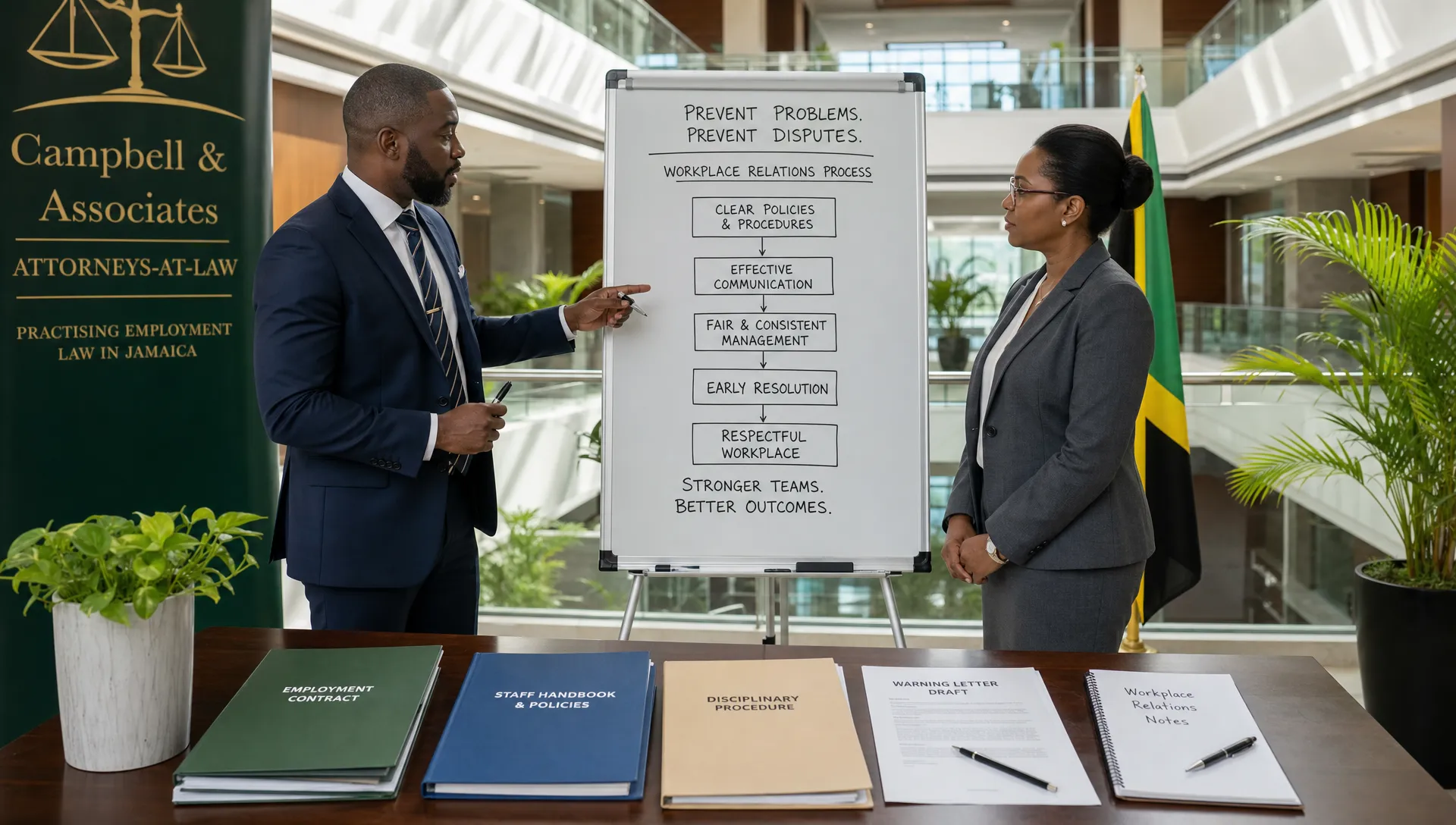
Workplace decisions often look operational at first. A hiring choice, a performance warning, a redundancy exercise, a workplace complaint, or a payroll classification may feel like routine management. But each of those decisions can create legal exposure if it is handled without proper structure.
That is where employment law attorneys can protect your business. Their role is not limited to defending a claim after something has gone wrong. The greater value often comes earlier, before a dispute escalates, when legal advice can help employers make clear, fair, well-documented decisions that support both compliance and commercial continuity.
For Jamaican businesses, employment law risk can arise from contracts, statutory obligations, workplace policies, industrial relations, data privacy, and the way management decisions are communicated. When these issues are handled proactively, a business is better placed to avoid unnecessary claims, preserve employee trust, and protect its reputation.
Why early employment law advice matters
Employment disputes can be expensive even when an employer believes it acted correctly. The direct cost of legal proceedings is only one part of the risk. A poorly managed workplace issue can also lead to management distraction, staff uncertainty, reputational harm, loss of key employees, and disruption to customer service.
In Jamaica, employment decisions may be judged against several sources of obligation, including employment contracts, workplace policies, collective agreements where applicable, statutory requirements, and principles of fairness. Matters may also involve the Ministry of Labour and Social Security, the Industrial Disputes Tribunal, the courts, or other regulators depending on the issue.
Early advice helps employers avoid a common mistake: focusing only on the desired business outcome and not enough on the process used to reach it. For example, an employer may have a legitimate reason to discipline an employee, restructure a role, or end a contract. But if the process is rushed, inconsistent, poorly documented, or contrary to the contract, the business may still face a claim.
A useful starting point is to understand the key employment law rules Jamaican employers should follow, then seek tailored advice when a specific decision carries meaningful risk.
When employment law attorneys can protect your business most
Not every HR question requires a lawyer. However, certain moments are high-risk because they affect rights, pay, status, reputation, or job security. In those situations, advice before acting is usually more valuable than advice after a complaint has been filed.
Hiring, offer letters, and employment contracts
The employment relationship begins before the first day of work. Job advertisements, interview promises, offer letters, probation terms, confidentiality clauses, benefits, restrictive covenants, and job descriptions can all create expectations or obligations.
Employment law attorneys can help employers draft contracts that reflect the reality of the role, the business need, and the applicable legal framework. This is especially important for senior employees, sales roles, technical staff, employees with access to confidential information, and roles involving regulated or sensitive data.
Strong contracts reduce ambiguity. They make it clearer what the employee is being hired to do, how performance will be assessed, what rules apply, and what happens if the relationship ends.
Employee versus independent contractor classification
Misclassification can create serious risk. A business may call someone an independent contractor, but the actual working relationship may point in another direction. Factors such as control, integration into the business, exclusivity, equipment, working hours, economic dependence, and how the services are performed may all become relevant.
If the classification is wrong, the business may face exposure for employment benefits, statutory payments, tax or payroll issues, and disputes over termination. Legal advice is especially important where contractors work long-term, perform core business functions, report to managers like employees, or are treated similarly to staff.
Workplace policies and handbooks
Policies are not just HR documents. They are risk-management tools. A well-drafted policy tells managers what to do and gives employees clarity about expected conduct.
Core policies often cover disciplinary procedures, grievance handling, anti-harassment standards, health and safety expectations, remote work, conflicts of interest, data protection, confidentiality, use of company systems, and social media conduct. The exact policies a business needs will depend on its size, industry, workforce, and risk profile.
Attorneys can help ensure policies are enforceable, practical, consistent with contracts, and aligned with Jamaican legal obligations. They can also help prevent the common problem of having policies that look good on paper but are impossible for managers to apply consistently.
Business moment | Risk if unmanaged | How legal advice helps |
Hiring and contracts | Unclear terms, disputed benefits, weak confidentiality protection | Drafts clear documents before the relationship begins |
Contractor arrangements | Misclassification, payroll exposure, benefit claims | Assesses the real working relationship and structures terms properly |
Discipline and performance | Claims of unfairness, inconsistency, poor process | Builds a fair process with proper records and communication |
Redundancy or restructuring | Statutory exposure, morale issues, disputes over selection | Plans consultation, selection criteria, notices, and documentation |
Workplace complaints | Escalation, retaliation claims, reputational harm | Guides investigations, confidentiality, and defensible outcomes |
Employee data | Privacy breaches, mishandling sensitive information | Aligns HR practices with data protection obligations |
Discipline, performance management, and investigations
Many employers wait too long before addressing conduct or performance issues, then act quickly when frustration peaks. That is when mistakes happen.
Employment law attorneys can help management design a process that is fair, proportionate, and properly documented. This may involve reviewing the allegation, identifying the relevant policy, preparing meeting notices, advising on suspension where appropriate, guiding an internal investigation, and helping decision-makers avoid bias or inconsistency.
The goal is not to make every workplace decision complicated. The goal is to ensure that serious decisions are supported by a fair process and reliable evidence.

Termination, redundancy, and restructuring
Ending employment is one of the clearest points at which legal advice can protect a business. Even where the business has a legitimate commercial reason, the process matters.
Redundancy and restructuring decisions may require careful planning around selection criteria, business justification, communication, statutory payments, notice, consultation, and the treatment of affected employees. Termination for cause requires a different analysis, including evidence, proportionality, prior warnings where relevant, and procedural fairness.
Before issuing a termination letter or announcing a restructure, employers should usually ask whether the decision is supported by documents, whether similarly situated employees have been treated consistently, whether contractual and statutory obligations have been considered, and whether the communication could be misinterpreted.
If you are unsure whether a situation has reached the point where advice is needed, this guide on when to seek legal advice on employment law explains common triggers for both employers and employees.
Workplace complaints, harassment, and discrimination concerns
Employee complaints must be handled carefully, especially where they involve harassment, discrimination, victimisation, retaliation, bullying, unsafe working conditions, or misconduct by a manager.
A weak response can worsen the problem. If an employee believes the business ignored a complaint or protected a senior person, the legal and reputational risk increases. On the other hand, employers must also protect the rights of the person accused and avoid reaching conclusions before the facts are established.
Attorneys can help structure investigations, define the scope, preserve confidentiality, identify conflicts of interest, review evidence, and advise on appropriate outcomes. In sensitive matters, outside legal guidance can also reassure stakeholders that the business is taking the issue seriously.
Employee data, monitoring, and confidentiality
Modern employment relationships involve significant personal data. Employers may collect identification documents, payroll information, medical certificates, disciplinary records, performance reviews, location data, emails, and other sensitive information.
Jamaica’s data protection landscape has made employee data a more important business risk area. The Office of the Information Commissioner provides guidance on data protection obligations, and employers should treat HR information as a compliance issue, not merely an administrative record.
Employment law attorneys, often working alongside data privacy counsel, can help employers review employee privacy notices, access controls, retention practices, monitoring policies, and responses to data requests or breaches. This is particularly important for businesses using biometric systems, remote-work monitoring tools, cloud HR software, or cross-border service providers.
Trade unions, collective issues, and industrial relations
When employee concerns become collective, the risk profile changes. Union engagement, collective bargaining, industrial action, group grievances, and changes to established workplace practices require careful legal and strategic handling.
Employment law attorneys can help employers understand their obligations, prepare for negotiations, communicate lawfully, and avoid actions that may inflame the dispute. In unionised or potentially unionising environments, legal advice should be obtained before major workplace changes are announced.
What protection looks like in practice
Good legal support is practical. It does not simply identify risk and leave management with no path forward. The best advice helps the business understand its options, compare likely consequences, and choose a course that is legally defensible and commercially sensible.
For example, before disciplining an employee, an attorney may help the employer clarify the allegation, review the contract and policy, check whether similar cases were handled consistently, prepare questions for an investigation meeting, and review the final decision letter. Before a redundancy, legal counsel may help document the business rationale, test the selection process, and prepare communications that are clear but not inflammatory.
This type of advice also creates an internal record. If the decision is later challenged, the business can show that it acted thoughtfully rather than impulsively. That record may become valuable in negotiations, mediation, litigation, or regulatory engagement.
Legal support can also help management avoid overcorrection. Employers sometimes tolerate serious misconduct because they fear legal consequences, or they make excessive concessions because they are unsure of their rights. Proper advice helps businesses act firmly where justified, while still respecting employee rights and process.
For a broader business-risk perspective, Henlin Gibson Henlin has also explained how attorneys’ legal guidance reduces business risk across contracts, compliance, governance, data privacy, and disputes.
Warning signs that you should call an employment lawyer before acting
Some workplace issues are routine. Others should trigger a pause before management sends the email, holds the meeting, or makes the announcement.
You should consider getting advice before acting if:
The decision may end someone’s employment or significantly reduce pay, status, hours, or benefits.
The employee has recently made a complaint, taken leave, reported misconduct, or raised a health or safety concern.
The matter involves a senior employee, regulated role, unionised environment, or confidential information.
Several employees are affected by a restructure, policy change, pay issue, or workplace complaint.
The employee alleges discrimination, harassment, retaliation, unfair treatment, or breach of contract.
The business wants to monitor employee communications, process sensitive data, or transfer HR data outside Jamaica.
Management is unsure whether someone is an employee, contractor, consultant, agent, or casual worker.
These signs do not mean the business is wrong. They mean the decision carries enough risk to justify a structured legal review.
How to choose the right employment law attorneys for your business
The right legal partner should understand both employment law and business reality. Employers do not only need technical answers. They need advice that accounts for cost, timing, employee relations, regulatory exposure, evidence, and reputational impact.
When choosing counsel, look for attorneys who can support both preventive advice and dispute response. A lawyer who understands litigation can draft better contracts and policies because they know how documents are tested when relationships break down. A lawyer who understands commercial realities can also help management choose options that protect the business without creating unnecessary confrontation.
Local knowledge matters. Jamaican employment disputes are shaped by local statutes, industrial relations practice, regulatory expectations, and workplace culture. Businesses should work with attorneys who can apply the law in that context rather than relying on generic templates or foreign HR practices.
It is also worth considering whether the firm can assist with connected areas such as data privacy, compliance, commercial litigation, arbitration, mediation, and risk management. Employment issues often overlap with these areas, especially when senior employees, confidential information, regulated industries, or cross-border operations are involved.
Frequently Asked Questions
When should a business contact employment law attorneys? A business should seek advice before making high-risk workplace decisions, including termination, redundancy, major disciplinary action, employee classification, workplace investigations, collective disputes, or changes affecting pay and benefits.
Can employment law attorneys help before there is a dispute? Yes. Preventive advice is often the most valuable form of protection. Attorneys can review contracts, policies, HR processes, data practices, and planned decisions before they become claims.
Do small businesses need employment law advice? Small businesses can face the same types of employment risk as larger companies, but with fewer internal resources to manage disputes. Clear contracts, consistent policies, and early advice can be especially important for smaller employers.
What documents should I prepare before speaking with an attorney? Useful documents may include the employment contract, offer letter, job description, relevant policies, payroll records, warnings, emails, meeting notes, complaint documents, and any draft termination or redundancy communication.
Can an attorney help resolve an employment dispute without going to court? Yes. Many workplace disputes can be addressed through negotiation, internal resolution, mediation, or settlement discussions. Legal advice helps employers assess risk and choose the most appropriate route.
Protect your business before the next workplace decision
Employment issues rarely become easier when they are ignored. The earlier a business seeks advice, the more options it usually has. Whether you are hiring, restructuring, investigating a complaint, reviewing policies, handling employee data, or responding to a threatened claim, experienced legal guidance can help you act with confidence.
Henlin Gibson Henlin supports businesses in Jamaica with client-focused legal services across employment-related risk, commercial disputes, compliance, data privacy, arbitration, mediation, and litigation. If your business is facing a sensitive workplace decision, consider getting advice before the issue escalates.
This article provides general information only and is not a substitute for legal advice on your specific circumstances.