
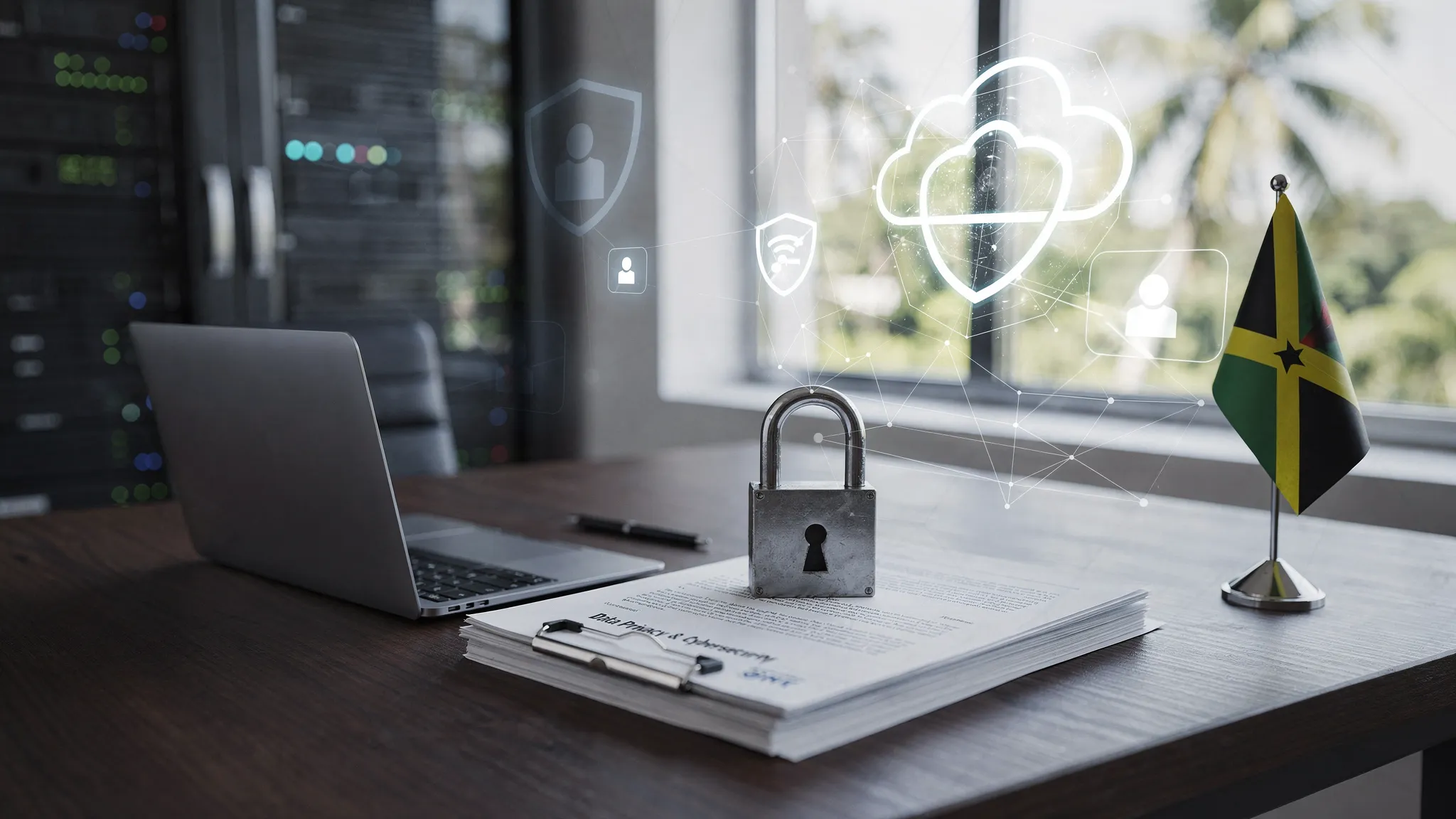
A cyber incident is rarely just an IT problem. If the incident touches names, email addresses, account records, payment details, health information, employee files or any other data that can identify a person, it also becomes a privacy issue.
That is where data privacy and cybersecurity law overlap. Cybersecurity law is concerned with protecting systems, networks and digital assets from unauthorised access, misuse and disruption. Data privacy law is concerned with how personal data is collected, used, stored, shared and protected. The two areas meet when weak security, poor governance or a cyberattack puts personal data at risk.
For Jamaican businesses, this overlap is increasingly important. The Data Protection Act, 2020 places legal responsibility on organisations that process personal data, while cybercrime laws, sector rules, contracts and common law duties may also shape how an organisation must prevent, investigate and respond to security incidents.
The core difference: privacy protects people, cybersecurity protects systems
Privacy and cybersecurity are connected, but they are not the same.
Data privacy focuses on the rights and interests of individuals. It asks whether an organisation has a lawful basis to collect personal data, whether it is using the data fairly, whether the data is accurate, whether it is retained for too long, and whether individuals can exercise their rights.
Cybersecurity focuses on the confidentiality, integrity and availability of systems and information. It asks whether access controls are strong enough, whether networks are monitored, whether backups work, whether attackers can exploit vulnerabilities, and whether the organisation can recover from disruption.
The overlap appears because personal data cannot be private if it is not secure. A business may have a well-written privacy notice, but if customer records are stored in an exposed database or shared with an insecure vendor, privacy compliance is still at risk.
Legal or operational issue | Data privacy question | Cybersecurity question | Where they overlap |
Customer database | Are we lawfully collecting and retaining this personal data? | Is access restricted, logged and protected? | Personal data must be governed and secured. |
Ransomware attack | Were individuals’ records accessed, altered, lost or made unavailable? | How did the attacker enter and how do we contain it? | Incident response must address both legal notification and technical recovery. |
Cloud service provider | Is the provider processing data under clear instructions and safeguards? | Does the provider use adequate controls, backups and monitoring? | Vendor contracts must allocate privacy and security duties. |
Employee monitoring | Are employees informed and is monitoring proportionate? | Are logs collected to detect threats and insider misuse? | Security monitoring must respect privacy principles. |
The Jamaica context: why the overlap matters
Jamaica’s Office of the Information Commissioner has a central role in the data protection framework. The Data Protection Act is built around data protection standards that require organisations to handle personal data lawfully, fairly and securely.
One of the most important privacy obligations is the requirement to use appropriate technical and organisational measures to protect personal data against unauthorised or unlawful processing, accidental loss, destruction or damage. That language brings cybersecurity directly into privacy compliance.
Separately, Jamaica’s cybercrime framework addresses unlawful access to computer systems, interference with data and other forms of computer misuse. In practice, a single incident may raise several legal questions at once: Was there unauthorised access? Was personal data involved? Were customers, employees, regulators or business partners owed notice? Did a vendor fail to meet contractual security obligations? Could the incident lead to litigation?
That is why organisations should avoid treating privacy, IT security, legal, compliance and risk management as separate silos. A breach response that focuses only on restoring systems may miss notification obligations. A privacy programme that focuses only on consent forms and policies may miss the technical controls needed to make those policies meaningful.

The main areas where data privacy and cybersecurity law overlap
1. Security is a privacy obligation
Under modern privacy laws, security is not optional. It is part of the legal standard for responsible data handling.
Appropriate safeguards may include technical controls such as encryption, multi-factor authentication, patch management, network monitoring, access logs and secure backups. They may also include organisational controls such as policies, staff training, vendor due diligence, incident response plans, retention schedules and clear accountability.
The right controls depend on context. A small professional services firm, an e-commerce platform, a hospital, a bank and a government contractor will not all face the same risks. The sensitivity of the data, volume of records, likelihood of harm and operational environment all matter.
Global frameworks such as the NIST Cybersecurity Framework can help organisations structure their approach around identifying, protecting, detecting, responding to and recovering from cyber risks. However, a framework alone is not legal compliance. The controls must be aligned with the organisation’s privacy obligations, contracts and sector-specific duties.
2. Data breaches require both technical and legal analysis
A cyber incident becomes a data privacy matter when personal data is compromised or is reasonably suspected to be at risk. That may involve external hacking, ransomware, phishing, business email compromise, a lost laptop, accidental email disclosure, misconfigured cloud storage or misuse by an insider.
The legal analysis should not wait until the IT team has finished its investigation. In the early hours of an incident, organisations need to preserve evidence, contain the threat, understand what data may be affected and assess whether notification duties are triggered.
Key questions usually include:
What happened, and when was it discovered?
What systems, accounts or records were affected?
Did the incident involve personal data, sensitive personal data or confidential business information?
Was data accessed, copied, altered, deleted, encrypted or made unavailable?
Are affected individuals likely to suffer harm?
Are there contractual, regulatory, insurance or law enforcement reporting obligations?
Not every cyber incident is a notifiable privacy breach. For example, an attempted intrusion that is blocked before any access occurs may still be a cybersecurity event, but it may not require privacy notification. Conversely, not every privacy breach is a cyberattack. Sending a spreadsheet to the wrong recipient can create a privacy issue even if no hacker is involved.
3. Cybercrime investigations must consider privacy and evidence
When an organisation suspects criminal activity, legal and technical teams must think carefully about evidence. Logs, emails, access records, endpoint data, firewall alerts and forensic images may become important in a law enforcement report, insurance claim, regulatory inquiry or lawsuit.
At the same time, evidence collection can involve personal data. For example, reviewing employee communications, user activity logs or customer account activity may be necessary, but it should be proportionate and controlled. Internal investigations should avoid unnecessary access to unrelated personal information.
This is a common point of tension. Cybersecurity teams need enough information to understand and contain the incident. Privacy and legal teams need to ensure that the investigation itself does not create additional compliance problems.
4. Vendor risk sits at the centre of both fields
Many privacy and cybersecurity failures happen outside the organisation’s walls. Cloud providers, payroll processors, payment vendors, marketing platforms, managed IT providers, call centres and software vendors may all handle personal data or connect to business systems.
A strong vendor agreement should not only say that the vendor will “keep data confidential.” It should address the practical obligations that matter during a real incident.
Useful contract areas include:
Clear definitions of the data being processed and the purpose of processing
Security obligations that reflect the sensitivity of the data and services
Restrictions on subcontracting and onward transfers
Breach reporting timelines and cooperation duties
Audit rights, certifications or assurance mechanisms where appropriate
Data return, deletion and retention obligations at the end of the relationship
Responsibility for costs, remediation and claims where the contract permits it
This is where privacy law, cybersecurity expectations and commercial risk allocation come together. A vendor may be technically capable, but if the contract is silent on breach cooperation or data deletion, the customer may face serious difficulties when something goes wrong.
5. Security monitoring can create privacy risks
Cybersecurity tools often collect data about people. Security information and event management systems, endpoint detection tools, access logs, CCTV, badge systems and email filtering solutions may capture employee identifiers, IP addresses, device information, location data or communications metadata.
These tools can be legitimate and necessary, especially for fraud prevention, threat detection and compliance. But they still need privacy safeguards. Organisations should be transparent where appropriate, limit access to monitoring data, define retention periods and ensure that monitoring is proportionate to the risk being addressed.
This issue is especially important in employment settings. Employees do not lose all privacy expectations because they are using company systems. Employers should ensure that workplace monitoring policies are clear, justified and consistently applied.
6. Board and management accountability is shared
Cybersecurity is often delegated to IT, while privacy is delegated to legal or compliance. That may be operationally convenient, but accountability ultimately sits with the organisation’s leadership.
Boards and senior management should understand the organisation’s most important data assets, major cyber risks, legal duties and incident response readiness. They do not need to be forensic experts, but they should be able to ask informed questions.
Important governance questions include whether the organisation knows what personal data it holds, whether critical systems are regularly tested, whether high-risk vendors are reviewed, whether employees receive training, and whether the incident response plan has been practised.
The legal risk is not limited to regulatory enforcement. A serious privacy or cybersecurity failure may lead to customer claims, shareholder concerns, contractual disputes, reputational harm, insurance coverage disputes and business interruption.
When a cyber incident becomes a privacy breach
A helpful way to think about the overlap is to ask whether the incident affects the confidentiality, integrity or availability of personal data.
Confidentiality is affected when personal data is accessed or disclosed without authorisation. This may happen through hacking, phishing, email misdirection, unauthorised employee access or a misconfigured database.
Integrity is affected when personal data is altered, corrupted or manipulated. For example, an attacker may change customer account details, payroll records or transaction data.
Availability is affected when personal data is lost, destroyed or made inaccessible. Ransomware is a common example. Even if an attacker does not publish the data, the inability to access critical personal records can still create legal and operational risk.
This is why breach response should not focus only on whether data was “stolen.” Privacy risk may exist even where the main problem is loss, encryption, destruction or unauthorised alteration.
Practical steps for organisations in Jamaica
Organisations do not need to solve every privacy and cybersecurity issue at once. They should start with the areas where legal risk and operational risk are highest.
A practical first step is to create or update a data inventory. If an organisation does not know what personal data it holds, where it is stored, who can access it and which vendors process it, it will struggle to comply with privacy law or respond effectively to cyber incidents.
Next, the organisation should map its most important systems and data flows. Customer portals, HR systems, payment platforms, case management systems, email accounts, cloud storage and backup environments often deserve priority review.
The following actions help connect privacy compliance with cybersecurity readiness:
Review access controls for systems that contain personal data.
Use multi-factor authentication for high-risk accounts.
Ensure backups are secure, tested and separated from the main network where appropriate.
Update privacy notices, internal policies and retention schedules.
Review vendor contracts for data protection and breach cooperation clauses.
Train employees on phishing, password hygiene and secure handling of personal data.
Prepare an incident response plan that includes legal, IT, communications and management roles.
Keep records of risk assessments, decisions, remediation steps and incidents.
Documentation matters. If an incident occurs, regulators, courts, insurers and business partners may ask what steps were taken before the breach. A documented, risk-based approach can be critical in showing that the organisation treated privacy and cybersecurity seriously.
Legal counsel’s role in the overlap
Legal counsel can help organisations translate technical events into legal decisions. This is especially important during a breach, when facts are uncertain and decisions must be made quickly.
Counsel may assist with determining whether the incident involves personal data, assessing notification obligations, coordinating forensic support, preserving privilege where applicable, reviewing communications to affected individuals, engaging with regulators and managing contractual or litigation risk.
Outside of incidents, counsel can help align privacy policies, cybersecurity governance, vendor agreements, employee procedures and board reporting. This is where proactive legal advice often saves cost. It is usually easier to correct weak contracts and unclear policies before an incident than during one.
Where the two areas do not overlap
Understanding the limits is just as important as understanding the overlap.
A cyberattack that disrupts a public website without affecting personal data may raise cybersecurity, commercial and reputational issues, but it may not raise a data privacy issue. A privacy breach caused by collecting unnecessary personal data may have little to do with cybersecurity. A dispute about software licensing or network ownership may involve technology law without involving privacy rights.
Still, in modern organisations, the separation is rarely complete. Most systems contain some personal data, even if only usernames, email addresses, logs or employee information. For that reason, privacy should be part of cybersecurity planning from the beginning, not added after an incident.
Frequently Asked Questions
Is data privacy law the same as cybersecurity law? No. Data privacy law focuses on the lawful, fair and secure handling of personal data. Cybersecurity law focuses on protecting systems, networks and digital assets from unauthorised access, misuse and disruption. They overlap when a security issue affects personal data.
Does every cyberattack create a data breach? Not necessarily. If an attempted attack is blocked and no personal data is accessed, altered, lost or made unavailable, it may not be a privacy breach. However, the organisation should still document the incident and assess the facts carefully.
Can ransomware be a privacy issue even if data is not published? Yes. Ransomware can affect the availability and integrity of personal data, not only confidentiality. If personal data is encrypted, destroyed or made inaccessible, the organisation may still need to assess privacy and legal consequences.
Who should lead a data breach response? The response should be coordinated across legal, IT, management, communications and relevant business teams. Legal counsel often plays an important role in assessing obligations, managing communications and reducing regulatory or litigation risk.
Why do vendor contracts matter for privacy and cybersecurity? Vendors often process personal data or connect to business systems. Contracts should clearly address security standards, breach notification, cooperation, subcontracting, data retention, deletion and responsibility if something goes wrong.
Need guidance on privacy, cybersecurity risk or breach response?
The overlap between data privacy and cybersecurity law is where legal accountability, technical controls and business risk meet. Organisations that prepare early are better placed to prevent incidents, respond effectively and demonstrate responsible governance.
Henlin Gibson Henlin advises clients on data privacy, compliance and risk, commercial disputes and related legal issues in Jamaica. If your organisation is reviewing its privacy framework, vendor contracts, cyber incident readiness or legal exposure after a breach, contact Henlin Gibson Henlin for tailored guidance.