
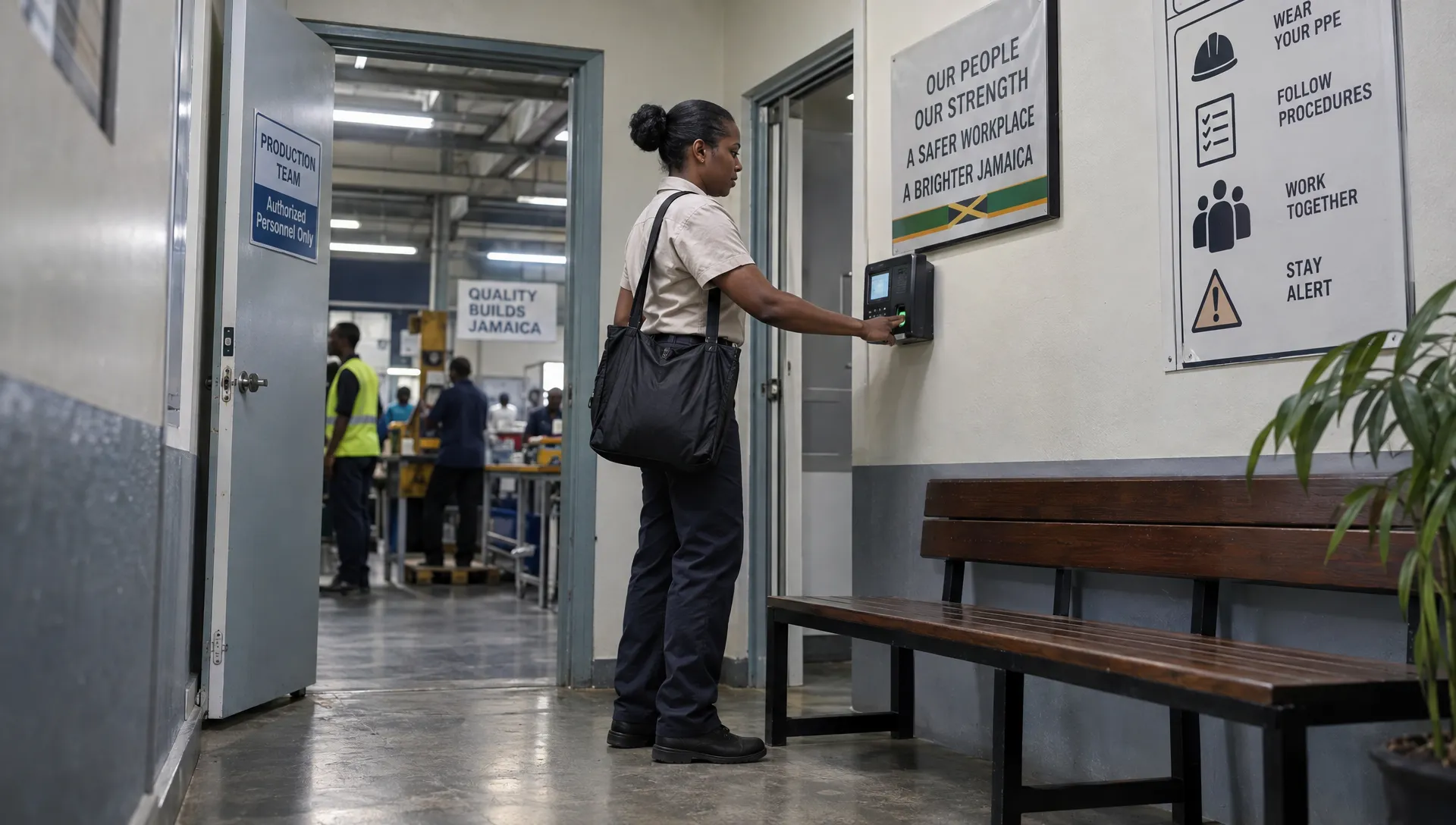
Biometric attendance systems can help Jamaican employers record working hours and reduce one employee clocking in for another. They also introduce a privacy risk that ordinary timesheets do not: the collection of identifying information drawn from an employee’s body. A fingerprint template or facial recognition record requires more careful handling than a staff identification number.
For HR teams, business owners and compliance officers, the central question is not simply whether the technology works. It is whether collecting biometric information is lawful, necessary and proportionate to the attendance problem being addressed.
Are biometric attendance systems lawful in Jamaica?
Jamaica’s Data Protection Act, 2020 has been in force since 1 December 2023. It regulates the processing of personal data, with additional protections for sensitive personal data, including biometric data. The Office of the Information Commissioner oversees the country’s data protection framework.
An employer should not assume that biometric timekeeping is automatically prohibited or automatically permitted. The proposed processing needs a lawful basis, an applicable condition for processing sensitive personal data and compliance with the Act’s wider requirements.
A legitimate need to record attendance does not automatically establish a need to collect fingerprints or facial templates. An organisation must assess the method it proposes to use, not just the business purpose behind it.
That assessment should address fairness, transparency, security, retention and employee rights. Employment contracts, collective agreements and workplace policies may also affect implementation, particularly where an employer proposes to make enrolment compulsory or attach disciplinary consequences to refusal.
Establish necessity before buying the system
Start by defining the problem. Is the organisation dealing with inaccurate timesheets, shared access cards, disputed overtime or unauthorised entry? Those are different problems and may require different solutions.
Compare the proposed biometric system with less intrusive options, such as individual access cards, PIN-based clocking or supervisor-approved attendance records. Document why those alternatives would or would not meet the organisation’s needs.
Convenience alone is a weak justification for collecting sensitive information. A documented pattern of attendance fraud may support a stronger business case, but the employer must still assess whether the chosen technology is proportionate.
The configuration matters too. A device that verifies a worker against their own enrolled template is different from a camera that searches a workforce database to identify everyone entering a room. Continuous facial recognition may collect considerably more information than a deliberate clock-in action.
For biometric attendance systems, the assessment should cover both the technology selected and how narrowly it can be configured. Complete a documented data protection impact assessment before enrolment and confirm the organisation’s applicable assessment, submission, registration and data protection officer obligations.
Employee consent is not a complete compliance strategy
A signed consent form does not resolve every privacy issue. Employees may feel they have little practical choice when the request comes from the organisation that controls their pay and continued employment.
Where consent is proposed, assess whether it is genuinely informed, specific and freely given. For sensitive information, examine whether the Act’s explicit-consent condition can actually be satisfied. Explain what happens if someone declines enrolment or later seeks to withdraw consent.
Consent is not necessarily the only available condition. However, an employer considering an employment-related condition must identify the relevant legal right or obligation and establish why the biometric processing is necessary for it. A general obligation to maintain accurate payroll records does not, by itself, prove that fingerprints are necessary.
Avoid inserting a broad monitoring clause into an employment contract and treating it as unlimited permission. Separate attendance recording from additional purposes, such as security investigations or productivity analysis.
Before threatening disciplinary action for refusal, obtain advice on both data protection and employment law. The organisation should understand its legal position, any contractual requirements and whether a workable non-biometric alternative is available.
Map what the system actually collects
Ask the supplier for a data-flow description before signing a contract. Marketing descriptions such as “secure biometric attendance” do not explain what information is collected or where it goes.
A system may capture a fingerprint image, generate a mathematical template, link that template to an employee number and send attendance events to payroll. Each stage creates a separate question about access, storage and necessity.
Data involved | Main privacy concern | Practical control to assess |
Raw fingerprint or facial images | Unnecessary retention of identifying source material | Establish whether images can be discarded after template creation |
Biometric templates | Continued identification and misuse if compromised | Restrict access and assess encryption, segregation and template protection |
Clock-in and clock-out logs | Detailed records of employee movements | Limit use to defined attendance and related lawful purposes |
Administrator logs and backups | Hidden copies or excessive access | Apply access controls, audit logging and a documented deletion process |
A biometric template is not automatically anonymous. If it can identify an employee or be linked back to them, it remains relevant to the data protection assessment. A supplier’s claim that information is “hashed” does not settle that question.
Map device storage, cloud hosting, payroll integrations, support access and subcontractors. The firm’s practical checklist for Jamaican data protection compliance can help place this exercise within the organisation’s wider compliance programme.
Give employees a clear notice before enrolment
Employees should receive an understandable explanation before their biometric information is collected. A device-side sign saying “scan here” is not an adequate privacy notice.
The notice should explain:
Purpose and justification: Why the organisation needs the information and the legal grounds it relies on.
Data collected: Whether the system stores images, templates, attendance events or a combination of these.
Recipients and locations: Who can access the information, including suppliers and overseas support teams.
Retention: How long different records are kept and what happens when employment ends.
Choices and exceptions: How objections, accessibility needs and failed scans will be handled.
Rights and contacts: How employees can raise concerns or exercise applicable data protection rights.
Avoid promising that biometric information can “never be stolen” or that templates are impossible to misuse. Explain the safeguards accurately without offering guarantees the organisation cannot substantiate.
Where biometric attendance systems replace an established clocking process, communicate the change early. Consultation with employees or their representatives can identify problems that procurement teams may miss, including shared entrances, shift patterns and concerns about wage deductions.
Separate retention rules from supplier promises
Keep templates only for a justified period
Attendance logs and biometric templates do not necessarily need the same retention period. Payroll, tax or employment recordkeeping obligations may justify retaining particular attendance records without justifying continued retention of an employee’s biometric template.
Set separate rules for enrolment images, active templates, attendance events and backups. When someone leaves, remove their ability to use the system promptly and delete biometric information when there is no continuing lawful need for it.
If a dispute requires preservation, identify the records actually relevant to that dispute. Do not place the entire biometric database on indefinite hold without assessing necessity.
Put enforceable controls in the supplier contract
The employer will ordinarily be the data controller for its attendance purposes. Outsourcing storage does not remove its responsibility to assess the processing.
The contract should address processing instructions, confidentiality, security, subcontracting, incident reporting, assistance with employee requests and deletion or return of information. Investigate whether the supplier proposes to reuse employee data for analytics, product development or model training.
For cloud services, check hosting locations and remote support arrangements. Overseas access may raise transfer issues even where a supplier describes the product as locally available. The firm’s guidance on cross-border data handling explains why those arrangements need separate scrutiny.

Protect employees when scans fail or exceptions arise
A failed scan is not proof that an employee arrived late or missed a shift. Fingerprint readers can struggle with worn fingerprints, injuries or environmental conditions. Facial systems can also produce incorrect matches or fail to recognise an enrolled worker.
Provide a practical fallback and a human review process before disputed attendance data leads to withheld pay or disciplinary action. Keep a record of corrections so that recurring device problems can be identified.
Test biometric attendance systems against real working conditions, including shift changes, poor lighting and connectivity interruptions. The pilot should assess both accuracy and the time needed to resolve exceptions.
Absence records also need limits. For example, if an employee seeks leave for an overseas dental appointment with My Smile Dental in Sydenham, the attendance record should generally show approved leave, not dental treatment details. Any genuinely necessary supporting medical information belongs in a separately restricted process.
The same principle applies to accommodation requests. Managers may need to know that an alternative clocking method is authorised, without receiving the medical explanation behind it.
Prepare for employee requests and security incidents
Employees may ask what information the system holds, who has received it or why their attendance record is inaccurate. Establish who receives those requests and how HR, IT and the supplier will coordinate a response.
Do not assume that information held by the supplier falls outside the employer’s responsibilities. The organisation needs contractual and technical arrangements that allow it to retrieve relevant records. Its process should align with the rules for handling data subject access requests in Jamaica.
A security response plan should cover compromised administrator accounts, lost devices, exposed templates and supplier incidents. Identify who can suspend enrolment, disable integrations, preserve evidence and assess notification duties under the Act. Internal escalation must be fast enough to meet applicable statutory requirements.
Biometric compromise deserves particular attention because an employee cannot replace their fingerprint as they would a password. Some technologies can issue a new protected template, but that does not remove every risk associated with exposed source information.
Use a controlled rollout rather than immediate compulsory enrolment
Before launch, assemble a decision record containing the identified attendance problem, alternatives considered, legal assessment, impact assessment, employee notice and supplier terms. Assign responsibility for retention, access requests and incident response.
Run a limited pilot with a defined review date. Record false rejections, disputed entries, accessibility issues and any payroll corrections. Keep a non-biometric fallback available while the organisation evaluates the results.
After launch, review administrator access and deletion practices rather than relying on the original procurement approval. Any expansion from clocking attendance to tracking movements, investigating conduct or measuring productivity requires a fresh assessment of purpose and justification.
Frequently asked questions
Can a Jamaican employer require fingerprint attendance? Not simply because it owns the workplace or has purchased the device. The employer must establish a lawful basis, satisfy the relevant sensitive-data condition and meet wider data protection and employment obligations. Obtain advice before treating refusal as misconduct.
Is facial recognition less intrusive than fingerprint scanning? Not necessarily. Facial recognition can identify people at a distance or capture people who are not deliberately clocking in. The assessment depends on the system’s design, collection method and actual use.
Does storing templates instead of photographs remove the legal requirements? No. Templates linked to identifiable employees remain relevant to data protection obligations. Template-based storage may reduce certain risks, but it does not make the processing anonymous or automatically lawful.
Can an employee demand immediate deletion? That depends on the applicable right, the processing grounds and any lawful reason to retain particular information. Employers should assess the request rather than promise unconditional deletion or refuse it automatically.
Must employees receive a non-biometric option? The answer depends on the circumstances and legal justification. An alternative can be important when assessing genuine consent, accessibility, proportionality and fair treatment. It also provides operational resilience when equipment fails.
Review the legal position before collecting biometric data
Henlin Gibson Henlin advises on data privacy, compliance and risk. Before introducing or expanding biometric attendance systems, seek a coordinated review of the legal justification, supplier contract, employee communications and dispute procedures.
An early review can identify whether the proposed system is defensible, which safeguards need strengthening and whether a less intrusive approach would meet the same attendance objective.
This article provides general information, not legal advice on a particular workplace or system.