
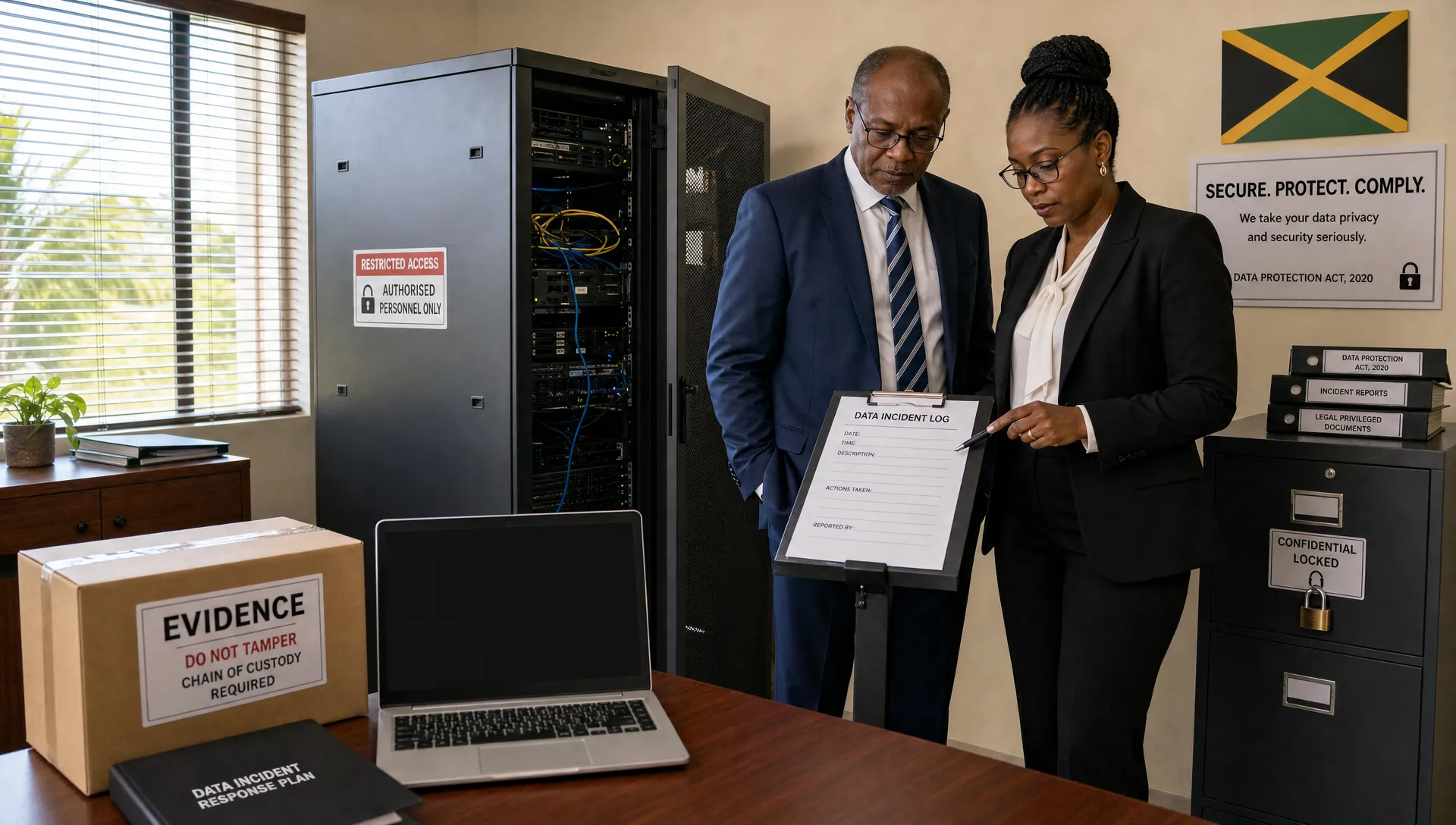
Data breach response is no longer just an IT exercise for Jamaican companies. It is a legal, operational, reputational, and customer trust issue that must be handled quickly and carefully. Under Jamaica’s Data Protection Act, 2020, companies that collect or use personal data need a practical plan for identifying incidents, assessing legal duties, communicating clearly, and reducing the risk of further harm.
The worst time to design that plan is after ransomware has locked your files, a payroll spreadsheet has been emailed to the wrong person, or a supplier tells you that customer records may have been exposed. By then, every hour matters.
This guide sets out the core data breach response steps every Jamaica company should have in place. It is not a substitute for legal advice on a specific incident, but it will help directors, managers, data protection officers, IT teams, and in-house counsel understand what a disciplined response should look like.
If your organisation is still strengthening its privacy baseline, it is worth reviewing a practical Data Protection Act requirements checklist before an incident occurs. Breach readiness is much easier when data mapping, governance, records, and security controls are already in place.
What counts as a data breach?
A data breach is not limited to a sophisticated cyberattack. In privacy law terms, it generally involves a security incident affecting personal data, including accidental or unlawful loss, destruction, alteration, unauthorised disclosure, or unauthorised access.
For a Jamaican company, that can include:
A stolen laptop containing employee or customer information
A misdirected email with payroll, account, medical, or identification data
Ransomware that encrypts files containing personal data
A cloud storage folder accidentally made public
An employee downloading client lists without authority
Paper files lost in transit or left in an unsecured location
A service provider confirming that your data was accessed by an unauthorised party
The key point is that a breach can be digital, physical, internal, external, accidental, or malicious. It can involve customers, employees, suppliers, patients, students, tenants, users, or any other identifiable individual.
It is also important to distinguish between a cybersecurity incident and a personal data breach. A blocked phishing attempt may be a security event, but not necessarily a reportable data breach. A misplaced HR file may involve no hacking at all, yet still trigger privacy obligations. For a deeper discussion of this distinction, see this guide on where data privacy and cybersecurity law overlap.
Step 1: Activate your incident response team immediately
Once a possible breach is discovered, the company should activate a small, authorised response team. Delays often happen because employees are unsure who owns the decision. A written escalation pathway removes that uncertainty.
The response team will usually include senior management, IT or cybersecurity personnel, legal counsel, the data protection officer or privacy lead, communications, HR if employee data is involved, and vendor management if a third-party processor is implicated. Regulated businesses may also need a contact responsible for sector regulator engagement.
Early legal involvement is important. Counsel can help determine whether the incident involves personal data, what legal duties may arise, whether notifications are required, and how to preserve legal privilege where litigation or regulatory scrutiny is reasonably anticipated.
The first internal message should be simple: preserve evidence, do not speculate, do not delete records, and route all external communications through the designated response team.
Step 2: Contain the breach without destroying evidence
Containment is urgent, but careless containment can make the investigation harder. The company’s goal is to stop ongoing exposure while preserving logs, devices, messages, and system records needed to understand what happened.
In a cyber incident, this may mean isolating affected machines, disabling compromised credentials, blocking suspicious IP addresses, suspending vulnerable integrations, rotating access keys, or temporarily taking a system offline. In a physical records incident, it may mean retrieving files, contacting the unintended recipient, securing storage areas, or confirming whether documents were copied.
Avoid premature wiping, reformatting, or broad system changes before forensic evidence is preserved. If outside forensic support is needed, engage it quickly and coordinate through legal and technical leads. The company may also need to notify its cyber insurer before incurring certain costs, depending on the policy.
Containment should be documented from the start. Record who made each decision, when it was made, what action was taken, and why. This becomes important later if the Information Commissioner, a court, a regulator, an insurer, or a commercial counterparty asks how the company responded.
Step 3: Identify the data, systems, and people affected
A breach assessment is only as good as the facts gathered. The response team should quickly build a working picture of the incident, then update it as evidence develops.
Your assessment should answer these core questions:
What happened, and when was it discovered?
Is the incident still ongoing?
What systems, files, accounts, devices, or records were affected?
What categories of personal data were involved?
How many individuals may be affected?
Are the individuals customers, employees, children, patients, financial clients, or another vulnerable group?
Was the data encrypted, anonymised, password-protected, or otherwise protected?
Was the data viewed, copied, exported, altered, deleted, or merely exposed?
Is a processor, supplier, cloud provider, payment provider, or contractor involved?
Could the incident cause identity theft, financial loss, discrimination, embarrassment, distress, fraud, or physical risk?
At this stage, the company should avoid making unsupported assurances such as no data was accessed unless the evidence actually supports that conclusion. A more accurate statement may be that the investigation is ongoing and that the company has not yet found evidence of unauthorised access.
Step 4: Assess legal risk and notification duties
Not every incident requires the same response, but every suspected breach should be assessed and documented. Under Jamaica’s data protection framework, the company needs to consider whether the breach creates risks to individuals and whether notification obligations arise under privacy law, contracts, employment obligations, sector rules, insurance policies, or cross-border laws.
A practical risk assessment should look at both the nature of the data and the likely consequences of the breach.
Risk factor | Why it matters | Practical questions to ask |
Sensitivity of data | Health, financial, identity, employment, or children’s data can increase harm | Could the data be used for fraud, discrimination, embarrassment, or coercion? |
Volume of data | Larger datasets can increase regulatory and reputational exposure | Is this one record, one department, or a full customer database? |
Identifiability | The easier it is to identify a person, the higher the privacy risk | Is the data directly identifiable or linked to other identifiers? |
Security controls | Encryption and access controls may reduce risk if properly implemented | Was the data encrypted, and were the keys also compromised? |
Recipient or attacker | Risk differs depending on whether data went to a trusted recipient or a criminal actor | Was the data sent to one known person, posted online, or exfiltrated? |
Likely harm | The response should match the real-world risk to people | What practical steps can affected persons take to protect themselves? |
The notification analysis should start early. Jamaican companies should aim to complete the legal assessment quickly, often within a 72-hour operational window from awareness, because privacy and sector-specific regimes can impose short reporting expectations. Do not wait until every technical detail is known before seeking legal advice. Regulators generally understand that investigations evolve, but they expect prompt, accountable action.
Step 5: Notify the right parties in the right way
Notification is one of the most sensitive parts of a breach response. A rushed notice can be inaccurate. A delayed notice can increase legal exposure and undermine trust. The correct approach depends on the facts, the level of risk, and the legal framework that applies.
Depending on the incident, a Jamaican company may need to consider notification to the Information Commissioner, affected individuals, contractual counterparties, insurers, banks, payment processors, law enforcement, sector regulators, or overseas regulators. A listed company or financial institution may have additional governance and reporting considerations.
Where affected individuals must be told, the notice should be clear, practical, and not overly defensive. It should generally explain what happened, what personal data was involved, what the company has done, what the individual can do to reduce risk, and who to contact for further information. If the facts are still developing, say so honestly.
The following timeline is a practical operating model, not a substitute for legal deadlines in a specific matter.
Time from discovery | Primary objective | Key actions |
0 to 4 hours | Escalate and contain | Activate response team, preserve evidence, isolate affected systems, secure records |
4 to 24 hours | Establish facts | Identify affected data, systems, users, vendors, and likely attack or error pathway |
24 to 48 hours | Assess legal duties | Evaluate risk to individuals, contractual duties, regulator issues, and insurance requirements |
48 to 72 hours | Prepare decisions and notices | Decide whether notifications are required, draft accurate notices, approve communications |
After notification | Remediate and monitor | Support affected persons, continue investigation, patch weaknesses, document lessons learned |

Step 6: Manage third-party and cross-border complications
Many breaches do not happen entirely inside the company. Cloud providers, payroll vendors, payment processors, call centres, logistics partners, software platforms, and professional advisers may all handle personal data on your behalf. If a processor discovers a breach, your contract should require prompt notice, cooperation, evidence preservation, and support for regulatory or individual notifications.
Do not assume that a vendor’s incident is only the vendor’s problem. If the data relates to your customers, employees, or clients, your company may still have obligations as the data controller or as a party responsible to affected individuals and regulators.
Cross-border incidents add another layer. A Jamaican company may face foreign privacy rules if it handles data about individuals overseas, has overseas operations, uses foreign processors, or serves customers in regulated markets. It may also need local legal advice where the breach intersects with public contracts, administrative investigations, or sanctions outside Jamaica. For example, businesses with Colombian exposure may need to coordinate with specialists such as Diana Ordoñez Abogada while Jamaican counsel manages domestic data protection obligations.
The practical lesson is simple: build cross-border escalation into your breach plan before an incident. Identify which markets matter, which contracts impose notification deadlines, and which external advisers may need to be contacted quickly.
Step 7: Keep a defensible breach record
A company should keep an internal breach file even where it decides that external notification is not required. That file helps prove that the organisation took the incident seriously, assessed risk, and made reasoned decisions based on available evidence.
A strong breach record will usually include the incident timeline, discovery date, containment steps, people involved, systems affected, categories of personal data, number of individuals affected, risk assessment, legal analysis, notification decisions, copies of notices, communications with vendors, remediation steps, and board or management approvals.
This record should be factual and disciplined. Avoid blame-focused commentary, casual speculation, or unsupported conclusions. If litigation is possible, legal counsel should guide how the investigation report is structured and circulated.
Step 8: Communicate without making the situation worse
Breach communication must balance transparency with accuracy. Customers and employees want clear information, not technical jargon or vague reassurances. Regulators want accountability, not excuses. Commercial partners want to know whether their data, systems, or customers are affected.
Before communicating externally, agree on approved messages for affected individuals, call centre staff, customer service, business partners, media enquiries, and internal employees. Everyone should know who is authorised to speak for the company.
The tone matters. A good breach notice is calm, specific, and helpful. It should avoid minimising the incident before the investigation is complete. It should not shift blame to a vendor if the company remains legally accountable. It should also avoid promising outcomes that cannot be guaranteed, such as saying identity theft will not occur.
If customers are affected, practical support can reduce harm. Depending on the incident, that may include password reset instructions, fraud monitoring guidance, account alerts, replacement credentials, dedicated support channels, or reminders about phishing attempts that may follow a breach.
Step 9: Fix the root cause and update your privacy programme
The response is not complete when notices are sent. A breach should trigger a serious review of the company’s technical, organisational, contractual, and governance controls.
Common remediation actions include patching vulnerabilities, resetting credentials, strengthening multi-factor authentication, improving access controls, encrypting portable devices, updating retention schedules, revising vendor contracts, training employees, improving logging, and testing backup restoration. For paper-based incidents, remediation may involve secure storage, courier controls, clean desk rules, file tracking, or changes to how documents are approved and transmitted.
A breach can also reveal weaknesses in the company’s lawful basis analysis, privacy notices, consent practices, and records of processing. If the incident shows that the company collected too much data, kept it too long, or failed to tell individuals how it would be used, the fix must go beyond cybersecurity. This is where broader compliance work on lawful bases, notices, and records becomes important.
Common mistakes Jamaican companies should avoid
Even well-resourced organisations can mishandle a breach if they act without a clear plan. The most common mistakes are usually preventable.
Treating the breach as an IT-only issue and involving legal too late
Deleting logs or wiping devices before evidence is preserved
Assuming a vendor breach creates no obligation for the company
Waiting for perfect information before starting the notification analysis
Giving customers vague or overly reassuring statements
Failing to document why notification was or was not made
Ignoring employee data because the focus is only on customers
Forgetting contractual notice deadlines in client, banking, insurance, or supplier agreements
Fixing the technical issue but not the governance failure that allowed it
The safest approach is to prepare a breach playbook, train the response team, and test the plan through tabletop exercises. A tabletop exercise does not need to be complicated. It can be a two-hour scenario in which management, IT, legal, HR, and communications walk through a simulated breach and identify gaps before a real incident occurs.
What should be in a Jamaica-ready breach response plan?
A useful plan should be short enough to use under pressure but detailed enough to guide real decisions. It should identify the response team, escalation triggers, emergency contacts, evidence preservation steps, vendor notification requirements, legal assessment criteria, approval workflows, communication templates, and post-incident review process.
It should also connect to the company’s wider privacy governance programme. If the organisation does not know what personal data it holds, where it is stored, who can access it, and which vendors process it, breach response becomes guesswork. Data mapping is therefore not just a compliance exercise. It is a crisis management tool.
For companies with significant personal data exposure, outside counsel can also help review contracts, insurance notice provisions, regulator strategy, and litigation risk. If you are assessing external support, this guide on how to choose data protection law firms explains what to look for in privacy counsel.
Frequently Asked Questions
Is every cyberattack a reportable data breach in Jamaica? No. A cyberattack becomes a data protection issue when personal data is affected or may have been affected. Even if notification is not required, the company should document its assessment and preserve evidence.
When should a company start the notification analysis? Immediately after becoming aware of a suspected breach involving personal data. The company should not wait for a complete forensic report before involving legal counsel and assessing whether regulators, affected individuals, insurers, or contractual partners must be notified.
Who should lead a data breach response? The response should be coordinated by an authorised incident team that includes management, IT, legal, privacy, communications, and relevant business leads. No single department should handle a serious breach alone.
What if the breach happened at a vendor or cloud provider? Your company may still have obligations if the affected data relates to your customers, employees, or business. Review the contract, require prompt facts from the vendor, preserve communications, and assess whether your company must notify anyone.
Should affected individuals be told before the investigation is finished? It depends on the risk and legal duties. In many cases, individuals may need timely notice even while the investigation continues. The notice should be accurate, practical, and clear about what is known and what is still being investigated.
What is the most important preparation step before a breach? Know your data. A company that has a current data inventory, clear vendor contracts, access controls, retention rules, and an escalation plan can assess and respond to a breach far faster than one that starts from scratch.
Build your breach response before the breach happens
A data breach can expose weak security, poor governance, inadequate contracts, and unclear decision-making all at once. The companies that respond best are not necessarily the ones with no incidents. They are the ones that can identify the problem quickly, protect affected people, meet legal duties, communicate responsibly, and learn from the event.
Henlin Gibson Henlin assists Jamaican businesses with data privacy, compliance, risk management, and dispute-related issues that can arise from serious data incidents. If your company handles personal data, now is the time to review your breach response plan, not after the first emergency call.