
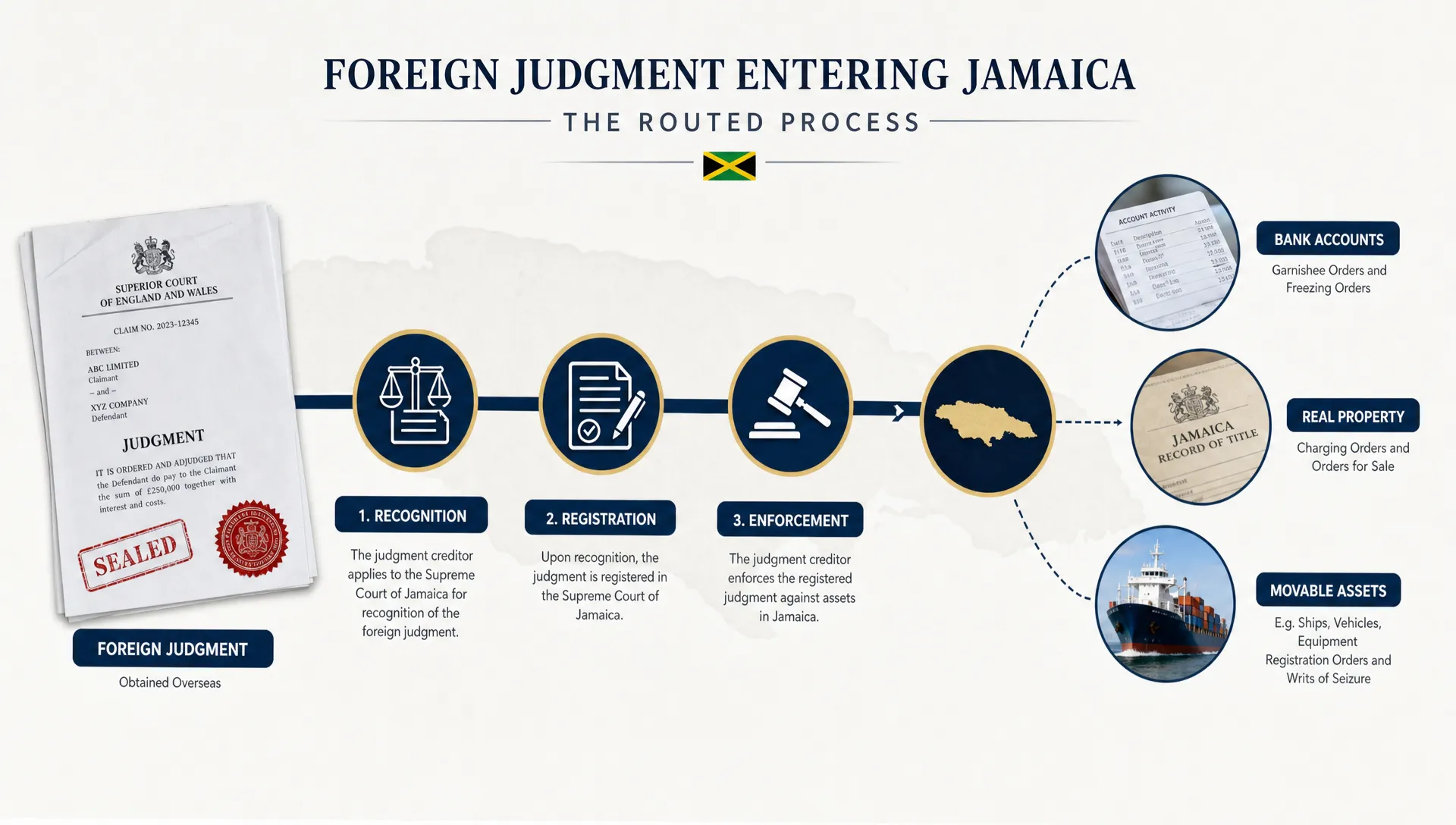
A foreign judgment can be a powerful asset, but it is not self-executing in Jamaica. If a creditor has won proceedings in another country and the debtor has assets, business operations or bank accounts in Jamaica, the creditor usually needs a local recognition or enforcement step before Jamaican enforcement mechanisms can be used.
The right route depends on the country where the judgment was made, the type of court that issued it, the wording of the order and the debtor’s likely objections. In commercial cases, this analysis should be done early, because delay can give a debtor time to move assets, restructure obligations or create procedural complications.
This guide explains the main ways to enforce a foreign judgment in Jamaica, what the Jamaican court will examine and how creditors can move from recognition to actual recovery. It is general information only and should not be treated as legal advice for any specific matter.
Recognition and enforcement are not the same thing
A foreign judgment may be persuasive evidence of a debt, but Jamaican enforcement officers cannot usually seize assets or attach debts simply because a foreign court made an order. The creditor first needs to make that judgment effective within Jamaica.
In practical terms, recognition means the Jamaican court accepts the foreign judgment as legally conclusive between the parties. Enforcement goes a step further: it allows the successful party to use local tools against assets in Jamaica.
That distinction matters. A debtor may accept that a foreign judgment exists but still resist enforcement by arguing, for example, that the foreign court had no jurisdiction over them, that they were not properly served or that the judgment is penal rather than compensatory.
The two main routes to enforce a foreign judgment in Jamaica
Foreign judgments are typically enforced in Jamaica through one of two routes: statutory registration, where available, or a common law claim based on the foreign judgment.
Issue | Reciprocal registration route | Common law action route |
When it applies | Where the judgment comes from a jurisdiction and court covered by Jamaica’s reciprocal enforcement framework | Where no reciprocal registration route applies, but the judgment satisfies common law requirements |
Main filing method | Application to register the judgment in the Supreme Court of Jamaica | Fresh claim in Jamaica treating the foreign judgment as a debt or obligation |
Court’s focus | Whether statutory requirements for registration are met and whether any set aside grounds apply | Whether the foreign judgment is final, conclusive, enforceable at common law and not subject to recognised defences |
Result if successful | The registered judgment can be enforced like a Jamaican judgment | The creditor obtains a Jamaican judgment, which can then be enforced locally |
Typical use case | Qualifying money judgments from reciprocating jurisdictions | Commercial judgments from non-reciprocating jurisdictions or courts not covered by the statute |
The choice is not always obvious from the face of the judgment. A creditor should check the source court, the legal nature of the order, the amount due, the status of any appeal and whether the debtor participated in or submitted to the foreign proceedings.
Route 1: registering a foreign judgment under reciprocal enforcement legislation
Jamaica has legislation dealing with reciprocal enforcement of certain foreign judgments. Where the statutory regime applies, the judgment creditor may be able to apply to the Supreme Court of Jamaica to register the foreign judgment rather than begin a full fresh lawsuit on the merits.
This route is generally designed for qualifying civil or commercial money judgments from recognised foreign courts. The details matter. A judgment will not automatically qualify merely because it comes from a Commonwealth country or from a major commercial jurisdiction. The current list of reciprocating jurisdictions, the relevant court, timing requirements and statutory exclusions should be checked before any filing is made.
A registration application will usually need to show that the judgment is final and conclusive, that a specific sum is payable, that the foreign court had jurisdiction according to Jamaican private international law principles and that enforcement would not offend Jamaican public policy or natural justice.
If the judgment is registered, it is treated much like a local judgment for enforcement purposes. The debtor will normally receive notice of registration and may have an opportunity to apply to set it aside on limited grounds. That set aside stage is often where disputes over service, jurisdiction or alleged unfairness are raised.
Route 2: suing on the foreign judgment at common law
Where statutory registration is not available, the creditor may still be able to enforce the foreign judgment by bringing a common law action in Jamaica. This is not a retrial of the foreign case. The claim is based on the principle that a final and conclusive foreign judgment creates an obligation that the Jamaican court can recognise.
In many commercial cases, the creditor’s claim will be framed as a debt arising from the foreign judgment. If the debtor has no arguable defence to recognition, the creditor may seek early judgment in Jamaica. If the debtor raises a recognised defence, the Jamaican court will examine that defence, but it will not ordinarily revisit the foreign court’s findings simply because the debtor disagrees with the outcome.
Common law enforcement is particularly important for judgments from jurisdictions that are not covered by a reciprocal enforcement statute. It is also relevant where the judgment falls outside a statutory registration regime but still meets the requirements for recognition at common law.
What the Jamaican court will look for
Before spending time and money on enforcement, a creditor should test the judgment against the core requirements. The strongest application is one where the court can quickly see that the foreign judgment is final, properly obtained and capable of local enforcement.
The judgment must usually be final and conclusive
A foreign judgment does not need to be immune from every possible procedural step, but it must generally be final in the sense that the foreign court has conclusively determined the parties’ rights. Interim orders, provisional remedies and orders that are still being actively reconsidered may require different treatment.
If an appeal is pending or the time for appeal has not expired, the Jamaican court may need to consider whether enforcement should proceed, be stayed or be conditioned on security. The answer will depend on the facts and the governing route.
The foreign court must have had jurisdiction
This is one of the most common battlegrounds. Jamaican law does not simply accept a foreign court’s view of its own jurisdiction. The enforcing court will ask whether the foreign court had jurisdiction in a way that Jamaican law recognises.
Relevant factors may include whether the debtor was present in the foreign jurisdiction when proceedings began, carried on business there, voluntarily appeared in the proceedings, agreed to a jurisdiction clause or otherwise submitted to the foreign court. A defendant who appeared only to challenge jurisdiction may be in a different position from one who defended the merits.
This is why cross-border contract drafting matters. Jurisdiction clauses, governing law clauses, service provisions and dispute resolution clauses can make later enforcement far more predictable. Businesses entering overseas transactions should review these issues at the contracting stage, not after default. Henlin Gibson Henlin has also outlined key drafting points in its guide to cross-border contracts and the terms Jamaican businesses should review.
The judgment should be for a definite civil obligation
The clearest cases involve a fixed sum of money due under a civil or commercial judgment. Orders for taxes, fines or penalties are usually treated differently and may not be enforceable through ordinary private judgment enforcement routes.
Non-money orders, such as injunctions or specific performance orders, require careful analysis. A Jamaican court may recognise certain foreign determinations for limited purposes, but direct enforcement of non-money relief can raise additional issues.
The process must have been fair
A debtor may resist enforcement by arguing that they were not properly served, had no fair opportunity to be heard or that the judgment was obtained in breach of natural justice. Default judgments are not automatically unenforceable, but the creditor should be ready to prove that the defendant received legally sufficient notice and that the foreign court’s process was fair.
Documents and evidence to prepare
A well-prepared enforcement file reduces avoidable objections. Creditors should not assume that the Jamaican court will infer missing procedural facts from the result alone.
Commonly useful documents include:
A certified or sealed copy of the foreign judgment and any related orders
Evidence that the judgment is final and remains unsatisfied, at least in part
Proof of service in the foreign proceedings and any appearance by the debtor
Copies of pleadings or reasons for judgment if they explain the basis of liability
Evidence of the amount due, including interest calculations and any payments received
Certified translations if any document is not in English
Information about Jamaican assets, bank relationships, receivables, land, vessels or business interests
Evidence supporting any urgent application to prevent asset dissipation
Where documents come from a foreign court, counsel should consider whether certification, notarisation or legalisation is needed. Small documentary gaps can become expensive if they allow the debtor to argue that the application is premature or unsupported.

How the process usually works in practice
The exact procedure depends on whether the creditor is using statutory registration or a common law action. Still, the practical flow is similar: assess the judgment, prepare evidence, file in the Supreme Court of Jamaica, address any debtor challenge and then enforce locally.
For a reciprocal registration application, the usual sequence is:
Confirm that the judgment qualifies: The creditor checks the source jurisdiction, the issuing court, the nature of the order, timing requirements and statutory exclusions.
Prepare the application evidence: The affidavit should exhibit the judgment, confirm the amount outstanding, explain finality and address jurisdiction, service and appeal status.
Apply to the Supreme Court of Jamaica: If the court is satisfied, it may order registration of the judgment on the required terms.
Serve notice of registration: The debtor is notified and may have a period within which to apply to set aside registration.
Respond to any challenge: If the debtor objects, the court determines whether a recognised ground for setting aside is made out.
Proceed to enforcement: Once the registration stands, the judgment creditor may use local enforcement mechanisms.
For a common law action, the creditor files a claim in Jamaica based on the foreign judgment. The debtor may defend on limited recognition grounds. If there is no real defence, the creditor may seek judgment without a full trial. If the matter is contested, the dispute usually centres on jurisdiction, natural justice, fraud, public policy, finality or satisfaction of the judgment.
Grounds on which a debtor may resist enforcement
A debtor cannot usually defeat enforcement by saying the foreign court made a factual or legal error. Jamaican courts are not there to conduct a general appeal from the foreign court. The recognised defences are narrower.
Common objections include lack of jurisdiction, improper service, breach of natural justice, fraud in obtaining the judgment, public policy concerns, lack of finality, prior satisfaction of the debt or an argument that the judgment is penal, fiscal or otherwise outside ordinary civil enforcement.
Fraud allegations require care. A debtor may not be allowed to dress up a losing argument from the foreign case as fraud. The court will want to know what fraud is alleged, when it was discovered and why it was not or could not have been dealt with in the original proceedings.
Public policy is also not a broad invitation to resist an inconvenient foreign judgment. The fact that Jamaican law might have approached the dispute differently will not necessarily make enforcement contrary to public policy. The objection is more likely to matter where enforcement would offend fundamental principles of justice or local law.
After recognition: turning the judgment into recovery
Winning recognition is only part of the task. The commercial question is whether the judgment can be collected. Creditors should identify assets before filing where possible, because enforcement strategy may influence the route, timing and urgency of the application.
Local enforcement may involve several tools, depending on the debtor’s asset profile and the type of Jamaican judgment obtained.
Enforcement objective | Possible local mechanism | Practical point |
Recover from bank accounts or receivables | Attachment of debts or garnishee-style relief | Useful where the creditor can identify a third party owing money to the debtor |
Seize movable assets | Writ or order for seizure and sale | Asset location and ownership evidence are important |
Reach land or valuable rights | Charging or other court-supervised remedies | Searches and title evidence may be needed |
Obtain information about assets | Examination or disclosure-related processes | Helpful where the debtor’s asset position is unclear |
Apply commercial pressure | Insolvency-related steps where legally available | Should be used carefully and only where the debt and statutory requirements support it |
The same practical questions that arise in local debt recovery also arise after a foreign judgment is recognised: Is the debtor solvent? Are the assets in the debtor’s name? Are there secured creditors ahead of you? Is there a realistic path to recovery? For a broader view of these commercial checks, see Henlin Gibson Henlin’s discussion of when court action makes sense for debt recovery in Jamaica.
If there is evidence that the debtor may dissipate assets, a creditor may need urgent interim relief. A freezing order is not a substitute for enforcement, and it is not granted simply because a creditor asks for one. The applicant must satisfy the legal test and provide strong evidence. Where asset preservation is a concern, the risks and obligations surrounding a freezing order in Jamaica should be considered early.
Special issues in cross-border judgment enforcement
Some foreign decisions require extra caution because they do not fit neatly into the standard money judgment model.
Foreign arbitral awards, for example, are not enforced in the same way as foreign court judgments. They are generally dealt with under arbitration legislation and applicable treaty frameworks. If your document is an arbitral award rather than a court judgment, the enforcement analysis will be different.
Judgments involving insolvency, admiralty and shipping, banking security, intellectual property or regulatory sanctions may also raise special issues. A foreign judgment against a company that owns a vessel, for instance, may call for a different asset strategy from a judgment against a trading company with Jamaican receivables. A judgment linked to banking facilities may require review of guarantees, security documents and competing creditor rights.
Currency and interest should also be addressed. The creditor should clearly explain the judgment currency, the amount outstanding, post-judgment interest claimed and any conversion into Jamaican dollars if that is being sought. The correct date and method for conversion can affect the value of the claim.
Practical strategy before filing in Jamaica
Before moving to enforce a foreign judgment in Jamaica, a creditor should step back and build a short enforcement plan. The legal route matters, but so does commercial leverage.
The plan should answer five questions. Does the judgment qualify for registration or require a common law action? What evidence proves service, jurisdiction and finality? What assets are in Jamaica? Is urgent preservation relief needed? What objections is the debtor likely to raise?
It is also worth considering settlement. The start of Jamaican enforcement proceedings can prompt a debtor to negotiate, particularly where local assets or banking relationships may be affected. Settlement discussions should not be allowed to compromise limitation periods or enforcement urgency, but they may reduce cost if the debtor has a genuine ability to pay.
Frequently Asked Questions
Can any foreign judgment be enforced in Jamaica? No. The judgment must satisfy the requirements of the applicable enforcement route. The Jamaican court will consider issues such as finality, jurisdiction, fairness, public policy and whether the judgment is the type that can be enforced locally.
Do I have to sue again in Jamaica from the beginning? Not necessarily. If reciprocal registration is available, the creditor may apply to register the judgment. If not, the creditor may bring a common law claim based on the foreign judgment, which is not usually a full rehearing of the original dispute.
Can a default judgment be enforced in Jamaica? Yes, a default judgment may be enforceable if it is final and the creditor can show proper service, jurisdiction and fairness. The debtor may still challenge enforcement if they can raise a recognised defence.
What if the debtor has no assets in Jamaica? Recognition may have limited immediate value if there are no reachable assets. Before filing, creditors should investigate bank accounts, receivables, land, shares, vessels, business operations and other possible enforcement targets.
Can the debtor challenge the foreign judgment on the merits? Usually not. Jamaican courts do not normally act as an appeal court for the foreign decision. Challenges are generally limited to recognised grounds such as lack of jurisdiction, fraud, breach of natural justice, public policy, non-finality or satisfaction.
Are foreign arbitral awards enforced the same way as foreign judgments? No. Arbitral awards are usually handled under arbitration enforcement rules, not ordinary foreign judgment enforcement rules. The correct process depends on the award, the seat of arbitration and the applicable legal framework.
Need advice on enforcing a foreign judgment in Jamaica?
Foreign judgment enforcement is time-sensitive and evidence-driven. The strongest applications are built around the right legal route, clean supporting documents and a realistic asset recovery strategy.
Henlin Gibson Henlin assists clients with cross-border disputes, commercial litigation, banking litigation, admiralty and shipping matters, arbitration-related issues and appellate work in Jamaica. If you need a law firm in Jamaica to assess recognition, registration or enforcement options, seek tailored advice before taking procedural steps.