
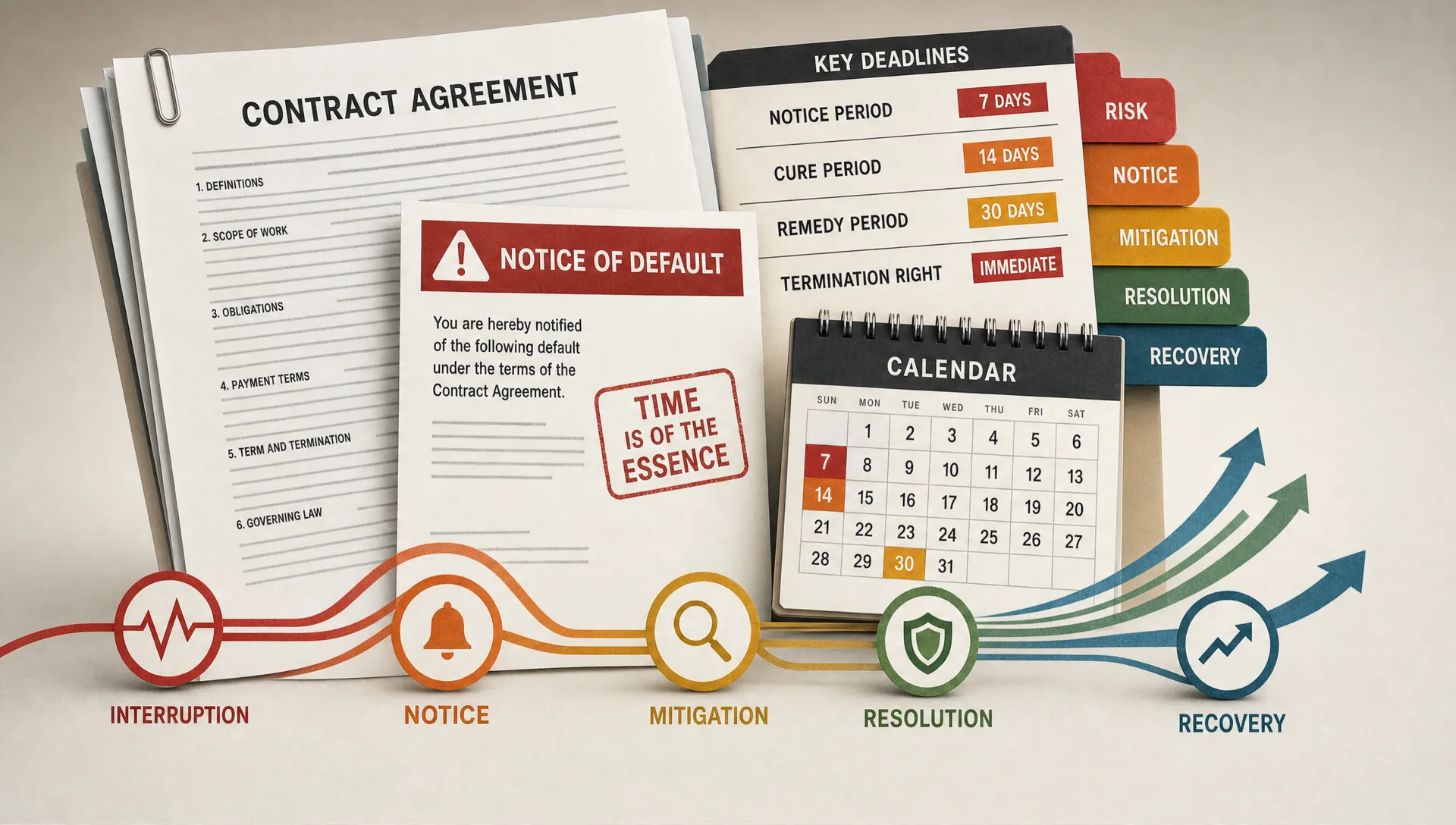
When a hurricane, port disruption, cyber incident, labour stoppage or sudden government measure interrupts business, the contract becomes more than paperwork. It decides who must perform, who gets more time, who absorbs cost and who may terminate.
A force majeure clause is the part of a contract that deals with extraordinary events outside the parties' control. It can protect a business from being treated as in breach when performance is genuinely prevented or delayed. It can also create hard procedural obligations, especially notice deadlines, that are easy to miss during a crisis.
For Jamaican companies, the practical question is not whether the disruption feels unfair. The question is whether the contract, read carefully, excuses or adjusts performance in the specific circumstances. This article gives a business-focused guide to reading, using and drafting force majeure clauses when disruption hits.
What a force majeure clause actually does
Force majeure is not a general right to walk away from a bad bargain. It is a contractual risk allocation tool. The parties agree in advance that if certain disruptive events occur, and those events affect performance in a defined way, the affected party may receive a particular form of relief.
That relief might be an extension of time, a temporary suspension of obligations, protection from damages for delay or a right to terminate if the disruption continues beyond a stated period. The clause may also require the affected party to notify the other side quickly, mitigate the effects and keep the other party updated.
In Jamaica, as in other common-law jurisdictions, force majeure depends heavily on the words the parties used. Courts do not usually rewrite a commercial contract just because performance has become more difficult or less profitable. The clause must be read in context, but its wording remains central.
A narrow clause that lists only hurricanes, earthquakes and war may not cover a supplier insolvency, cyber outage or port congestion. A broader clause may cover events beyond reasonable control, but even then the party relying on it must usually show a clear link between the event and the failure to perform.
Force majeure and frustration are not the same
Businesses sometimes treat force majeure and frustration as interchangeable. They are different concepts.
Force majeure comes from the contract. Frustration is a common-law doctrine that may apply where an unforeseen event makes performance impossible or radically different from what the parties agreed. Frustration is a high threshold and is not a routine solution for increased costs, reduced demand or a difficult market.
Issue | Force majeure | Frustration |
Source | Express wording in the contract | Common-law doctrine |
Threshold | Depends on the clause | Usually very high |
Typical trigger | Listed events or events beyond reasonable control | Event makes performance impossible or radically different |
Notice requirements | Often strict and time-sensitive | Not usually clause-based, but prompt communication still matters |
Effect | Suspension, extension, excuse from liability or termination, depending on wording | Contract may be discharged from the point of frustration |
English commercial decisions can be useful reference points in common-law analysis, although local advice is needed for Jamaican disputes. In Tandrin Aviation Holdings Ltd v Aero Toy Store LLC, the court rejected an attempt to rely on force majeure where the real issue was a market downturn and financing difficulty. The point for businesses is direct: ordinary commercial risk is not automatically force majeure.
Events that may trigger a force majeure clause
Most clauses contain either a list of covered events, a general catch-all phrase or both. The list matters. The catch-all matters too. A clause that refers to events beyond the reasonable control of the affected party may still require the event to be similar in nature to the listed examples, depending on the wording.
Common examples include:
Natural disasters such as hurricanes, floods, earthquakes and severe storms
Fire, explosion, epidemic, pandemic or public health restrictions
War, terrorism, civil unrest, riots and government action
Strikes, lockouts or industrial disputes, especially where they affect third parties
Port closures, shipping disruption, customs delays and transport interruptions
Utility failures, telecommunications outages, cyber incidents or system failures, if expressly covered
Shortage of materials or supplier failure, if the clause is drafted broadly enough
For Jamaican businesses, the risk profile often depends on sector. A hotel group may focus on storms, travel restrictions and utility interruption. An importer may care more about port closures, vessel delay and customs issues. A lender may be concerned with borrower default, collateral, notices and enforcement timing. A technology or data-driven business may need to address cloud service failures, security incidents and regulatory consequences.
A supplier's failure to perform is especially sensitive. If your supplier lets you down, that does not always excuse your obligation to your own customer. The question is whether your contract makes that supplier failure a force majeure event, whether there were alternative sources and whether you acted reasonably once the problem became known. If disruption begins upstream, our guide on what to do when a supplier suddenly fails to perform explains the immediate evidence, notice and contract-review steps that often matter.
The wording that decides whether the clause works
Small wording choices can change the outcome of a force majeure dispute. The most important words usually describe the required effect on performance.
If the clause says the event must prevent performance, the burden may be demanding. The affected party may need to show that performance was legally or physically impossible, not merely more expensive. If the clause says hinder or delay, it may be easier to rely on, but the party still has to prove real disruption.
Causation is another common battleground. The force majeure event must be the reason performance was not delivered as promised. If a business was already unable to perform because of cashflow problems, poor planning or lack of inventory, a later hurricane or port delay may not be enough.
The English Court of Appeal decision in Classic Maritime Inc v Limbungan Makmur SDN BHD illustrates why causation and the structure of the clause matter. A party relying on force majeure should be ready to show not only that the event occurred, but also how it affected the particular obligation in question.
Notice is not a formality
Many force majeure clauses require notice within a specific number of days after the affected party becomes aware of the event. Some require written notice to a named person or address. Others require details of the event, the obligations affected, expected duration and mitigation steps.
During a disruption, business teams often focus on operations first and paperwork later. That can be costly. If the clause makes timely notice a condition of relief, late or incomplete notice may weaken the claim even where the underlying event is serious.
A good force majeure notice should usually identify the contract, describe the event, explain the affected obligations, state the relief being claimed and reserve rights where appropriate. It should avoid exaggeration. If the full impact is not yet known, say so and commit to updates.
Evidence should be preserved from the beginning. Keep weather alerts, port notices, government orders, supplier communications, shipping records, emails, meeting notes, photographs, outage reports and internal mitigation logs. In commercial litigation Jamaica disputes, contemporaneous records often carry more weight than explanations prepared months later.

What relief can a force majeure clause provide?
The clause should be read all the way to the consequences section. Identifying a force majeure event is only the first step. The next step is to determine what the clause actually allows.
Type of relief | What it may mean in practice | Business risk to check |
Suspension | Obligations pause for the period of disruption | Does payment also pause, or only delivery or service obligations? |
Extension of time | Deadlines move by the length of the delay or a stated period | Does the extension apply automatically or only after notice? |
Excuse from liability | A party may avoid damages for non-performance caused by the event | Are there exclusions for money obligations or pre-existing breaches? |
Cost allocation | The contract states who bears additional costs | If silent, each party may argue for a different outcome |
Termination right | Either or one party may terminate after prolonged disruption | Check cure periods, refund obligations and transition duties |
Payment obligations deserve particular care. Many contracts treat the obligation to pay money differently from the obligation to deliver goods or services. A buyer may not be able to rely on force majeure merely because revenue has fallen or financing has become harder. Clear drafting is needed if the parties intend a different outcome.
Sector-specific concerns for Jamaican businesses
Force majeure risk is not identical across industries. The same storm, port closure or cyber event can affect contracts in different ways.
In admiralty and shipping, the clause may interact with charterparty terms, bills of lading, demurrage, laytime, cargo handling and port authority directions. Delay at one port can affect a chain of contracts, so notice must be coordinated carefully.
In construction and real estate development, force majeure often affects completion dates, liquidated damages, labour availability, materials, permits and insurance claims. A contractor may need to show that the delay sits on the critical path, not merely that some inconvenience occurred.
In banking and finance, disruption may affect covenants, reporting deadlines, payment defaults and enforcement steps. A borrower should not assume that a general force majeure clause excuses repayment unless the agreement clearly says so.
In technology, outsourcing and data-heavy contracts, a force majeure clause should be considered alongside data protection, cybersecurity, service levels, business continuity obligations and regulatory reporting. A cloud outage may delay performance, but it may also trigger contractual duties to notify, investigate and protect information.
How to draft a stronger force majeure clause
The best time to improve a force majeure clause is before disruption occurs. Generic boilerplate creates uncertainty. A stronger clause reflects the real risks of the business, the supply chain and the transaction value.
Drafting issue | Weak approach | Stronger approach |
Covered events | Acts of God and other events | Specific events tailored to the business, plus a carefully drafted catch-all |
Supplier failure | Silence on upstream disruption | State whether supplier, subcontractor or carrier failure is covered and when |
Cyber and technology risk | No reference to systems or cyber incidents | Address outages, attacks, platform failures and business continuity duties |
Notice | Notice as soon as possible | Clear timing, method, recipient and required content |
Mitigation | No express duty | Duty to use reasonable steps to avoid or reduce delay |
Consequences | Event excuses performance | State whether obligations are suspended, extended, terminated or adjusted |
Long disruption | No endpoint | Termination right after a defined period, with transition provisions |
A well-drafted clause should also work with the rest of the contract. Termination, insurance, limitation of liability, dispute resolution, governing law, confidentiality and payment provisions should not contradict the force majeure mechanism.
If the contract contains arbitration or mediation provisions, consider how quickly a dispute can be escalated. Arbitration and mediation may offer a practical path where parties want a commercial solution without immediately moving to court, but emergency relief may still be needed in some cases.
Immediate steps when disruption hits
When performance is under threat, delay can reduce options. A structured response helps management avoid accidental waiver, missed notice deadlines or inconsistent statements.
Read the entire contract, not just the force majeure heading.
Identify the exact obligations affected, including delivery, payment, reporting and confidentiality duties.
Check notice deadlines, method of service and required supporting details.
Preserve evidence showing the event, timing, impact and mitigation efforts.
Consider alternatives, including substitute suppliers, revised delivery routes, partial performance or temporary workarounds.
Communicate carefully with the counterparty and avoid admitting breach unnecessarily.
Track costs, losses and decisions in real time.
Seek legal advice before terminating, withholding payment or making a firm legal position known.
If the matter involves threatened termination, urgent court papers, a major default, frozen accounts or reputational risk, the timing of legal advice becomes critical. Henlin Gibson Henlin has also published guidance on when to contact legal counsel for an urgent business matter, which is useful where a disruption is moving quickly from operational problem to legal dispute.
Common mistakes to avoid
One common mistake is assuming that a serious event automatically excuses performance. Seriousness helps explain the context, but the contract decides the legal effect.
Another mistake is relying on force majeure when the real problem is price movement, reduced demand or lack of funds. Unless the clause clearly covers those risks, they often remain ordinary commercial risks.
A third mistake is sending a vague notice. A short email saying that the business is affected by circumstances beyond its control may not satisfy the contract. The notice should be specific enough to connect the event to the affected obligations.
Businesses also weaken their position when they stop communicating. Force majeure does not usually remove the duty to act reasonably, mitigate loss or update the counterparty. Silence can create commercial distrust and make later negotiation harder.
Finally, do not ignore dispute resolution clauses. A contract may require negotiation, mediation, arbitration or a particular court process before final relief is available. Missing those steps can create procedural complications.
Frequently Asked Questions
Does Jamaican law automatically excuse performance during a hurricane or major disruption? Not automatically. If the contract has a force majeure clause, the wording of that clause is the starting point. If there is no clause, a party may consider frustration, but that is usually a narrow doctrine and should not be assumed.
Is a hurricane always a force majeure event? A hurricane may be listed as a covered event, but the affected party still needs to show that it caused the relevant failure or delay and that any notice and mitigation requirements were satisfied.
Can force majeure excuse payment obligations? Sometimes, but many contracts treat payment obligations separately. A party should not assume that reduced revenue, financing difficulty or market conditions excuse payment unless the agreement clearly supports that position.
What should I do if the other party sends a force majeure notice? Review the clause, check whether the event is covered, ask for evidence of impact, assess your own mitigation options and reserve your rights where appropriate. A response should be prompt but careful.
Can we renegotiate instead of starting a dispute? Yes. Many force majeure situations are best handled commercially, especially where both parties want the relationship to continue. Mediation, standstill terms, revised deadlines and partial performance arrangements may preserve value while legal rights are protected.
Get advice before the clause becomes a dispute
Force majeure clauses can protect a business, but only when they are read, invoked and documented properly. They can also expose a business if notices are late, evidence is weak or the clause does not cover the disruption at hand.
If disruption is affecting a key contract, Henlin Gibson Henlin can assist with contract review, notices, negotiation, arbitration and commercial litigation strategy. For support from an experienced law firm in Jamaica, contact Henlin Gibson Henlin before positions harden and options narrow.