
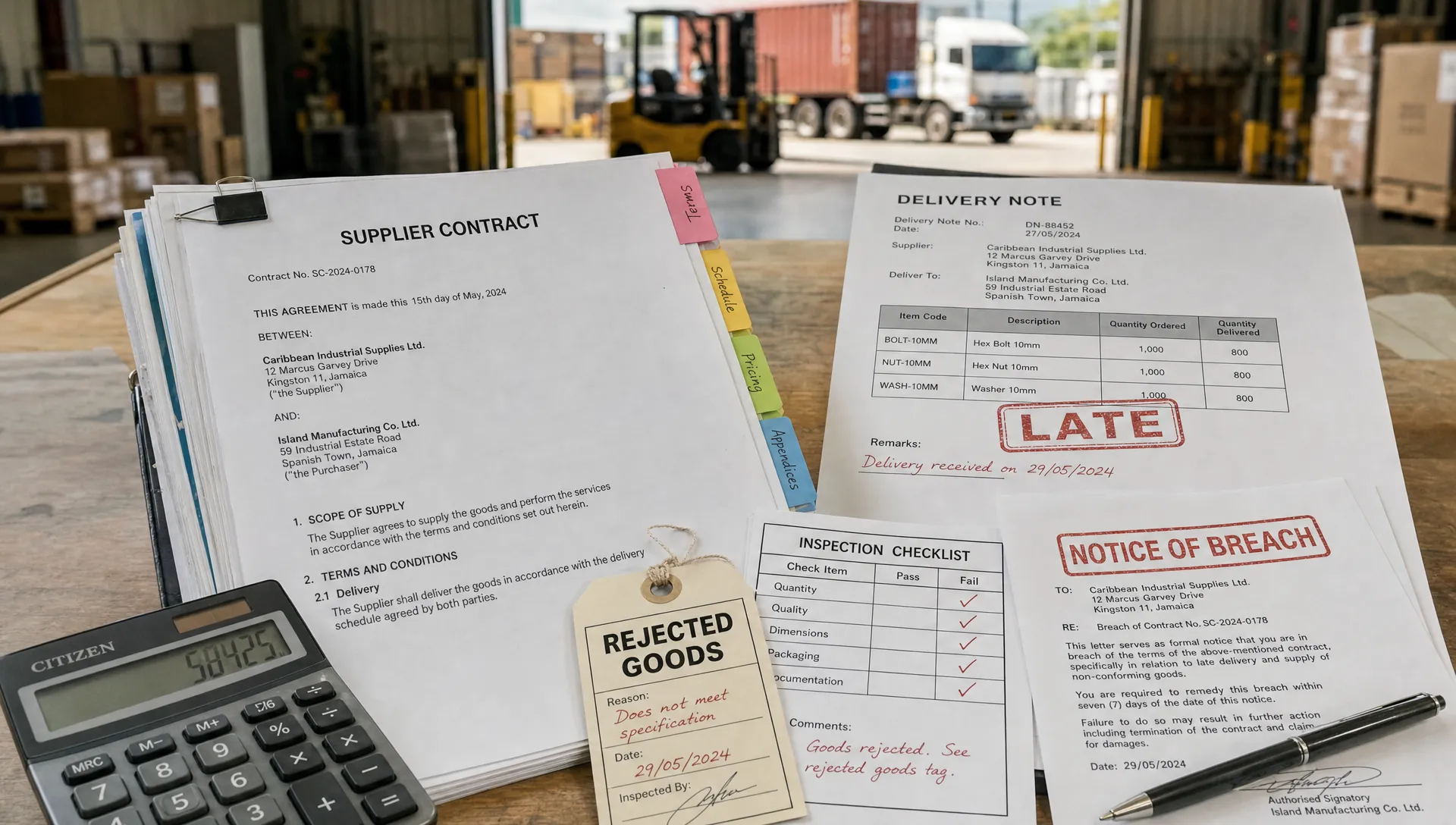
A supplier failure can move quickly from operational inconvenience to legal exposure. One missed shipment may delay production, trigger penalties under your own customer contracts, interrupt a construction timetable or leave you without critical inputs before a peak trading period.
The first instinct is often to send a sharp message, stop payment or find a replacement immediately. Those may be appropriate in some cases, but acting before you understand your contractual rights can make the dispute more expensive. The better approach is to stabilise the business, preserve evidence and make decisions that keep your legal options open.
This guide sets out practical steps Jamaican businesses can take when a supplier suddenly fails to perform, whether the issue involves late delivery, defective goods, non-delivery, service interruption or refusal to honour agreed terms.
1. Confirm what the supplier was actually required to do
Before treating the supplier as being in breach, return to the documents. A commercial relationship may involve more than one contract. The operative terms may be spread across a signed agreement, purchase order, quotation, statement of work, email exchange, delivery note, service level agreement or standard terms and conditions.
Focus first on the obligation that has not been performed. Was the supplier required to deliver by a fixed date, meet a minimum specification, provide ongoing support, maintain stock levels, obtain insurance or use a named carrier? A late delivery is not always the same as a repudiatory breach, and a defective delivery may trigger inspection, rejection or cure provisions before termination is available.
Also check whether your own business had to do something first. Suppliers sometimes fail because they did not receive approved artwork, site access, import documentation, payment, measurements, technical information or clear instructions. If your business contributed to the delay, the legal position becomes more nuanced.
Issue to check | Why it matters | Practical question |
Delivery date or milestone | Determines whether performance is late | Was time expressly stated to be critical? |
Specifications | Helps prove defective or incomplete performance | What objective standard did the supplier agree to meet? |
Payment terms | Affects suspension and set-off decisions | Are any invoices overdue, disputed or conditional? |
Notice clause | Controls how formal notices must be served | Is email valid notice or is written service required? |
Cure period | May prevent immediate termination | Must the supplier be given time to remedy the breach? |
Force majeure clause | May excuse or delay performance in limited circumstances | Did the event actually prevent performance? |
Dispute resolution clause | Dictates the route for escalation | Does the contract require mediation, arbitration or court proceedings? |
This review should happen quickly, but not casually. If the contract is valuable or the failure threatens your own obligations to customers, involve legal counsel before sending a termination notice or making statements that may later be relied on against you.
2. Preserve evidence before the story changes
Supplier disputes often turn on documents. The party with the clearest timeline usually has the advantage, especially where memories differ or senior decision-makers were not copied on early communications.
Create a central file containing the signed contract, purchase orders, invoices, delivery schedules, payment confirmations, WhatsApp messages, emails, photographs, inspection reports, meeting notes and call summaries. If goods were delivered late or in defective condition, record the date and time of delivery, who received them and what was observed. Photograph packaging, labels, serial numbers, damage and any missing components.
If the supplier promised performance verbally, make a contemporaneous note of who said what, when and in what context. Then confirm the conversation in writing using neutral language. For example: “Further to our call at 10:15 a.m. today, you advised that the remaining units will not be delivered this week and that you will provide a revised delivery date by 4:00 p.m.”
Avoid exaggeration. Words such as “fraud”, “abandonment” or “gross negligence” may feel justified in the moment, but they can distract from the core issue if you cannot prove them. A careful record of non-performance is usually more powerful than an angry accusation.
3. Send a clear notice, not an emotional complaint
Once you understand the contract and have gathered the essential evidence, notify the supplier in writing. The goal is to put the supplier on notice, reserve your rights and create a record that you acted reasonably.
A strong notice will usually identify the contract, describe the failure, refer to the relevant obligation, state the impact on your business, request immediate performance or a proposed remedy and reserve your right to claim losses. If the contract has a cure period, make sure your notice complies with it. If it specifies a method of service, follow it precisely.
Tone matters. A notice that is firm, factual and commercially sensible is harder to criticise later. It also leaves room for a practical solution if the supplier can still perform.
Avoid making threats you are not ready to carry out. If you say you will terminate by a specific date unless the breach is cured, make sure termination is legally available and operationally realistic. Wrongful termination can expose your business to a counterclaim, even if the supplier was initially at fault.
4. Test any force majeure or excuse for non-performance
Suppliers often explain sudden non-performance by pointing to events outside their control, such as port congestion, hurricanes, road disruption, overseas manufacturer delays, labour issues, cyber incidents, regulatory changes or unexpected price increases.
Those explanations matter, but they do not automatically excuse performance. Under Jamaican commercial practice, the starting point is the contract. If there is a force majeure clause, read it closely. The clause will usually define qualifying events, set out notice requirements and explain the consequences, such as suspension of obligations, extension of time or termination after a prolonged event.
A supplier relying on force majeure should usually be able to show a direct link between the event and the failure to perform. It should also show that it took reasonable steps to avoid or reduce the impact. Increased cost alone may not be enough unless the clause expressly covers that situation.
If there is no force majeure clause, a supplier may try to argue frustration of contract, but that is a narrow doctrine. It generally applies where an unforeseen event makes performance impossible or radically different, not merely more difficult or less profitable. This is a fact-sensitive issue and should be assessed carefully before either side takes a hard position.
5. Protect your operations and reduce losses
Legal rights are important, but the court or arbitral tribunal will also expect a claimant to act reasonably to reduce avoidable loss. This is often called mitigation. In business terms, it means you should take sensible steps to limit the damage caused by the supplier’s failure.
That may include sourcing replacement goods, reallocating stock, notifying affected customers, adjusting schedules, using temporary service providers, claiming under insurance or negotiating interim arrangements. Keep records of the additional costs and the reasons why you chose each option. If you later claim damages, you may need to prove that the replacement cost was reasonable in the circumstances.
For companies that rely on multiple B2B counterparties, supplier disruption is also a reminder to maintain a stronger pipeline of alternative vendors, partners and customers. Commercial teams that use tools such as Prosperian's AI-powered B2B prospecting platform may be better placed to identify and qualify new business contacts quickly, but operational and legal due diligence should still be carried out before switching to a new supplier.

When you take mitigation steps, do not destroy evidence. If defective goods need to be moved, repaired or replaced urgently, photograph them first and preserve samples where possible. If specialist testing is required, consider whether the supplier should be invited to attend or inspect, especially where the quality issue is disputed.
6. Be careful with payment, set-off and disputed invoices
Payment decisions are often where supplier disputes become more heated. A buyer may want to stop all payments immediately, while the supplier may continue issuing invoices despite late, incomplete or defective performance.
Whether you can withhold payment depends on the contract, the nature of the breach and the relationship between the unpaid invoice and the supplier’s failure. If the invoice relates to goods or services already accepted, withholding payment may be risky unless there is a contractual right of set-off or a genuine basis for disputing the amount. If the invoice relates to the failed performance itself, the position may be stronger.
The key is to separate undisputed sums from disputed sums. If part of an invoice is properly payable, paying that portion can show good faith and reduce the risk of escalation. For a deeper discussion of preserving commercial relationships when payment is contested, see this guide to handling a disputed invoice without damaging commercial relations.
Do not assume that simply labelling an amount as “set-off” will protect you. Set-off can be technical, especially where there are multiple contracts, cross-claims, insolvency concerns or financing arrangements. If the amount is substantial, get advice before withholding payment.
7. Decide whether you want performance, replacement or exit
Not every supplier failure should end in litigation. Sometimes the best outcome is a rapid cure, a revised delivery schedule, a price adjustment or a controlled transition to a new supplier. In other cases, the failure is serious enough that continuing the relationship creates greater risk.
Your response should match the commercial objective:
Cure: Appropriate where the supplier can still perform and delay has not destroyed the value of the contract.
Price reduction or credit: Useful where performance is late or defective but still has some value.
Replacement supply: Often necessary where your own customer obligations or production timelines are at risk.
Termination: Appropriate only where the contract or general law permits it and the business can manage the consequences.
Claim for damages: Relevant where the failure caused measurable loss, such as additional procurement costs, lost profit, penalties or wasted expenditure.
Termination deserves particular care. Some contracts allow termination for any material breach after notice and failure to cure. Others allow immediate termination for specified events, such as insolvency, abandonment, persistent failure, breach of confidentiality or non-compliance with law. If you terminate without a proper legal basis, the supplier may argue that your termination was itself a repudiatory breach.
If the supplier provides a business-critical service, consider whether termination creates transition risks. You may need access to data, tools, passwords, drawings, spare parts, customer records, stock, licences or subcontractor information. The contract may contain exit assistance obligations, but if it does not, leverage can disappear once termination is complete.
8. Consider the wider legal and regulatory risks
Supplier non-performance is not always a simple breach of contract issue. Depending on the sector, the failure may affect data protection, intellectual property, shipping, consumer rights, banking obligations, health and safety, employment arrangements or regulatory compliance.
If the supplier processes personal data for your business, a sudden failure may raise questions under Jamaica’s Data Protection Act, especially if access controls, breach reporting, data return or deletion obligations are affected. If the supplier is holding your confidential information, source code, designs, brand assets or customer lists, intellectual property and confidentiality protections may need immediate attention.
For importers, exporters and logistics-dependent businesses, a supplier failure may overlap with shipping documents, bills of lading, cargo damage, demurrage, marine insurance, customs issues or charterparty obligations. Those matters can involve short deadlines and specialised evidence, so early advice is important.
Where the supplier’s failure affects consumers, banks, regulated entities or public-facing services, reputational and compliance risks may be just as urgent as contractual recovery. Coordinate your legal response with operations, finance, compliance and communications so that the business speaks with one consistent voice.
9. Watch for insolvency warning signs
A sudden failure to perform may be a one-off operational problem. It may also be a sign that the supplier is in financial distress. Warning signs include repeated missed deadlines, requests for unusual advance payments, staff departures, inability to provide basic updates, unpaid subcontractors, bounced payments, abrupt changes in bank details or demands to renegotiate pricing midstream.
If insolvency is suspected, move carefully. Paying new advances without safeguards may increase your exposure. Termination rights may be affected by the contract and the legal status of the supplier. Recovery of goods, deposits or confidential information may become more complicated if other creditors are also making claims.
Practical protections may include requiring performance milestones, escrow arrangements, direct payment to critical subcontractors, retention of title clauses, parent company guarantees, performance bonds or letters of credit. Some of these tools must be built into the contract before a problem arises, but they may still be relevant if the parties negotiate a rescue plan.
10. Choose the right dispute resolution path
If the supplier does not cure the breach or offer a workable solution, escalation may be necessary. The right path depends on the contract, the amount at stake, the urgency of the issue and the relationship between the parties.
Negotiation is usually the first step, especially where the supplier remains important to your business. Mediation can be effective where both sides need a commercial solution but disagree about responsibility or compensation. Arbitration may be required if the contract contains an arbitration clause, and it can be useful for cross-border supply arrangements or confidential disputes. Litigation may be necessary where urgent court orders are needed, where there is no arbitration clause or where a binding public judgment is strategically preferable.
Potential remedies may include damages, debt recovery, declarations, injunctions, delivery up of property, specific performance in limited circumstances or interim relief to preserve assets or evidence. The availability of each remedy depends on the facts, the contract and the applicable law.
Prepare for dispute resolution as if the matter may proceed, even if you hope to settle. That means keeping the evidence organised, calculating losses carefully, preserving privilege over legal advice and ensuring internal messages do not undermine your formal position.
A practical first 72-hour plan
The first three days after a serious supplier failure often shape the outcome. A structured response can prevent avoidable mistakes.
Timeframe | Priority | Action |
First 24 hours | Stabilise facts | Gather contracts, purchase orders, emails, invoices and delivery records |
First 24 hours | Protect evidence | Photograph defects, record missed deliveries and document calls |
First 24 to 48 hours | Review legal position | Check notice, cure, termination, force majeure and dispute resolution clauses |
First 48 hours | Protect operations | Identify alternatives, customer impacts, insurance options and urgent deadlines |
First 48 to 72 hours | Send formal notice | Issue a factual notice reserving rights and requiring a clear response |
First 72 hours | Decide escalation | Assess whether to negotiate, mediate, terminate, replace or commence proceedings |
The plan should be adapted to the seriousness of the failure. A missed stationery delivery does not require the same response as a failed software implementation, cargo disruption or default by a sole-source construction supplier. The principle is the same: act quickly, but do not act blindly.
Frequently Asked Questions
Can I terminate the contract as soon as the supplier fails to deliver? Not always. You need to check the contract, the seriousness of the breach and any notice or cure requirements. Immediate termination may be available for certain serious breaches, but wrongful termination can create liability.
Should I keep paying the supplier during the dispute? It depends on the payment terms and whether the sums are genuinely disputed. In many cases, it is safer to separate disputed and undisputed amounts rather than withholding everything automatically.
What if the supplier blames a hurricane, port delay or overseas manufacturer? The supplier must usually show that the event falls within the contract’s force majeure clause and actually prevented performance. It may also need to show that it gave proper notice and took reasonable steps to reduce the impact.
Can I recover the extra cost of buying from another supplier? Often, yes, if the original supplier breached the contract and your replacement purchase was a reasonable mitigation step. Keep evidence of quotes, urgency, availability and why the replacement cost was necessary.
Is mediation worth considering in a supplier dispute? Yes, especially where the relationship has value or both parties need a fast commercial outcome. Mediation can preserve flexibility, but you should still prepare your evidence and legal position carefully.
When legal advice becomes urgent
Seek legal advice promptly if the supplier failure threatens major revenue, customer contracts, regulated obligations, confidential information, imported cargo, critical infrastructure, financial facilities or your ability to continue trading. You should also get advice before terminating, withholding substantial payments, making allegations of fraud or commencing urgent proceedings.
Henlin Gibson Henlin advises businesses on commercial disputes, arbitration and mediation, banking litigation, data privacy, intellectual property and shipping-related matters. If a supplier has failed to perform and you need to protect your position, contact Henlin Gibson Henlin for guidance tailored to your contract and commercial objectives.