
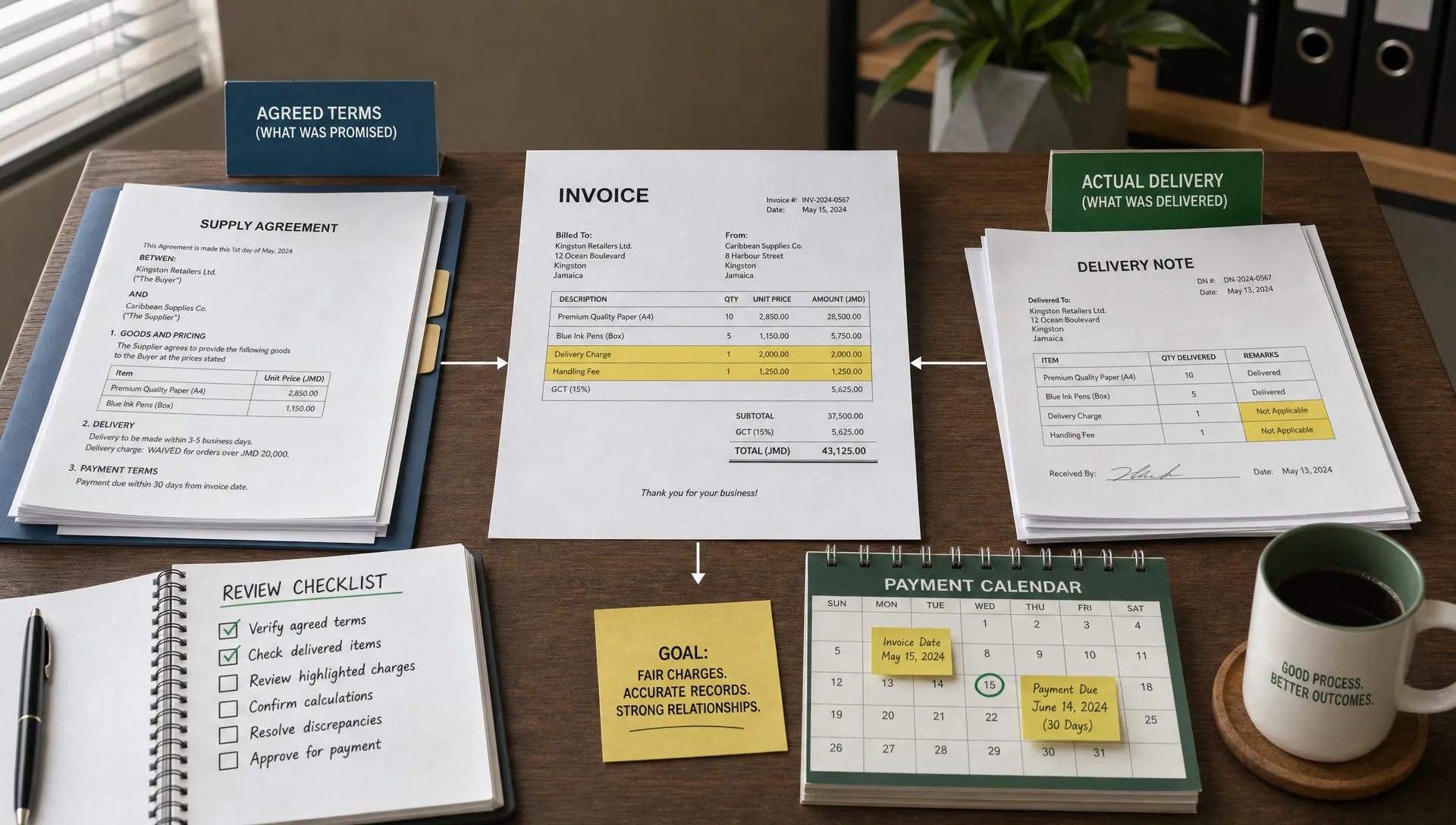
A disputed invoice can put a business relationship under immediate strain. One side sees unpaid money, the other sees an incorrect charge, unfinished work or a failure to honour agreed terms. If the first response is silence, blame or a threat, a manageable accounting issue can become a commercial dispute.
The better approach is disciplined and practical: clarify what is actually disputed, preserve the records, communicate quickly and leave room for a commercial solution. This is especially important in Jamaica, where long-term business relationships, referrals and reputation often matter as much as the immediate invoice value.
This article offers general guidance for businesses handling invoice disputes. It is not a substitute for legal advice on a specific contract, debt or dispute.
Why disputed invoices damage relationships
Most invoice disputes do not start as legal battles. They usually begin with a mismatch between expectations and paperwork. A supplier believes the job was completed, a customer believes the work was incomplete. A consultant bills for extra hours, the client says those hours were never approved. A shipping or logistics invoice includes storage, demurrage or handling charges that the customer did not expect.
The relationship usually deteriorates because the parties react to the emotion of the dispute rather than the substance. The supplier may feel disrespected. The customer may feel pressured or overcharged. Finance teams may chase payment without knowing the commercial history behind the invoice. Operational teams may promise credits or discounts without confirming legal or accounting consequences.
A disputed invoice should be treated as both a cash-flow issue and a relationship issue. That means you need enough structure to protect your rights and enough tact to keep the conversation open.
Start by identifying the real dispute
Before rejecting an invoice or demanding payment, isolate the reason for the disagreement. A vague complaint such as “this invoice is wrong” is hard to resolve. A specific dispute such as “the invoice charges 120 units but only 90 were delivered” gives both sides something to verify.
Use the contract, purchase order, proposal, delivery note, acceptance certificate and email trail to classify the issue. If the parties worked informally, create a chronology from messages, call notes and records of performance.
Type of invoice dispute | What to check first | Practical next step |
Price or rate dispute | Contract, proposal, fee schedule, quotation | Compare the billed rate with the accepted rate |
Quantity dispute | Delivery notes, timesheets, inventory records | Confirm what was actually delivered or performed |
Scope dispute | Statement of work, change requests, emails | Identify whether the billed item was included or extra |
Quality dispute | Inspection reports, photos, complaints, service records | Separate non-payment from claims about defective work |
Timing or milestone dispute | Project plan, completion certificate, acceptance terms | Check whether payment was due on delivery, approval or completion |
Tax or charge dispute | Tax invoice, GCT treatment, expense policy | Involve accounting or tax advisers where necessary |
Authority dispute | Purchase order, approval emails, internal policy | Confirm who had authority to order or approve the work |
This step matters because different disputes require different solutions. A clerical error can be corrected quickly. A quality complaint may require remedial work or a negotiated reduction. A disagreement over contract interpretation may need legal input before anyone makes admissions or concessions.
Preserve the record before positions harden
Invoice disputes often escalate because the parties rely on memory instead of evidence. Even if you expect the issue to settle, preserve the documents as if someone neutral may need to review them later.
Collect the signed contract, purchase orders, invoices, receipts, delivery records, emails, WhatsApp messages, meeting notes, photographs and any internal approval records. If several people were involved, ask each person to provide a short factual timeline while events are still fresh. Avoid editing or deleting messages that may be relevant.
This is not about preparing for a fight. It is about making negotiation more accurate. If the dispute later becomes formal, a clean record will help counsel assess the issues faster. Henlin Gibson Henlin has also covered how to assess litigation issues before they escalate, including the importance of identifying stakeholders and preserving evidence early.
Respond quickly, but do not overstate your position
Silence is one of the most damaging responses to a disputed invoice. If you received the invoice and disagree with it, acknowledge it promptly. If you issued the invoice and the customer challenges it, respond without taking the complaint personally.
A good first response should do four things: confirm receipt, identify the disputed items, request missing information if needed and set a short timetable for review. It should not accuse the other side of bad faith unless you have a strong basis for doing so.
Here is a simple wording you can adapt:
Thank you for your email regarding Invoice [number]. We understand that you dispute [briefly identify item]. We are reviewing the contract documents, delivery records and related correspondence and will revert by [date]. In the meantime, please send any specific documents or calculations you are relying on so that we can address the issue accurately. All rights are reserved.
If you are the party disputing the invoice, avoid language such as “we will never pay this” unless that is truly your position. A better approach is to state that payment is withheld pending review of specified issues. If part of the invoice is not disputed, say so clearly.
Separate the disputed amount from the undisputed amount
One of the best ways to preserve goodwill is to avoid treating the entire invoice as contaminated when only part of it is in issue. If JMD 800,000 is invoiced and only JMD 150,000 is disputed, the parties should consider whether the undisputed amount can be paid or credited separately.
For the customer, paying the undisputed portion may show good faith and reduce pressure. For the supplier, accepting partial payment without careful wording can create confusion if the customer later argues that the payment settled the whole account. The payment reference, receipt and covering email should therefore be clear.
For example, the customer might say that payment is made only in respect of the undisputed portion of Invoice [number] and that the remaining balance remains under review. The supplier might acknowledge receipt on that same limited basis. If the parties intend a payment to be full and final settlement, that should be documented carefully and usually reviewed by counsel before release language is signed.
Be especially careful with tax invoices, credit notes, GCT treatment and accounting entries. A commercial compromise may have accounting consequences, so finance and legal teams should work together rather than treating the issue as purely operational.
Keep the commercial solution visible
A disputed invoice does not always require a winner and a loser. In many cases, the solution is commercial rather than legal. The right outcome may be a corrected invoice, a credit note, additional work, a revised deadline or an agreed payment schedule.
Common settlement options include:
Corrected invoice: Use this where the dispute is caused by a clerical error, wrong rate, incorrect quantity or duplicated charge.
Credit or discount: Use this where there is a genuine performance issue but the relationship is worth preserving.
Remedial work: Use this where the supplier can fix the problem and the customer still wants the underlying product or service.
Staged payment plan: Use this where the debt is accepted but the customer needs time to pay.
Mutual release: Use this where the parties want finality and agree that no further claims will be pursued on the invoice.
The best commercial solution depends on leverage, evidence, relationship value and future business. A small concession may be sensible if it preserves a major client relationship. A firm legal position may be necessary if the same customer repeatedly raises weak disputes to delay payment.

Negotiate without weakening your legal position
Good negotiation is not the same as surrendering. You can be courteous and still protect your rights. The key is to avoid careless admissions, vague promises and undocumented side agreements.
Before a negotiation call, decide who will speak for the business. A finance officer may know the payment history but not the commercial background. A project manager may know the facts but not the legal effect of accepting a discount. Where the amount is significant, agree on the negotiation limits internally before speaking with the other side.
After each call, send a short written summary. Record what was agreed, what remains disputed and what each party will do next. If settlement terms are still being negotiated, say that clearly. If a final agreement is reached, document it in writing before changing invoices, releasing goods, suspending services or waiving rights.
Be careful with labels such as “without prejudice” or “subject to contract”. They can be useful in settlement discussions, but they should be used correctly. If the dispute is serious, legal advice can help ensure settlement communications are protected where possible and final documents say what the parties intend.
Know when to involve legal counsel
Not every disputed invoice needs a lawyer. Many are resolved by accounts teams and commercial managers. Legal support becomes valuable when the amount is substantial, the facts are contested, the contract is unclear or the relationship is already under strain.
Consider legal input where:
The other party threatens to terminate a contract, suspend performance or report the matter externally.
The invoice relates to a regulated industry, shipping transaction, banking facility or public procurement issue.
There are allegations of fraud, misrepresentation, defective work or breach of confidentiality.
The dispute involves cross-border parties, foreign currency, jurisdiction clauses or arbitration provisions.
The debt is old, repeated or part of a wider pattern of non-payment.
You need to issue a demand letter, settlement agreement or formal notice under the contract.
Early legal input does not mean immediate litigation. In many cases, counsel can help narrow the issues, draft measured correspondence and propose a settlement route that protects the business relationship. If negotiation stalls, structured processes such as mediation or arbitration may be appropriate. For a broader view of escalation options, see this guide to practical solutions legal teams use to solve disputes.
If the contract contains an arbitration clause or the dispute involves confidentiality, enforcement or technical evidence, the choice of forum matters. Henlin Gibson Henlin has explained key considerations in choosing between arbitration and litigation, which can be useful where an invoice dispute is no longer just an accounting disagreement.
Points Jamaican businesses should keep in mind
For businesses operating in Jamaica, invoice disputes often sit at the intersection of contract law, commercial practice, tax compliance and reputation. The first question is usually contractual: what did the parties agree, who had authority to agree it and when did payment become due?
Late payment interest, administrative charges and collection costs should not be assumed. They are easier to pursue where the contract, accepted terms or applicable law provides a clear basis. If those charges appear only on an invoice sent after the deal was made, they may be harder to enforce.
If the invoice contains personal information, customer data or employee details, be careful about how it is shared during collection or escalation. Jamaica’s data protection framework may be relevant where personal data is processed, disclosed or transferred. Businesses should also consider confidentiality clauses before forwarding contracts, invoices or correspondence to third parties.
In shipping, logistics and international trade, invoice disputes can become more complex. Charges may turn on bills of lading, charterparty terms, delivery windows, port charges, demurrage, storage or foreign exchange provisions. In those cases, admiralty and shipping experience can help the parties distinguish between a simple billing error and a contractual liability issue.
A practical 7-day plan for a disputed invoice
Speed helps, but only if it is organised. The following plan can help a business respond within a week without rushing into a damaging position.
Timing | Action | Goal |
Day 1 | Acknowledge the dispute or objection in writing | Prevent silence from escalating tension |
Day 2 | Gather contracts, invoices, delivery records and correspondence | Build a factual record |
Day 3 | Identify the exact disputed items and undisputed amount | Narrow the issue |
Day 4 | Hold an internal review with finance, operations and management | Align commercial and legal priorities |
Day 5 | Speak with the other party using a clear agenda | Test whether settlement is possible |
Day 6 | Send a written summary and proposed resolution | Avoid misunderstanding |
Day 7 | Escalate for legal review if no progress is made | Protect rights before positions harden |
The timetable can be adjusted for urgent or high-value disputes, but the sequence is useful. Acknowledge, investigate, narrow, negotiate, document and escalate only when needed.
Frequently Asked Questions
Should I refuse to pay the whole invoice if only part is disputed? Usually, it is better to identify the disputed and undisputed portions separately. Paying or accepting the undisputed amount can preserve goodwill, but the wording should make clear what remains unresolved.
Can I charge interest on an unpaid disputed invoice? It depends on the contract, accepted terms and applicable law. Before adding interest, late fees or collection costs, check whether there is a clear legal or contractual basis.
Should I mark emails “without prejudice” during invoice negotiations? It may be appropriate for genuine settlement discussions, but the label should not be used casually. If the dispute is significant, ask counsel how to frame settlement communications.
When does a disputed invoice become a legal dispute? It becomes more serious when the parties deny liability, threaten termination, allege breach of contract, refuse to share documents or stop negotiating. At that point, legal review can help prevent mistakes.
Can mediation help with an invoice dispute? Yes. Mediation can be useful where both sides want a practical resolution and an ongoing business relationship matters. It can also help where emotions or communication breakdowns are blocking settlement.
Need help resolving a disputed invoice?
A disputed invoice should be handled firmly, but not recklessly. The goal is to protect cash flow, preserve evidence and leave space for a sensible commercial outcome.
If an invoice dispute is affecting your business, Henlin Gibson Henlin can assist with commercial litigation, arbitration and mediation, contract review and strategic dispute resolution in Jamaica. Early advice can help you decide whether to negotiate, settle, escalate or enforce your rights with confidence.