
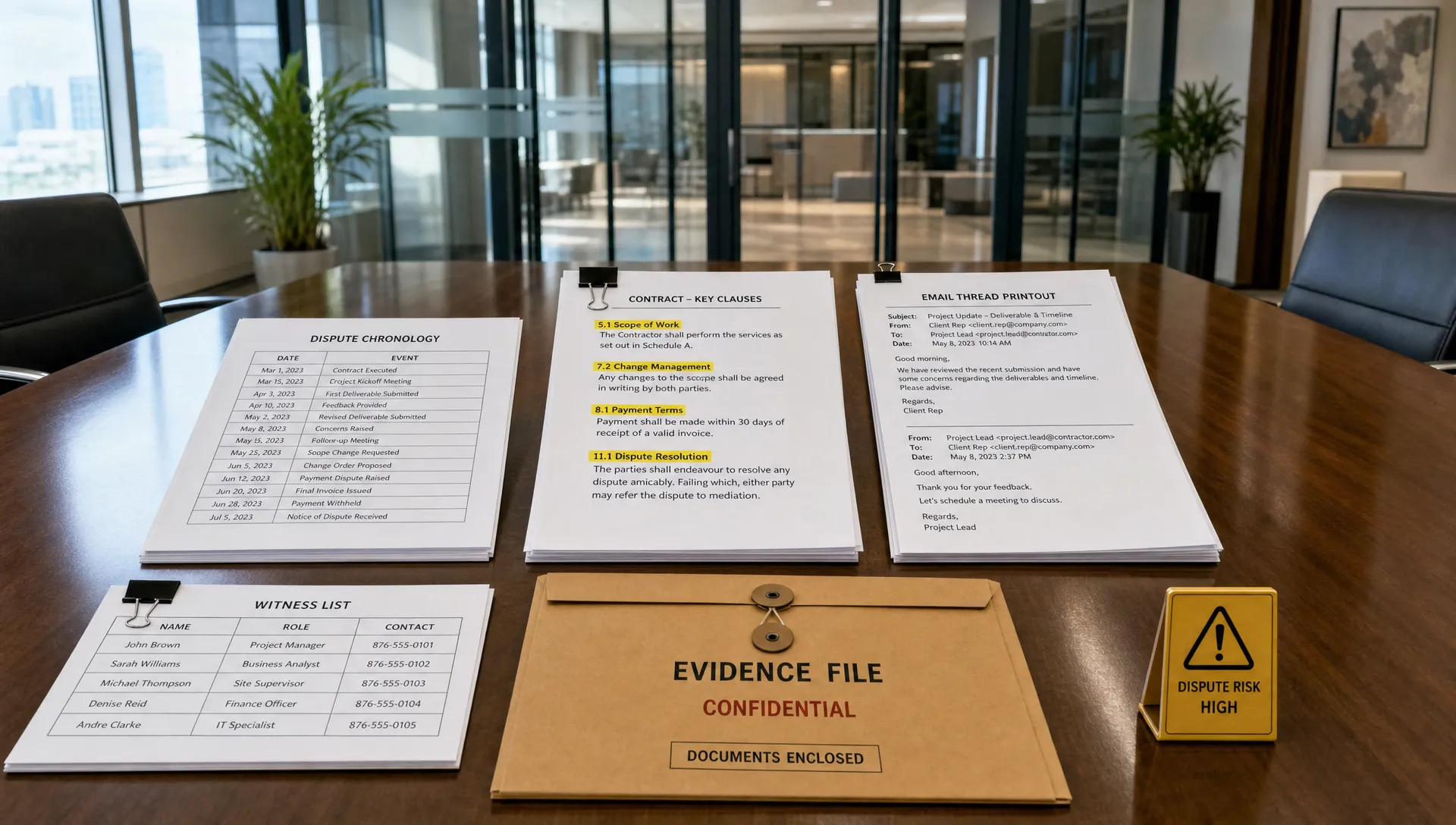
Most disputes do not become expensive overnight. They escalate because warning signs are missed, evidence is not preserved, decision-makers delay, or the business treats a legal risk as only an operational inconvenience. By the time a claim is filed, the organisation may already be dealing with urgent deadlines, strained relationships, reputational pressure, and avoidable legal costs.
Assessing litigation issues early is therefore not about being aggressive. It is about understanding risk before the dispute controls the business. For Jamaican companies, directors, professionals, public-facing organisations, and individuals involved in high-value disagreements, a disciplined early assessment can make the difference between a contained dispute and a long, costly fight.
What does it mean to assess litigation issues early?
Early litigation assessment is the process of identifying the legal, factual, commercial, and procedural risks in a dispute before it escalates. It helps you answer practical questions: What happened? What rights were breached? What evidence exists? What are the likely remedies? What deadlines apply? Is settlement realistic? Should the matter go to court, arbitration, mediation, or negotiation?
This is broader than asking, “Can we sue?” or “Can they sue us?” A proper assessment looks at both sides of the dispute. It tests strengths, weaknesses, costs, timing, enforcement, reputational exposure, and business disruption.
If your organisation is already seeing repeated contract issues, unpaid invoices, shareholder tension, procurement concerns, employee complaints, or customer disputes, it may be useful to compare those patterns with the commercial litigation risks Jamaican businesses should watch. The earlier those patterns are recognised, the more options you usually have.
Warning signs that a dispute may escalate
Not every disagreement becomes litigation. Some conflicts are resolved through discussion, a corrected invoice, a clarified contract clause, or a revised delivery schedule. Others show signs that the relationship is deteriorating and that legal intervention may soon be necessary.
Common escalation signals include:
A party stops responding or communicates only through formal letters.
Payment delays become repeated, unexplained, or strategic.
One side begins alleging fraud, bad faith, misrepresentation, or breach of trust.
Key documents are missing, altered, withheld, or disputed.
Employees, directors, customers, or suppliers begin giving conflicting accounts.
A party threatens to terminate a contract, report the matter to a regulator, or issue court proceedings.
The dispute starts affecting cash flow, operations, reputation, or investor confidence.
The most important point is timing. Once emotions harden and positions become public, settlement can become more difficult. Early assessment gives you space to choose a proportionate response instead of reacting under pressure.
Step 1: Define the real dispute, not just the complaint
The first mistake many organisations make is accepting the first version of the problem as the legal issue. A customer complaint may actually be a contract interpretation issue. A supplier dispute may reveal procurement weaknesses. A shareholder disagreement may involve fiduciary duties, company records, disclosure obligations, or governance failures.
Start by separating the facts from assumptions. Identify what is known, what is alleged, what is disputed, and what must be verified. Create a short chronology of events, including dates, meetings, correspondence, payments, approvals, and performance milestones.
Then ask: What is the real source of conflict? Is it non-payment, poor performance, delay, defective goods, breach of confidentiality, misuse of intellectual property, regulatory non-compliance, or a breakdown in governance?
This framing matters because the remedy depends on the legal issue. The same facts may support a claim for debt, damages, injunction, account, specific performance, declaratory relief, or another remedy. If the issue is framed incorrectly at the start, the entire strategy may move in the wrong direction.
Step 2: Identify the parties and stakeholders
Litigation risk often extends beyond the two parties named in a dispute. Directors, guarantors, insurers, lenders, contractors, agents, employees, regulators, customers, and affiliated companies may all be relevant.
For example, a construction dispute may involve the employer, contractor, subcontractor, architect, engineer, quantity surveyor, insurer, and financing institution. A data privacy complaint may involve the company, its service providers, IT vendors, employees, and affected customers. A shipping or admiralty matter may involve cargo owners, carriers, charterers, ports, insurers, and banks.
This stakeholder map helps determine who must be notified, who controls key records, who may become a witness, and who could be joined to any proceedings.
It also reminds businesses that litigation issues are not limited to large commercial actors. Schools, care providers, charities, sports programmes, and youth organisations can also face disputes involving safeguarding, consent, negligence, privacy, accessibility, and documentation. For instance, structured community programmes such as Ons Plekske show how service-based organisations often need clear roles, routines, and communication channels to reduce misunderstandings and protect vulnerable participants.
Step 3: Preserve evidence before it disappears
Evidence is often the deciding factor in whether a dispute settles quickly or becomes contested. A party may feel morally right, but litigation turns on proof. Emails, WhatsApp messages, contracts, purchase orders, board minutes, invoices, receipts, delivery records, photographs, CCTV footage, call logs, employee records, metadata, and accounting files may all become important.
Preservation should begin as soon as litigation is reasonably anticipated. That means suspending routine deletion where necessary, securing physical documents, identifying custodians of records, and avoiding informal editing of files. It also means controlling internal commentary. Casual messages such as “we are in trouble” or “delete this” can create damaging implications if disclosed later.
A simple evidence review should answer these questions:
Evidence question | Why it matters |
What documents prove the agreement or obligation? | Establishes the legal foundation of the claim or defence. |
What records prove performance, breach, loss, or payment? | Shows whether the facts support the legal position. |
Who created, received, or controlled the records? | Identifies witnesses and document custodians. |
Are there gaps, contradictions, or missing files? | Helps assess weaknesses before the other side exploits them. |
Is digital evidence at risk of deletion? | Supports timely preservation and avoids later disputes. |
Preserving evidence is not the same as building a one-sided story. A strong assessment includes unfavourable documents too. Surprises are much less damaging when your legal team discovers them before the opposing party does.

Step 4: Check limitation periods, notice requirements, and procedure
Some litigation issues become urgent because of deadlines. A claim may be subject to a limitation period. A contract may require notice within a specific time. An insurance policy may require prompt notification. A dispute resolution clause may require negotiation, mediation, expert determination, or arbitration before court proceedings.
Missing a deadline can weaken or even defeat an otherwise strong position. Equally, filing in the wrong forum or ignoring a contractual dispute process can waste time and increase costs.
This is why early legal review is critical before a party sends a final demand, terminates a contract, admits liability, refuses performance, or files a claim. If court proceedings are being considered, reviewing the practical steps in what to do before filing a civil claim can help clarify the legal basis, forum, evidence, and risk profile before action is taken.
Step 5: Assess the commercial impact, not only the legal merits
A case can be legally strong but commercially unwise. Litigation may strain cash flow, distract senior management, affect lender confidence, expose private information, or damage business relationships. Conversely, a modest claim may justify firm action if it protects a principle, prevents repeated breaches, or stops reputational harm.
A sound assessment should estimate likely costs, recovery prospects, enforcement risk, business disruption, and reputational consequences. If the opposing party has no assets, a court judgment may be difficult to enforce. If the dispute involves a long-term commercial partner, a negotiated solution may preserve value. If the matter involves fraud, confidentiality, restraint of trade, or misuse of intellectual property, urgent relief may be necessary.
The goal is not to avoid litigation at all costs. The goal is to ensure that any litigation decision serves the client’s wider objectives.
Step 6: Decide whether to negotiate, mediate, arbitrate, or litigate
Once the facts, law, evidence, deadlines, and commercial impact are understood, the next question is route. Many disputes benefit from negotiation or mediation, especially where the parties have an ongoing relationship. Others require firm litigation action because delay would prejudice the claim, encourage further breach, or allow assets or evidence to disappear.
Arbitration may be appropriate where the contract requires it, where confidentiality is important, or where the parties want a specialist decision-maker. Court litigation may be better where urgent injunctive relief, public precedent, joinder of multiple parties, or formal enforcement mechanisms are needed. The choice should be strategic, not automatic.
For commercial contracts with dispute resolution clauses, it is often worth assessing the pros and cons of choosing between arbitration and litigation before making a move that could affect jurisdiction, timing, and cost.
Common mistakes that make litigation issues worse
Many disputes escalate because the first response is emotional, incomplete, or poorly documented. A rushed letter can make unnecessary admissions. A hostile email can inflame the other side. An internal investigation can contaminate witness evidence if handled carelessly. A delayed response can suggest indifference or bad faith.
The most common mistakes include ignoring early warning signs, failing to preserve documents, making verbal agreements without confirmation, communicating without legal review in high-risk matters, underestimating reputational exposure, and focusing only on blame rather than remedy.
Another frequent mistake is treating settlement discussions as a sign of weakness. In reality, early negotiation can be a sign of control. It allows a party to test the other side’s position, narrow issues, protect commercial relationships, and avoid unnecessary procedural expense. The key is to negotiate from an informed position, not from fear or uncertainty.
A practical early litigation assessment checklist
When a dispute first appears serious, decision-makers should pause and run a structured review. The following checklist can help:
Identify the contract, law, duty, or obligation at the centre of the dispute.
Prepare a clear chronology with supporting documents.
Preserve emails, messages, records, photographs, and financial evidence.
Identify witnesses and record what each person actually knows.
Check limitation periods, notice clauses, insurance obligations, and dispute resolution provisions.
Estimate potential losses, costs, enforcement prospects, and business disruption.
Consider whether negotiation, mediation, arbitration, or litigation best fits the objective.
Get legal advice before making admissions, terminating contracts, or issuing threats.
This type of review does not need to delay action. In many cases, it accelerates good decision-making because the organisation can see what is urgent, what is uncertain, and what can be resolved commercially.
When should you involve litigation counsel?
You should consider involving litigation counsel as soon as the dispute carries meaningful financial, operational, reputational, regulatory, or strategic risk. Legal advice is especially important where the other side has retained counsel, where a deadline is approaching, where evidence may be lost, or where the matter involves directors, shareholders, confidential information, fraud, data, banking, shipping, intellectual property, or cross-border issues.
Early counsel involvement can help frame the dispute correctly, preserve privilege where applicable, avoid harmful admissions, evaluate remedies, and develop a strategy that fits the client’s objectives. It can also help decide whether the matter should be resolved quietly or pursued firmly.
In short, the best time to assess litigation issues is before escalation removes your best options.
Frequently Asked Questions
What are litigation issues? Litigation issues are the legal, factual, procedural, and commercial questions that affect a dispute. They may include liability, evidence, limitation periods, remedies, forum, costs, enforcement, and settlement prospects.
How early should a business assess litigation risk? A business should assess litigation risk as soon as a dispute shows signs of seriousness, such as repeated non-payment, formal allegations, threatened termination, missing documents, regulatory concerns, or involvement of lawyers.
Does early assessment mean we are preparing to sue? Not necessarily. Early assessment helps you understand your options. It may lead to negotiation, mediation, improved documentation, a commercial settlement, arbitration, or litigation if necessary.
What is the biggest mistake businesses make before litigation? One of the biggest mistakes is failing to preserve evidence. Another is sending emotional or poorly reviewed communications that later become harmful exhibits in the dispute.
Can a strong case still be settled? Yes. In many situations, a strong case is easier to settle because the evidence and legal position are clear. Settlement can reduce cost, protect relationships, and achieve a practical outcome faster than a full trial.
Take control before the dispute controls you
Litigation issues become more manageable when they are assessed early, calmly, and strategically. If your organisation is facing a serious dispute, threatened claim, contract breakdown, governance issue, or commercial conflict, timely legal guidance can help protect your position and preserve your options.
Henlin Gibson Henlin assists clients in Jamaica with litigation strategy, commercial disputes, civil claims, arbitration, mediation, compliance risk, intellectual property, admiralty and shipping matters, appellate work, and related legal issues. If a dispute is beginning to escalate, consider seeking advice before key evidence is lost, deadlines pass, or positions harden.