
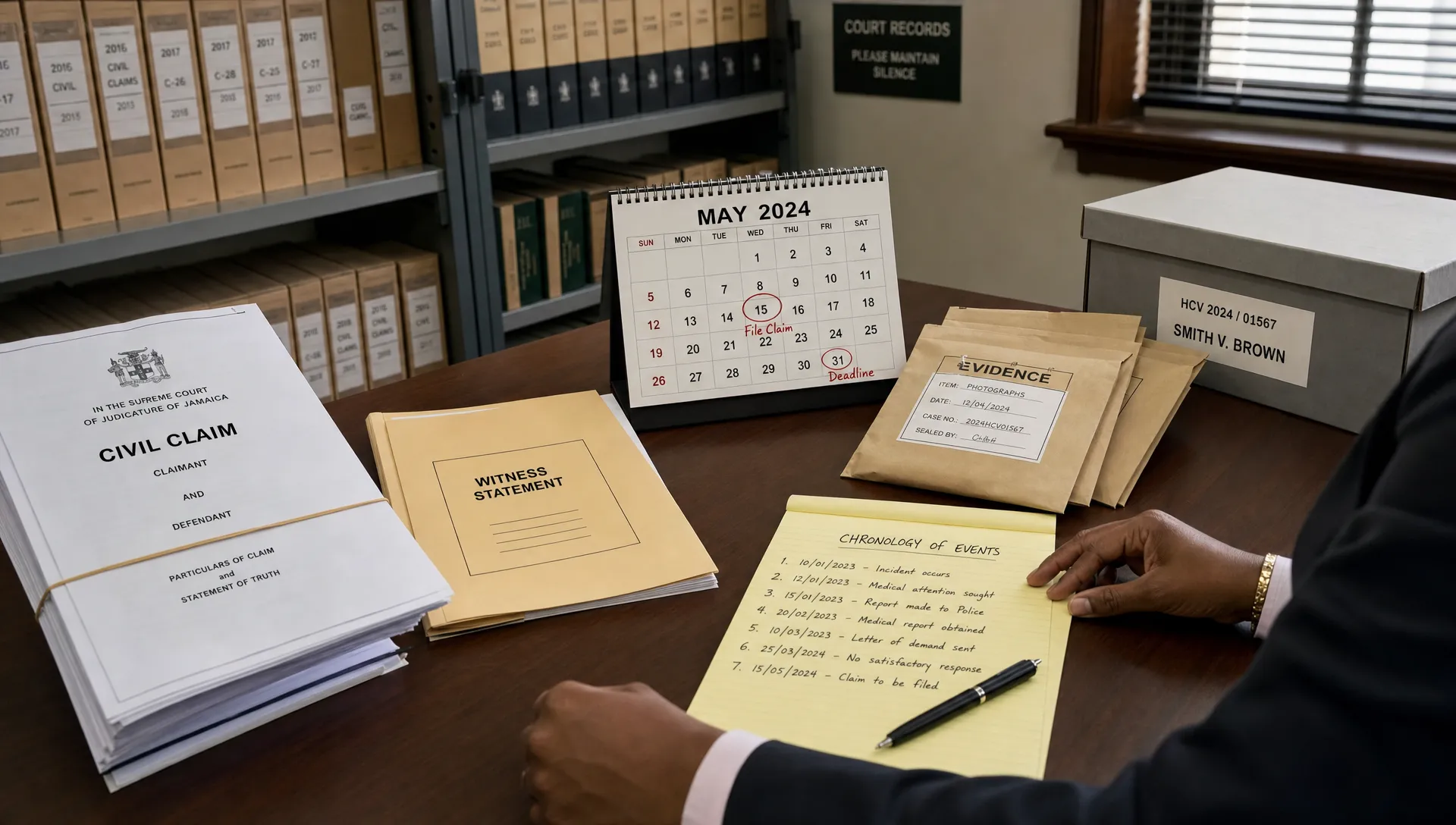
Filing a civil claim can feel like the decisive step that finally moves a dispute forward. In reality, the strength of many civil legal matters is shaped before the claim form is ever filed. The way you preserve evidence, define the dispute, calculate deadlines, identify parties, and approach settlement can affect cost, timing, leverage, and the outcome.
In Jamaica, civil disputes may involve unpaid debts, breached contracts, property disagreements, negligence, shareholder issues, employment-related claims, professional disputes, consumer complaints, or other non-criminal matters. If you are still clarifying whether your issue is civil or criminal, this overview of civil matters for businesses and individuals is a useful starting point.
This guide focuses on what to do before filing a claim, so you can make a more informed decision and avoid avoidable mistakes. It is general information, not legal advice for your specific facts.
First, clarify what you are really claiming
A civil claim is not simply a complaint that someone treated you unfairly. It must usually be grounded in a recognised legal basis, supported by facts, and tied to a remedy the court can grant.
Before filing, ask: what legal duty was owed, how was it breached, what loss resulted, and what remedy are you seeking? If the dispute is contractual, the starting point may be the contract terms, the parties’ conduct, and any written variations. If it is a negligence claim, the questions may include duty of care, breach, causation, and damage. If it involves property, ownership records, boundaries, possession, leases, or equitable rights may matter.
A clear claim theory helps your attorney decide whether court action is appropriate, whether another procedure applies, and what evidence is needed. It also helps prevent the claim from becoming too broad, too emotional, or too difficult to prove.
Pre-filing issue | Key question to answer | Why it matters |
Legal basis | What right, duty, contract term, or legal obligation was breached? | A claim must be grounded in law, not only dissatisfaction. |
Remedy | Do you want money, an injunction, specific performance, a declaration, or another order? | The remedy affects strategy, court choice, urgency, and evidence. |
Evidence | What documents, witnesses, records, and communications support your position? | Unsupported allegations are vulnerable to challenge. |
Deadline | Is there a limitation period or procedural time limit? | A valid claim can be lost if filed too late. |
Defendant | Who is legally responsible? | Naming the wrong party can cause delay, cost, or dismissal risk. |
Check limitation periods and urgent deadlines early
One of the most important pre-filing steps is time analysis. Limitation periods set deadlines for bringing certain types of claims. The relevant period can depend on the cause of action, the date the claim accrued, the identity of the parties, and the nature of the relief sought.
Do not assume that negotiations, promises to pay, or informal discussions automatically protect your position. In some situations, correspondence may be relevant. In others, time may continue to run while parties are still talking.
Urgency is a separate issue. Some claims require immediate steps because delay can prejudice the remedy. For example, if confidential information is being misused, assets may be dissipated, construction may be proceeding on disputed land, or a contract is about to be terminated, waiting may make the problem harder to reverse. In appropriate cases, interim relief may be considered, but it requires careful preparation and candour to the court.
A practical early question is this: if you do nothing for the next 30, 60, or 90 days, what changes? If evidence may disappear, money may be moved, property may be sold, or a business relationship may collapse, speak with counsel before assuming you have time.
Identify the correct court, forum, or procedure
Not every civil dispute belongs in the same place. Some claims may proceed in the Supreme Court. Others may be appropriate for a Parish Court, a tribunal, arbitration, or another dispute resolution process, depending on the value, subject matter, contract terms, parties, and remedy sought.
A contract may contain an arbitration clause, mediation requirement, governing law clause, or jurisdiction clause. These provisions should be reviewed before filing. If a party files in the wrong forum, the other side may challenge the claim, causing delay and additional cost.
The remedy also matters. A straightforward debt claim may involve a different strategy from a matter seeking an injunction, specific performance, or complex commercial relief. Claims involving companies, estates, government bodies, minors, trustees, insurers, overseas parties, or regulated industries may require additional procedural care.
Before filing, confirm whether the dispute is properly suited to litigation and whether any preconditions apply. This is where early legal analysis can save significant time.
Preserve evidence before it disappears
Civil claims are often won or lost on evidence. Memories fade, phones are replaced, emails are deleted, employees leave, invoices go missing, and WhatsApp threads become difficult to authenticate. Once litigation becomes likely, preserving relevant material should be a priority.
Start by collecting the core documents: contracts, purchase orders, invoices, receipts, bank records, emails, letters, messages, photographs, delivery notes, meeting minutes, reports, and any prior complaints. Keep originals where possible. Do not edit files, delete messages, alter metadata, or create backdated documents.
Witness evidence should also be considered early. Identify who saw or heard what happened, who negotiated the agreement, who approved payments, who inspected goods, who gave instructions, and who can explain industry practice. A short chronology can help organise the facts while memories are still fresh.
Evidence type | Examples | Pre-filing tip |
Contract documents | Agreements, amendments, terms and conditions, purchase orders | Keep the signed version and any draft history if relevant. |
Payment records | Invoices, receipts, bank confirmations, statements | Match payments to dates, obligations, and disputed amounts. |
Communications | Emails, letters, text messages, WhatsApp messages | Preserve full threads, not only favourable excerpts. |
Visual records | Photos, videos, inspection images, site records | Record when, where, and by whom they were taken. |
Witness information | Names, roles, contact details, short factual notes | Capture facts early without coaching or pressuring witnesses. |
If the dispute involves personal information, confidential business records, or regulated data, evidence collection should be handled carefully. The goal is to preserve what is relevant without creating privacy, confidentiality, or compliance problems.
Identify the right parties before naming them
Naming the correct claimant and defendant sounds simple, but it is a common source of avoidable problems. The person you dealt with may not be the legally responsible party. A trading name may not be the registered company. A director may not be personally liable for a company’s obligations unless specific legal grounds exist. A landlord, tenant, guarantor, insurer, parent company, agent, contractor, or subcontractor may each have different roles.
For businesses, confirm the legal name of the company, registration details, contract party, and signatory authority. For individuals, confirm names, addresses, and capacity. If a party has died, is bankrupt, is a minor, or is acting through an estate or trustee, additional steps may be needed.
The wrong party can challenge the claim, seek costs, or force amendments. Sometimes amendments are possible. Sometimes the delay creates limitation or tactical problems. It is better to verify early than to repair later.
Consider whether a demand letter or settlement attempt is appropriate
Before filing a claim, it is often sensible to send a carefully drafted letter setting out the complaint, the legal and factual basis, the remedy sought, and a reasonable deadline for response. This may lead to settlement, clarify the issues, or reveal the other side’s defence.
A demand letter should not be a venting exercise. It should be accurate, measured, and strategic. Overstating the case can damage credibility. Threatening steps you are not prepared to take can weaken your position. Admitting too much, or using careless language, can create problems later.
Settlement communications may have legal consequences, especially where they are intended to be “without prejudice” or relevant to costs. Get advice before making offers, accepting payment plans, or signing releases. A quick settlement can be valuable, but only if it resolves the right claims against the right parties on terms you understand.
Mediation should also be considered. Jamaica’s Civil Procedure Rules encourage efficient case management, and mediation can help parties resolve disputes without a full trial. Even when a claim has not yet been filed, early neutral discussions may narrow the dispute, preserve commercial relationships, and reduce cost. For a deeper look at how procedure and mediation interact, see this explanation of Civil Procedure Rules and mediation in Jamaica.

Assess the cost, risk, and commercial value of filing
A claim may be legally arguable but commercially unwise. Before filing, consider whether the likely recovery justifies the cost, time, stress, and uncertainty of litigation.
Costs may include attorney’s fees, court fees, expert reports, process servers, transcript costs, document management, travel, and time away from work or business. If the matter is defended, the process may take longer than expected. If expert evidence is needed, costs can increase significantly.
There is also adverse costs risk. Court costs are subject to the court’s discretion, but an unsuccessful party may be ordered to contribute to the other side’s legal costs. Even a successful party may not recover all expenses. Settlement offers, conduct, proportionality, and procedural compliance can all affect the costs position.
The defendant’s ability to pay is another practical issue. A judgment is valuable only if it can be enforced. Before filing, consider whether the other party has assets, income, insurance, a continuing business, or a reason to settle. If the defendant is insolvent, has disappeared, or has no reachable assets, the strategy may need to change.
This does not mean strong claims should be abandoned. It means the decision to file should be grounded in both legal merit and practical recovery.
Prepare for the discipline of litigation
Once a claim is filed, the dispute enters a structured process. The parties must comply with rules, deadlines, disclosure obligations, court orders, witness statement requirements, and case management directions. Jamaica’s Civil Procedure Rules are designed to deal with cases justly, and procedural missteps can affect both strategy and cost.
Before filing, make sure you are ready for that discipline. Litigation is not only about telling your side of the story. It requires documents, consistency, responsiveness, and a willingness to make decisions under pressure.
Good pre-filing preparation usually includes a written chronology, a list of key documents, a calculation of losses, a summary of witnesses, a review of possible defences, and an assessment of settlement options. It should also include an honest discussion of weaknesses. Every claim has risks. Knowing them early helps you prepare, negotiate, and avoid surprises.
Think through possible defences and counterclaims
A strong pre-filing review does not only ask, “Why am I right?” It also asks, “What will the other side say?”
The defendant may argue that there was no contract, the terms were different, the loss was caused by someone else, the claim is out of time, payment was made, goods were accepted, notice was inadequate, the claimant failed to mitigate loss, or the court is the wrong forum. In commercial disputes, the defendant may bring a counterclaim, alleging its own losses.
Anticipating defences does not weaken your position. It strengthens it. It helps you decide what evidence to gather, what facts need explanation, whether settlement is sensible, and how to frame the claim.
If your own conduct may be criticised, address that with your attorney before filing. Surprises are far more damaging after proceedings have begun.
Know when to involve an attorney before filing
Some civil disputes can be resolved without formal proceedings. Others should be reviewed by an attorney before any demand letter or court document is sent. Early advice is especially important where the dispute involves substantial money, property rights, injunctions, business interruption, confidential information, multiple parties, complex contracts, limitation concerns, or reputational risk.
An attorney can assess the merits, identify the correct forum, draft pre-action correspondence, protect urgent remedies, preserve privilege where appropriate, and help you avoid statements that may be used against you. If you are unsure whether your matter has reached that point, this guide on when to hire attorneys for civil matters in Jamaica outlines common warning signs.
Early involvement does not always mean immediate litigation. Often, it means choosing the right path before positions harden and costs escalate.
A practical pre-filing checklist
Before filing a civil claim, pause and confirm that the foundation is in place. At minimum, you should be able to answer these questions clearly:
What legal claim am I bringing, and what facts support each part of it?
What remedy do I want, and can the court or forum grant it?
Is the claim within the relevant limitation period or procedural deadline?
Have I identified the correct claimant and defendant?
Have I preserved the key documents, messages, records, and witness details?
Have I calculated my losses and gathered proof of those losses?
Have I considered settlement, mediation, or a demand letter?
What are the likely costs, risks, and enforcement issues?
What defences or counterclaims might the other side raise?
Am I ready to comply with court rules, deadlines, and disclosure obligations?
If the answer to several of these questions is “I am not sure,” that is not a reason to panic. It is a reason to get organised before filing.
Frequently Asked Questions
Do I have to send a demand letter before filing a civil claim in Jamaica? Not always, but it is often a sensible step. A demand letter can clarify the dispute, invite settlement, and create a useful record. In some matters, specific procedures or contract terms may require notice before action.
What if I am close to a limitation deadline? Seek legal advice immediately. Waiting to complete negotiations or gather every document may put the claim at risk. An attorney can assess whether urgent filing or another protective step is needed.
Can mediation happen before a claim is filed? Yes, parties can explore mediation or settlement before proceedings begin. Mediation may also occur after filing, depending on the case and court directions.
What evidence should I keep before filing? Preserve contracts, invoices, receipts, bank records, emails, letters, messages, photographs, reports, and witness details. Keep complete records where possible, and avoid deleting, editing, or selectively saving only favourable material.
Is filing a claim always the best option? No. Sometimes negotiation, mediation, arbitration, debt restructuring, or a commercial settlement may be more efficient. The best option depends on the strength of the claim, urgency, cost, recoverability, and your wider objectives.
Before you file, get the strategy right
Civil legal matters require more than a strong sense of being wronged. They require timing, evidence, correct parties, clear remedies, procedural discipline, and a realistic view of risk.
Henlin Gibson Henlin assists clients in Jamaica with civil and commercial disputes, litigation strategy, mediation, arbitration, and related legal services. If you are considering filing a claim, early legal guidance can help you protect your position and choose the most effective next step.