
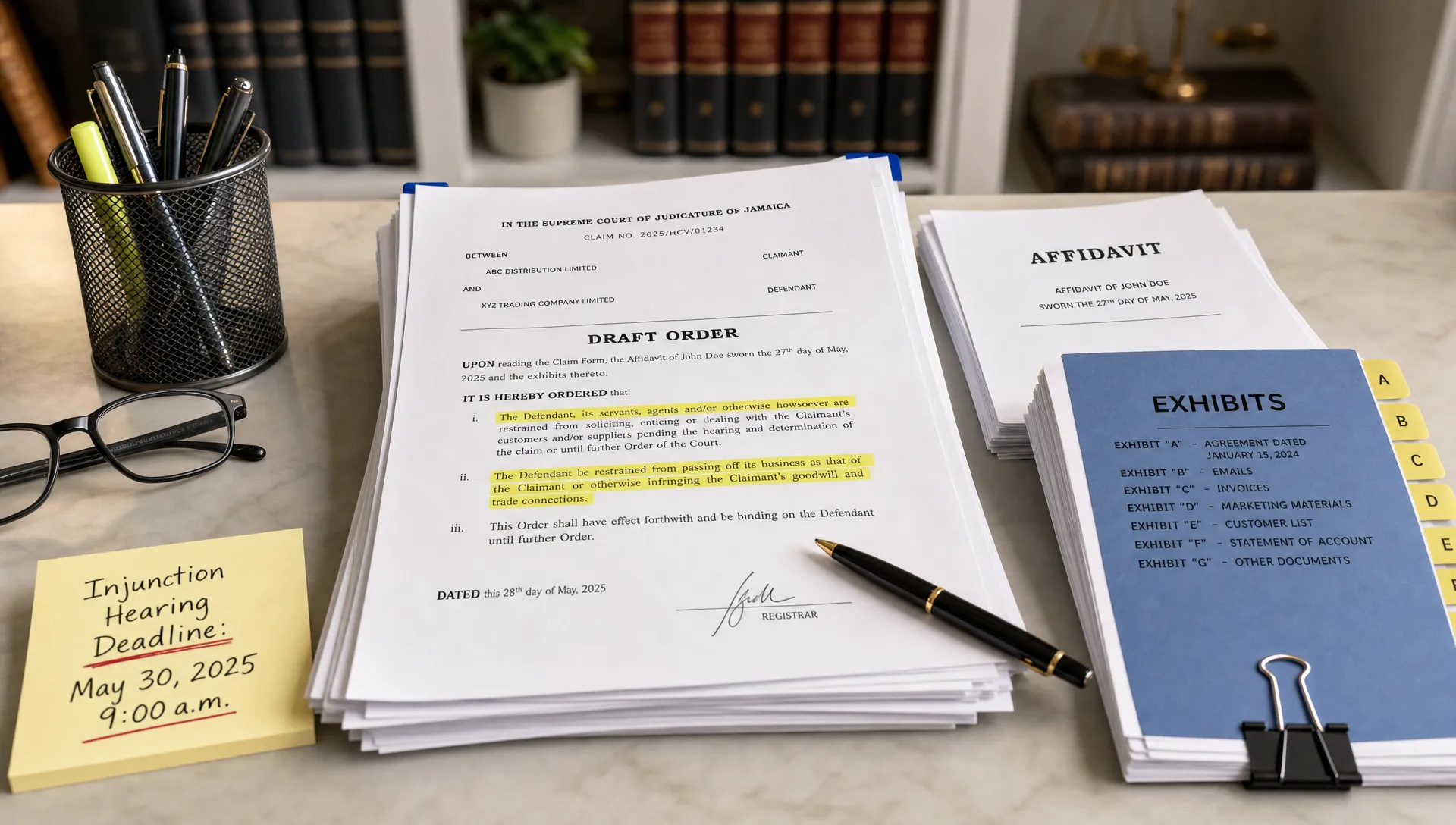
In commercial disputes, timing often determines whether a legal remedy will be useful at all. A damages award months or years later may not help if assets have disappeared, confidential information has already been used or a critical contract has been disrupted beyond repair.
That is where injunctions can matter. An injunction is a court order requiring a party to do something, stop doing something or preserve the position until the dispute is resolved. In business disputes, it is usually sought as an urgent interim remedy, although final injunctions may also be granted after trial.
This guide explains how injunctions in commercial disputes generally work, the types of orders businesses may encounter, the principles courts consider and the practical steps to take before applying for or responding to one. It is general information only, not legal advice on any specific matter.
What is an injunction in a commercial dispute?
An injunction is an equitable remedy, meaning it is discretionary. The court does not grant it simply because a party asks for it or because a claim appears arguable. The applicant must show that the order is necessary, fair and proportionate in the circumstances.
In commercial litigation, injunctions are commonly used to protect the effectiveness of the final judgment. They may preserve assets, prevent misuse of confidential information, restrain breaches of restrictive covenants, maintain contractual arrangements or stop actions that would cause harm not easily corrected by money.
Jamaican courts, drawing on common law and equitable principles, usually assess interim injunctions through well established considerations such as whether there is a serious issue to be tried, whether damages would be an adequate remedy, where the balance of convenience lies and whether the applicant has acted promptly and fairly.
The Privy Council decision in National Commercial Bank Jamaica Ltd v Olint Corp Ltd remains an important reference point in this area. The Board emphasised that courts should often take the course that is likely to cause the least irremediable prejudice if it later turns out the interim order should or should not have been granted.
Why injunctions are important in business disputes
Commercial disputes often involve fast moving risks. A supplier may threaten to terminate a critical arrangement, a former employee may be accused of taking client data, a borrower may be moving assets beyond reach or shareholders may be fighting over control of a company.
In those situations, a conventional claim for damages may be too slow. An injunction can provide temporary control while the legal issues are properly argued. It can also reduce pressure on the parties by setting clear limits on what may happen before trial or settlement.
That said, injunctions are powerful orders. They can interfere with business operations, freeze assets and impose strict compliance obligations. Courts tend to approach them carefully because an interim order may have serious consequences before the underlying dispute has been fully tried.
For companies trying to identify problems earlier, it is worth reviewing the warning signs discussed in commercial litigation risks Jamaican businesses should watch. Many injunction applications become necessary because a risk was not documented or escalated quickly enough.
Common types of injunctions in commercial disputes
The form of injunction depends on the risk being addressed. Some orders prevent action, others compel action and others preserve assets or evidence.
Type of injunction | What it does | Common commercial use |
Prohibitory injunction | Stops a party from taking a particular step | Preventing disclosure of confidential information, sale of disputed assets or breach of a restrictive covenant |
Mandatory injunction | Requires a party to take positive action | Restoring access to premises, delivering up goods or continuing a contractual obligation in limited cases |
Freezing order | Restrains a party from dealing with assets | Preserving assets where there is a risk of dissipation before judgment |
Interim injunction | Operates before trial or final determination | Maintaining the status quo while the dispute proceeds |
Final injunction | Granted after the court determines the claim | Permanently restraining conduct or requiring corrective action |
Without notice injunction | Granted before the other side is heard, usually in urgent cases | Preventing immediate asset movement, evidence destruction or serious irreversible harm |
A prohibitory injunction is usually easier to obtain than a mandatory injunction because it preserves the position rather than forcing a party to change it. Mandatory orders are not impossible, but courts tend to scrutinise them closely, especially where compliance would affect ongoing commercial operations.
A freezing order, sometimes called a Mareva injunction, is a particularly serious form of interim relief. It does not give the applicant security over the defendant’s assets, but it can restrict the defendant from disposing of or moving assets in a way that would frustrate enforcement of a future judgment. Businesses served with such an order should treat it as urgent and seek advice immediately. For a focused discussion, see this guide on how to respond to a freezing order in Jamaica.
The legal principles courts usually consider
The court’s approach depends on the type of injunction, the stage of the proceedings and the evidence before it. Still, several core principles often arise in commercial injunction applications.
Serious issue to be tried
The applicant must usually show that the claim is not frivolous or hopeless. At the interim stage, the court is not normally conducting a full trial of the facts. The question is whether there is a real legal and factual dispute that deserves determination.
The classic English authority American Cyanamid Co v Ethicon Ltd is often cited across common law jurisdictions for the modern approach to interim injunctions. Its influence is visible in how courts consider whether there is a serious question to be tried, then move to practical issues such as adequacy of damages and balance of convenience.
In some cases, particularly mandatory injunctions or orders that effectively decide the dispute at an early stage, a court may require a stronger showing from the applicant.
Adequacy of damages
If money would adequately compensate the applicant at the end of the case, the court may be less inclined to grant an injunction. Commercial disputes often involve financial harm, but not every financial harm is easy to value or recover.
For example, damages may be inadequate where the dispute involves loss of goodwill, misuse of trade secrets, damage to regulatory standing or the risk that a defendant will not be able to satisfy a judgment. On the other hand, if the issue is a straightforward unpaid invoice and the defendant appears solvent, an injunction may be harder to justify.
The court may also consider whether the applicant’s undertaking as to damages would protect the respondent. This undertaking is a promise to compensate the respondent if the injunction later turns out to have been wrongly granted.
Balance of convenience
The balance of convenience asks which course is less likely to cause unfair or irreversible harm. The court may compare the prejudice to the applicant if the injunction is refused with the prejudice to the respondent if it is granted.
This is often the decisive issue. A court may ask whether the order preserves the status quo, whether it disrupts an operating business, whether third parties will be affected and whether a less restrictive order would be sufficient.
Promptness and conduct
Delay can weaken an injunction application. If a business claims urgent harm but waits weeks without explanation, the court may question whether the order is truly necessary.
Conduct matters as well. Because injunctions are equitable remedies, applicants are expected to act with candour and fairness. This is especially important in without notice applications, where the respondent is not present to correct the record.
Full and frank disclosure
If an applicant seeks an order without notice to the other side, it must make full and frank disclosure of material facts, including facts that may assist the absent respondent. The duty is not limited to presenting the applicant’s best points.
Failure to disclose material facts can lead to the injunction being discharged, even if the applicant has an arguable case. It may also affect costs and the court’s view of the applicant’s credibility.

Evidence needed for an injunction application
An injunction application usually stands or falls on affidavit evidence. The court needs clear facts, not speculation. The applicant should be able to explain what happened, what harm is threatened, why the matter is urgent and why damages would not be enough.
Useful evidence may include contracts, correspondence, board minutes, payment records, company filings, screenshots, delivery records, internal reports, witness statements and financial documents. In data, confidentiality or intellectual property disputes, digital evidence should be preserved carefully to avoid claims that it was altered or taken out of context.
A strong evidence file usually has a clear chronology. Judges are often asked to make urgent decisions with limited time, so a disorganised bundle can weaken an otherwise serious application. Businesses preparing for litigation can benefit from the practical steps in this guide on building a better evidence file for court.
The evidence should also address the proposed order. If the applicant asks to restrain asset transfers, the affidavit should explain the asset risk. If the applicant seeks to prevent disclosure of confidential information, the evidence should identify the information, why it is confidential and how disclosure is threatened.
Applying for an injunction: practical steps
The procedure will depend on the court, the urgency and whether the application is made with or without notice. In commercial matters, the following steps are commonly important.
Assess the legal basis and objective
Before rushing to court, the applicant should identify the claim that supports the injunction. The court will want to know the underlying legal right being protected. This may arise from contract, fiduciary duty, confidentiality, intellectual property rights, company law, property rights or another recognised cause of action.
The applicant should also define the practical objective. A vague request to stop “harmful conduct” is unlikely to help. The draft order should specify exactly what the respondent must do or must not do.
Consider whether notice should be given
Most applications should be made on notice, allowing the respondent to be heard. Without notice relief is reserved for cases where giving notice would defeat the purpose of the order or where urgency makes notice impractical.
Examples may include a credible risk that assets will be moved once notice is given or evidence will be destroyed. Even then, the applicant should expect a return date where the respondent can challenge the order.
Prepare the affidavit and draft order
The affidavit should set out the facts in a structured way, exhibit the key documents and explain urgency. The draft order should be realistic, precise and enforceable. Overbroad orders are vulnerable to challenge because they may restrain lawful conduct or impose unnecessary burdens.
The applicant should also be ready to give the usual undertaking as to damages. Depending on the circumstances, the court may require evidence that the applicant can meet that undertaking.
Plan for service and compliance
An injunction is only useful if it can be served and enforced. The applicant should consider how the respondent will be notified, what documents must be served and whether third parties such as banks, agents or business partners need to know about the order.
Once the order is granted, compliance should be monitored carefully. If the respondent breaches it, enforcement may involve contempt proceedings, but that is a serious step requiring proper evidence and procedural care.
Responding to an injunction application
A business served with an injunction should act quickly. Ignoring the order can create serious consequences, even if the business believes the order was wrongly granted.
The first step is to read the order closely and identify what it requires, what it prohibits, when it expires and when the next hearing is scheduled. The respondent should preserve documents, notify relevant internal stakeholders and avoid informal communications that could worsen the dispute.
A respondent may be able to apply to discharge, vary or narrow the injunction. Grounds may include lack of urgency, material non-disclosure, an inadequate undertaking as to damages, excessive breadth or evidence that the applicant’s claim is weak.
The respondent should also prepare evidence addressing the balance of convenience. For example, if an injunction would shut down ordinary business operations, affect employees, interrupt customer obligations or harm third parties, the court should have that evidence before it.
Injunctions and arbitration clauses
Many commercial contracts contain arbitration clauses. That does not necessarily remove the need for urgent court assistance. In some disputes, interim relief may be needed before an arbitral tribunal is constituted or where assets and evidence require immediate protection.
The relationship between court proceedings and arbitration depends on the contract, the governing law, the arbitration rules and the remedy sought. A business should review the dispute resolution clause before filing any application because starting in the wrong forum can create delay, cost and strategic risk.
If the dispute may proceed by arbitration, the injunction strategy should fit the broader plan for resolving the case. For a wider comparison of dispute resolution options, see arbitration or litigation when choosing the better route.
Commercial situations where injunctions may arise
Injunctions are not limited to one type of business dispute. They may arise across sectors and practice areas, including corporate law, banking, intellectual property, real estate, employment linked disputes, competition issues and admiralty and shipping matters.
Common examples include attempts to restrain the sale of disputed shares, prevent the misuse of confidential business information, preserve collateral, stop unlawful interference with a distribution agreement, maintain access to commercial premises or prevent dissipation of assets before judgment.
In intellectual property disputes, injunctions may be sought to stop use of a mark, copyright material, designs, trade secrets or confidential know how. In shareholder disputes, they may be used to prevent major corporate decisions pending determination of rights. In banking litigation, freezing orders and other interim remedies may become relevant where recovery risk is high.
In maritime disputes, different remedies may also be available depending on the claim, including vessel arrest in appropriate admiralty proceedings. An injunction may still play a role, but it should be considered alongside the specific remedies available in admiralty and shipping litigation.
Risks of seeking an injunction
An injunction can be effective, but it is not risk free. Businesses should consider both legal and commercial consequences before applying.
The undertaking as to damages is a major consideration. If the respondent suffers loss because of an injunction and the court later finds the order should not have been granted, the applicant may be required to compensate the respondent.
There is also a cost risk. Urgent applications can require intensive preparation, affidavit evidence, hearings and follow up applications. If the application is unsuccessful or overreaching, the applicant may face adverse costs orders.
Reputation and business relationships matter as well. An injunction can escalate a dispute quickly, especially where banks, suppliers, customers or regulators become aware of it. Sometimes that escalation is necessary. In other cases, a targeted letter, negotiation, mediation or preservation undertaking may achieve the same practical result with less disruption.
How businesses can prepare before urgent relief is needed
The best injunction strategy often begins before a crisis. Businesses that maintain clear contracts, preserve records and escalate legal risks early are better placed to act if urgent court relief becomes necessary.
Practical preparation includes keeping executed contracts and amendments in one place, recording key business decisions, using confidentiality protocols, preserving digital evidence and documenting communications with counterparties. It is also useful to identify who inside the organisation has authority to approve urgent legal steps.
When a dispute begins to surface, businesses should avoid deleting messages, altering files, pressuring witnesses or making threats that could later appear unreasonable. The court’s view of the parties’ conduct can affect the outcome of an injunction application.
Frequently Asked Questions
What is the main purpose of an injunction in a commercial dispute? The main purpose is to prevent harm that may not be adequately repaired by damages after trial. It can preserve assets, evidence, confidentiality, contractual rights or the status quo while the dispute is being resolved.
Can an injunction be granted without telling the other side first? Yes, but only in appropriate urgent cases. The applicant must usually show that giving notice would defeat the purpose of the application or that immediate action is necessary. The applicant must also provide full and frank disclosure of material facts.
What is an undertaking as to damages? It is a promise by the applicant to compensate the respondent if the injunction is later found to have been wrongly granted and the respondent suffered loss as a result. Courts treat this undertaking seriously.
Is a freezing order the same as winning the case? No. A freezing order is an interim protective measure. It restricts dealings with assets in certain circumstances, but it does not decide the underlying claim or give the applicant ownership of the assets.
Can injunctions be used if the contract has an arbitration clause? They may be available in some cases, particularly where urgent interim relief is needed before or alongside arbitration. The contract and applicable law should be reviewed carefully before deciding where and how to apply.
Strategic support for urgent commercial disputes
Injunctions in commercial disputes require speed, precision and careful judgment. A strong application can protect a business from serious harm, but an overbroad or poorly supported application can create cost, delay and exposure under an undertaking as to damages.
Henlin Gibson Henlin advises on complex commercial disputes, including litigation, arbitration, banking disputes, intellectual property matters and other urgent business conflicts. If your organisation is considering an injunction or has been served with one, early legal advice can help you assess the risks and choose the right next step.