
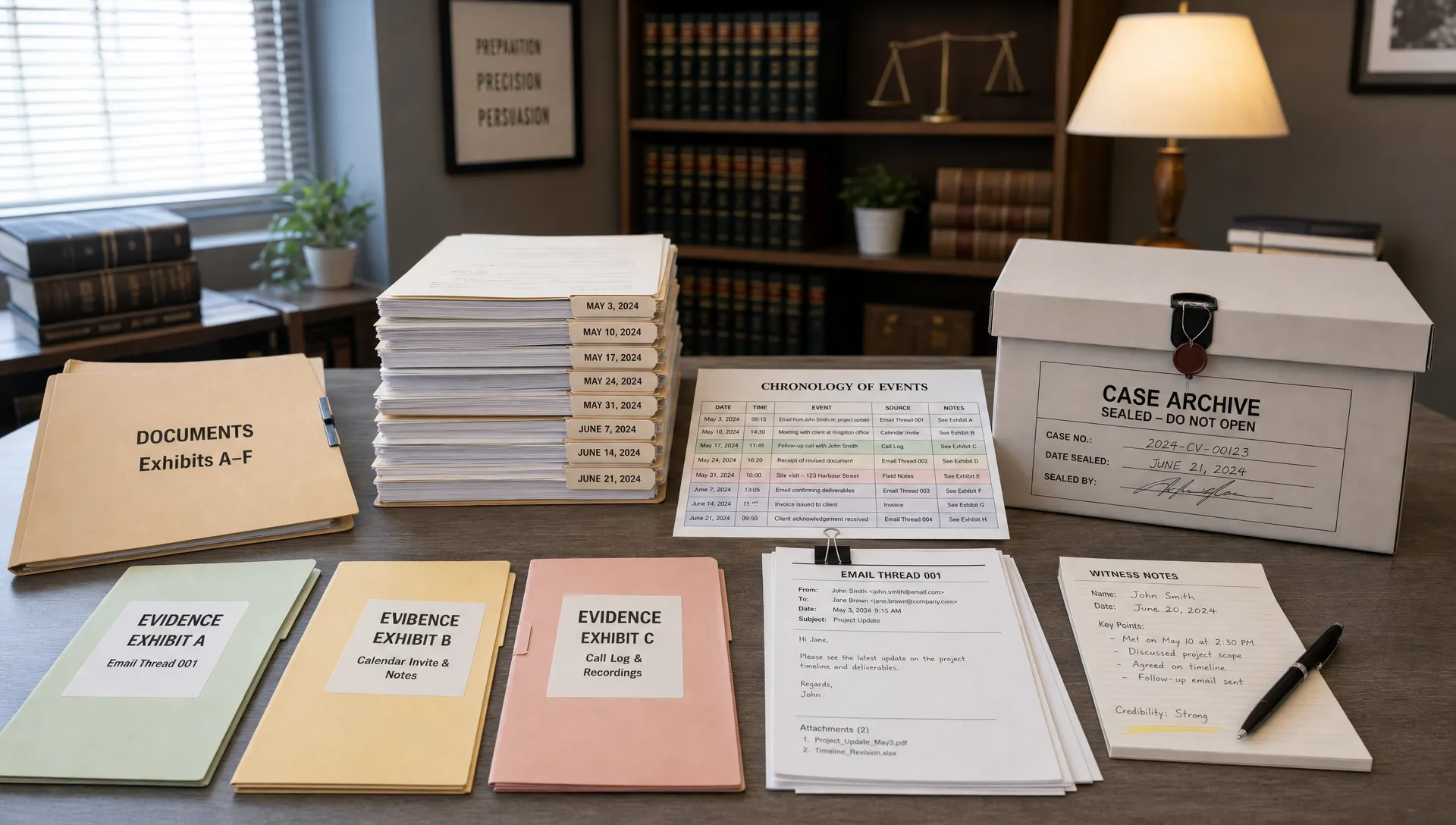
Good evidence is rarely a surprise. In most civil, commercial, employment, consumer, property, banking, intellectual property, and regulatory disputes, the strongest court files are built long before trial, often before a claim is filed or defended.
An evidence file is not simply a folder full of documents. It is a structured record that helps your attorney prove the facts that matter, respond to the other side’s case, test witnesses, identify weaknesses, and comply with court procedures. A large file may still be weak if it is disorganised, incomplete, or full of material that cannot be authenticated.
This guide explains how to build a better evidence file for court, with practical steps for preserving documents, digital records, witness material, expert evidence, and timelines. It is general information, not a substitute for legal advice on your specific matter.
What a Good Evidence File Should Do
A court-ready evidence file should help answer four core questions: what happened, when it happened, who was involved, and how the relevant facts can be proved.
In litigation, the court is not usually concerned with every detail of a dispute. It is concerned with facts that are relevant to the legal issues. For example, a commercial litigation matter may turn on whether a contract was formed, whether payment was due, whether performance was defective, and what loss was suffered. An employment dispute may turn on policies, warnings, communications, performance records, and procedural fairness. A property dispute may depend on title documents, photographs, survey material, valuations, correspondence, and records of occupation or damage.
A better evidence file therefore has three qualities:
Relevance: it connects directly to a legal issue or a fact in dispute.
Reliability: it can be traced to a source, date, author, device, transaction, witness, or expert.
Usability: it is organised so your legal team can find, understand, and use it quickly.
If you are still deciding whether to bring a claim, evidence gathering should happen alongside the broader steps to take before filing a civil claim, including checking limitation periods, identifying the correct parties, and assessing whether litigation is commercially sensible.
Start With the Issues, Not the Paperwork
Many people start by dumping every email, receipt, screenshot, voice note, and letter into a folder. That is understandable, but it can make the case harder to assess. A better approach is to begin with the issues that must be proved.
Ask your attorney to help identify the likely legal questions. In a contract claim, those questions may include formation, breach, causation, loss, mitigation, and defences. In a negligence claim, they may include duty, breach of duty, causation, damage, and foreseeability. In a judicial review, regulatory, or compliance matter, the questions may include statutory authority, fairness, procedure, reasonableness, and record-keeping.
Once the issues are clear, collect evidence issue by issue. This avoids two common problems: missing key proof because it did not seem important at the time, and overwhelming the file with irrelevant material that distracts from the case.
A simple issue map can help. For each issue, note the documents, witnesses, dates, and gaps. If a fact cannot be supported by a document or witness, mark it as a gap rather than assuming it is proved.
Use a Clear Evidence File Structure
A well-structured file saves time and reduces risk. It also helps your attorney prepare pleadings, affidavits, witness statements, applications, disclosure lists, mediation briefs, and trial bundles.
The exact structure will depend on the case, but the following framework works for many disputes.
File section | What to include | Why it matters |
Case overview | One-page summary, parties, key issues, current status | Gives the legal team quick context |
Chronology | Dated timeline of events with source references | Helps identify sequence, delay, causation, and inconsistencies |
Core documents | Contracts, invoices, notices, policies, reports, court papers | Contains the documents most likely to be relied on |
Communications | Emails, letters, WhatsApp exports, text messages, call logs | Shows admissions, demands, instructions, warnings, and responses |
Financial records | Receipts, bank statements, ledgers, payslips, valuations, loss calculations | Supports damages, payment history, and commercial impact |
Witness material | Names, contact details, notes of what each witness can speak to | Helps prepare witness statements and test credibility |
Physical or site evidence | Photographs, videos, inspection notes, product samples, property records | Preserves conditions that may change over time |
Expert material | Medical, engineering, accounting, valuation, technical, or environmental reports | Supports specialist facts outside ordinary knowledge |
Procedural documents | Demand letters, responses, court orders, filed documents, hearing notes | Tracks compliance and litigation history |
Gaps and questions | Missing records, uncertain dates, potential weaknesses | Helps the legal team plan next steps honestly |
Use consistent file names. A practical format is: YYYY-MM-DD - document type - short description - source. For example: 2026-03-14 - email - supplier confirms delivery delay - ABC Ltd.
Do not alter original documents. Keep a clean copy of originals and use working copies for highlighting, notes, or comments.
Preserve Evidence Before It Disappears
Evidence can be lost quickly. People delete messages, devices are replaced, staff leave, websites change, buildings are repaired, and memories fade. Once a dispute is likely, take reasonable steps to preserve material that may be relevant.
For businesses, this may require a litigation hold. That means instructing relevant employees not to delete or destroy documents, emails, messages, shared drive folders, CCTV, transaction records, or device data connected to the dispute. For individuals, it may mean preserving phones, original receipts, medical records, photographs, and communication threads.
Be especially careful with automatic deletion settings. Messaging platforms, CCTV systems, email retention tools, and cloud drives may delete data after a set period. If relevant material is lost after a dispute is foreseeable, it may create serious evidential and procedural problems.
Preservation does not mean publishing or sharing everything. Some material may be privileged, confidential, commercially sensitive, or governed by privacy and data protection obligations. For example, employee records, customer data, banking information, medical material, and commercially sensitive documents should be handled carefully. If in doubt, preserve the material but ask your attorney before circulating it.
Build a Chronology That Proves the Story
A chronology is one of the most useful tools in a court file. It turns a pile of records into a sequence the court can understand.
A strong chronology should be factual, not argumentative. Instead of writing, “The other party deliberately misled us,” write what can be proved: “The supplier emailed revised delivery dates after receiving the deposit.” Your attorney can later decide how the fact should be framed in pleadings or submissions.
A practical chronology may look like this:
Date | Event | Evidence reference | Notes or gaps |
10 Jan 2026 | Contract signed by both parties | Core Documents 01 | Confirm whether all schedules were attached |
15 Feb 2026 | First invoice issued | Financial 03 | Payment due date disputed |
28 Feb 2026 | Email complaint sent about defective goods | Communications 12 | Attach photographs mentioned in email |
5 Mar 2026 | Site inspection conducted | Expert 02 | Await final report |
The chronology should be updated throughout the case. Each new document, hearing, settlement offer, inspection, or witness development should be added. This helps the legal team spot inconsistency, missing proof, and opportunities for settlement or procedural applications.
Handle Digital Evidence Carefully
Digital evidence often becomes the heart of modern litigation. Emails, WhatsApp messages, text messages, call logs, photographs, cloud files, video meetings, accounting platforms, access logs, and social media posts may all be relevant.
Screenshots can be useful, but they are often not enough on their own. Where possible, preserve the original digital source. For emails, save the original message format if available, not only a printed copy. For WhatsApp or text messages, export the full conversation with dates and participants where possible. For social media posts, record the URL, date, time, username, and surrounding context. For photographs and videos, keep the original files because metadata may assist with date, location, and device information.
The same principle applies to remote proceedings and digital testimony. Jamaica’s Civil Procedure Rules 2002 helped modernise civil procedure, and Henlin Gibson Henlin has discussed how the rules enabled evidence to be taken by video-link. Where digital participation, recordings, or remote communications are relevant to a dispute, keep accurate records of invitations, attendance, transcripts, platform logs, and any court directions.
Avoid editing, cropping, renaming without a system, or forwarding digital evidence in ways that strip metadata. If a file must be shared, keep the original separately and provide copies to your legal team.

Treat Physical, Property, and Expert Evidence With Extra Care
Some disputes depend on conditions that change. A damaged shipment may be repaired or discarded. A building affected by water intrusion may be cleaned. A defective product may be replaced. A vessel, vehicle, machine, or construction site may be altered. If the physical condition matters, it should be documented promptly and responsibly.
Take clear photographs and videos from multiple angles. Record the date, time, location, and person taking the images. If possible, include a scale reference, such as a ruler or identifiable fixed point. Do not move, repair, dispose of, or test important physical items without first getting legal advice, especially if the other side may need an opportunity to inspect them.
Expert evidence may be needed where the court requires specialist assistance. This can arise in medical injury, accounting loss, valuation, engineering, construction, intellectual property, shipping, data systems, environmental damage, and product defect cases. In property damage or contamination disputes, records from qualified remediation professionals can become important, including inspection reports, photographs, chain-of-custody notes, invoices, and certification documents. For comparison, a licensed environmental services provider will typically show the kinds of credentials, emergency response records, and service documentation that may matter when physical conditions need to be verified.
Your attorney should guide the appointment and scope of any expert. Not every helpful specialist report will be admissible as expert evidence, and court rules may require independence, proper instructions, and disclosure of assumptions. The safest approach is to involve legal counsel before instructing an expert whose report may be used in court.
Keep Witness Information Practical and Accurate
Witness evidence is not just about who supports your position. It is about who can give admissible, credible, first-hand evidence on a material issue.
Create a witness list that includes each person’s full name, role, contact details, relationship to the dispute, what they personally observed, and what documents or communications connect to their evidence. Separate first-hand knowledge from hearsay. For example, a manager who personally attended a meeting is different from an employee who heard about it afterwards.
Do not coach witnesses or ask them to “improve” their account. Encourage them to preserve their own notes, emails, messages, diaries, calendars, photographs, and records. If memories are fresh, write a factual note of what the witness recalls, but mark who prepared the note and when. Your legal team can later determine whether and how that witness should provide a formal statement or affidavit.
Witness credibility can be damaged by exaggeration, selective memory, or inconsistency with documents. A carefully prepared evidence file helps your attorney compare witness accounts against the documentary record before the case reaches court.
Separate Privileged, Confidential, and Without Prejudice Material
Not everything in your possession should be placed in the general evidence file. Some documents may be protected by legal professional privilege. Some settlement communications may be “without prejudice.” Some material may be confidential, commercially sensitive, or subject to statutory data protection duties.
Create separate sections for sensitive categories and tell your attorney what they contain. Do not send privileged legal advice to third parties. Do not forward internal legal strategy emails to witnesses, business partners, or opponents. Do not assume that writing “confidential” or “without prejudice” on a document automatically protects it. The substance and purpose of the communication matter.
This is especially important for companies handling customer data, employee files, banking records, healthcare information, or confidential business material. A strong evidence file is not only organised, it is also controlled.
Review the File Like the Other Side Will
A useful exercise is to review the evidence file from the opponent’s perspective. What facts will they deny? What documents might they rely on? Which witness may be vulnerable in cross-examination? What records are missing? What version of events is contradicted by an email, invoice, log, photograph, or earlier statement?
This kind of disciplined review is part of how experienced litigation teams assess risk. If you want a wider view of case preparation, Henlin Gibson Henlin has explained how civil litigation teams prepare strong cases, including early case assessment, evidence preservation, procedural planning, and witness preparation.
Your evidence file should not hide weaknesses from your attorney. It should expose them early. A problem discovered before filing may be manageable. A problem discovered during cross-examination may be damaging.
Common Mistakes That Weaken an Evidence File
Even a strong claim can be undermined by poor evidence handling. The following mistakes are common and avoidable.
Mistake | Why it causes problems | Better approach |
Keeping only screenshots | Screenshots may omit metadata, context, or source details | Preserve original files, exports, device records, and full threads |
Mixing legal advice with general documents | Privilege may be put at risk | Keep legal advice in a separate privileged folder |
Saving files with vague names | Documents become hard to locate and verify | Use date-based, descriptive file names |
Editing photos or documents | Authenticity may be challenged | Keep originals and create clearly marked working copies |
Ignoring damaging documents | The legal team cannot assess risk properly | Include unfavourable material in a confidential review section |
Waiting too long to collect evidence | Records may be deleted and memories may fade | Preserve evidence as soon as a dispute is foreseeable |
The goal is not to create a perfect file overnight. The goal is to build a reliable system that improves as the case develops.
Frequently Asked Questions
What should I put in an evidence file for court? Include documents, communications, photographs, videos, financial records, witness information, expert reports, procedural documents, and a chronology that links each item to the facts in dispute.
Are screenshots acceptable evidence? Screenshots can help, but they are often stronger when supported by original files, message exports, email headers, metadata, device records, or other proof of source and date.
Should I include documents that hurt my case? Yes, preserve them and show them to your attorney. Hiding weaknesses from your legal team can lead to poor strategy and serious problems later.
Can I organise the evidence file myself before hiring a lawyer? You can start organising records, preserving originals, and preparing a chronology. However, legal advice is important before filing, disclosing, altering, destroying, or sharing sensitive material.
How early should I begin preserving evidence? As soon as a dispute is likely or reasonably foreseeable. Early preservation protects documents, digital records, physical items, and witness recollections before they change or disappear.
Build the File Before the Fight Escalates
A better evidence file gives your legal team a clearer view of the facts, risks, remedies, and strategy. It can strengthen negotiations, improve pleadings, support interim applications, assist mediation, and prepare the case for trial if settlement is not possible.
If you are facing a serious dispute in Jamaica, whether commercial, civil, regulatory, employment-related, property-based, or appellate, speak with experienced counsel early. Henlin Gibson Henlin assists clients with careful case assessment, evidence strategy, and advocacy across complex legal matters. The sooner your evidence is preserved and organised, the stronger your position is likely to be.