
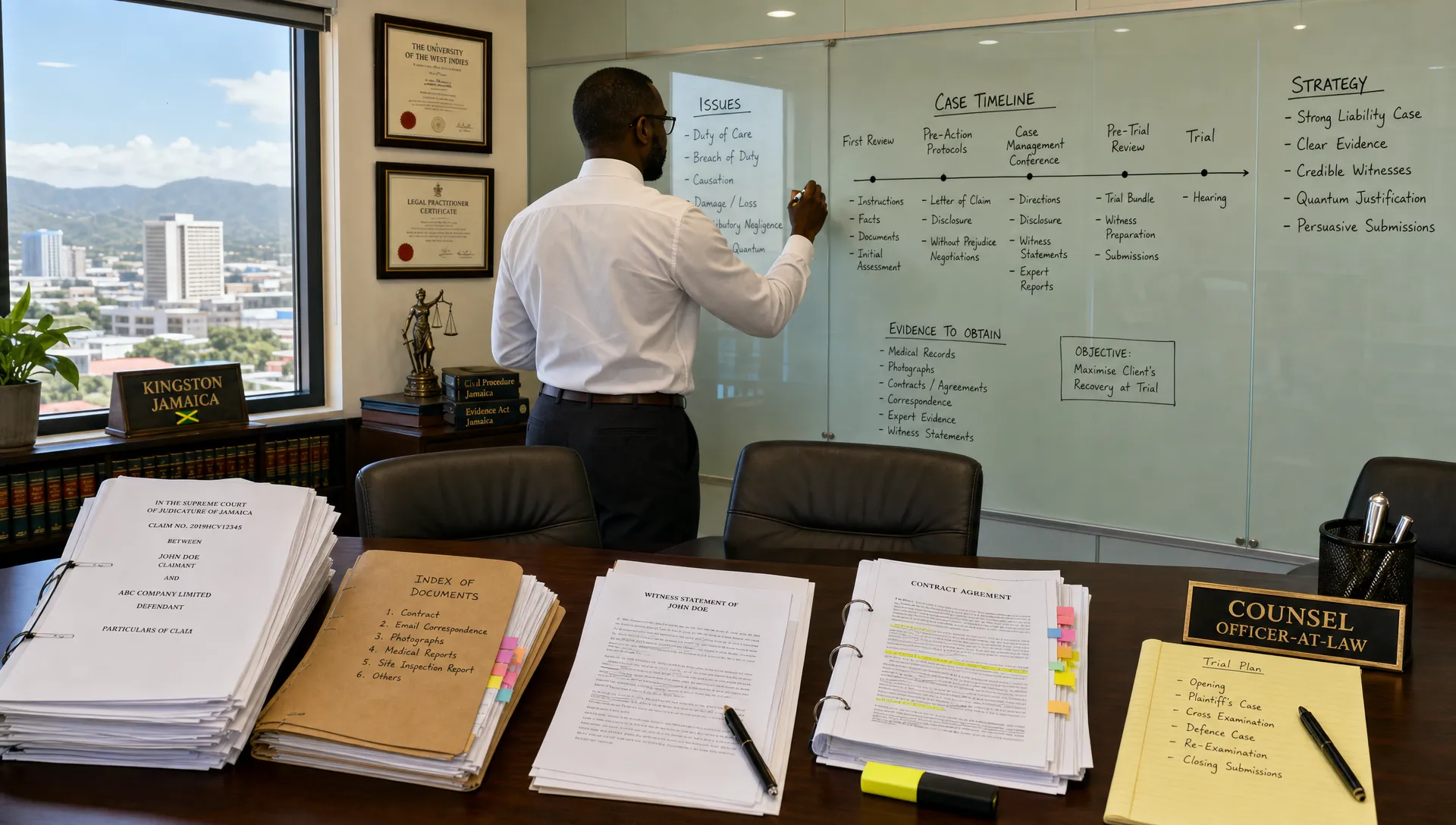
Strong civil cases are built long before anyone stands in court. By the time a judge hears an application, reviews a witness statement or considers written submissions, a civil litigation team has usually spent weeks or months testing the facts, organising evidence, identifying legal risks and preparing a practical route to resolution.
For clients, this preparation can feel invisible. A letter is drafted, a claim is filed, a hearing date is set, but behind each step is a series of strategic decisions. The strongest attorneys civil litigation teams are not simply reacting to the other side. They are shaping the case from the beginning, with a clear view of the client’s objective, the court’s requirements and the evidence needed to prove each point.
This guide explains how civil litigation attorneys prepare strong cases, particularly in the Jamaican legal context, and what clients can do to help their legal team protect their position.
Strong preparation starts with early case assessment
A civil dispute often begins with urgency: a debt is unpaid, a contract has been breached, property is under threat, an injunction may be needed or a business relationship has broken down. The first job of the litigation team is to slow the situation down enough to assess it properly.
Early case assessment is not just about asking, “Can we sue?” It is about asking whether litigation is the best route, what remedies are realistically available, how strong the evidence is, what the likely costs and risks are, and whether the matter can be resolved without a full trial.
At this stage, attorneys usually examine the basic building blocks of the dispute: who the parties are, what legal duties may exist, what happened, what documents support the client’s position, what the other side is likely to say and what deadlines may apply. In Jamaica, as in many common law jurisdictions, limitation periods, procedural rules and available interim remedies can significantly affect strategy.
Clients who seek advice early often give their legal team more options. If you are unsure whether a dispute is serious enough for legal action, Henlin Gibson Henlin’s guide on when to hire attorneys for civil matters in Jamaica explains common warning signs, including court papers, significant financial exposure, property issues and urgent deadlines.
The team defines the real objective
A strong civil case is not always the one that demands the most aggressive remedy. It is the one aligned with the client’s commercial, personal or reputational objective.
For example, a business claimant may want payment of an overdue sum, but also needs to preserve a supply relationship. A defendant may want to avoid judgment, but may be equally concerned about public allegations, regulatory consequences or disruption to operations. A property dispute may require urgent protection of assets rather than immediate pursuit of damages.
Civil litigation attorneys therefore begin by clarifying what success means. That may include:
Recovering money or enforcing a contractual right
Defending against a claim and limiting exposure
Securing urgent injunctive relief
Preserving assets, documents or confidential information
Reaching a negotiated settlement on acceptable terms
Preparing the matter for trial where settlement is not realistic
This objective shapes everything that follows. It influences how the claim or defence is pleaded, what evidence is prioritised, whether interim applications are necessary and how settlement discussions are approached.
Legal issues are separated from background noise
Civil disputes often arrive with a large amount of history. Clients may understandably focus on unfair conduct, broken trust, difficult personalities or years of frustration. While that context can matter, a court usually needs the legal issues to be framed with precision.
A litigation team separates the background story from the questions the court must decide. The key questions may include whether a contract existed, whether a duty was owed, whether that duty was breached, whether loss was caused by the breach, what remedies are available and whether any defence applies.
This issue-framing exercise prevents the case from becoming unfocused. It also helps the attorneys identify gaps before the other side does.
Preparation question | Why it matters | Practical example |
What must be proved? | The team must match facts to legal elements | A breach of contract claim needs proof of the agreement, breach and resulting loss |
Who has the burden of proof? | The party making an allegation usually needs evidence to support it | A claimant alleging misrepresentation must be able to prove the representation and reliance |
What remedies are realistic? | Strategy changes depending on whether the goal is damages, an injunction or another order | A business may need urgent restraint of conduct rather than compensation later |
What defences may arise? | Anticipating the other side’s case avoids surprise | A defendant may rely on payment, waiver, limitation or lack of causation |
What facts are disputed? | Trial preparation focuses on what the court actually needs to resolve | If contract terms are admitted, the fight may be over interpretation or performance |
This is one reason experienced litigation teams are valuable in complex disputes. They do not treat every fact as equally important. They prioritise the facts that carry legal weight.
Evidence preservation is treated as a priority
Evidence can strengthen a case, weaken it or disappear entirely if not protected early. Civil litigation teams therefore move quickly to identify, preserve and organise relevant material.
In modern disputes, evidence may include contracts, invoices, emails, WhatsApp messages, letters, board minutes, bank records, photographs, CCTV footage, delivery records, expert reports, project documents and internal policies. In commercial matters, electronic records and metadata may also become important.
A careful legal team will consider not only what helps the client, but also what may hurt the client. This is essential because litigation strategy must be based on the real evidential picture, not only the most favourable version of events.
Good evidence preparation usually involves three disciplines. First, the team identifies what exists and where it is located. Second, it preserves the material so it is not lost, altered or destroyed. Third, it assesses whether the evidence is admissible, reliable and relevant to the issues.
Clients should avoid deleting messages, editing records, creating after-the-fact summaries that could be misunderstood or communicating directly with the other side without advice once a dispute is active. Even well-intentioned actions can create problems if they affect the integrity of the evidence.
Pleadings turn the case theory into a formal position
In civil litigation, pleadings are more than paperwork. They define the formal case. They tell the court and the opposing party what is alleged, what is denied and what relief is being sought.
In Jamaica, civil procedure is governed by rules designed to manage cases fairly and efficiently. The Jamaica Civil Procedure Rules provide the framework for how civil claims are commenced, defended and managed. A litigation team must prepare pleadings that comply with procedural requirements while still advancing a persuasive and accurate case theory.
Strong pleadings are usually clear, specific and disciplined. They avoid unnecessary allegations, distinguish facts from argument and connect the requested remedy to the evidence. Weak pleadings may be vague, overbroad or emotionally charged, which can make the case harder to prove and easier to attack.
For claimants, the pleadings must set out a proper legal basis for relief. For defendants, the defence must respond carefully to the allegations and raise any positive defences that should be advanced. In some cases, counterclaims, ancillary claims or applications to strike out may also be considered.
Procedural planning keeps the case under control
A strong civil case can still be damaged by missed deadlines, incomplete disclosure, late witness statements or poorly prepared applications. Litigation is procedural as well as substantive.
Civil litigation attorneys therefore map the case timetable carefully. They monitor filing deadlines, service requirements, case management orders, disclosure obligations, expert evidence timelines, hearing dates and trial preparation milestones. This procedural control is especially important in multi-party disputes, commercial claims and matters involving urgent relief.
Procedural planning also helps manage cost and uncertainty. A team that understands the likely stages of the case can advise the client on what to expect, when major decisions may arise and where settlement discussions may be most productive.
For a broader look at how coordinated litigation teams manage demanding disputes, the article on how litigation practice groups handle complex claims explains how strategy, evidence, experts, settlement planning and courtroom execution work together.

Witness preparation focuses on accuracy, not performance
Witness evidence often sits at the centre of a civil case. Documents may show what was written, signed or paid, but witnesses explain what happened, why decisions were made and how events unfolded.
Good witness preparation is not coaching a witness to give a preferred answer. It is helping the witness understand the process, review relevant documents, focus on matters within their personal knowledge and communicate clearly. A witness who exaggerates, speculates or tries to argue the case can damage credibility, even if the underlying position is strong.
Civil litigation teams typically assess each potential witness by asking whether the person has direct knowledge of important facts, whether their evidence is consistent with the documents, whether there are credibility concerns and whether their testimony will assist the court on disputed issues.
Witness statements should be carefully prepared, but they must remain the witness’s evidence. The strongest statements are usually clear, chronological and supported by documents where available. They avoid unnecessary commentary and focus on facts the witness can properly speak to.
Expert evidence is used where specialised knowledge is needed
Some civil cases require more than factual evidence. Disputes involving valuation, construction, accounting, banking practices, intellectual property, shipping, technology, data privacy or professional standards may require expert input.
The role of an expert is different from the role of an advocate. An expert assists the court on matters within specialised knowledge. The litigation team identifies whether expert evidence is necessary, what questions the expert should address and whether the expert’s opinion genuinely supports the client’s case.
Expert evidence can be powerful, but it can also introduce cost, delay and risk. A responsible team will consider whether the issue truly requires expert opinion or whether it can be proved through documents and factual witnesses. Where experts are used, their instructions must be carefully framed so the opinion addresses the actual issues in dispute.
Settlement strategy is built alongside trial strategy
Preparing a strong case does not mean ignoring settlement. In fact, one of the benefits of strong preparation is that it allows the client to negotiate from an informed position.
A litigation team should usually assess settlement throughout the matter, not only on the courthouse steps. The value of a claim may change after disclosure, witness statements, expert reports or interim applications. A defence may become stronger or weaker as evidence develops. A commercial relationship may become worth preserving, or the need for final judgment may become unavoidable.
Mediation and negotiation can be effective where both sides understand the risks. However, settlement discussions are most productive when the legal team has already tested the evidence and can explain the strengths and weaknesses of the case. Without that preparation, a client may settle too cheaply, reject a sensible offer or misunderstand the risks of trial.
For clients trying to understand the role of counsel across the life of a dispute, Henlin Gibson Henlin’s overview of what litigation attorneys do and when to hire one is a useful companion to this preparation-focused guide.
Trial preparation turns information into persuasion
By the time a matter approaches trial, the litigation team should know the record thoroughly. Trial preparation involves more than collecting documents and witnesses. It requires transforming the case into a coherent presentation that helps the court answer the legal questions clearly.
Attorneys typically refine the case theory, organise trial bundles, prepare examination and cross-examination plans, identify the key documents, anticipate objections, prepare legal submissions and ensure witnesses understand the trial process. The goal is not to overwhelm the court with every available detail. It is to present the right details in the right order.
A strong trial theme is simple enough to understand but supported by the evidence. For a claimant, the theme may be that a clear promise was made, breached and caused measurable loss. For a defendant, it may be that the claimant cannot prove causation, has overstated the loss or is relying on a version of events contradicted by the documents.
Courtroom advocacy depends on preparation. The most effective cross-examination often comes from careful review of documents, timelines and prior statements. The most persuasive submissions usually come from disciplined issue-framing long before trial begins.
How clients can help build a stronger civil case
Clients play a major role in litigation preparation. Even the best attorneys can only work with the information available to them. A client who is organised, candid and responsive gives the legal team a stronger foundation.
Clients can help by providing complete documents early, explaining the full background honestly, identifying relevant witnesses, preserving electronic communications, avoiding direct confrontations with the other side and asking questions when legal advice is unclear.
It is especially important to tell the legal team about facts that may appear unfavourable. A damaging document or difficult witness is easier to manage if discovered early. Surprises late in the case can affect pleadings, settlement strategy, credibility and trial preparation.
Clients should also be clear about business realities. Litigation does not happen in a vacuum. Cash flow, reputation, regulatory concerns, management time and commercial relationships may all affect the best strategy. A client-focused legal team will consider those factors when advising on the path forward.
Common mistakes that weaken civil litigation cases
Many weak cases are not weak because the client had no rights. They become weak because preparation was delayed, evidence was mishandled or strategy was unclear.
Common mistakes include waiting too long to seek advice, sending emotional written communications, failing to preserve documents, overstating the claim, ignoring procedural deadlines, treating settlement as a sign of weakness and assuming that oral promises will be easy to prove without supporting evidence.
Another frequent issue is focusing only on what feels unfair rather than what can be proved. Courts decide cases based on evidence and law. A strong litigation team helps translate the client’s experience into a case the court can properly determine.
What makes a civil litigation team strong?
A strong civil litigation team combines legal analysis, procedural discipline, evidential judgment and practical client communication. It understands that every case has legal, factual and human dimensions.
The best teams ask hard questions early. They do not promise certainty where litigation risk exists. They prepare for trial while remaining alert to settlement opportunities. They explain the process in a way clients can understand. Most importantly, they build the case around evidence rather than assumption.
In civil litigation, strength is not measured by volume of correspondence or aggressive language. It is measured by readiness, credibility, strategic focus and the ability to adapt as the case develops.
Frequently Asked Questions
What does a civil litigation attorney do before filing a claim? A civil litigation attorney assesses the facts, reviews documents, identifies legal issues, considers limitation periods, evaluates remedies and advises whether court action, negotiation or another route is appropriate.
Why is evidence preservation so important in civil litigation? Evidence preservation protects documents, messages, records and other material that may prove or disprove key issues. Lost or altered evidence can weaken a case and create procedural or credibility problems.
Do all civil cases in Jamaica go to trial? No. Many civil disputes are resolved through negotiation, mediation, settlement or procedural applications. However, strong trial preparation often improves settlement leverage because both sides can better assess risk.
When should a client involve attorneys in a civil dispute? A client should seek advice as soon as a dispute involves significant money, property, contract rights, reputational risk, urgent relief, court papers or deadlines. Early advice usually preserves more strategic options.
Can a strong case still lose? Yes. Litigation always carries risk because outcomes depend on evidence, law, procedure, judicial assessment and the opposing party’s case. Strong preparation improves the position, but it cannot guarantee a result.
Preparing for a civil dispute with confidence
Civil litigation rewards preparation. The earlier a legal team can assess the facts, preserve evidence, frame the issues and plan the procedure, the stronger the client’s position is likely to be.
If you are facing a civil or commercial dispute in Jamaica, Henlin Gibson Henlin offers experienced, client-focused legal support across civil litigation, commercial litigation, appellate matters, arbitration, mediation and related practice areas. To discuss your situation, visit Henlin Gibson Henlin and seek advice before deadlines or evidence issues limit your options.