
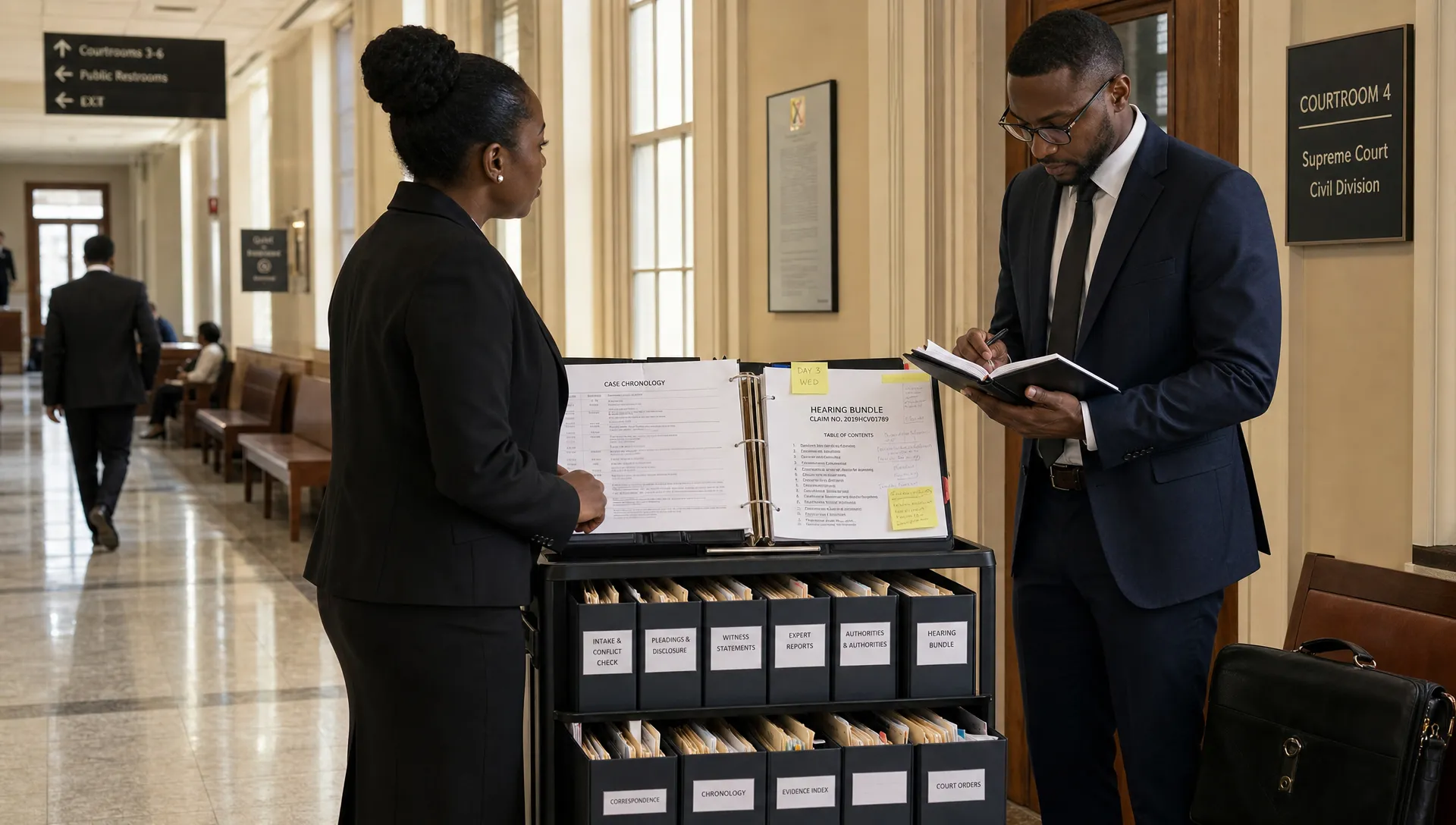
Complex claims rarely fail because one lawyer misses a dramatic courtroom moment. More often, they become difficult because facts are scattered, documents are incomplete, deadlines move quickly, several areas of law overlap, and the business consequences reach beyond the pleadings.
That is why serious disputes are often handled by litigation practice groups rather than a single lawyer working in isolation. A litigation practice group brings together lawyers with different strengths, including advocacy, case analysis, evidence management, negotiation, appellate strategy, regulatory awareness, and subject matter knowledge. The goal is not simply to add more people to a matter. The goal is to build a coordinated structure around a complex claim so that every legal, commercial, and procedural issue is handled deliberately.
For businesses, directors, financial institutions, rights holders, maritime interests, and individuals involved in high-value disputes, understanding how these teams work can make the litigation process less opaque and help you engage your lawyers more effectively.
What makes a claim complex?
A claim becomes complex when the legal dispute cannot be understood by looking at one document, one event, or one rule. Complexity can come from the facts, the number of parties, the value of the claim, the governing law, the evidence, the urgency, or the consequences of losing.
Common features of complex claims include:
Multiple parties with competing versions of events
Large volumes of contracts, emails, financial records, shipping documents, or technical material
Claims involving fraud, breach of fiduciary duty, insolvency, intellectual property, data privacy, competition, banking, or regulatory issues
Urgent applications, such as injunctions or orders to preserve assets or evidence
Cross-border elements, including foreign parties, overseas assets, or international contracts
Expert evidence on valuation, accounting, engineering, technology, medical issues, or industry standards
Parallel proceedings, such as court claims, arbitration, investigations, or appeals
In Jamaica, complex commercial and civil disputes must also be managed within procedural rules, court timetables, evidential requirements, and practical realities such as cost, enforcement, and reputational exposure. A strong litigation practice group looks at all of these factors together, rather than treating the matter as a simple sequence of court filings.
Why litigation practice groups are built around strategy
A complex claim needs more than reaction. It needs an early theory of the case, a clear understanding of the client’s objectives, and a plan that can adapt as evidence emerges. This is where a practice group adds value.
The team will usually begin by asking practical questions: What outcome does the client need? Is the priority money, an injunction, control of an asset, protection of confidential information, preservation of a commercial relationship, or public vindication? What are the strongest facts? What are the weaknesses? What must be proven? What can the opposing side prove? What deadlines matter immediately?
This kind of strategic mapping is similar to the wider process explained in Henlin Gibson Henlin’s article on how a legal team develops strategy in complex cases, where coordination, evidence control, and procedural discipline are central to good case management.
In a complex matter, the group’s job is to turn uncertainty into a structured plan. That plan may include court proceedings, settlement discussions, mediation, arbitration, urgent interim relief, appeal preparation, or a combination of several routes.
The core roles inside a litigation practice group
Litigation teams vary depending on the claim, but complex disputes usually require several distinct roles. The same lawyer may perform more than one role, especially in a focused team, but the functions still need to be covered.
Role | Main contribution to a complex claim | Why it matters |
Lead litigation partner | Sets overall strategy, assesses risk, supervises key decisions, and manages client communication | Keeps the case aligned with the client’s commercial and legal objectives |
Advocate or trial lawyer | Presents arguments, examines witnesses, handles hearings, and shapes courtroom strategy | Converts the case theory into persuasive submissions and evidence |
Associate or case manager | Reviews documents, drafts pleadings, prepares chronologies, tracks deadlines, and coordinates filings | Prevents procedural gaps and keeps the matter organised |
Subject matter lawyer | Advises on areas such as IP, data privacy, compliance, shipping, banking, or competition law | Ensures specialised legal issues are not missed or oversimplified |
External expert witness | Gives independent opinion evidence on technical, financial, or industry questions | Helps the court or tribunal understand specialised facts |
The best results usually come when these roles are integrated early. If the advocate only sees the file shortly before trial, or the specialist lawyer is consulted after pleadings have closed, important opportunities may already be lost.
Stage 1: Early case assessment and claim triage
The first stage is to understand the dispute before it expands. Litigation practice groups conduct an early case assessment to identify the facts, legal causes of action, possible defences, available remedies, limitation issues, urgent risks, and likely cost of the matter.
This stage is not just about deciding whether the client has a claim. It is also about deciding whether litigation is the best route. Sometimes the correct first move is a demand letter, negotiation, mediation, arbitration, a regulatory response, or urgent court action. In other situations, the safest step is to avoid escalating the dispute until the evidence is stronger.
At this point, the group will usually create a working chronology. This is a timeline of key events, contracts, communications, payments, breaches, notices, meetings, and decisions. A good chronology often reveals the true shape of the case. It can show whether the dispute is really about a failed contract, a governance breakdown, a debt recovery problem, misuse of confidential information, or a broader commercial relationship that has collapsed.
Early triage also includes risk analysis. Lawyers will look at what the client must prove, what documents are missing, which witnesses are likely to help or hurt the case, whether there are counterclaims, and whether the opposing party has assets that can satisfy a judgment or award.
Stage 2: Preserving evidence and managing documents
Evidence is the foundation of complex litigation. In many commercial claims, the outcome depends less on what each side says happened and more on what the documents show. Contracts, emails, board minutes, invoices, bank records, shipping papers, policies, data logs, and internal reports can become decisive.
A litigation practice group will usually move quickly to preserve relevant material. This may include advising the client not to delete emails, alter records, destroy drafts, or continue informal messaging about the dispute. In some cases, it may be necessary to secure devices, preserve digital records, or instruct forensic experts.
The team must also protect legal professional privilege and confidentiality. Not every internal communication should be widely circulated. Not every draft analysis should be shared. A disciplined legal team helps the client avoid creating unnecessary documents that may later damage the case.
Document management is especially important in claims involving regulated industries, data privacy, intellectual property, financial transactions, maritime trade, or corporate governance. The litigation team needs to know what exists, where it is located, who controls it, and whether it can be used in court or arbitration.
Stage 3: Defining the issues and choosing the forum
Once the facts are clearer, the litigation practice group narrows the dispute into legal issues. This is where a broad complaint becomes a properly framed claim or defence. The lawyers determine the causes of action, the remedies to pursue, the evidence needed for each issue, and the arguments most likely to persuade the court or tribunal.
Forum choice can be crucial. Some disputes belong in court. Others may be governed by an arbitration clause. Some may benefit from mediation before positions harden. The wrong forum can increase cost, delay enforcement, or create procedural complications.
For commercial parties, the decision may involve confidentiality, speed, enforceability, appeal rights, the need for urgent relief, and the nature of the relationship between the parties. If your dispute may be subject to an arbitration agreement, it is worth reviewing the practical differences between arbitration and litigation as dispute resolution routes before committing to a strategy.
This stage is also where pleadings matter. A pleading that is too broad can weaken credibility and increase cost. A pleading that is too narrow can leave valuable remedies behind. Complex claims require pleadings that are precise enough to satisfy procedural requirements but flexible enough to support the evidence as it develops.

Stage 4: Coordinating experts, witnesses, and technical evidence
Many complex claims turn on specialised knowledge. A banking dispute may require financial analysis. A construction claim may need engineering evidence. A technology or data privacy dispute may require digital forensic input. An intellectual property claim may involve market confusion, valuation, or technical comparison.
Litigation practice groups help identify when expert evidence is needed and what question the expert must answer. This is important because an expert is not there to argue the client’s case. The expert’s role is to assist the court or tribunal on matters within the expert’s field. If the legal team asks the wrong question, the expert report may be less useful, even if the expert is highly qualified.
Witness preparation is also handled carefully. Witnesses need to understand the process, review relevant documents, and give evidence honestly and clearly. They should not be coached to change their evidence. Instead, they should be prepared to explain what they know, what they do not know, and how their recollection fits with the documents.
In a complex claim, the lawyers must ensure that witness statements, expert reports, pleadings, and submissions all work together. Inconsistencies can be damaging. A coordinated practice group reduces that risk by testing the case from several angles before the opposing side does.
Stage 5: Managing settlement without weakening the case
Strong litigation teams do not treat settlement as a sign of weakness. They treat it as one possible route to a controlled outcome. In fact, many complex claims are resolved through negotiation or mediation because the parties recognise the cost, delay, uncertainty, or commercial disruption of continuing to trial.
The key is to negotiate from a position of preparation. A party that understands its evidence, risks, legal merits, and enforcement options can negotiate more effectively than one that simply wants the dispute to disappear.
A litigation practice group may prepare a settlement strategy that considers the likely value of the claim, the probability of success, legal costs, reputational exposure, business interruption, tax or accounting consequences, confidentiality, and the opponent’s ability to pay.
Settlement documents must also be drafted carefully. A poorly drafted settlement can create fresh disputes about payment dates, releases, confidentiality, admissions, costs, future claims, or default consequences. For complex matters, the settlement agreement should be as carefully managed as the pleadings.
Stage 6: Procedural control and courtroom execution
Complex claims often involve procedural steps before trial, including applications for interim relief, disclosure, witness directions, expert evidence, case management conferences, amendments, strike-out applications, summary judgment applications, or security for costs. The exact steps depend on the matter, the forum, and the applicable rules.
A litigation practice group must keep procedural control. Missing a deadline, failing to respond to an application, or overlooking a court direction can affect the entire case. Good teams maintain calendars, assign responsibility, prepare filings early, and keep clients informed about what each step means.
Courtroom execution is the visible part of the work, but it is built on months or years of preparation. The advocate must know the documents, understand the commercial context, anticipate the opposing argument, and present the case in a way that assists the judge or tribunal. This includes clear written submissions, focused oral argument, disciplined examination of witnesses, and realistic engagement with weaknesses.
Clients who want a broader overview of the litigation function may also find it useful to understand what litigation attorneys do throughout a dispute, from initial evaluation through settlement or trial.
Stage 7: Appeals and post-judgment strategy
A complex claim does not always end when judgment is delivered. The losing party may consider an appeal. The winning party may need to enforce the judgment. There may be cost orders, stays of execution, asset tracing issues, or related claims that remain unresolved.
An effective litigation practice group thinks about appeal risk before trial, not after judgment. That means preserving legal arguments, making proper objections where necessary, ensuring the record is clear, and identifying issues that may become important on appeal.
Post-judgment strategy is equally important. A favourable judgment has practical value only if it can be enforced. Before and during the claim, the team should consider whether the opposing party has assets, whether assets are in Jamaica or overseas, whether security is needed, and what enforcement mechanisms may be available.
How clients can work effectively with a litigation practice group
Clients play a major role in complex claims. The legal team can only build a strong strategy if the client provides accurate information, preserves documents, and communicates early about risks or changes.
The most helpful clients are usually those who are candid with their lawyers from the beginning. Surprises are dangerous in litigation. A fact that seems embarrassing, inconvenient, or commercially sensitive may be manageable if disclosed early. If it emerges for the first time during cross-examination, mediation, or an opponent’s application, it can cause serious damage.
Before engaging or working with a litigation practice group, consider asking:
Who will lead the matter and who will handle day-to-day coordination?
What are the strongest and weakest parts of the claim or defence?
What documents and witnesses are needed immediately?
Is court, arbitration, mediation, or negotiation the better route at this stage?
What urgent deadlines or limitation issues exist?
How will legal costs, settlement options, and risk be reviewed as the case develops?
These questions help convert the lawyer-client relationship into a working partnership. They also make it easier to keep the case aligned with the client’s broader objectives.
Why the group approach matters in high-stakes disputes
Complex claims are not won by volume alone. They are won by judgment, preparation, coordination, and timing. A large pile of documents is not a strategy. A strong legal argument is not enough if the evidence is disorganised. A good settlement offer may be missed if the team has not assessed risk properly.
Litigation practice groups bring structure to the uncertainty of serious disputes. They identify the real issues, preserve evidence, manage procedure, coordinate experts, prepare witnesses, negotiate intelligently, and present the case clearly. Most importantly, they help clients make decisions based on legal merit and practical risk, not pressure or guesswork.
For businesses and individuals in Jamaica facing a serious claim, the earlier a coordinated litigation team is involved, the better the chance of protecting rights, controlling risk, and choosing the right path forward.
Frequently Asked Questions
What is a litigation practice group? A litigation practice group is a team of lawyers who work together on disputes, court proceedings, arbitration, settlement strategy, and related risk management. In complex claims, the group may include lawyers with different strengths, such as advocacy, commercial litigation, appellate work, compliance, intellectual property, or sector-specific knowledge.
How is a litigation practice group different from hiring one litigation attorney? One attorney may be able to handle many disputes effectively, but complex claims often require several coordinated functions at once. A practice group can divide work across strategy, evidence review, pleadings, hearings, expert coordination, negotiation, and appeal planning while keeping the matter under unified supervision.
Do complex claims always go to trial? No. Many complex claims settle before trial through negotiation, mediation, or other dispute resolution processes. A strong litigation practice group prepares as if the matter may proceed to trial while also assessing settlement opportunities when they serve the client’s interests.
When should a business involve a litigation practice group? A business should seek legal guidance as soon as a serious dispute appears likely, especially if there are large sums at stake, urgent deadlines, important contracts, regulatory issues, confidential information, reputational risk, or possible cross-border elements. Early advice can help preserve evidence and avoid strategic mistakes.
Why does local legal experience matter in Jamaica? Local experience matters because litigation strategy must account for Jamaican procedure, court practice, timelines, remedies, enforcement realities, and commercial context. Complex claims may also involve international elements, but the local forum and procedural framework can still shape the outcome.
Need guidance on a complex claim?
If you are dealing with a high-value dispute, urgent commercial conflict, regulatory issue, intellectual property concern, shipping matter, banking dispute, or potential appeal, early strategic advice can make a material difference. Henlin Gibson Henlin provides client-focused legal services across a wide range of practice areas in Jamaica, including commercial litigation, civil litigation, arbitration, compliance, data privacy, intellectual property, admiralty and shipping, and appellate matters.
This article is general information only and is not a substitute for legal advice on your specific circumstances. For a complex claim, speak with a qualified attorney before taking or delaying action.