
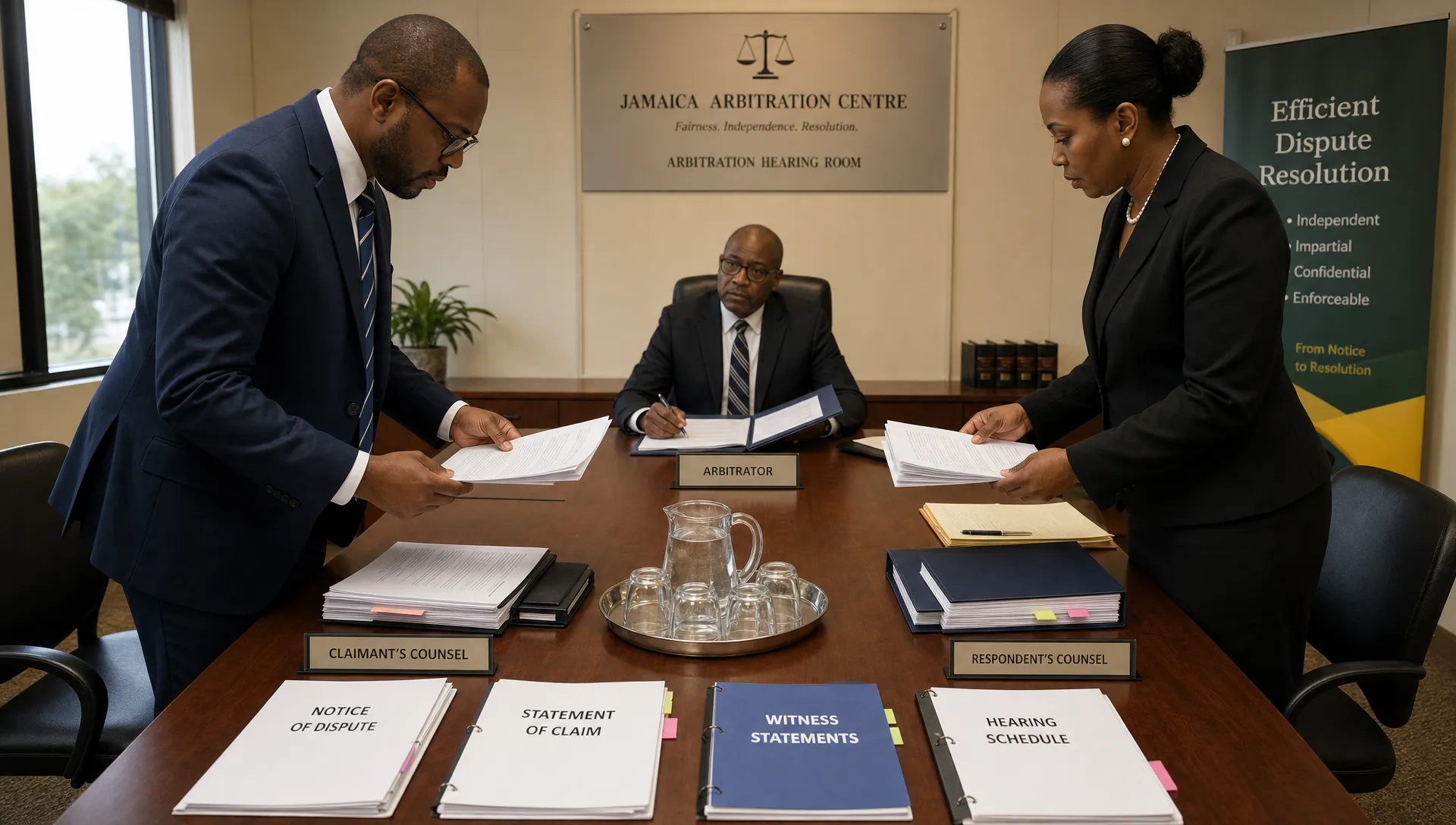
Arbitration is a private dispute resolution process where the parties put their dispute before one or more neutral decision-makers instead of a court. Whether the issue is a cross-border supply contract, a shareholder disagreement, a construction claim or work arbitration arising from an employment relationship, the broad path usually runs from a notice of dispute to a response, tribunal appointment, evidence, hearing and final award.
This guide explains that lifecycle in practical terms for businesses, in-house teams and individuals who need to understand what happens next. The exact procedure will depend on the contract, the arbitral rules, the seat of arbitration and any applicable law, so this is a general overview rather than legal advice for a specific matter.
Where Work Arbitration Fits Into the Wider Arbitration Process
Arbitration begins with consent. The consent may be found in a contract clause signed before any dispute arose or in a later agreement to refer a specific dispute to arbitration. Once that agreement exists, arbitration can operate as a binding alternative to court litigation, with the arbitrator or tribunal empowered to make an award.
For parties deciding whether the arbitral route is suitable, the key differences usually concern privacy, procedural flexibility, enforceability and the limited scope for appeals. Henlin Gibson Henlin has covered those strategic considerations in more detail in its guide to choosing between arbitration and litigation.
For a company facing work arbitration or any commercial arbitration, the first question is not who is right but what the parties agreed about forum, rules, seat and appointment. That early review affects everything that follows.
1. Before Notice: Check the Arbitration Agreement
Before sending a notice of dispute, counsel should examine the arbitration clause with care. A defective notice, a missed precondition or service on the wrong entity can create avoidable objections at the start of the case.
The clause may require negotiation or mediation before arbitration. It may name an arbitral institution, specify the number of arbitrators or set the legal seat of the arbitration. The seat matters because it usually determines which court has supervisory powers over the arbitration and which procedural law applies.
A practical pre-notice review should cover these points:
The correct parties to the arbitration agreement
The scope of disputes covered by the clause
Any mandatory negotiation, mediation or cooling-off period
The governing law, seat of arbitration and language
The rules for appointing the arbitrator or tribunal
Limitation periods, contractual notice periods and service requirements
In high-value matters, this stage overlaps with early case assessment, evidence preservation and budgeting. For a deeper preparation checklist, see Henlin Gibson Henlin’s article on preparing for arbitration in a high-value dispute.
2. Notice of Dispute: Starting the Case
The notice of dispute is the document that formally starts the arbitration, unless the applicable rules provide otherwise. It does not always need to prove the entire case, but it should identify the parties, the arbitration agreement, the dispute, the relief sought and the proposed method for appointing the tribunal.
The notice stage is where work arbitration shifts from a grievance or negotiation problem into a formal legal process. It should therefore be clear, accurate and aligned with the remedies the claimant may later seek.
A strong notice usually avoids exaggeration. It sets out enough facts to show jurisdiction and the nature of the claim without locking the claimant into unnecessary detail before evidence has been reviewed. If the contract requires service by a particular method, such as registered delivery or email to a designated address, the claimant should follow that method precisely and keep proof of service.
In institutional arbitration, the notice may also require payment of a filing fee and submission to the institution. In ad hoc arbitration, the notice is usually served directly on the respondent and may include a proposal for the arbitrator.
3. Response and Early Objections
The respondent’s first formal step is usually a response or answer. This document may accept that arbitration is the correct forum, deny liability, raise counterclaims or challenge jurisdiction.
Jurisdictional objections can be serious. A respondent may argue that it never agreed to arbitrate, that the dispute falls outside the clause or that mandatory steps were not completed before the notice was served. Many arbitration laws and rules allow the tribunal to decide on its own jurisdiction, subject to limited court review.
The response also shapes the timetable. If there is a counterclaim, the claimant will need a chance to answer it. If urgent relief is required, either side may ask for interim measures before the final award. At this stage, parties should also decide whether settlement discussions can continue without delaying necessary procedural steps.
In work arbitration, early objections should be handled strategically rather than reflexively. A weak technical objection can increase cost and irritate the tribunal, but a strong jurisdictional objection may prevent the case from proceeding in the wrong forum.
4. Appointing the Tribunal and Setting Procedure
The tribunal may be a sole arbitrator or a panel of three arbitrators. The contract or arbitral rules usually decide the default position. In complex commercial disputes, three-member tribunals are common, but a sole arbitrator can reduce cost and simplify scheduling.
Independence and impartiality are essential. Proposed arbitrators should disclose relationships, prior appointments or circumstances that could create a reasonable concern about bias. If a party believes an arbitrator is conflicted, it must usually raise the challenge promptly.
Once the tribunal is appointed, work arbitration becomes a managed proceeding rather than an exchange of accusations. The tribunal will often hold a preliminary meeting or case management conference to set the timetable, define procedural rules and address document production, witness evidence, expert evidence and hearing dates.
Procedural flexibility is one of arbitration’s main advantages. The parties and tribunal can tailor the process to the dispute instead of following every step of ordinary court procedure. That flexibility works best when each side is prepared, realistic and willing to identify the issues that truly matter.

Indicative Arbitration Lifecycle
The following table shows a typical sequence. Actual deadlines depend on the arbitration clause, rules, tribunal directions and complexity of the dispute.
Stage | Main purpose | Practical point |
Pre-notice review | Confirm jurisdiction, parties and procedural requirements | Check conditions precedent before sending anything |
Notice of dispute | Start the arbitration and identify the claim | Serve it exactly as the contract requires |
Response | Answer the claim and raise objections or counterclaims | Preserve jurisdictional points early |
Tribunal appointment | Put the decision-maker in place | Review disclosures for independence and impartiality |
Procedural timetable | Set pleadings, evidence and hearing steps | Use case management to control cost |
Hearing or documents-only process | Present evidence and submissions | Match the process to the value and complexity of the dispute |
Award | Decide liability, remedies, interest and costs | Review compliance and enforcement options promptly |
5. Statements of Case, Evidence and Disclosure
After the timetable is set, the parties move into the written phase. The claimant files a statement of claim with the legal and factual basis for the remedy sought. The respondent files a defence and any counterclaim. The claimant may then file a reply.
These documents are more detailed than the initial notice and response. They should identify the contract terms relied on, key events, breaches, loss and the remedies requested. Legal submissions may be included in the pleadings or reserved for later, depending on the tribunal’s directions.
Evidence is often the heart of the process. Documents, emails, payment records, technical reports and meeting notes may matter more than broad assertions. Witness statements should be tied to issues the tribunal must decide. Expert evidence may be needed for valuation, delay, engineering, accounting or market practice.
Good work arbitration preparation means organising evidence around the issues rather than simply collecting every document connected to the dispute. That approach helps control cost and makes the tribunal’s task easier.
Disclosure in arbitration is usually narrower than court discovery, but it can still be significant. The tribunal may order production of specific categories of documents if they are relevant and material to the outcome.
6. Interim Measures and Settlement Windows
Some disputes cannot wait for a final award. A party may need an order preserving assets, protecting confidential information, maintaining goods or preventing conduct that would undermine the arbitration. Depending on the law, rules and timing, interim measures may be sought from the tribunal, an emergency arbitrator or a court.
Interim relief should be used carefully. It requires evidence, urgency and a remedy the decision-maker has power to grant. It can also affect settlement dynamics, since an early interim decision may reveal strengths or weaknesses in the case.
Arbitration does not prevent negotiation. Many disputes settle after the notice, after the exchange of pleadings or shortly before the hearing when risks become clearer. Mediation can also run alongside arbitration if the parties agree. The important point is to keep settlement discussions structured and to avoid missing procedural deadlines while negotiations continue.
In work arbitration, settlement may be especially valuable where the parties have an ongoing commercial or employment relationship. A final award resolves the legal dispute, but it may not repair the working relationship.
7. The Hearing: Testing the Evidence
Not every arbitration requires a full oral hearing. Smaller disputes or pure legal issues may be decided on documents only. Where facts, credibility or expert disagreement matter, a hearing is usually appropriate.
At the hearing, each side presents its case through opening submissions, witness examination, cross-examination, expert evidence and closing submissions. The tribunal controls the process and may ask questions throughout. Hearings can be in person, virtual or hybrid, depending on the procedural order and practical needs of the case.
The hearing is not a free-form debate. It is the point where the issues defined in the pleadings meet the evidence. Counsel will usually focus on the contractual wording, key documents, credibility of witnesses and the calculation of loss.
In work arbitration, the hearing can feel less formal than court, but the consequences are serious. A party should treat witness preparation, document bundles and submissions with the same discipline expected in high-stakes litigation.
After the hearing, the tribunal may invite post-hearing written submissions. These submissions help the tribunal analyse evidence, authorities and the precise wording of the relief sought.
8. The Award: Reasons, Remedies and Costs
The award is the tribunal’s decision. It may be final or partial. A partial award can decide a threshold issue, such as jurisdiction or liability, while leaving damages or costs for later.
A final award usually deals with liability, remedies, interest and costs. Remedies may include damages, declarations, specific performance or other relief permitted by the contract, applicable law and arbitral rules. The award should identify the parties, the arbitration agreement, the issues, the tribunal’s reasoning and the decision.
Many awards are reasoned, meaning the tribunal explains why it reached its decision. Reasons matter because they help the parties understand the outcome and can be relevant if enforcement or challenge proceedings later arise.
Once the award is issued, parties should review deadlines immediately. Some rules allow a short window to request correction of clerical errors or interpretation of a point in the award. Those requests are not appeals on the merits.
After the Award: Compliance, Enforcement and Limited Challenges
A party that loses an arbitration may comply voluntarily, especially where it has assets, reputation or ongoing business interests at stake. If it does not comply, the successful party may need to enforce the award through the courts.
The value of work arbitration often depends on enforceability. One reason arbitration is common in cross-border commerce is the international framework for recognition and enforcement of awards under the New York Convention. Jamaica’s modern arbitration framework also reflects principles associated with the UNCITRAL Model Law, which supports a court-supervised but arbitration-friendly structure.
Challenges to awards are usually limited. A court will not normally rehear the dispute because one party dislikes the result. Grounds for refusing recognition or setting aside an award tend to focus on issues such as lack of jurisdiction, procedural unfairness, improper tribunal composition or conflict with public policy.
For background on Jamaica’s move toward a more modern arbitration regime, Henlin Gibson Henlin’s note on Jamaica’s Arbitration Bill remains a useful policy overview.
Practical Points for Parties Entering Arbitration
Parties often underestimate how much the early steps influence the final result. A vague notice, poor preservation of documents or late jurisdictional objection can create problems that follow the case to the award.
The safest approach is to treat arbitration as a structured legal proceeding from the first sign of escalation. Preserve communications, map the contractual obligations, identify witnesses early and keep commercial objectives in view. Winning every procedural point is rarely as important as presenting a coherent case that gives the tribunal a clear route to the requested remedy.
Work arbitration also benefits from early cost control. The parties should consider whether the value of the dispute justifies a three-member tribunal, extensive document production or a lengthy oral hearing. A well-designed procedure can protect fairness without allowing the process to become disproportionate.
Frequently Asked Questions
What starts an arbitration? Arbitration usually starts when the claimant serves a notice of dispute or notice of arbitration in accordance with the contract and applicable arbitral rules.
Is arbitration the same as mediation? No. Mediation is a facilitated negotiation where the mediator does not impose a decision. Arbitration is adjudicative, meaning the arbitrator or tribunal makes a binding award.
Can a party refuse to participate after receiving a notice? A party can refuse in practice, but that may not stop the arbitration. If the tribunal has jurisdiction and proper notice was given, the case may proceed and an award may be issued.
How long does work arbitration take? Timing depends on the clause, rules, tribunal availability, complexity and evidence. A streamlined matter may finish in months, while a complex commercial arbitration can take longer.
Can an arbitral award be appealed? Usually not in the same way as a court judgment. Most challenges are limited to procedural, jurisdictional or public policy grounds, depending on the governing law and seat.
Need Guidance on an Arbitration Matter?
If you have received a notice of dispute, are considering whether to commence arbitration or need to understand the risks of an arbitration clause, early legal advice can make a significant difference. Henlin Gibson Henlin assists clients with arbitration, mediation and commercial dispute strategy in Jamaica and cross-border matters.
To discuss your position with an experienced legal team, contact Henlin Gibson Henlin before procedural deadlines narrow your options.