
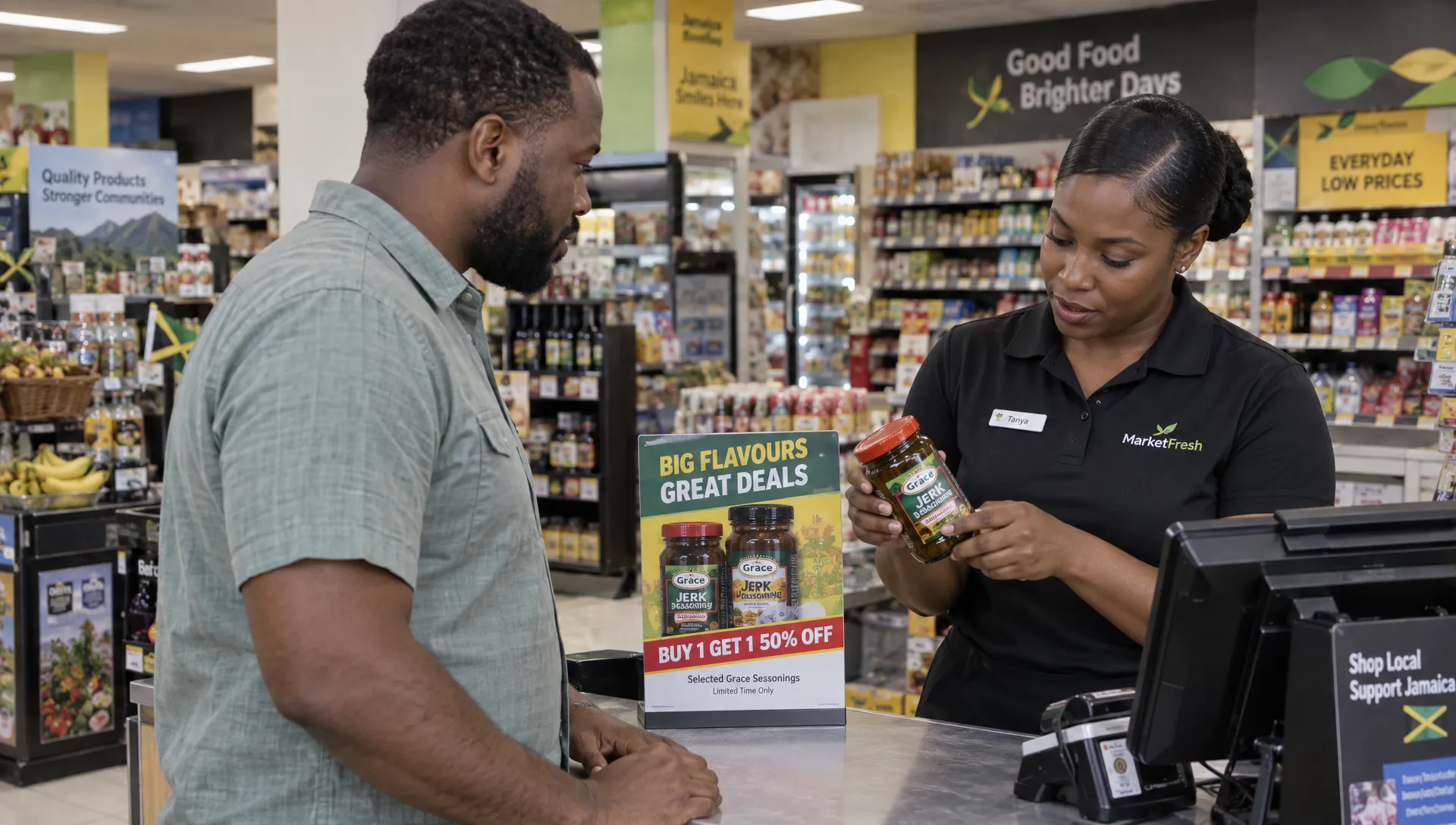
Misleading advertising claims in Jamaica can arise from more than an outright false statement. A genuine discount can become misleading if the reference price is inaccurate, while a technically correct headline can give the wrong impression when important conditions are hidden. For businesses, the practical challenge is to make every claim match the evidence, the price and what customers will actually receive.
This guide explains how to review promotional messages before publication, document their basis and correct problems without creating further confusion.
What Jamaican law expects from advertising
Two important parts of Jamaica’s legal framework are the Fair Competition Act and the Consumer Protection Act. The Fair Competition Act addresses false or misleading representations made when promoting goods, services or business interests. The Consumer Protection Act provides additional protections relevant to dealings between suppliers and consumers.
The Fair Trading Commission administers the Fair Competition Act. The Consumer Affairs Commission provides consumer information and handles consumer complaints within its remit. The appropriate route for a particular issue depends on the facts and the legal provisions involved.
A useful working standard is to ask whether an advertisement accurately communicates the offer and whether anything omitted could materially affect a purchasing decision. Review the words, images, price presentation and qualifications together rather than checking each sentence in isolation.
Advertising for regulated products or services may also require sector-specific review. Health-related products, financial services and other regulated offerings should not be approved solely against a general marketing checklist.
Spot misleading advertising claims in Jamaica before publication
The safest review begins with what the customer is likely to understand, not what the marketing team intended. Apply two separate checks: the message conveyed and the evidence supporting it.
Assess the overall message
Read the advertisement without the background knowledge your team has. A headline saying “Free delivery” may suggest there is no delivery charge, even if the offer only applies within a particular area or above a minimum order value.
Images can create claims too. A photograph showing accessories alongside a product may imply that they are included. A prominent certification badge can suggest independent approval, even where the business has merely completed its own internal assessment.
Identify conditions that change the offer’s meaning and place them where customers can notice them before deciding to buy. Small print should explain a claim, not contradict it.
A practical test: Ask a colleague who was not involved in the campaign to describe the offer after a brief look. If their understanding differs from what you will deliver, revise the advertisement.
Check whether evidence supports the promise
Statements about measurable performance need evidence appropriate to the claim. “Lasts twice as long” requires a defensible comparison, including what was compared and under which conditions. “Customers love it” is different from a precise claim that a stated percentage of customers recommend it.
Do not assume that a supplier’s brochure proves every claim you want to make. Check whether its evidence relates to the exact product, formulation, model or service being advertised.
Also distinguish opinion from factual promises. An enthusiastic slogan may be understood as promotional language, but “Jamaica’s lowest price” invites a market-wide comparison. Calling a statement a slogan does not resolve the risk if customers are likely to understand it as a factual claim.
Keep the supporting material before publication rather than trying to assemble it after a complaint.
Common advertising claims that need closer review
The examples below illustrate safer drafting approaches. They are not legal safe harbours: each revised statement still needs to be true, supported and presented clearly.
Claim | Potential problem | Safer approach |
“50% off” | The comparison price was never genuinely charged or applies to a different product | Identify a defensible reference price and the products covered |
“Free installation” | Customers must pay an unavoidable installation-related charge | Explain the included work and any additional charges prominently |
“Guaranteed results” | The business cannot support the promised outcome | Describe supported results and explain the actual guarantee, if offered |
“Only two left” | The scarcity message is artificial or repeatedly resets | Use accurate stock information and remove outdated messages |
“Official distributor” | The business lacks current authorisation | Verify the relationship and use only wording the authorisation supports |
“Up to 70% off” | The headline suggests a broader discount than the promotion delivers | Explain which products qualify and how the discount varies |
Discounts, final prices and limited stock
For price promotions, preserve the basis of the comparison. Record which item was sold at the reference price, when that price applied and whether the same package or quantity is being compared.
Make the currency clear, particularly when advertising to both Jamaican and overseas customers. Explain the treatment of applicable General Consumption Tax, delivery charges and other unavoidable costs so the headline does not give a false impression of the amount payable.
For instalment offers, distinguish the instalment amount from the total cost and disclose relevant financing conditions. A low weekly figure can be misleading if customers are left unaware of a deposit or other mandatory payments.
Limited-stock claims should reflect actual availability. If a promotion covers only selected branches, sizes or product lines, say so. “While stocks last” should not be used to obscure the fact that the advertised offer has little meaningful availability.
Results, comparisons and endorsements
Comparative advertising should compare like with like. If you claim that your service is cheaper than a competitor’s, check the package, service period, fees and date of comparison. A comparison that was accurate at launch can become outdated.
Testimonials also need careful handling. Retain evidence that the customer gave the statement and approved its use. Do not edit a testimonial so heavily that it changes its meaning or present an exceptional result as the outcome customers should ordinarily expect.
As a transparency measure, clearly identify paid or otherwise incentivised endorsements. Do not present a person who received payment, free products or another benefit as an independent customer without explaining the relationship.
Businesses seeking to avoid misleading advertising claims in Jamaica should review the surrounding presentation as well as the quotation itself. Photographs, captions and before-and-after images can imply promises that the written disclaimer does not adequately explain.
Build a claim file before the campaign launches
A claim file gives reviewers a practical basis for approving an advertisement. It should connect each significant factual statement to evidence and show which qualifications customers must see.
For each campaign, retain:
The exact claim: Include the headline, images, captions and relevant spoken wording.
Supporting evidence: Keep test reports, price records, stock information or authorisation documents as appropriate.
Scope and limitations: Record the products, locations, dates and customer groups covered.
Required disclosures: Specify the conditions that must appear with the claim.
Approval and final versions: Preserve the approved wording and what was actually published.
The file does not need to be elaborate. A small business can use a shared folder and a simple review document, provided the records are clear and accessible.
Set a review date for time-sensitive claims. Competitor pricing, stock levels, licences and promotional terms can change. Evidence supporting an advertisement last month may not support it today.

Make approval a business process, not just a copy check
Marketing staff may know how the campaign should sound, but other teams hold the facts that determine whether it is accurate. Finance can confirm prices and charges, operations can verify availability and service capacity, while legal advisers can assess sensitive claims and qualifications.
Give one person responsibility for coordinating those checks and approving the final version. The process should cover the material actually published, not an earlier draft that later acquired a stronger headline or lost a qualification.
Use a proportionate approach. Routine descriptions may need a straightforward accuracy check. Claims about health outcomes, financial benefits, guarantees, competitor superiority or regulatory approval deserve closer review.
Check consistency across channels too. A radio advertisement, social post and landing page should not describe materially different versions of the same promotion.
For recurring campaigns, reusable wording can save time, but only if someone confirms that the underlying facts remain unchanged. A previously approved advertisement is not automatically suitable for a new offer.
Keep social media, influencers and website terms aligned
Short formats make clear disclosure harder, not less necessary. If an important condition cannot be communicated adequately in a social post, change the headline or simplify the offer. Do not rely on customers following several links to discover that the promotion is substantially narrower than it first appears.
Give influencers and agencies written instructions identifying approved claims, required qualifications and statements they must not make. Check published content and request corrections when it departs from those instructions.
Your website should reinforce the advertised offer. Pricing, eligibility, delivery terms and guarantee conditions should remain consistent from the landing page through checkout. Well-drafted website terms and conditions can help clarify the transaction, but they should not be treated as a cure for a misleading headline.
Customer-facing staff also need the correct terms. A campaign can create further problems if staff make unsupported promises when responding to enquiries.
What to do when a claim may already be misleading
If a concern arises, preserve the advertisement and supporting records before changing or removing it. Save screenshots, publication dates, campaign instructions and relevant customer communications.
Pause the disputed claim while you establish what happened. Determine whether the problem concerns inaccurate facts, missing conditions, outdated information or a mismatch between the advertised offer and what the business delivered.
Consider whether a correction needs to reach the same audience as the original message. Quietly editing a web page may not address confusion created by a widely circulated promotion. The appropriate response could also involve contacting affected customers or reviewing individual transactions, depending on the circumstances.
Obtain legal advice promptly where complaints are escalating, a regulator has contacted the business or customers allege financial loss. A broader review of consumer-law business risks can help identify whether the advertising problem also affects sales practices, warranties or complaint handling.
Frequently asked questions
Can an advertisement be misleading even if its individual statements are true? Yes. The combination of wording, images and omitted information can give customers an inaccurate understanding of the offer. Review the whole message rather than relying only on literal accuracy.
Does “terms and conditions apply” protect a business? Not by itself. It does not explain which conditions materially affect the offer. Important limitations should be communicated clearly, and advertising terms cannot override applicable statutory rights.
Can a business repeat a manufacturer’s claim? Do not assume it is safe simply because the manufacturer supplied it. Check that the evidence supports the exact claim and that it applies to the product and circumstances you are advertising.
How often should advertising claims be reviewed? Review them before publication and whenever a relevant fact changes. Time-sensitive claims about prices, availability or comparisons also need scheduled checks during the campaign.
Who should review misleading advertising claims in Jamaica? The review should involve the people who can verify the facts, with legal input for higher-risk claims, disputed promotions and regulatory concerns. The level of review should reflect the claim and its potential consequences.
Get legal guidance before a high-risk campaign
Before publishing a campaign built around a guarantee, a major price comparison or a sensitive product claim, resolve uncertainty about the evidence and wording. It is usually easier to revise an advertisement before launch than to manage complaints afterwards.
Henlin Gibson Henlin provides legal services in Jamaica, including competition law and policy, compliance and risk law and commercial litigation. Contact the firm to discuss the legal issues affecting your proposed advertising or an existing dispute.
This article provides general information, not legal advice on a particular advertisement or transaction.