
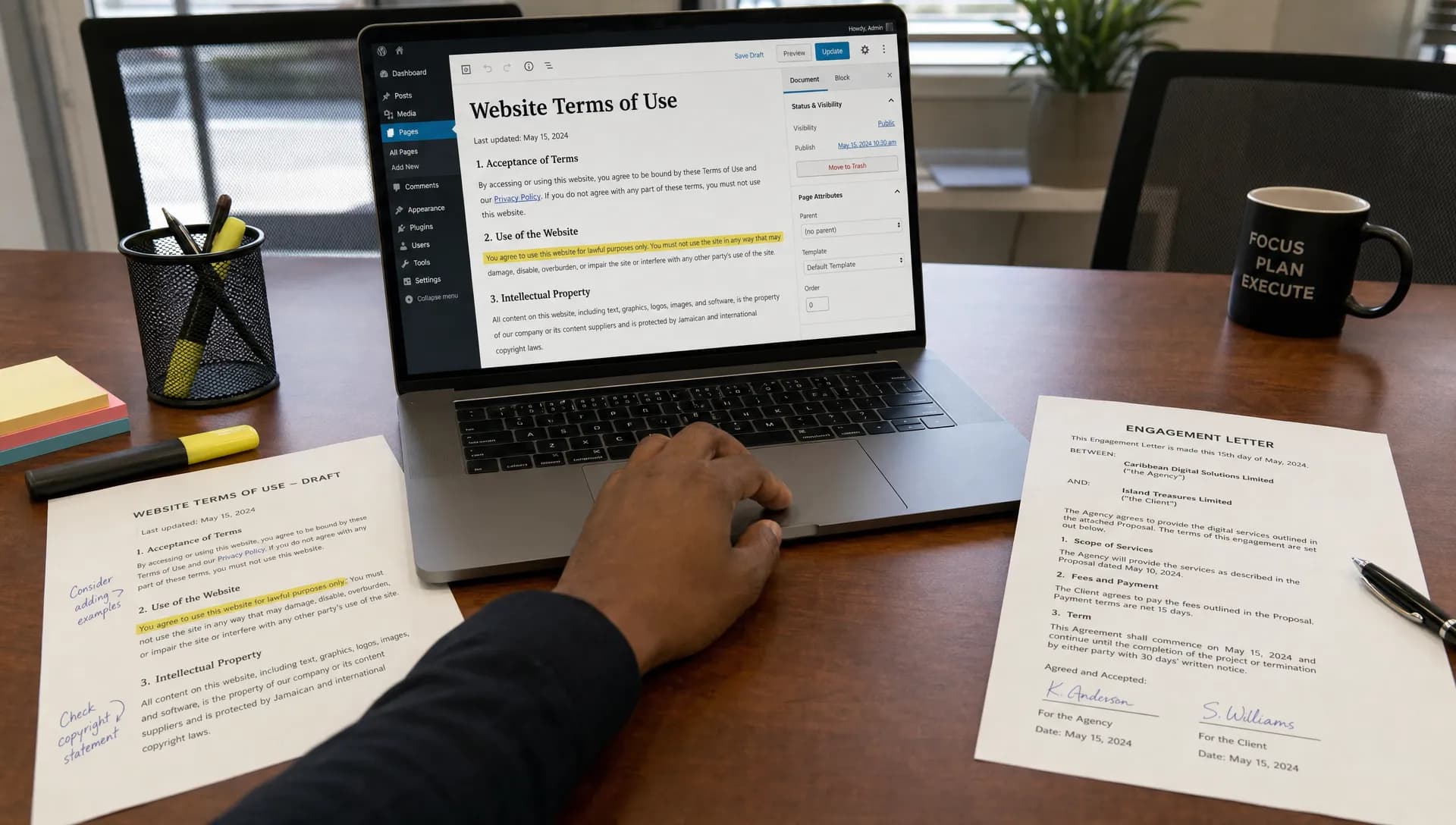
Website terms and conditions that reduce business risk are not copied boilerplate sitting in a website footer. For Jamaican businesses, they can help define the commercial relationship with customers, limit avoidable disputes, protect intellectual property and make online transactions easier to enforce. This guide is general information, not legal advice for a specific business model or transaction.
Why website terms matter for business risk
They create contract clarity before a dispute starts
A website often becomes the first place where a customer, supplier, investor or platform user interacts with your business. If your terms are vague, outdated or hidden, your business may struggle to prove what the user agreed to, when they agreed to it and what rules applied at the time.
Clear terms can address practical issues such as how orders are accepted, whether quotations are binding, when payment is due, what happens if a customer cancels and which country’s law applies. That matters in commercial litigation because many disputes begin with different assumptions about the same transaction.
For a Jamaican company selling locally and overseas, website terms and conditions that reduce business risk should match the way the business actually operates. A retailer, professional services firm, online marketplace, fintech, logistics provider and software company all need different risk controls.
They support trust, not just legal protection
Good terms should not read like a trap. Customers are more likely to complete a transaction when pricing, delivery, refunds, service limits and complaint procedures are easy to understand. Transparent terms can also reduce customer service pressure because users know where to look before emailing or calling.
This is especially relevant where consumer rights, payment disputes and data handling are involved. Website terms should work alongside your privacy notice, cookie consent tools and sector specific disclosures rather than contradicting them.
Website terms and conditions that reduce business risk: core clauses
Website use and account rules
Start with a plain explanation of who may use the website, whether users must be over a certain age, how accounts are created and what conduct is prohibited. If your site allows logins, subscriptions, online bookings or customer portals, the terms should explain account security, password responsibility and when the business may suspend or terminate access.
For platforms, directories and marketplaces, this section becomes even more important. You may need rules for false information, scraping, spam, impersonation, abusive conduct and misuse of automated tools. The wording should be practical enough for your team to enforce consistently.
Products, services, pricing and availability
If your website displays products, service packages, professional information or quotations, your terms should explain what is binding and what is informational. Businesses often create risk by making broad statements about outcomes, delivery speed or product availability without setting any conditions.
Terms can clarify that prices may change, that availability is not guaranteed until an order is accepted and that images or descriptions are provided for guidance where appropriate. For professional services, the terms should also avoid accidentally creating a client relationship before formal engagement documents are signed.
Payments, cancellations and refunds
Payment clauses should cover accepted payment methods, due dates, taxes, failed payments, chargebacks, late payment consequences and currency issues. If the business sells across borders, it should be clear whether prices are in Jamaican dollars, United States dollars or another currency.
Refund and cancellation language should be drafted carefully. It must fit your actual business, and it should not conflict with applicable consumer protection law or card network rules. A refund clause that sounds strict but cannot be enforced may create more risk than a fair, well structured process.
Intellectual property and content use
A website is full of intellectual property: copy, graphics, photographs, videos, logos, product descriptions, software, downloadable materials and databases. Terms should state who owns that content and what limited permissions users receive.
This is not only about stopping infringement. It also helps preserve brand value, protect search visibility and prevent unauthorised copying by competitors. If your business relies on creative assets, software, training materials or technical content, the terms should align with your wider intellectual property law strategy.
User content, reviews and submissions
If users can post reviews, upload files, submit comments or send ideas through the website, the terms should say what they may submit and what rights the business has to use or remove that content. Without this, disputes can arise over copyright, defamatory content, privacy breaches or offensive material.
A sound clause can require users to confirm that they own or have permission to upload the content. It can also reserve the right to moderate, edit or remove material that breaches the terms, the law or community standards.
Privacy, cookies and data protection boundaries
Website terms should not replace a privacy policy. Instead, they should point users to the correct privacy notice and explain that personal data will be handled under that notice. In Jamaica, businesses should be aware of obligations under the Data Protection Act, 2020 and guidance from the Office of the Information Commissioner.
If your website tracks users, uses analytics, embeds advertising tools or targets visitors in the European Union, data protection risks may also extend beyond Jamaica. Henlin Gibson Henlin’s guide to GDPR website pages, banners and tracking is a useful companion where a site may fall within EU privacy rules.

Clauses that protect the business when something goes wrong
Disclaimers and no reliance clauses
Disclaimers help define what your website does and does not promise. A blog, for example, may provide general information without giving professional advice. A product page may describe typical use but not guarantee that the product suits every customer’s specific purpose.
The clause should be reasonable and specific. Overbroad disclaimers may be challenged, especially in consumer transactions. The stronger approach is to identify actual risk areas, such as informational content, third-party links, availability of the website, technical interruptions and reliance on user supplied information.
Limitation of liability
A limitation of liability clause can cap or exclude certain categories of loss where the law allows. This may include indirect loss, loss of profits, loss of data or business interruption. The clause should be drafted with care because some liabilities cannot be excluded, and consumer facing terms are often judged more strictly than business to business terms.
Website terms and conditions that reduce business risk should not rely on aggressive limitation wording alone. They should also reduce the chance of disputes through clearer processes, better disclosures and realistic service descriptions.
Indemnities
An indemnity is a promise by one party to compensate another for specified losses. On a website, indemnities often cover user breaches, misuse of the platform, infringement of third-party rights, unlawful uploads or false information supplied by the user.
Indemnities can be valuable, but they should not be used casually. A court or counterparty may scrutinise wording that is unclear or disproportionate. In business to business arrangements, indemnities should also connect with insurance, limitation of liability and dispute resolution clauses.
Governing law and dispute resolution
Your terms should state the governing law and the forum for disputes. A Jamaican business may prefer Jamaican law and Jamaican courts, but cross-border sales can complicate enforcement. If customers, suppliers or digital infrastructure are located overseas, the wording needs careful review.
Arbitration and mediation clauses may also be appropriate. Mediation can preserve commercial relationships and resolve lower value disputes efficiently. Arbitration may help with confidentiality and cross-border enforcement in suitable cases. For more detail on international deal risk, see this related guide on key terms in cross-border contracts.
Common drafting mistakes that increase risk
Many businesses adopt website terms once and then forget them. The problem is that websites evolve. A site that began as a brochure may later accept payments, collect customer data, host user reviews or sell downloadable products. The terms need to change as the risk profile changes.
Drafting mistake | Why it creates risk | Better approach |
Copying terms from another website | The wording may not match your business, jurisdiction or customers | Draft terms around your actual sales process and legal exposure |
Hiding terms after checkout | Users may argue they were not given proper notice | Present key terms before payment or account creation |
Using a harsh refund clause | It may conflict with consumer rights or damage customer trust | Set a lawful, clear and workable refund procedure |
Mixing privacy terms into commercial terms | Data protection notices may become incomplete or confusing | Use separate but consistent terms, privacy and cookie documents |
Forgetting cross-border users | Foreign customers may raise jurisdiction, tax or enforcement issues | Review governing law, currency, delivery and dispute clauses |
Leaving old service descriptions online | Customers may rely on outdated promises | Audit website content when services, pricing or policies change |
A separate risk is inconsistency. If your homepage promises “no questions asked refunds” but your terms say “all sales are final,” the inconsistency may be used against you. Marketing, checkout pages, order confirmations and customer emails should align with the formal terms.
Special considerations for Jamaican businesses
B2B and B2C terms should not be identical
Business to business terms can often assume a more commercial audience, but consumer facing terms require extra care. Consumer rights, unfair terms concerns, clear pricing and accessible complaint procedures matter more when dealing with individuals purchasing for personal use.
For example, a company selling software subscriptions to corporate clients may need strong clauses on licence scope, user seats, confidentiality, service availability and payment default. A retailer selling household goods online may need more detail on delivery, returns, warranties and customer support.
Sector specific risks should be reflected
A tourism operator, real estate platform, shipping business, bank related service provider, online education provider and creative agency will not face the same legal risk. Website terms should reflect the sector rather than use generic clauses.
For example, a logistics or admiralty and shipping business may need online booking terms that sit properly with bills of lading, delivery documents and cargo liability rules. A financial services related website may need stronger disclosures around eligibility, regulatory status, payment processing and complaints. A real estate law Jamaica issue may arise if a site presents property information in a way that users treat as binding.
Contractor, vendor and platform relationships need separate documents
Website terms normally govern the relationship between the website operator and website users. They should not be used as a substitute for contractor contracts, vendor agreements, employment documents or shareholder arrangements.
If your online business uses freelancers, software developers, sales agents or delivery providers, you may need separate written agreements dealing with scope, confidentiality, intellectual property ownership, payment and termination. Henlin Gibson Henlin has also covered contractor contract clauses that prevent disputes, which is useful where a website depends on external service providers.
How often should website terms be reviewed?
Website terms should be reviewed whenever the business changes how it sells, collects data, accepts payments or interacts with users. A yearly review is sensible for many businesses, but trigger events are more important than the calendar.
A review is especially useful when launching ecommerce, adding subscriptions, expanding outside Jamaica, using new payment processors, introducing user accounts, collecting sensitive personal data, changing refund policies or adding advertising and analytics tools.
It is also wise to keep records of previous versions. If a dispute arises, the business may need to show which terms applied on a specific date. Version control, publication dates and archived copies can make that easier.
Practical checklist before publishing your terms
Before placing terms on your website, test them against the user journey. Can a customer see them before placing an order? Do the terms match the checkout page? Are important limitations visible enough? Do they reflect your actual refund, delivery and support practices?
A practical review should cover:
The identity and contact details of the business operating the website
When a contract is formed and when an order may be rejected
Pricing, taxes, payment methods, billing cycles and failed payment rules
Delivery, cancellation, refund and complaint procedures
Intellectual property ownership and permitted use of website content
Governing law, dispute resolution and limits on liability
For higher risk businesses, the checklist should go further. Regulated industries, cross-border ecommerce, online platforms, data heavy websites and businesses with recurring subscriptions should obtain tailored advice rather than relying on template terms.
Frequently Asked Questions
Are website terms and conditions legally required in Jamaica? Not every website is required to have general commercial terms, but many businesses need them to manage contract, payment, intellectual property, data and dispute risks. Separate legal notices, such as privacy information, may be required depending on what the website does.
Can I copy terms from another company’s website? Copying another company’s terms is risky. The wording may be protected by copyright, may not fit Jamaican law and may not reflect your business model. It can also create obligations your business never intended to accept.
What is the difference between website terms and a privacy policy? Website terms govern commercial use of the site, including payments, refunds, account rules, liability and disputes. A privacy policy explains how personal data is collected, used, shared, stored and protected.
Should online stores include refund terms? Yes. Refund and cancellation rules should be clear before purchase, consistent with consumer rights and aligned with actual business practice. Unclear refund terms often lead to chargebacks, complaints and reputational damage.
Do website terms help with commercial litigation Jamaica risks? They can. Well drafted terms may reduce ambiguity, preserve evidence of the agreed process and support enforcement if a dispute becomes formal. They do not prevent every claim, but they can improve the business’s position.
Need website terms tailored to your business?
Generic templates rarely reflect the way a real business sells, handles data, manages complaints and limits exposure. If your website takes payments, serves customers outside Jamaica, hosts user content or supports regulated activity, tailored legal review can reduce avoidable risk.
Henlin Gibson Henlin provides client focused legal services across commercial, data privacy, intellectual property, dispute resolution and corporate matters. To discuss website terms that fit your business, visit Henlin Gibson Henlin and seek advice before a small drafting gap becomes a costly dispute.