
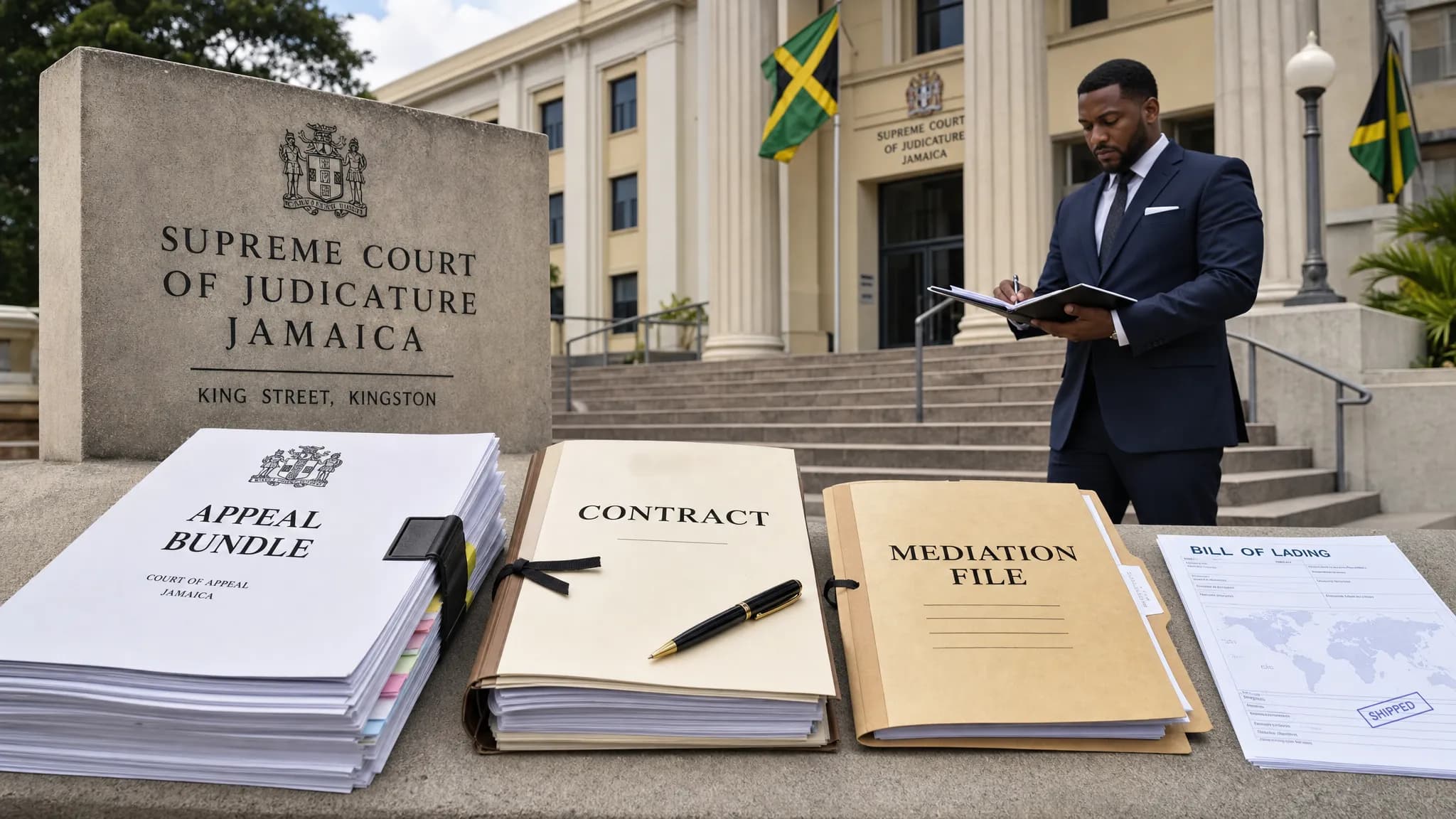
Choosing an advocate law firm is rarely a casual decision. By the time you are searching for one, there may already be a dispute, a regulatory risk, a commercial deadline, a threatened claim, or an appeal window that cannot be missed. The right firm can help you understand the real issues, protect your position, and choose the most effective path forward. The wrong fit can cost time, money, leverage, and peace of mind.
In Jamaica, clients often use the phrase advocate law firm when they mean a firm with strong courtroom, negotiation, advisory, and dispute resolution capabilities. That may involve commercial litigation, civil proceedings, arbitration, appellate advocacy, compliance issues, intellectual property disputes, shipping matters, banking litigation, or other complex legal work.
This guide explains how to evaluate an advocate law firm with confidence, especially when the matter is important enough that strategy, judgement, and execution all matter.
Understand what an advocate law firm should actually do
An advocate does more than speak in court. Effective advocacy begins long before a hearing. A strong legal team should help you identify the real dispute, assess the evidence, test the strengths and weaknesses of your position, and decide whether court, negotiation, mediation, arbitration, or another forum is best suited to your objectives.
That distinction matters because legal problems are not always solved by the most aggressive route. In some cases, immediate court action may be necessary to preserve rights or stop harm. In others, early negotiation or mediation may protect commercial relationships and reduce costs. A capable advocate law firm should be able to explain the difference and recommend a course of action based on the facts, not instinct alone.
For a deeper look at the practical role of advocacy in serious disputes, Henlin Gibson Henlin has also outlined what an advocate does in complex legal disputes, including issue analysis, evidence management, pleadings, and forum selection.
Start with the legal problem, not the firm name
Reputation is useful, but it is not enough. The best law firm for one matter may not be the best fit for another. Before comparing firms, define the legal problem as clearly as possible.
Ask yourself what outcome you need. Are you trying to recover money, defend a claim, stop unlawful conduct, protect intellectual property, manage a regulatory issue, preserve business continuity, or appeal an unfavourable decision? The clearer your objective, the easier it becomes to identify the type of legal skill you need.
You should also consider timing. Some matters are urgent because limitation periods, filing deadlines, injunction applications, contractual notice periods, or appeal timelines may apply. If timing is tight, responsiveness and procedural competence become major selection factors.
Finally, consider the level of risk. A routine contract disagreement is different from a dispute that could affect a company’s licence, reputation, market position, or financial stability. Higher-risk matters require stronger strategic planning and often more senior oversight.
Match the firm’s practice areas to your matter
A common mistake is choosing a firm based only on general litigation ability. Litigation experience is important, but practice fit matters. A dispute involving a bank facility, a shipping contract, a data privacy incident, or a trade mark conflict may require more than general courtroom skill. It may require sector knowledge and familiarity with the legal framework surrounding the dispute.
Use the table below to assess whether a firm’s experience aligns with your needs.
Your legal issue | What to look for in an advocate law firm | Why it matters |
Commercial dispute | Experience with contracts, shareholder issues, debt recovery, injunctions, and business claims | Commercial disputes often require speed, commercial judgement, and cost control |
Civil litigation | Ability to manage pleadings, evidence, court procedure, negotiation, and trial preparation | Strong procedure reduces avoidable delays and tactical errors |
Appeal | Appellate advocacy, legal research, written submissions, and issue refinement | Appeals are usually won or lost on precise legal arguments and the record below |
Arbitration or mediation | Experience with alternative dispute resolution and settlement strategy | The best result may come outside traditional court proceedings |
Compliance or risk issue | Regulatory understanding and practical risk advice | Prevention and early response can reduce exposure |
Intellectual property dispute | Knowledge of trade marks, copyright, passing off, licensing, or enforcement | IP matters often require fast action to protect commercial value |
Admiralty or shipping matter | Sector-specific knowledge of maritime claims, vessels, cargo, and related procedure | Shipping disputes can involve urgent, technical, and cross-border issues |
If your matter spans several areas, look for a firm with the capacity to connect them. For example, a technology business may need advice that touches commercial litigation, intellectual property, data privacy, and regulatory compliance. A shipping dispute may involve contract law, admiralty procedure, insurance, and urgent court applications.
Evaluate strategy, not just confidence
Confidence can be reassuring, but strategy is more valuable. During an initial consultation, listen for how the firm thinks through the matter. A serious advocate should not simply tell you that you have a strong case before reviewing documents, timelines, correspondence, and evidence.
A strategic firm will usually ask targeted questions. What documents exist? Who are the key witnesses? What has been said in writing? Are there contractual dispute resolution clauses? Has a deadline already passed? Is there a risk of asset dissipation, reputational harm, regulatory enforcement, or business interruption?
Good legal strategy should also include options. You should understand the likely benefits and risks of each route. For example, filing a claim may create pressure but increase costs. Negotiation may preserve relationships but may not work against an uncooperative opponent. Arbitration may offer privacy but depends on the contract and procedural rules. An appeal may be justified, but only if there are proper legal grounds.
Be cautious if a lawyer guarantees a result. No ethical advocate can promise the outcome of a contested legal matter. What a strong firm can do is assess prospects, explain risks, prepare thoroughly, and pursue your interests with skill.
Ask who will actually handle the work
When hiring an advocate law firm, you are hiring both judgement and execution. It is important to know who will be responsible for the file, who will appear in court or at hearings, who will draft key documents, and how senior lawyers will supervise the matter.
This is not about insisting that only one person does everything. Complex matters often benefit from a team. Senior lawyers may shape strategy and advocacy, while other attorneys assist with research, drafting, document review, and procedural tasks. What matters is clarity. You should know how the team is structured and how communication will flow.
Ask how updates will be handled. Will you receive written advice after major developments? How quickly can you expect responses? Who is your main point of contact? Clear communication is especially important where decisions must be made quickly, such as settlement offers, urgent applications, or regulatory responses.

Consider fees in terms of value and predictability
Legal fees should be discussed early and clearly. The cheapest firm is not always the best choice, especially where the matter is complex or high-value. At the same time, a client should not be left guessing how costs may develop.
Ask for clarity on billing structure, likely stages of work, disbursements, court-related costs, and factors that may increase fees. Some matters are difficult to estimate precisely at the outset because the opponent’s conduct, volume of evidence, urgency, or procedural complications can change the workload. Even so, a good firm should be able to explain the cost drivers.
Value is not only about hourly rates or total fees. It is also about avoiding unnecessary steps, selecting the right forum, preparing properly, reducing risk, and helping you make informed commercial decisions. Poor strategy can be far more expensive than good advice.
For a broader checklist on evaluating experience, staffing, strategy, fees, confidentiality, and communication, see these practical questions to ask when selecting a law firm.
Check professional standing and ethical fit
Trust is central to the lawyer-client relationship. In Jamaica, attorneys-at-law are regulated within the legal profession, and clients should feel comfortable verifying professional standing where appropriate. The General Legal Council is an important reference point for the regulation of attorneys-at-law in Jamaica.
Ethical fit is not only about formal discipline. It is also about how a firm handles confidentiality, conflicts of interest, candour, and client instructions. A responsible advocate should tell you when a position is weak, when documents create risk, or when a proposed step may be disproportionate.
You should also expect honesty about conflicts. If a firm has acted for an opposing party or has another relationship that may affect the matter, that issue should be identified and handled properly. Confidentiality is particularly important in commercial disputes, data privacy matters, intellectual property cases, and matters involving sensitive financial or reputational information.
Look for local knowledge with broader perspective
For matters in Jamaica, local legal knowledge is crucial. Procedure, court practice, filing requirements, professional norms, and judicial expectations all affect how a matter should be managed. An advocate who understands the local environment can often anticipate practical issues that are not obvious from the law alone.
At the same time, many modern disputes have international or cross-border elements. A Jamaican business may deal with overseas suppliers, international shipping, foreign shareholders, digital platforms, regional regulators, or global intellectual property concerns. In those cases, an advocate law firm should be able to think beyond one narrow legal question and help coordinate a practical response.
This is especially important for companies operating in regulated or reputation-sensitive sectors. A legal strategy that wins a point in court but damages business relationships, public confidence, or regulatory standing may not be the best overall result.
Watch for warning signs before you commit
Most clients are focused on finding positives, but red flags are just as important. Be cautious if a firm seems unwilling to explain its approach, avoids discussing fees, dismisses your questions, or pressures you to act before understanding the facts.
Other warning signs include vague claims of expertise, poor responsiveness before engagement, lack of clarity about who will handle the matter, or a tendency to promise victory. You should also be careful if the advice seems driven by emotion rather than evidence and legal analysis.
A strong advocate can be firm and assertive without being reckless. The goal is not to create conflict for its own sake. The goal is to protect your interests using the most effective lawful strategy available.
Build a shortlist and compare firms consistently
Once you understand your legal issue, create a shortlist of firms that appear to match the matter. Do not rely only on directories, rankings, or referrals. Those can be useful starting points, but your decision should be based on fit.
A simple selection process can help:
Define your objective, urgency, documents, opponents, and potential risks.
Identify firms with relevant practice experience and advocacy capability.
Schedule consultations and ask the same core questions of each firm.
Compare strategy, communication, staffing, fees, and professional fit.
Choose the firm that gives you confidence in both judgement and execution.
If you are comparing lawyers in Jamaica more generally, it may also help to review guidance on how to identify the best lawyers in Jamaica with confidence, especially where reputation, practice area, and client expectations must be weighed carefully.
Frequently Asked Questions
What is an advocate law firm? An advocate law firm is commonly understood as a law firm with strong ability to represent clients in disputes, negotiations, hearings, court proceedings, arbitration, mediation, appeals, and other situations where persuasive legal argument and strategy are required.
How do I know if I need an advocate rather than general legal advice? You may need advocacy-focused support if you are facing a claim, considering court action, responding to a regulatory issue, preparing for arbitration or mediation, appealing a decision, or dealing with a dispute that could affect your finances, rights, business, or reputation.
Should I choose the most aggressive law firm? Not necessarily. Effective advocacy is strategic, not merely aggressive. The right firm should know when to negotiate, when to litigate, when to seek urgent relief, and when a less confrontational route may produce a better result.
What should I bring to an initial consultation? Bring key contracts, correspondence, court documents, notices, timelines, invoices, policies, photographs, witness details, and any other records connected to the issue. Organising documents in date order can help the lawyer assess the matter more efficiently.
Can an advocate law firm guarantee success? No. Legal outcomes depend on facts, evidence, law, procedure, the opposing party, and the decision-maker. A trustworthy firm can assess prospects and risks, but it should not guarantee a particular outcome.
Choosing with confidence
The right advocate law firm should combine legal knowledge, strategic judgement, preparation, communication, and ethical clarity. Look for a team that understands your objective, can explain your options, and is prepared to protect your interests with focus and discipline.
For individuals, companies, and institutions seeking experienced legal representation in Jamaica, Henlin Gibson Henlin offers client-focused legal services across areas including commercial litigation, data privacy, compliance and risk law, intellectual property, admiralty and shipping, appellate work, arbitration and mediation, banking litigation, civil litigation, and competition law. When the matter is important, choosing the right advocate is one of the first strategic decisions you make.