
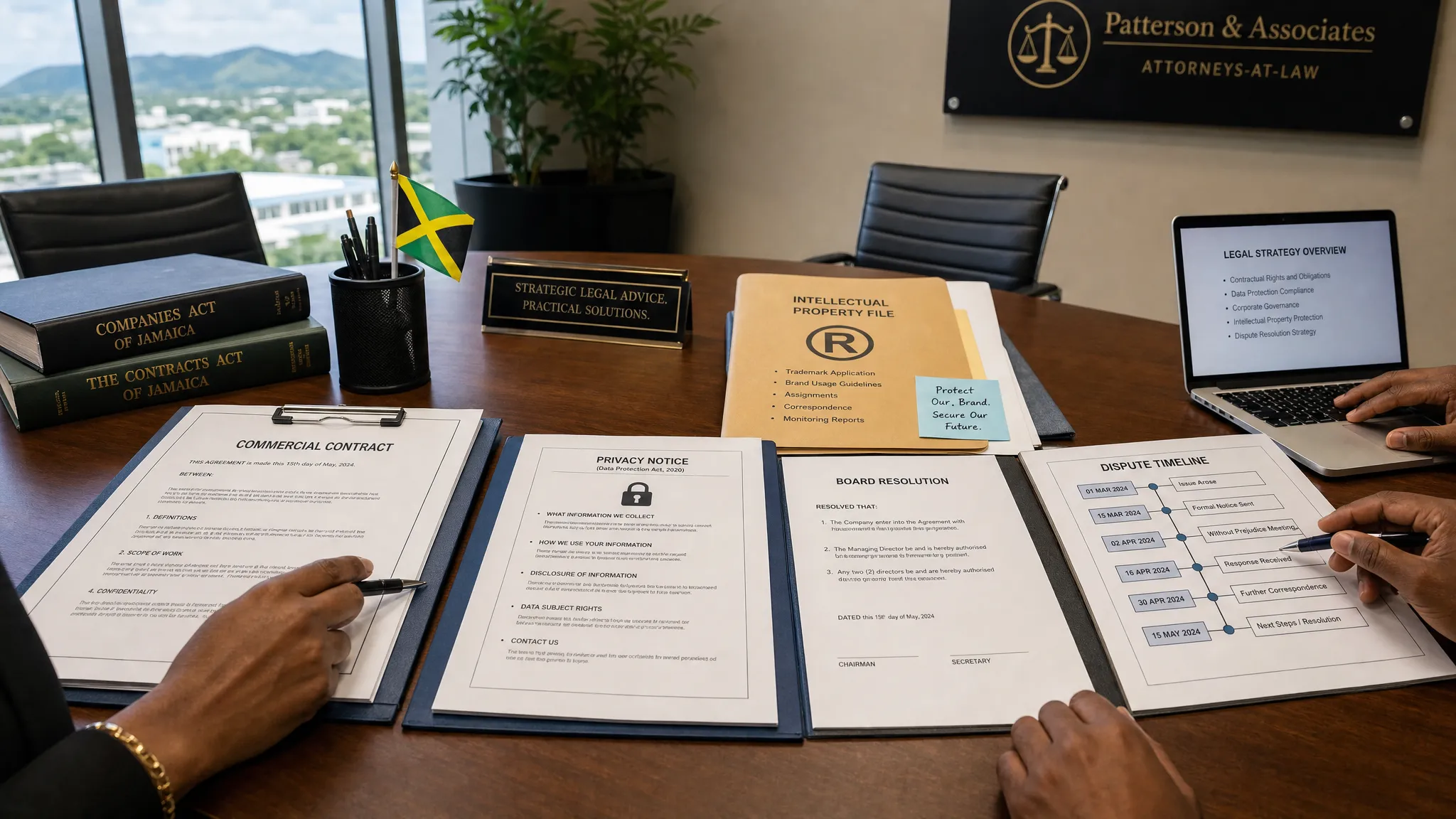
For many businesses, legal support becomes urgent only when something has already gone wrong: a contract dispute, a regulatory notice, an employee complaint, a data incident, or a deal that suddenly looks risky. But the most valuable legal support is often the kind that helps you make better decisions before a problem escalates.
Choosing trusted legal support for your business is therefore not just about finding a lawyer with the right credentials. It is about finding advisers who understand your commercial goals, can explain risk clearly, protect confidential information, and help you act with confidence in Jamaica’s legal and regulatory environment.
Whether you are launching a company, expanding operations, entering a new contract, protecting intellectual property, managing staff, or preparing for litigation, the right legal relationship can become a practical business asset.
Start with the business problem, not the lawyer
Before you contact a law firm, define what you need help with in business terms. A vague request such as “we need a lawyer” will often lead to a vague consultation. A clearer statement helps the firm assess whether it can assist and helps you compare your options more objectively.
For example, your business may need support because it is:
Negotiating a commercial agreement with a supplier, customer, distributor, or lender
Facing a claim, demand letter, injunction threat, or unpaid debt issue
Reviewing compliance obligations under company, privacy, competition, employment, or sector-specific rules
Protecting a brand, design, confidential information, or other intellectual property
Handling a workplace dispute, redundancy process, or senior employee exit
Preparing for arbitration, mediation, litigation, or an appeal
Managing cross-border transactions, shipping issues, or international commercial relationships
The more precisely you describe the issue, the easier it is to identify the type of legal support your business truly needs. A business facing a regulatory compliance question may need a very different approach from one preparing for commercial litigation, even if both issues involve risk.
Look for relevant business law experience
Trust is easier to build when a legal adviser has experience with matters similar to yours. That does not always mean the lawyer must have handled the exact same fact pattern. It does mean they should understand the legal area, the commercial stakes, and the practical consequences of each option.
In Jamaica, businesses may need guidance across several overlapping areas of law. A single business decision can involve contract law, company law, employment law, data protection, tax considerations, and dispute risk. For instance, onboarding a new technology vendor may raise privacy, cybersecurity, intellectual property, liability, and service-level issues at the same time.
When speaking with a prospective firm, ask how the team approaches similar matters. You are not asking for confidential details about other clients. You are assessing whether the lawyers can identify the issues that matter and explain how they would structure the work.
Henlin Gibson Henlin’s practice areas include commercial litigation, data privacy, compliance and risk law, intellectual property, admiralty and shipping, appellate work, arbitration and mediation, banking litigation, civil litigation, and competition law and policy. For businesses with multifaceted legal needs, breadth can be important because legal problems rarely stay in one lane.
Assess whether the firm understands risk, not just rules
A business lawyer’s role is not simply to recite the law. Strong legal support helps management understand the range of possible outcomes, the likelihood of each, the cost of inaction, and the commercial trade-offs.
For example, a contract clause may be legally enforceable but commercially unrealistic. A litigation strategy may be aggressive but expensive. A settlement may feel unsatisfying but protect cash flow and management time. A regulatory compliance plan may need to be phased because the business cannot implement every control immediately.
Trusted legal support should help you answer practical questions such as:
What is the legal risk if we proceed?
What is the commercial risk if we delay?
What documents or evidence do we need to preserve?
What options are available before litigation becomes necessary?
What decision needs to be made now, and what can be revisited later?
This kind of guidance is especially important for directors, founders, in-house managers, and executives who must balance legal advice with operational realities.

Check communication style early
Legal expertise matters, but so does communication. If advice is difficult to understand, delayed, or disconnected from your business priorities, it becomes harder to act on it.
During the first conversation, notice whether the lawyer asks focused questions. A good adviser will want to understand the facts, deadlines, stakeholders, documents, and business objective before offering a view. Be cautious if you receive sweeping assurances before the lawyer has reviewed the necessary information.
Clear communication should include plain explanations of the legal issues, realistic next steps, likely timelines, fee expectations, and areas of uncertainty. In complex matters, you may not receive a definitive answer immediately, and that is not a weakness. It is often a sign that the lawyer is being careful.
For more detailed questions to ask when evaluating a firm, see Henlin Gibson Henlin’s guide on law firm selection.
Prioritise confidentiality and file handling
Businesses often share sensitive material with their lawyers: financial records, board discussions, employee information, customer data, intellectual property, litigation strategy, and commercially sensitive negotiations. You should be comfortable with how a firm handles confidential information.
Ask how documents are shared, who within the firm will access your file, how conflicts are checked, and how urgent communications are managed. For regulated businesses or companies handling personal data, confidentiality is also connected to privacy and information governance.
This is especially relevant in light of Jamaica’s Data Protection Act, which affects how organisations handle personal data. If your business processes customer, employee, vendor, or user information, legal support may need to address privacy notices, contracts, retention, security, breach response, and accountability. You can read more about building a practical privacy programme in Henlin Gibson Henlin’s article on data privacy frameworks.
Match the firm to your business stage
The legal needs of a start-up are not the same as those of an established company, a regulated enterprise, a shipping operator, or a business preparing for litigation. Choose support that matches both your current issue and your likely next stage.
Business stage or situation | Legal support to consider | Why it matters |
Starting or restructuring a business | Company formation, governance, shareholder arrangements, contracts | Helps reduce future ownership, liability, and management disputes |
Growing operations | Employment contracts, vendor agreements, data privacy, compliance reviews | Supports scalable operations and reduces regulatory exposure |
Building brand value | Trade mark, copyright, confidential information, licensing advice | Protects commercial identity and business assets |
Entering major contracts | Contract review, negotiation strategy, risk allocation | Helps prevent unclear obligations and costly disputes |
Facing a dispute | Commercial litigation, mediation, arbitration, evidence strategy | Preserves rights and supports informed resolution decisions |
Operating internationally | Cross-border contract, shipping, data, enforcement, or arbitration advice | Helps manage jurisdiction, enforcement, and regulatory complexity |
This type of matching prevents businesses from choosing counsel based only on reputation or convenience. The best fit is the firm that can serve the actual business need in front of you.
Ask how the firm approaches disputes before there is one
Many business relationships eventually involve disagreement. That does not mean every dispute should go to court. Trusted legal support should help you plan for dispute prevention and dispute resolution.
This begins at the contract stage. Clear payment terms, termination rights, limitation of liability clauses, governing law provisions, dispute resolution clauses, confidentiality obligations, and recordkeeping duties can make a significant difference if the relationship later breaks down.
If a dispute has already arisen, the firm should be able to assess whether negotiation, mediation, arbitration, litigation, or urgent court action is appropriate. Jamaica’s legal system recognises both court proceedings and alternative dispute resolution mechanisms. For commercial parties, the right route depends on urgency, cost, confidentiality, enforceability, and the relationship between the parties.
A strong legal adviser will not automatically push every matter toward litigation. They will help you understand when litigation is necessary, when settlement is sensible, and when interim steps are needed to protect your position.
Evaluate commercial awareness
Legal advice is most useful when it reflects the realities of business. A technically correct answer may still be poor advice if it ignores budget, timing, reputational risk, customer relationships, internal capacity, or industry practice.
Commercial awareness shows up in the way a lawyer discusses options. For example, instead of saying only that a clause is risky, a commercially aware lawyer may explain how to reduce the risk, what compromise language may be acceptable, and what the business should monitor after signing.
This is particularly important for Jamaican businesses involved in banking, shipping, technology, professional services, manufacturing, distribution, hospitality, construction, or regulated industries. Legal support should help the business move forward responsibly, not simply identify obstacles.
Review fees and scope with care
Trust can quickly erode if expectations about fees and scope are unclear. Before work begins, ask what the engagement will cover, what it will not cover, how fees are calculated, and what may cause costs to change.
Some matters are predictable enough for a defined scope. Others, especially disputes, regulatory matters, or negotiations involving multiple parties, may require more flexible estimates. What matters is transparency.
A business should leave the initial engagement discussion understanding who will work on the matter, what the immediate next step is, what information the client must provide, and how updates will be handled. If the legal issue is urgent, confirm deadlines and escalation points in writing.
Watch for red flags
Not every impressive pitch translates into trusted legal support. Be cautious where a lawyer or firm:
Guarantees a result in a contested or uncertain matter
Gives detailed advice before reviewing documents or facts
Avoids discussing fees, scope, or likely timelines
Does not explain who will be responsible for the work
Treats confidentiality or conflicts as an afterthought
Uses legal language without helping you understand the practical impact
Pressures you to act without explaining options and risks
A lawyer can be confident without being careless. In business matters, you want measured judgement, not unrealistic promises.
Prepare well for the first consultation
The first consultation is more productive when you arrive organised. Bring or send the key documents in advance if requested. These may include contracts, correspondence, invoices, company records, policies, pleadings, notices, board minutes, or relevant screenshots.
It is also helpful to prepare a short timeline. Dates often matter in legal analysis, especially where limitation periods, contractual notice periods, filing deadlines, disciplinary steps, or regulatory responses are involved.
Finally, be ready to explain what outcome the business wants. Do you want to close a deal, avoid litigation, recover money, protect a brand, respond to a regulator, discipline an employee, preserve a relationship, or defend a claim? The answer will shape the legal strategy.
Build a long-term legal relationship where possible
Some legal issues are one-off matters, but many businesses benefit from an ongoing relationship with a firm that already understands their operations. Over time, trusted legal support can help identify patterns, strengthen contracts, improve internal policies, and reduce preventable disputes.
This does not mean calling a lawyer for every routine decision. It means knowing when legal input can prevent a small issue from becoming expensive. Employment processes, privacy practices, contract templates, debt recovery procedures, board governance, and intellectual property protection are all areas where early guidance can create long-term value.
For Jamaican businesses, a dependable legal relationship can also be useful when opportunities arise quickly. If your adviser already understands your business, they can respond more efficiently when a transaction, dispute, or compliance issue becomes urgent.
Why local insight matters in Jamaica
Business law does not operate in the abstract. Local court practice, regulatory expectations, administrative processes, commercial norms, and enforcement realities all affect legal strategy.
For example, a business operating in Jamaica may need to consider the Companies Act, employment laws, data protection obligations, sector-specific licensing, intellectual property registration, banking relationships, customs issues, or dispute resolution options. Where cross-border elements are involved, local advice may also need to coordinate with overseas counsel.
A trusted Jamaican law firm should therefore combine legal knowledge with practical awareness of the local business environment. That combination is often what helps clients make decisions that are both legally sound and commercially workable.
Frequently Asked Questions
What does trusted legal support mean for a business? Trusted legal support means more than having a lawyer available in an emergency. It means working with advisers who understand your business objectives, explain risks clearly, protect confidentiality, communicate reliably, and help you make informed decisions.
When should a business contact a lawyer? A business should seek legal advice before signing significant contracts, hiring or terminating key staff, handling sensitive personal data, responding to a dispute, entering regulated activity, protecting intellectual property, or making decisions that could create liability.
Should I choose a specialist lawyer or a full-service law firm? It depends on the issue. A specialist may be suitable for a narrow matter, while a firm with multiple practice areas can be useful when the issue involves several legal risks, such as contracts, employment, privacy, litigation, and regulatory compliance.
How can I tell if a law firm understands my business? Look at the questions the firm asks. Strong business counsel will ask about your objectives, deadlines, documents, stakeholders, risk tolerance, and commercial priorities before recommending a strategy.
Is litigation always the best way to resolve a business dispute? No. Litigation may be necessary in some cases, especially where urgent relief or formal enforcement is required. However, negotiation, mediation, or arbitration may be more appropriate depending on cost, confidentiality, timing, and the parties’ relationship.
Speak with Henlin Gibson Henlin about your business legal needs
Choosing trusted legal support is one of the most important decisions a business can make. The right legal team can help you manage risk, protect value, resolve disputes, and move forward with greater confidence.
Henlin Gibson Henlin is a leading law firm in Jamaica offering client-focused legal services across areas including commercial litigation, data privacy, compliance and risk law, intellectual property, arbitration and mediation, admiralty and shipping, banking litigation, civil litigation, appellate matters, and competition law and policy.
If your business needs practical, strategic legal guidance, contact Henlin Gibson Henlin to discuss how the firm may be able to assist.