
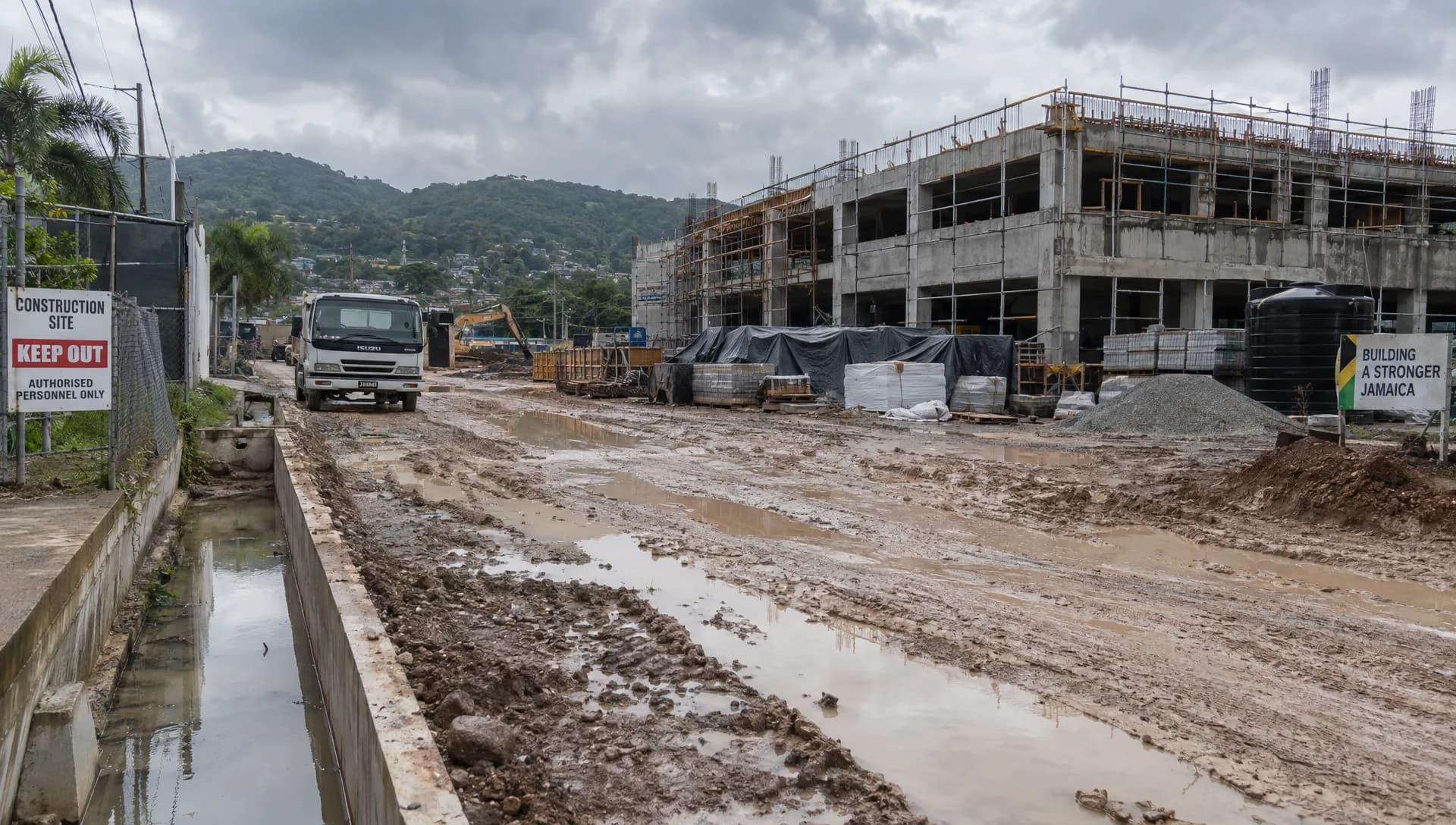
A construction project can fall behind because drawings arrive late, access is restricted, materials are delayed or severe weather interrupts work. Handling construction delay claims in Jamaica requires more than showing that completion slipped. You need to identify the contractual entitlement, give the required notices and demonstrate how the event affected completion or caused recoverable loss.
For contractors, developers and project owners, the immediate priority is to protect the evidence and meet deadlines while keeping the works moving where possible. The approach below explains how to assess, prepare and respond to a delay claim without confusing extra time with an entitlement to extra payment.
Separate the right to more time from the right to money
A delay claim may involve several distinct forms of relief. They should be assessed separately, even when they arise from the same event.
Type of claim or relief | What it addresses | What needs to be established |
Extension of time | Adjustment of the contractual completion date | A qualifying event and its effect on completion under the contract |
Prolongation costs | Recoverable costs of remaining on the project longer | Contractual or legal entitlement, causation and supported expenditure |
Disruption costs | Loss of productivity during the works | The disruptive event and a supported productivity loss |
Acceleration costs | Additional expenditure to complete sooner | The basis for recovery, relevant instructions or agreement and resulting costs |
Liquidated damages | Contractually agreed damages for specified delay | An enforceable clause and satisfaction of applicable contractual requirements |
An extension of time does not automatically entitle a contractor to additional payment. For example, a contract may allow extra time for exceptionally adverse weather while leaving the associated costs with the contractor.
Equally, an employer should not assume that liquidated damages become payable simply because the original completion date has passed. The properly adjusted completion date, required notices or certificates and the enforceability of the clause all matter.
How to preserve construction delay claims in Jamaica
Start with the complete contract, not a remembered version of its standard terms. Amendments, special conditions, schedules and incorporated documents may change the allocation of risk significantly.
Identify the provisions governing commencement, site access, completion, extensions of time, variations, payment and dispute resolution. Check who has authority to issue instructions and who must receive notices. Where a FIDIC, JCT or other standard form is used, establish the exact edition and project-specific amendments.
At the first sign of a material delay, take these practical steps:
Record the event: Note when it began, when it became apparent and which activities it affected.
Check notice requirements: Identify deadlines, required content, permitted delivery methods and the correct recipient.
Preserve programme evidence: Retain the agreed baseline, current updates, progress reports and underlying scheduling files.
Consider mitigation: Assess reasonable resequencing, alternative resources or other measures without assuming that extra expenditure will be recoverable.
A delayed shipment, for example, is not automatically the employer’s risk merely because it arrived through a Jamaican port. Responsibility may depend on procurement obligations, the cause of the delay and any contractual relief for changes in law or exceptional events.
Give notice before the full impact is known
One recurring risk in construction delay claims in Jamaica is waiting until the final cost or completion impact can be calculated before sending a notice. Some contracts require an early notification followed by detailed particulars and subsequent updates.
A useful initial notice identifies the event, relevant dates, affected work and the contractual basis being relied on. It should explain the likely effect as far as reasonably known and identify further information that will follow. Avoid presenting an uncertain estimate as a final assessment.
A site meeting discussion or progress report may not satisfy a formal notice clause. Check the prescribed recipient, address, delivery method and any requirements for expressly identifying the communication as a notice or claim. Keep evidence of delivery.
Some notice provisions may operate as conditions to entitlement. Their wording and legal effect require careful review. If a deadline may have been missed, obtain advice promptly rather than assuming either that the claim is lost or that the other party’s knowledge excuses non-compliance.
For continuing events, maintain the updates required by the contract. A single early letter may not discharge every reporting obligation.
Prove the effect on completion, not just the existence of a problem
A late drawing or unavailable work area does not necessarily delay overall completion. The affected activity may have available float, or another activity may already control the completion date.
The central task is to connect the event to the project’s critical path, meaning the sequence of activities that determines completion at the relevant time. For construction delay claims in Jamaica, this connection often matters more than the volume of correspondence submitted.
Compare the planned work with actual progress using reliable records. Relevant evidence includes programme updates, daily site diaries, labour returns, photographs, inspection records, requests for information and delivery documents. Preserve original electronic files rather than retaining only printed charts.
For illustration, suppose foundation information is released ten working days late. That does not necessarily justify a ten-day extension. Available float, the actual need date, other constraints and the contractor’s readiness to proceed may reduce or change the impact.
Choose an analysis method that fits the contract, project status and quality of the records. An assessment made during the works may differ from a retrospective analysis after completion. A delay specialist can help explain programme logic and causation, but cannot reliably reconstruct facts that were never recorded.
Deal carefully with concurrent delay
Concurrent delay can arise where employer-risk and contractor-risk events overlap and each has a relevant delaying effect. Two events occurring during the same week are not necessarily concurrent in the sense relevant to the claim.
Suppose access to a critical work area is unavailable while the contractor also lacks a necessary specialist crew. The assessment must examine whether each problem independently affected completion, the periods involved and the contract’s allocation of responsibility.
Avoid automatically dividing responsibility equally or subtracting every day of contractor delay from the claimed extension. Entitlement to time and entitlement to money may require different treatment. The legal consequences depend on the contract and applicable law, so a blanket rule can produce an unreliable assessment.
Calculate recoverable loss with supporting records
The financial part of construction delay claims in Jamaica should follow the demonstrated cause and period of delay. It should not simply reproduce the difference between the original budget and the final project cost.
Potential prolongation items may include additional site supervision, site accommodation, equipment hire, security and insurance costs. Recovery depends on the relevant entitlement and proof that the event caused the expenditure. The period when costs were incurred may not correspond neatly with an extension awarded at the end of the programme.
Cost item | Useful supporting evidence |
Site staff | Payroll records, timesheets and deployment records |
Hired equipment | Hire agreements, invoices and off-hire records |
Extended site facilities | Rental invoices and payment records |
Additional security | Contracts, attendance records and invoices |
Remobilisation | Instructions, movement records and invoices |
Keep prolongation, disruption and acceleration calculations separate. They concern different effects and can overlap financially if not checked. Avoid claiming the same expenditure through both a variation valuation and a delay claim.
Claims for head-office overheads or lost opportunities need particular care. A formula is not a substitute for establishing entitlement and supporting the loss. The broader principles governing recovery of losses for breach of contract also matter, including causation, remoteness and mitigation.
Record mitigation decisions and their costs. Reasonable mitigation does not necessarily require a contractor to accelerate at its own expense. Before adding shifts or resources, clarify instructions, payment arrangements and any reservation of rights.

Assemble a claim that can be checked
A persuasive submission allows the contract administrator, opposing party or decision-maker to follow the reasoning without searching through an unstructured document collection.
Organise the submission around a clear chain: entitlement, event, programme impact and financial consequence. Include the following components where relevant:
Executive summary: State the relief sought, relevant period and principal grounds.
Contractual basis: Identify the clauses, amendments and notices relied on.
Chronology: Set out dated events with references to supporting documents.
Delay analysis: Explain affected activities, programme logic and the completion impact.
Quantum assessment: Separate cost categories and connect them to records.
Supporting documents: Provide an indexed set of relevant notices, instructions, programmes and financial evidence.
State assumptions and information gaps openly. If the assessment is interim because the event continues, say so and explain the basis for updating it.
Avoid relying only on a broad claim that numerous employer events caused the entire overrun and all additional costs. Where possible, distinguish individual events, contractor-responsible problems and unrelated expenditure. Unsupported aggregation makes a claim harder to assess and defend.
How employers should assess a contractor’s claim
Employers reviewing construction delay claims in Jamaica should apply the same evidence-led approach. A claim should not be accepted because it is lengthy or rejected merely because the project has other performance problems.
Check the notice position, contractual risk allocation and authority behind the alleged instruction. Test the claimed effect against programme updates and actual progress. Request specific missing information, such as the relevant schedule file or equipment invoice, rather than issuing a general demand for more evidence.
Where the contract gives an engineer, architect or contract administrator responsibility for assessment, follow that mechanism and its requirements. Keep communications clear about what has been accepted, disputed or left open pending further information.
Maintain a separate record of potential employer claims, including defects, contractor-responsible delay and any proposed liquidated damages. Set-off, deductions and withholding payment require their own contractual and legal assessment. They should not be treated as automatic responses to a disputed delay claim.
Choose the right route to resolve the dispute
Start with the contract’s dispute procedure. It may require an initial determination, negotiation, referral to a dispute board or another step before arbitration or litigation. Do not assume that a foreign statutory adjudication procedure applies to a Jamaican project.
A focused meeting can resolve disagreements about dates or documents before positions harden. Mediation may assist where the parties need a commercial settlement, especially if work is continuing. A settlement should clearly address extensions, payment, damages, outstanding claims and whether any rights are reserved.
If a binding arbitration agreement covers the dispute, it may require arbitration rather than court proceedings. The arbitration clause, governing law and procedural requirements need to be considered together.
Contractual claim notices are separate from legal filing deadlines. Review the relevant limitation periods for Jamaican civil claims early. Negotiations, mediation or an ongoing contract assessment should not be assumed to stop time running.
Finally, do not suspend work, terminate the contract or withhold payment merely because a claim remains unresolved. Those steps can create additional exposure unless the contract and applicable law support them and the required procedure is followed.
Frequently asked questions
Can heavy rain justify an extension of time in Jamaica? It can, depending on the contract, the weather threshold and the demonstrated effect on completion. Ordinary seasonal conditions and exceptionally adverse weather may be treated differently. Keep reliable weather and site records rather than relying on a general description of bad conditions.
Can a contractor recover costs whenever an extension is granted? No. A time entitlement and a money entitlement are separate questions. The contractor must establish a basis for payment and support the claimed loss with evidence.
What if there is no signed construction contract? Relevant obligations may still arise from accepted quotations, correspondence, purchase orders or the parties’ conduct. Identifying the agreed terms becomes especially important. Do not assume that a standard-form notice clause, extension mechanism or arbitration clause applies without evidence that it was incorporated.
Should the contractor wait until completion to submit a claim? Not if the contract requires earlier notice or particulars. Notify events within the applicable period, submit available details and update the assessment as required. Waiting can damage both contractual entitlement and the quality of the evidence.
Get advice before the dispute affects the project further
The strongest construction delay claims in Jamaica combine timely notices, reliable programme evidence and a clear connection between the event and the relief sought. Early legal review can identify weaknesses before they become harder to correct.
For advice on a disputed delay, contractual notice or proposed enforcement step, contact Henlin Gibson Henlin to discuss the contract and available dispute-resolution options.
This article provides general information, not legal advice on a particular project or contract.