
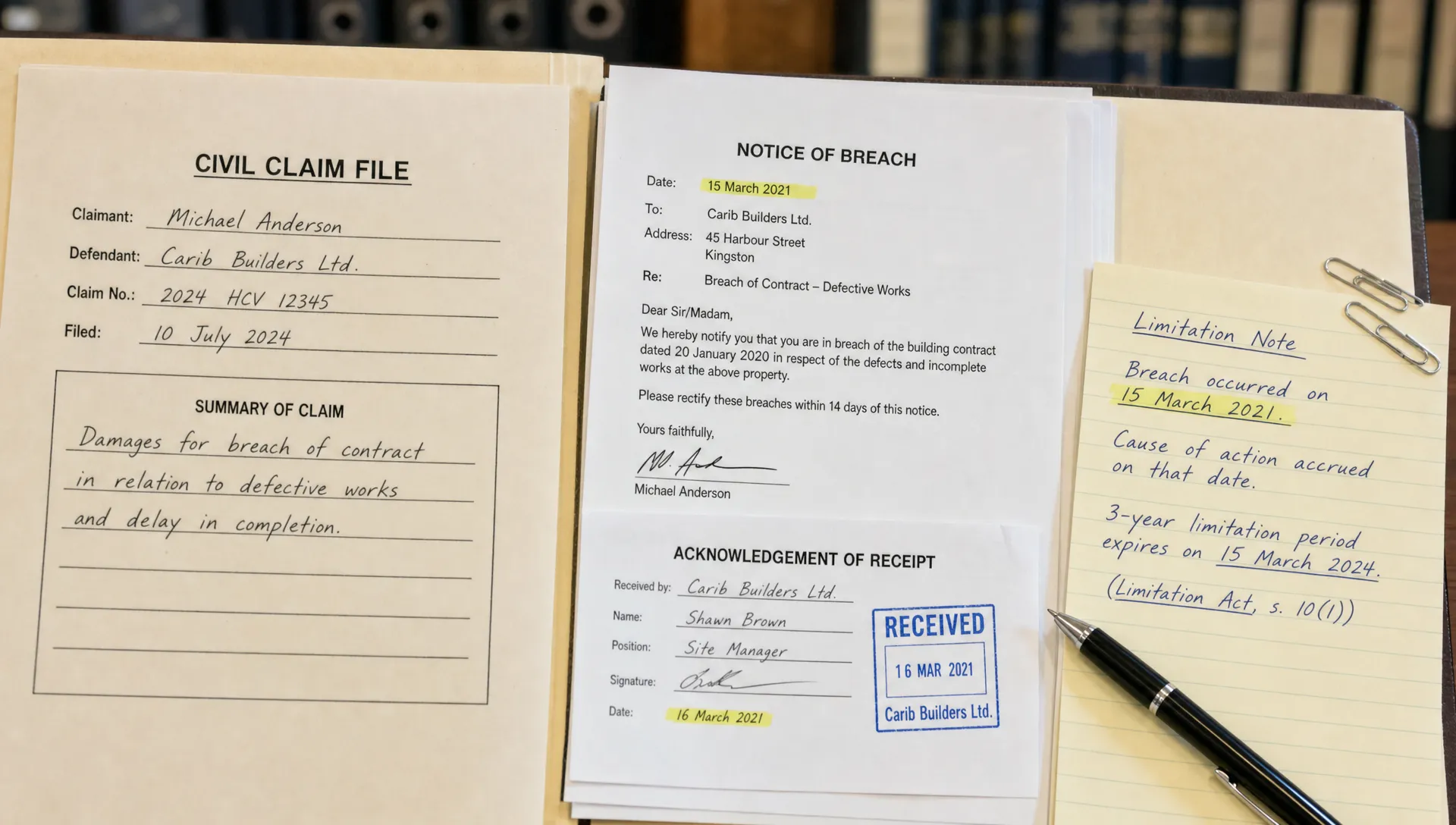
Limitation periods in Jamaican civil claims are filing deadlines that can decide whether a claimant gets to be heard at all. A strong case can still fail if proceedings are started too late, and a weak defence can become powerful if the defendant can properly plead that the claim is statute-barred. For businesses, individuals and insurers, limitation should be checked before letters of demand, settlement talks or pleadings are drafted.
This guide explains the practical principles behind limitation in Jamaican civil litigation. It is general information, not legal advice, because limitation often turns on the exact facts, the cause of action, the defendant’s legal status and the statute governing the claim.
Why limitation periods in Jamaican civil claims matter
A limitation period is not just an administrative deadline. It is a legal defence that may bar a claimant from pursuing a civil remedy after a specified time has passed. In many cases, the clock starts when the cause of action “accrues”, meaning when all the facts needed to sue first exist.
For claimants, the risk is obvious: delay can destroy an otherwise valid claim. For defendants, limitation can be one of the first issues to investigate because it may narrow the dispute or dispose of it entirely. For commercial parties, a limitation analysis also affects provisioning, settlement strategy and whether it is worth commencing proceedings.
Before filing, it is sensible to combine limitation review with broader pre-action checks such as identifying the correct defendant, preserving evidence and assessing remedies. Henlin Gibson Henlin has separately outlined practical steps to take before filing a civil claim in Jamaica, which should be read alongside any limitation analysis.
The starting point: when does time begin to run?
The most important question is usually not “How long is the period?” but “When did it start?” In Jamaican civil claims, the answer depends on the legal basis of the claim.
In a contract case, time commonly starts from breach, not from the date the claimant later appreciates the full financial impact. If a borrower misses a payment, a supplier fails to deliver or a party repudiates an agreement, the accrual date may be tied to that breach.
In tort claims, such as negligence, nuisance or trespass, time usually runs from the date damage occurs or the wrongful act is complete. Some wrongs are one-off events, while others may be continuing or repeated. That distinction can affect whether there is one limitation clock or a series of separate claims.
In debt recovery, the due date for payment is critical. A written acknowledgment of the debt or a part payment may affect the analysis, but it should not be assumed that informal discussions, promises or negotiations automatically preserve the claim. Creditors should also consider whether the debtor can actually satisfy a judgment, an issue discussed in Henlin Gibson Henlin’s guide to debt recovery in Jamaica.
Common limitation issues by claim type
The table below gives a practical overview of issues that frequently arise. It is not a substitute for advice on a particular statute, contract or factual history.
Claim type | Common limitation issue | Practical point |
Simple contract and ordinary debt | Time often runs from breach or payment due date | Check invoices, credit terms, acceleration clauses and acknowledgments |
Tort, including negligence | Time may run from damage or completion of the wrongful act | Identify the first actionable loss, not only the date of complaint |
Defamation | Shorter statutory periods may apply | Publication date and republication issues matter |
Public authority claims | Special statutory protection and shorter deadlines may apply | Identify whether the defendant acted under public duty or statutory authority |
Land and possession disputes | Different rules may apply to recovery of land, adverse possession and equitable relief | Do not treat real estate disputes like ordinary contract claims |
Admiralty and shipping claims | International conventions or local statutes may impose short periods | Cargo, collision and charterparty disputes need urgent review |
Employment disputes | Court claims and statutory labour routes may have different timelines | Identify the correct forum before time expires |
Data and privacy claims | Statutory procedures may interact with civil remedies | Preserve breach notices, correspondence and technical evidence |
The main lesson is that labels can mislead. A “commercial dispute” may include contract, tort, restitution, company law, banking litigation or intellectual property law elements. Each cause of action may have a different clock.
Contract, debt and commercial litigation deadlines
Contract claims are common in commercial litigation in Jamaica. They arise from supply agreements, construction contracts, loan documents, leases, distribution arrangements, shareholder arrangements and professional services agreements.
The limitation analysis begins with the obligation that was breached. If payment was due on a fixed date, the clock may start then. If performance was due upon demand, the wording of the contract and the timing of demand may matter. If a contract is executed as a deed or under seal, a longer period may apply than for an ordinary simple contract, but the document must be reviewed carefully.
Banking litigation often adds further complexity. Loan agreements may include acceleration clauses, guarantees, security documents, mortgages and acknowledgments. A claim against a principal debtor may not raise exactly the same limitation issues as a claim against a guarantor. Security enforcement can also involve different procedural and equitable considerations.
Commercial parties should avoid relying on ongoing negotiations as protection. Settlement discussions may be useful, but they do not necessarily stop time running. If limitation is close, parties can consider protective proceedings, standstill agreements or urgent advice on whether the claim can still be preserved.
Personal injury, professional negligence and medical evidence
Personal injury and professional negligence claims can be especially fact-sensitive because the claimant may need to prove breach of duty, causation, medical condition and financial loss. The date of the incident is usually central, but later treatment records may also matter.
Medical and dental records can help establish when symptoms were first reported, what treatment was received and how loss developed. If treatment took place overseas, for example with a provider such as Beenleigh Dental, appointment confirmations, invoices, referral letters and clinical notes should be preserved early because overseas records can take time to obtain.
Professional negligence claims may also raise questions about when damage first occurred. A client may discover poor advice long after it was given, but discovery and accrual are not always the same. Fraud, concealment or mistake may affect the analysis in some cases, but these are technical issues and should be assessed promptly.
Public authority, constitutional and regulatory claims
Claims involving public authorities require early attention. Jamaican law has statutory protections for certain acts done under public duty or statutory authority, and shorter timeframes may apply depending on the defendant and the nature of the act complained of.
This is not limited to central government. Public bodies, regulators, statutory agencies and officials may raise limitation or procedural objections. A claimant should identify the legal character of the defendant before assuming that the ordinary limitation period applies.
Constitutional claims, judicial review and public law remedies also have their own procedural rules and urgency requirements. These are not ordinary civil claims for limitation purposes. Delay can be fatal even where no familiar contract-style deadline appears on the face of the matter.

Admiralty, shipping, insurance and cross-border disputes
Admiralty and shipping disputes can move quickly because vessels, cargo, insurers and counterparties may be spread across several jurisdictions. Cargo damage, charterparty defaults, collision, unpaid bunkers, port charges and vessel arrests may all raise limitation issues.
Some maritime claims are governed by specific statutes, bills of lading, charterparty terms or international convention rules. These can impose shorter periods than ordinary contract litigation. In practice, parties should secure documents immediately: bills of lading, mate’s receipts, survey reports, protest letters, delivery records, notices of claim and insurance correspondence.
Cross-border disputes add another layer. The governing law, jurisdiction clause, arbitration clause and place of performance can all influence the limitation analysis. A Jamaican court may need to consider foreign law if the contract selects it. Conversely, a claim connected to Jamaica may face limitation arguments abroad.
For background on how civil cases proceed through the Jamaican courts, including pleadings and case management, see Henlin Gibson Henlin’s overview of civil litigation in Jamaica.
Arbitration, mediation and limitation risk
Arbitration and mediation are valuable dispute resolution tools, but they do not remove limitation risk. If an agreement requires arbitration, the relevant question becomes when arbitration is properly commenced under the contract, arbitration rules and applicable law.
A mediation clause can also create timing issues. Parties may be required to negotiate or mediate before litigation, but they must still monitor the limitation deadline. If the pre-action process takes months, a claimant may need advice on standstill arrangements or protective steps.
Settlement discussions should be documented carefully. If a defendant makes a written acknowledgment or part payment, it may affect a debt limitation issue. If the communication is marked without prejudice, or if it is vague, its legal effect may be disputed. The safest course is not to rely on ambiguity close to a deadline.
Special issues in consumer, employment, data and IP claims
Consumer rights claims may arise from defective goods, misleading conduct, unsafe services or unfair business practices. The correct route may be a civil claim, a statutory complaint or both. The limitation period may depend on whether the claim is framed as contract, negligence, misrepresentation or breach of statute.
Employment law disputes also require care. A wrongful dismissal claim in court is different from an industrial dispute or statutory complaint. The forum affects the available remedy, procedure and timing. Employees and employers should identify the claim type early, especially where settlement talks are ongoing.
Data protection claims are increasingly important as Jamaica’s Data Protection Act becomes embedded in business practice. A data incident may lead to regulatory engagement, customer complaints, contractual claims, confidentiality issues and possible civil action. Limitation review should sit alongside evidence preservation, breach response and compliance advice.
Intellectual property law claims may involve infringement, passing off, breach of licence, misuse of confidential information or online takedown issues. The date of first infringement matters, but continuing infringement may raise fresh issues. Delay can also affect interim remedies, even apart from formal limitation.
How limitation affects defendants and insurers
Defendants should investigate limitation immediately after service of a claim. A limitation defence must usually be pleaded properly. If it is missed, the defendant may lose the chance to rely on it or may need permission to amend.
Insurers should also review limitation in two directions. First, the underlying claim may be statute-barred. Second, the insured’s notification obligations under the policy may create separate timing issues. A late notice problem is not the same thing as a limitation defence, but both can affect coverage and litigation strategy.
Where the facts are unclear, defendants should ask for particulars, collect contracts and correspondence and identify the earliest possible accrual date. In some cases, an application may be made to dispose of a stale claim early. In others, limitation may need to be tried with the facts.
Practical steps before a deadline expires
A limitation review should be practical, not theoretical. The aim is to identify the safest filing date, preserve the strongest causes of action and avoid avoidable disputes over timing.
Key steps include:
Identify every possible cause of action, not just the most obvious one
List the earliest possible accrual date for each claim
Check whether any shorter statutory period applies
Review contracts for governing law, jurisdiction and arbitration clauses
Preserve invoices, emails, notices, board minutes, photographs and expert reports
Confirm the correct legal name and address of each defendant
Consider whether an acknowledgment, part payment, fraud, concealment, minority or disability issue affects time
Seek advice before relying on settlement negotiations to delay filing
For companies, limitation checks should be part of routine risk management. A business that waits until receivables are old, documents are missing or key employees have left will face both evidential and limitation problems.
Frequently asked questions
What happens if a Jamaican civil claim is filed after the limitation period? The defendant may plead that the claim is statute-barred. If the defence succeeds, the court may dismiss the claim even if the underlying complaint once had merit.
Does sending a demand letter stop time from running? Usually, no. A demand letter can be important evidence and may be required in some contexts, but it should not be treated as a substitute for filing proceedings or properly commencing arbitration.
Can parties extend a limitation period by agreement? Parties may sometimes use standstill agreements or contractual arrangements to manage timing, but these must be drafted carefully. Do not assume informal negotiations extend time.
Is limitation the same as an appeal deadline? No. Appellate work involves procedural deadlines for challenging a decision, and those deadlines are often much shorter. Missing an appeal deadline can have serious consequences even though it is not the same as a statutory limitation period.
Do limitation periods apply to arbitration and mediation? Yes, limitation can still matter. The issue is whether the claim has been commenced in the required way under the arbitration agreement, applicable rules and governing law.
Final thoughts
Limitation periods in Jamaican civil claims should be assessed at the very start of any dispute. The answer may depend on contract wording, statutory rules, the identity of the defendant, the remedy sought and the evidence available.
If a deadline may be approaching, delay is the wrong strategy. Claimants should seek advice before the window closes, and defendants should examine limitation before engaging deeply on the merits. A careful early review can preserve rights, shape settlement strategy and prevent a civil claim from being lost before it begins.