
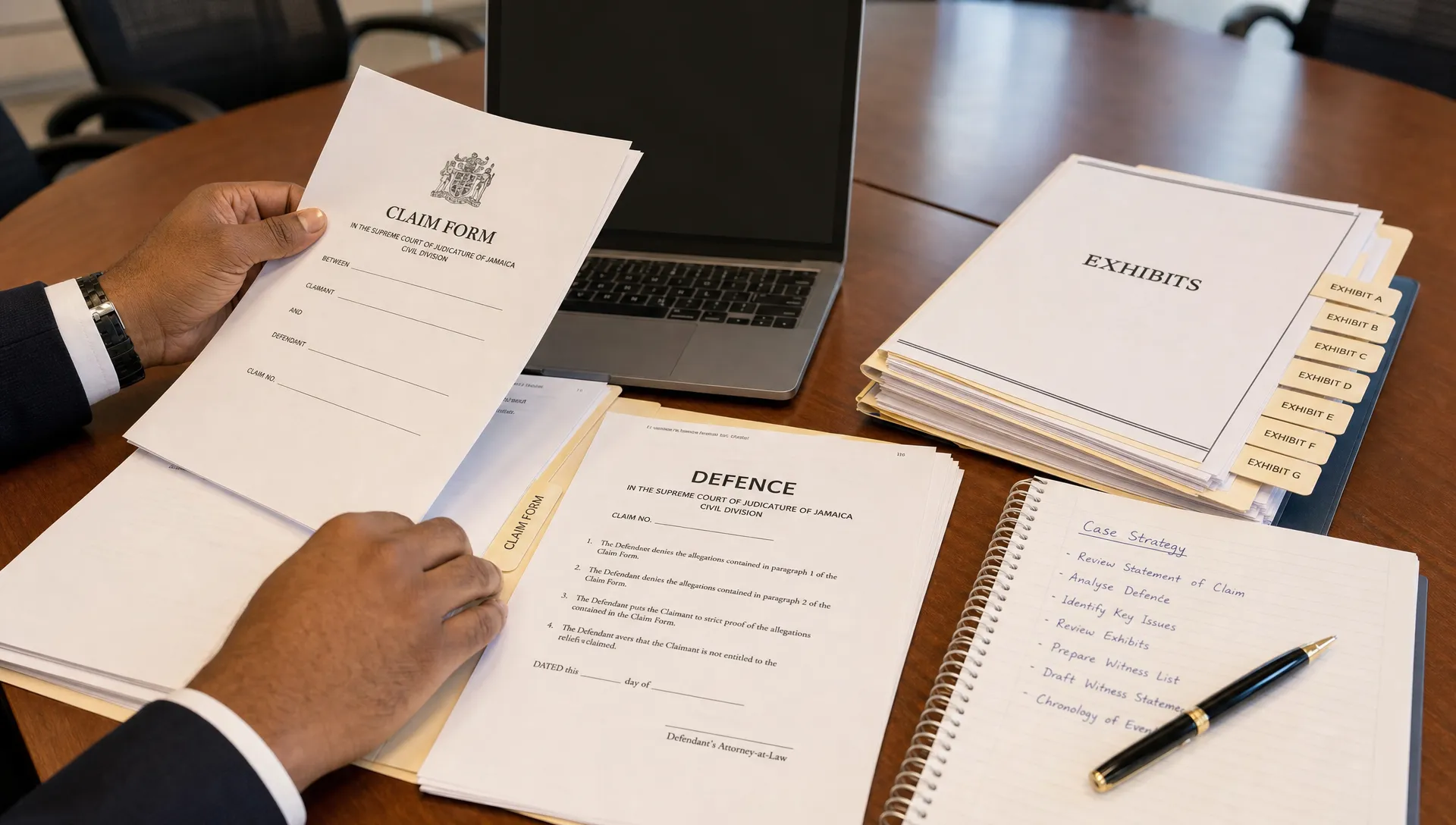
Civil litigation is the court process used to resolve legal disputes between individuals, businesses, organisations or other private parties. If you have searched for “civil litigation, what is it?”, the simplest answer is this: it is how a person or entity asks a court to decide a non-criminal dispute and grant a remedy, such as compensation, an injunction or a declaration of legal rights.
In Jamaica, civil litigation sits within a common law system influenced by English legal traditions, Jamaican statutes and the Civil Procedure Rules. It is structured, deadline-driven and often document-heavy. A strong claim is not only about who is “right”; it also depends on evidence, procedure, timing, strategy and whether the remedy being sought is legally available.
This guide explains how civil litigation works in Jamaica, what kinds of disputes commonly reach the courts and what parties should understand before starting or defending a claim.
Civil litigation, what is it in practical terms?
Civil litigation is the formal process for resolving civil disputes through the courts. A civil dispute usually concerns private rights and obligations rather than criminal guilt. The person bringing the claim is generally called the claimant, and the person responding is the defendant.
The claimant asks the court to recognise a legal wrong and provide a remedy. That remedy may include:
Damages: Money awarded to compensate for loss, harm or breach of duty.
An injunction: A court order requiring someone to do something or stop doing something.
A declaration: A court statement confirming the parties’ legal rights or obligations.
Specific performance: An order requiring a party to perform a contractual obligation.
Possession or recovery orders: Orders relating to land, property or assets.
Civil litigation is different from informal negotiation because the court has authority to make binding decisions. It is also different from criminal prosecution because the purpose is usually compensation, enforcement of rights or protection of legal interests, not punishment by the state.
For a broader explanation of how civil disputes differ from criminal cases, Henlin Gibson Henlin’s guide to civil matters for businesses and individuals provides helpful background.
Civil litigation versus criminal proceedings
Civil and criminal proceedings may sometimes arise from the same facts, but they are legally distinct. For example, a serious road accident may lead to criminal charges in one context and a civil claim for negligence in another. A fraud allegation may involve police action and a separate civil claim to recover money.
Issue | Civil litigation | Criminal proceedings |
Main purpose | Resolve private disputes and grant civil remedies | Prosecute offences against the state |
Usual parties | Claimant and defendant | Prosecution and accused |
Standard of proof | Balance of probabilities | Beyond reasonable doubt |
Possible outcomes | Damages, injunctions, declarations, enforcement orders | Conviction, acquittal, fines, imprisonment or other penalties |
Who controls the case | Usually the parties, subject to court control | The prosecution, subject to court control |
The standard of proof is a major difference. In civil litigation, the claimant must usually prove the case on a balance of probabilities. In simple terms, the court must be satisfied that the claimant’s version is more likely than not. Criminal cases require a higher standard because liberty and criminal conviction are at stake.
Common types of civil litigation in Jamaica
Civil litigation covers a wide range of disputes. Some are highly commercial and involve companies, banks, contracts or regulated industries. Others involve family property, estates, personal injuries or neighbourhood conflicts.
Common civil litigation matters in Jamaica include:
Contract disputes, including non-payment, breach of supply agreements and failed business arrangements.
Debt recovery claims involving unpaid invoices, loans or commercial credit.
Land and property disputes, including possession, boundary issues, trespass and competing claims to title.
Negligence claims, including personal injury and professional negligence matters.
Defamation claims involving alleged damage to reputation.
Estate and probate disputes, including challenges involving wills, administrators or beneficiaries.
Shareholder, partnership and company disputes.
Banking, insurance and financial services litigation.
Judicial review and constitutional claims, where public law remedies may be sought.
The right procedure and forum depend on the nature of the dispute. A debt recovery claim will not be managed in exactly the same way as a constitutional claim, a land dispute or an urgent injunction application.
Which courts handle civil litigation in Jamaica?
Jamaica’s court system includes several levels, and the correct court depends on the subject matter, monetary value and type of remedy being sought. The main civil courts include the Parish Courts, the Supreme Court and the Court of Appeal. In appropriate cases, appeals may go beyond Jamaica to the Judicial Committee of the Privy Council.
Parish Courts hear many civil matters within their jurisdiction, including certain debt, contract, landlord and tenant and local civil disputes. The Supreme Court has broad civil jurisdiction and hears higher-value, complex and specialised matters, including many commercial claims, injunction applications, judicial review proceedings and serious civil disputes.
The Court of Appeal reviews decisions from lower courts where an appeal is permitted. Appeals are not usually a complete re-trial. They often focus on whether the judge made an error of law, procedure or assessment that justifies appellate intervention.
For readers who want more context on the structure of Jamaican courts, Henlin Gibson Henlin’s overview of Jamaica’s legal system explains the common law foundation, court hierarchy and role of judicial precedent.
How civil litigation works in Jamaica
Civil litigation is not a single event. It is a sequence of procedural steps designed to define the dispute, identify the evidence, narrow the issues and allow the court to decide the matter fairly. The exact route depends on the type of claim, the court and any urgent applications.
Pre-action assessment
Before a claim is filed, a lawyer will usually assess the facts, legal basis, likely remedies, limitation periods, evidence and practical value of the claim. This stage matters because a weakly framed claim can create cost exposure, delay and strategic disadvantage.
Pre-action steps may include reviewing contracts, gathering correspondence, preserving digital records, sending a demand letter, identifying the correct parties and considering settlement. In some matters, urgent relief may be needed before all pre-action steps can be completed.
If you are considering a claim, it is worth reviewing what should be done before filing a civil claim in Jamaica, especially where limitation periods, evidence or the identity of the proper defendant may be in question.
Filing the claim
Civil proceedings usually begin when the claimant files the required court documents. Depending on the nature of the case, this may include a claim form, particulars of claim, fixed date claim form, affidavit evidence or other supporting documents.
The documents should clearly identify the parties, the facts relied on, the legal basis for the claim and the remedy sought. Pleadings are important because they define the issues the court will eventually decide. A party may struggle to rely on a point that was not properly pleaded.
Service on the defendant
After filing, the claimant must ensure the defendant is properly served. Service gives formal notice of the proceedings and triggers deadlines for responding. If service is defective, the case may be delayed or challenged.
Service is more than an administrative step. It affects fairness, jurisdiction and the defendant’s obligation to respond. Where a defendant is difficult to locate, outside Jamaica or a company with specific service requirements, legal advice becomes especially important.
Acknowledgment, defence and reply
A defendant who receives court papers must act quickly. The rules usually require a formal response within a specified time. Depending on the claim, the defendant may file an acknowledgment of service, defence, counterclaim or application challenging the claim.
If a defendant ignores a properly served claim, the claimant may be able to seek default judgment, depending on the type of case and the procedural requirements. Default judgment can have serious consequences, including enforcement against assets.
Case management
Modern civil litigation in Jamaica is shaped by active case management. The court may set timetables, narrow issues, order disclosure, direct the filing of witness statements, address expert evidence and encourage settlement where appropriate.
Case management helps prevent litigation from becoming unfocused or unnecessarily expensive. It also gives the court a clearer picture of what is truly disputed. Parties who miss deadlines or fail to comply with court orders may face sanctions, including costs orders or restrictions on the evidence they can use.
Stage | What usually happens | Why it matters |
Pre-action review | Facts, evidence, limitation periods and remedies are assessed | Helps avoid weak, late or poorly framed claims |
Filing | Court documents are prepared and lodged | Formally starts the claim |
Service | Defendant receives official notice | Triggers response deadlines |
Defence | Defendant admits, denies or counters the claim | Defines the disputed issues |
Case management | Court sets directions and deadlines | Keeps the matter focused and procedurally fair |
Disclosure and evidence | Documents, witness statements and expert reports may be exchanged | Builds the factual basis for trial |
Trial | Witnesses may be examined and legal arguments made | Court decides liability and remedy |
Judgment and enforcement | Court gives decision and orders | Successful party may take steps to enforce |

Disclosure, witness statements and expert evidence
Civil cases often turn on documents. Contracts, emails, invoices, letters, bank records, photographs, meeting notes and phone records may become critical. Parties are generally expected to preserve relevant evidence once a dispute is anticipated.
Witness statements set out the evidence that witnesses will give at trial. In technical matters, expert evidence may be needed, such as valuation, engineering, accounting or medical evidence. Expert evidence must be carefully managed because it can affect cost, timing and settlement strategy.
Interim applications
Not every issue waits until trial. A party may need an interim order before the final hearing. Examples include injunctions, orders preserving property, applications to strike out a claim, summary judgment applications or requests for specific procedural relief.
Interim applications can change the direction of a case. An urgent injunction may protect business assets, confidential information or property rights. A successful summary judgment application may resolve a case without a full trial. A failed application may increase costs and delay.
Trial and judgment
If the case does not settle, it proceeds to trial. At trial, the court considers the pleadings, documents, witness evidence, expert evidence and legal submissions. Witnesses may be cross-examined. The judge then decides whether the claimant has proved the case and what remedy should be granted.
Judgment may be delivered orally or in writing, depending on the matter. The court may also make orders about interest, costs and the timing of compliance.
Enforcement
Winning a judgment does not always mean immediate payment or compliance. If the losing party does not obey the court order, enforcement steps may be required. Depending on the facts, these may involve mechanisms for recovering money, securing assets or compelling compliance.
Enforcement strategy should be considered early. A claim against a defendant with no recoverable assets may have limited practical value, even if the legal case is strong.
Settlement, mediation and arbitration
Many civil disputes settle before trial. Settlement can occur before a claim is filed, during case management, after evidence is exchanged or even shortly before trial. A negotiated outcome may reduce cost, protect relationships and give parties more control than a judgment.
Mediation can be useful where the parties need a confidential, structured negotiation assisted by a neutral mediator. It may be especially valuable in commercial disputes, family property conflicts, estate disputes and cases where ongoing relationships matter.
Arbitration is different. It is a private dispute resolution process where an arbitrator makes a binding decision, usually because the parties agreed to arbitration in a contract. Arbitration can be effective for some commercial disputes, but it is not automatically better than court litigation. The choice depends on confidentiality, enforceability, urgency, cost, appeal rights and the nature of the dispute.
If your contract contains an arbitration clause, review it early. Henlin Gibson Henlin’s discussion of arbitration or litigation in Jamaica explains factors that may influence which route is more suitable.
How long does civil litigation take in Jamaica?
There is no single timeline for civil litigation. A straightforward debt claim may move more quickly than a complex commercial, land, estate or constitutional case. Timelines depend on the court’s schedule, the number of parties, the volume of evidence, interlocutory applications, expert reports, settlement efforts and whether there is an appeal.
Delay is not always caused by the court. Parties may contribute to delay by filing incomplete documents, missing deadlines, failing to disclose evidence, changing attorneys late or pursuing unnecessary applications. Good litigation management aims to reduce avoidable delay while protecting the client’s legal position.
A practical timeline discussion should include not only “how long until trial?” but also “how quickly can we protect the client’s interests?” Sometimes an interim order, settlement agreement or targeted application is more urgent than final judgment.
What does civil litigation cost?
The cost of civil litigation varies. Relevant factors include the complexity of the case, the number of witnesses, the volume of documents, expert evidence, urgency, court fees, service costs, attorney time and whether the matter goes to trial or appeal.
Costs orders are also important. In civil litigation, the court may order one party to pay some of the other party’s legal costs. This does not always mean full reimbursement. Cost recovery depends on the court’s order, the rules and the circumstances of the case.
Because litigation can become expensive, parties should assess proportionality. A claim may be legally valid but commercially unwise if the likely recovery is small, the defendant has limited assets or the dispute can be resolved through negotiation at lower cost.
How to prepare if you are involved in a civil dispute
Preparation can significantly affect the outcome of a civil case. Whether you are bringing or defending a claim, early organisation helps your attorney assess the merits, identify risks and build a coherent strategy.
Useful preparation steps include:
Preserve contracts, emails, messages, invoices, receipts, photographs and any other relevant documents.
Create a timeline of key events, including dates, meetings, payments and promises made.
Identify all parties involved, including companies, directors, agents, guarantors or insurers where relevant.
Avoid deleting messages, altering documents or making public comments about the dispute.
Keep communications factual and avoid threats or admissions without legal advice.
Consider your commercial objective, including settlement, payment, preservation of property or reputational protection.
Early legal advice is particularly important when you receive court papers, face a limitation deadline, need urgent injunctive relief or are involved in a high-value business or property dispute. If you are unsure about the lawyer’s role, this guide to what litigation attorneys do and when to hire one offers a useful overview.
Frequently Asked Questions
What is civil litigation in Jamaica? Civil litigation is the court process for resolving non-criminal disputes between private parties, businesses or organisations. It may involve claims for money, injunctions, declarations, property remedies or enforcement of legal rights.
Is civil litigation the same as suing someone? Suing someone is one way to describe starting civil litigation, but civil litigation includes much more than filing a claim. It also includes service, defence, case management, evidence, applications, settlement discussions, trial, judgment and enforcement.
Can a civil case be settled before trial? Yes. Many civil cases settle before trial through negotiation, mediation or other dispute resolution methods. Settlement may save time and cost, but the terms should be carefully documented.
What happens if a defendant ignores a civil claim? If a defendant is properly served and does not respond within the required time, the claimant may be able to apply for default judgment, depending on the type of case and the applicable rules.
Do I need an attorney for civil litigation? Some parties may handle simple matters themselves, but legal advice is strongly recommended where the dispute involves significant money, property, business risk, urgent relief, complex evidence or court deadlines.
Can a civil judgment be appealed? In appropriate cases, a party may appeal a civil judgment. Appeal rights and deadlines depend on the court, the type of order and the applicable rules. Legal advice should be sought quickly because appeal timelines can be strict.
Speak with a civil litigation team in Jamaica
Civil litigation can protect rights, recover losses and resolve serious disputes, but it requires careful judgment from the start. The strength of a case often depends on how early the issues are identified, how well the evidence is preserved and whether the chosen strategy matches the client’s practical objective.
Henlin Gibson Henlin assists clients with civil litigation and related dispute resolution matters in Jamaica, including commercial, banking, appellate, arbitration and mediation matters. If you are considering a claim or need to respond to court proceedings, you can contact Henlin Gibson Henlin for guidance tailored to your circumstances.
This article provides general information only and is not a substitute for legal advice on a specific matter.