
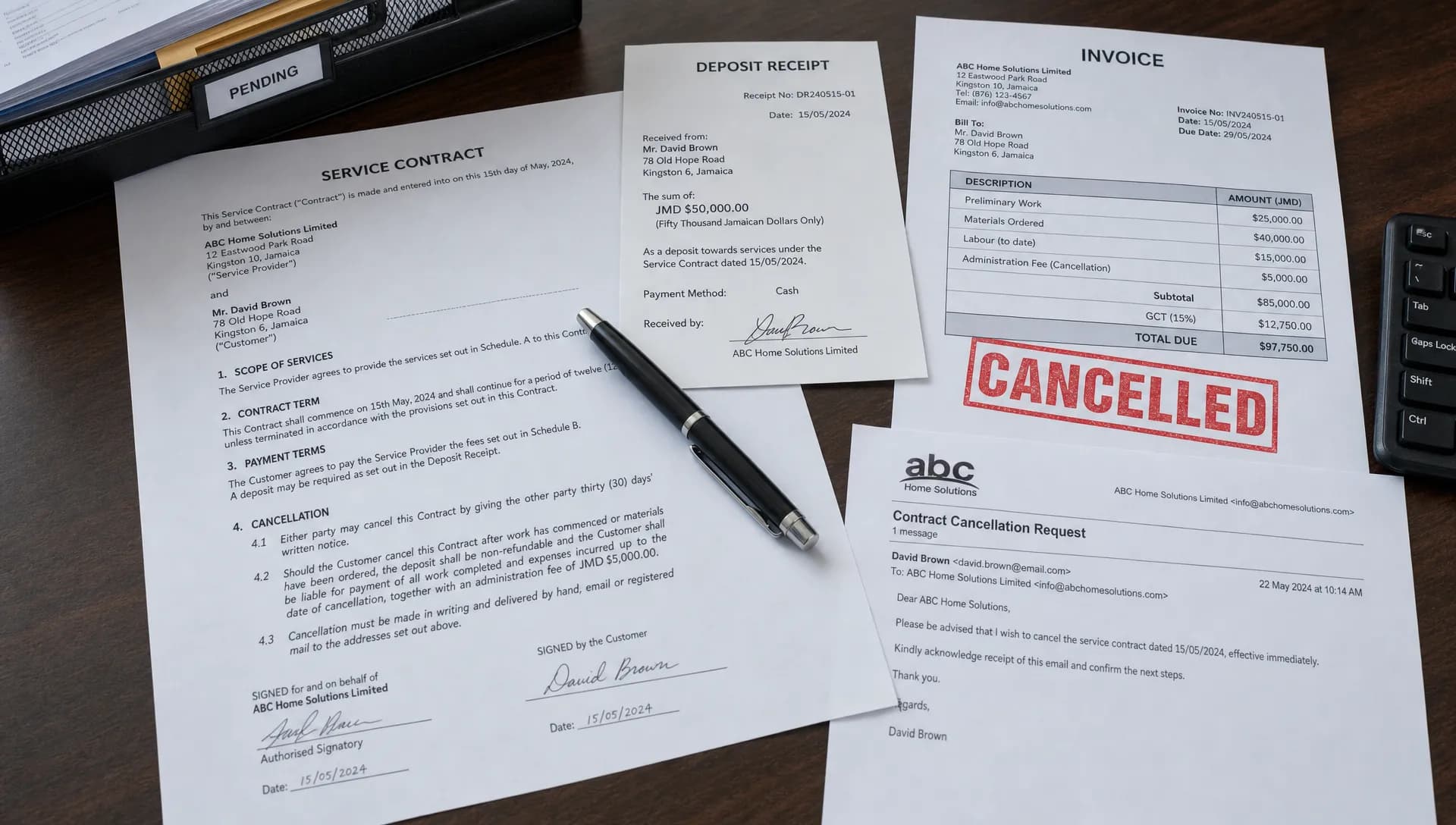
A customer cancellation can be more than an inconvenience. It can leave your business with unused stock, blocked calendar time, subcontractor commitments, cash flow pressure and a difficult question: do you refund, reschedule, enforce the agreement or negotiate? For Jamaican businesses, the safest response is rarely an emotional one. It is a documented, contract-led process that protects your legal position without damaging commercial relationships unnecessarily.
This guide explains the practical steps to take when a customer cancels and the protections to build into your contracts before the next cancellation happens. It is general information, not legal advice. The right answer will depend on your contract, the facts and the type of customer involved.
Start by identifying what the customer is cancelling
Before deciding whether you are entitled to keep a deposit, charge a fee or claim damages, identify the legal status of the arrangement. A cancellation request is not always a breach of contract. Sometimes it is simply a customer declining a quote before any binding agreement was formed.
Ask these questions first:
Was there a signed contract, accepted proposal, purchase order or written confirmation?
Did the customer pay a deposit or part payment?
Did your business already incur costs or turn away other work?
Did the contract include a cancellation, refund or rescheduling clause?
Is the customer a consumer, a company or a public sector entity?
Is the cancellation connected to your performance, delay, product quality or a change in the customer’s circumstances?
In Jamaica, many commercial relationships are built through emails, invoices, WhatsApp messages, purchase orders and partial payments rather than a long-form contract. That does not automatically mean there is no agreement. A binding contract may arise if the usual elements are present, including offer, acceptance, consideration and an intention to create legal relations.
The first step is therefore not to argue. It is to collect the documents and reconstruct the deal.
Build cancellation protection into your contract before there is a dispute
The best time to protect your business when a customer cancels is before the sale is confirmed. A clear cancellation clause can reduce uncertainty, preserve cash flow and give your staff a consistent script when customers ask for refunds.
A strong clause should be specific enough that the customer understands the commercial bargain. It should explain when the customer may cancel, how much notice is required, what happens to deposits, whether rescheduling is available and which costs remain payable.
For example, a catering business, construction contractor, marketing agency and software provider will not need the same wording. A contractor may need protection for ordered materials and subcontractor costs. A professional services firm may need protection for reserved time and work already performed. A retailer may need different terms for standard goods, customised goods and special orders.
Your cancellation terms should usually cover:
Notice method: State whether cancellation must be sent by email, letter or another written method.
Timing: Set different outcomes for cancellation 30 days out, 7 days out and after performance has begun, where appropriate.
Deposits: Explain whether the deposit is refundable, partly refundable or applied to cancellation charges.
Work in progress: Confirm that completed work, committed costs and third-party expenses remain payable.
Rescheduling: Allow one rescheduled date if that makes business sense, with a deadline and administrative fee if needed.
Dispute process: Include negotiation, mediation, arbitration or court options that fit the value and urgency of the contract.
Governing law: For Jamaican businesses, state clearly which law governs the contract and where disputes are to be handled.
The clause should be visible before the customer commits. If you hide cancellation terms in a document sent only after payment, you may have a harder time relying on them later.
What to do immediately after a customer cancels
Once a customer says they are cancelling, move quickly but carefully. Your response in the first 24 to 48 hours can affect your ability to recover payment or resolve the dispute commercially.
Confirm the cancellation in writing. If the cancellation came by phone, send a neutral email summarising what was said. Avoid admissions such as “we understand this is our fault” unless that is a considered legal position. Use calm wording: “We acknowledge your message requesting cancellation and are reviewing the contract and work completed to date.”
Next, preserve evidence. Save the signed contract, invoice, quotation, payment records, emails, text messages, delivery notes, staff time records and proof of expenses. If physical goods were prepared for the customer, photograph them and keep supplier invoices. If a cancellation later becomes commercial litigation, those records may matter more than your memory of the conversation.
You should also stop avoidable costs where possible. Contract law generally expects a party claiming loss to take reasonable steps to reduce that loss. If you can cancel a supplier order, rebook the date or redirect stock to another customer, document those efforts. Mitigating loss does not mean giving up your rights. It means acting commercially and preserving a more credible claim.
The same evidence discipline applies when the problem runs in the other direction, such as when a supplier suddenly fails to perform. In both scenarios, the businesses that fare best are usually those that check the contract early, preserve documents and communicate formally.
Decide whether to refund, reschedule or enforce payment
Not every cancellation should be treated the same way. A rigid “no refunds ever” policy can cause reputational harm and may be vulnerable in some consumer situations. On the other hand, automatically refunding every cancellation can teach customers that your time, inventory and opportunity costs have no value.
Use the contract and the commercial context to decide your response.
Scenario | Practical response | Legal issue to check |
Customer rejected a quote before acceptance | Confirm no booking or order was finalised | Whether a binding contract existed |
Customer cancels after paying a deposit | Apply the deposit clause and explain the calculation | Whether the clause is clear and proportionate |
Customer cancels after work has begun | Invoice for completed work and committed costs | Evidence of performance and loss |
Customer alleges your business failed to perform | Investigate before enforcing payment | Possible breach, misrepresentation or service issue |
Customer requests rescheduling | Offer documented new terms if commercially sensible | Whether the original contract is varied |
Customer reverses a card payment | Gather contract, delivery and communication records | Chargeback rules and banking evidence |
If there is room to preserve the relationship, consider a structured compromise. For instance, you might retain a portion of the deposit for costs already incurred and apply the balance as credit toward a future order. Put any compromise in writing and make clear whether it is a full and final settlement or a one-time commercial concession.

Watch the consumer rights angle
A cancellation by an individual consumer can raise different considerations from a cancellation by a company. Businesses should take care with refund policies, marketing statements and contract terms that may be seen as unfair, misleading or unclear.
The Consumer Affairs Commission of Jamaica provides public information on consumer protection issues and complaints. If your business sells to consumers, your cancellation policy should be written in plain language, displayed before purchase and applied consistently. Staff should understand the difference between a change-of-mind cancellation and a complaint that the product or service was defective, delayed or misrepresented.
You should be especially careful with “non-refundable” wording. A non-refundable deposit may be commercially reasonable in some cases, particularly where your business reserves capacity or incurs costs. But a blanket refusal to refund in every situation can create risk, especially if the customer’s cancellation is linked to your own delay, defective performance or unclear terms.
The stronger approach is transparency. Explain what is refundable, what is not, why the charge exists and how it is calculated.
Do not overlook data protection when handling cancellations
Customer cancellations often involve personal data: names, addresses, payment details, identification documents, medical information, shipping details, event guest lists or employee contact information. If the transaction ends, your business should still handle that information responsibly.
Jamaica’s Data Protection Act, 2020 introduced obligations for organisations that process personal data. The Office of the Information Commissioner is the regulator responsible for oversight under the Act. A cancellation does not give a business permission to keep personal data indefinitely, share it casually or use it for unrelated marketing without a lawful basis.
Review your retention practices. Keep records needed for accounting, tax, legal claims and dispute resolution, but limit access and avoid unnecessary duplication. If the customer asks for deletion or objects to further processing, do not answer casually. Check your legal obligations and respond through a controlled process.
This matters for trust as much as compliance. A customer who is already unhappy about a cancellation may react strongly if they believe their personal information is being mishandled.
Make cancellation fees defensible, not punitive
Many businesses want a cancellation fee that deters last-minute withdrawals. That is understandable, but the fee should be connected to a legitimate commercial loss or administrative burden. If a charge looks like a punishment rather than a fair protection of business interests, it may be harder to defend.
Courts applying common law principles are generally more comfortable with clauses that reflect a genuine business rationale. That might include reserved time, staff scheduling, perishable goods, custom materials, supplier penalties, administrative work or the loss of a realistic replacement sale.
To make your cancellation fee more defensible, keep it proportionate and explainable. A sliding scale often works better than a single flat penalty. For example, a cancellation one month before an event may cause less loss than one made 24 hours before, after stock has been purchased and staff confirmed.
You should also avoid inconsistent conduct. If your written policy says one thing but your team routinely promises something else over WhatsApp, the paper policy may not settle the dispute. Train staff to use approved language and to escalate unusual requests before making commitments.
Consider payment risks, chargebacks and banking evidence
Customer cancellations sometimes become payment disputes. A customer may stop a cheque, reverse a card payment, dispute a bank transfer or request a chargeback through their card issuer. By that stage, the issue is no longer only about contract language. It is also about evidence and timing.
Keep your payment records organised. You may need to show the signed agreement, proof that the customer accepted the terms, proof of delivery or performance, correspondence about the cancellation and your refund policy. If you operate in a sector with frequent disputes, such as online retail, travel, events or professional services, create a standard evidence pack for payment challenges.
If a large sum is at stake, get advice before sending lengthy explanations to banks, payment processors or the customer. A poorly worded response can create admissions that later affect negotiation or litigation. Banking litigation support may be needed where the payment dispute is complex, high value or tied to wider fraud, insolvency or commercial issues.
Use negotiation, mediation or arbitration before court where appropriate
Court is sometimes necessary, especially where the amount is substantial, the customer’s breach is clear or the dispute affects your business reputation. But many cancellation disputes are better handled through structured negotiation, arbitration or mediation.
Mediation can be useful where both sides have a continuing commercial relationship or where the dispute involves practical solutions, such as rescheduling, partial refund, revised delivery or staged payment. Arbitration may be suitable where the contract already contains an arbitration clause or where confidentiality is important.
Before escalating, send a formal letter that sets out the relevant contract terms, timeline, sums claimed, evidence and deadline for response. The tone should be firm but professional. Threats and emotional language rarely help. If litigation becomes necessary, a clear paper trail will support your position.
A law firm in Jamaica with experience in commercial contracts, arbitration and commercial litigation Jamaica can help assess whether to negotiate, file a claim, defend a chargeback or take urgent steps to protect assets and evidence.
A practical cancellation protection checklist
Review your customer-facing documents this week. Most businesses do not need a more aggressive policy. They need clearer terms, better acceptance records and a consistent internal process.
Use this checklist as a starting point:
Your quotation states when it becomes binding.
Your cancellation and refund terms appear before payment.
Deposits are described clearly, including when they are refundable.
Custom orders, special imports and reserved service dates have tailored terms.
Staff use approved wording when confirming bookings or cancellations.
Customer communications are stored in one place.
Your business tracks costs incurred before and after cancellation.
Your data retention practices match your privacy obligations.
Your dispute clause fits the likely value and urgency of disputes.
High-value contracts are reviewed by counsel before signature.
For many businesses, the goal is not to sue more customers. It is to reduce ambiguity so that cancellation disputes can be resolved quickly, commercially and with fewer surprises.
Frequently Asked Questions
Can I keep a customer’s deposit if they cancel? It depends on the contract, the timing of the cancellation, the reason for cancellation and whether the deposit term was clearly communicated. A deposit is easier to defend when it reflects reserved capacity, incurred costs or other legitimate business loss.
What if the customer says they never agreed to my cancellation policy? You will need evidence that the policy formed part of the agreement before the customer committed. Signed contracts, accepted quotations, website checkout terms, email confirmations and payment acknowledgements can all be relevant.
Should I offer a refund even if the contract says no refund? Sometimes a partial refund or credit is the better commercial decision, especially where the customer relationship matters or your loss is limited. However, record the basis of any concession and avoid creating a precedent that undermines your policy.
When should I involve a lawyer after a cancellation? Seek legal advice early if the amount is significant, the customer threatens legal action, a chargeback is filed, the facts are disputed, confidential information is involved or the cancellation affects a wider commercial relationship.
Protect your contracts before the next cancellation
A customer cancellation can expose weak paperwork, unclear refund terms and inconsistent internal practices. It can also become a manageable business issue if your contracts are clear and your response is disciplined.
Henlin Gibson Henlin provides client-focused legal services to Jamaican businesses across commercial litigation, arbitration and mediation, data privacy, compliance and related commercial matters. If your business needs to strengthen its cancellation clauses or respond to a serious customer dispute, contact Henlin Gibson Henlin for guidance tailored to your circumstances.