
When a counterparty runs out of money, a commercial problem can become a legal risk in a matter of days. A supplier may stop deliveries, a customer may stop paying, a contractor may abandon a project or a borrower may default. The instinct may be to terminate immediately, demand payment in full or seize whatever you can. Those reactions can backfire if the contract, insolvency process or court order limits what you can do.
For Jamaican businesses, the safest response is structured and evidence-led. Insolvency does not automatically end every contract, but it changes the priority of claims, the leverage between the parties and the practicality of enforcement. The goal is to protect your position without creating a new breach of your own.
First response when a contract party becomes insolvent
Your first 24 to 72 hours matter. Before sending an aggressive notice or stopping performance, separate confirmed facts from rumours. Insolvency can mean several things in practice, including cash-flow distress, receivership, liquidation, bankruptcy, a restructuring proposal or an informal creditor workout.
Confirm the status of the counterparty
Ask for written confirmation of the counterparty's position and identify who now has authority to act. If a receiver, trustee, liquidator or other office-holder has been appointed, communications should usually be directed through that person or copied to them.
You should also check basic public records where relevant, such as company filings, registered office details, court filings if proceedings have started and any notices sent to creditors. Do not assume that a late payment or a press report gives you the right to terminate. You need to know whether there is a formal insolvency event and what process applies.
Stabilise your commercial exposure
While you assess the legal position, limit new exposure where the contract allows. That may mean pausing fresh purchase orders, moving to cash in advance for future supply, stopping discretionary credit or ring-fencing inventory, documents and project materials.
The key word is lawful. If you are still bound to perform, an abrupt suspension may put you in breach. If the contract allows suspension for non-payment, insolvency or failure to provide adequate assurance, follow the exact notice requirements before relying on that right.
Review the contract before making a move
The contract is your operating manual, but it must be read alongside any applicable insolvency rules, court orders and equitable principles. A clause may look clear at first glance, yet the way you enforce it can affect whether your claim is admitted, whether you remain a supplier or whether you become exposed to a damages claim.
Focus on default, termination and notice clauses
Look for an insolvency event of default, non-payment default, material breach provision, cure period, termination for convenience clause and any right to suspend performance. Then check the notice clause. Many contracts specify the method of notice, address, deemed delivery period and person to receive it.
If a contract requires written notice and a five-day cure period, a phone call is not enough. If it requires delivery to a registered office, emailing an operations manager may not trigger the contractual timeline.
Check payment, security and ownership rights
Some rights become more valuable when a counterparty is insolvent. Others become harder to enforce. The most useful review usually covers these clauses:
Contract issue | What to check | Why it matters |
Termination for insolvency | Whether insolvency is an event of default and whether notice is required | Terminating too early can create liability |
Suspension of performance | Whether unpaid invoices or credit concerns allow suspension | Helps reduce future exposure without ending the contract |
Retention of title | Whether goods remain yours until paid for | May improve recovery if goods are identifiable |
Set-off | Whether mutual debts can be netted | Can reduce the amount you owe or the amount at risk |
Guarantees and indemnities | Whether directors, parent companies or third parties stand behind the obligation | May provide a recovery route outside the insolvent estate |
Dispute resolution | Whether litigation, arbitration or mediation applies | Determines forum, timing and strategy |
Notice requirements | Who must receive notices and how they must be served | Defective notices often weaken an otherwise strong position |
If the immediate problem is non-performance rather than confirmed insolvency, treat that as a related but separate issue. A supplier that suddenly fails to perform may require urgent operational steps even before formal insolvency is confirmed.
Protect evidence, money and leverage
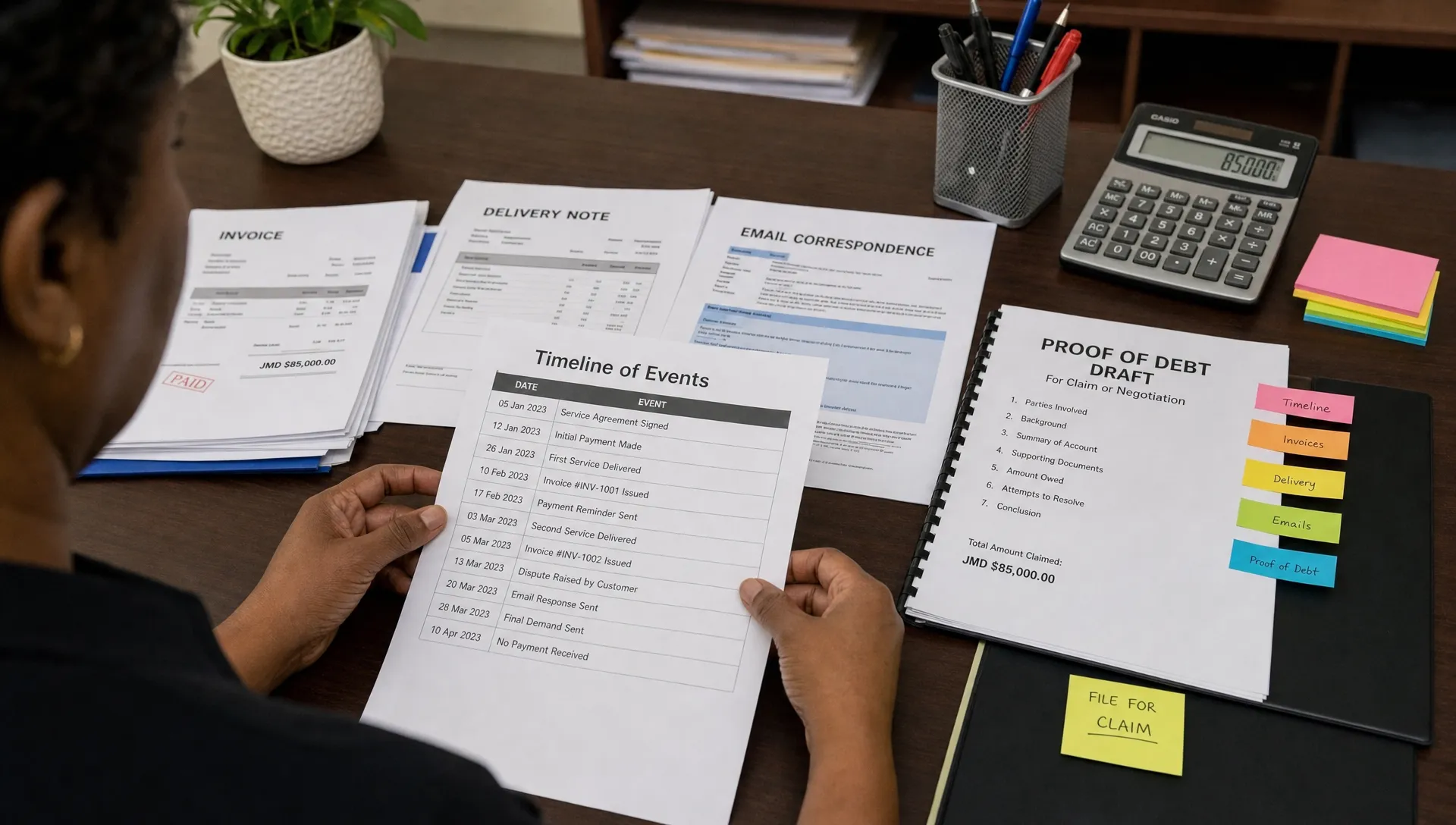
Once insolvency is on the table, your file needs to be clean. Invoices, emails, delivery notes, account statements, purchase orders, meeting notes and payment records may become the foundation for a proof of debt, court application, arbitration claim or negotiated settlement.
Create a complete record of the debt or breach
Prepare a timeline showing the contract date, obligations, performance history, invoices issued, payments received, defaults, notices and losses. Keep original documents where possible and preserve electronic records in their native form.
If the counterparty disputes the debt, separate the admitted amount from the disputed amount. A precise position is more persuasive than a broad demand. It also helps you decide whether negotiation, mediation, court proceedings or proof in the insolvency process is the better route.
Avoid weakening your own claim
Do not agree to informal variations without documenting them. Do not release security, deliver additional goods or accept a vague repayment plan unless you understand the consequences. A distressed counterparty may promise future payment to keep goods or services flowing, but those promises are only useful if they are enforceable and commercially realistic.
If you receive a large or unusual payment shortly before a formal insolvency process, get advice before assuming the money is safe forever. Depending on the facts and the process involved, certain transactions made in the run-up to insolvency may later be reviewed or challenged.
Understand the insolvency process in Jamaica
Insolvency affects enforcement because it may change who controls the counterparty's assets and how creditors are paid. In Jamaica, the answer can depend on the type of debtor, the nature of the proceeding, the security documents and whether the court has made any relevant orders.
Identify who controls the assets
A receiver may be focused on secured assets. A liquidator may be collecting and distributing company assets. A trustee or other office-holder may be administering an estate for creditors. Management may still be involved in an informal workout, but their authority may be limited once a formal process begins.
That distinction matters. If you negotiate with the wrong person, your agreement may be ineffective. If you enforce against assets without permission, you may breach a stay, interfere with secured creditor rights or create a dispute that could have been avoided.
Decide whether to sue, prove or negotiate
Court action is not always the best response to insolvency. If the debtor has no assets, litigation may produce a judgment that is difficult to collect. If there is a moratorium or stay, you may need permission before continuing proceedings. If there is an insolvency claims process, filing a proof of debt may be the correct step.
Before spending money on proceedings, assess collectability, the debtor's identity, available security and the amount in dispute. Henlin Gibson Henlin has written separately on whether court action for debt recovery still makes sense, a question that becomes even more important when insolvency is involved.

Choose a commercial strategy: continue, renegotiate or exit
After the first legal review, decide what outcome you actually want. Not every insolvency requires termination. In some cases, the best result is continued supply on safer terms. In others, the priority is orderly exit, debt recovery or preservation of rights against guarantors and insurers.
Continue only with better protection
If the insolvent party is a critical supplier, immediate termination may disrupt your own business. You may prefer to keep the contract alive while requiring cash in advance, shorter payment cycles, direct engagement with the receiver or liquidator, delivery milestones, updated insurance certificates or access to stock and project materials.
Continuation should be documented carefully. If you waive existing defaults or agree to new terms, say so clearly. If you are reserving rights while allowing limited performance, make that reservation express.
Renegotiate where value remains
A restructuring proposal, repayment plan or standstill agreement can work where the underlying business remains viable. The agreement should identify admitted debts, disputed debts, future performance obligations, payment dates, default consequences and security.
For larger exposures, consider whether guarantees, charges, escrow arrangements, letters of credit or parent company support are available. The stronger the security, the less you depend on joining the queue of unsecured creditors if the rescue fails.
Exit where the risk outweighs the benefit
If continued performance will deepen your loss, termination may be the commercial answer. Make sure the default has occurred, notices are valid, cure periods have expired and no insolvency restriction prevents termination at that time.
Also plan the handover. Recover your confidential information, protect intellectual property rights, secure data, retrieve equipment and arrange replacement suppliers or service providers. A clean exit is not only about ending the contract. It is about reducing the next dispute.
Special issues by contract type
Different commercial relationships create different insolvency risks. The same general principles apply, but the practical priorities vary.
Relationship | Main risk | Practical response |
Supplier contract | Non-delivery, loss of deposits or unfinished orders | Confirm stock position, review suspension rights and arrange alternatives |
Customer contract | Unpaid invoices and ongoing credit exposure | Stop avoidable credit, preserve account records and consider proof of debt |
Construction or services contract | Abandoned work, defects and subcontractor claims | Secure site records, materials, warranties and replacement options |
Banking or secured lending | Competing claims over charged assets | Review security, priority, enforcement rights and any standstill obligations |
IP or technology contract | Loss of access to software, licences or source materials | Review licence survival, escrow, confidentiality and transition rights |
Shipping or logistics contract | Cargo delays, liens, charter defaults or port costs | Identify who controls cargo, freight documents and maritime claims |
Data-heavy contracts need extra care. If the insolvent party processes personal data, insolvency does not remove obligations under Jamaica's Data Protection Act or confidentiality clauses. Transfers of customer files, employee records or databases should be handled with legal and technical controls, especially if systems are being sold, migrated or shut down.
Common mistakes to avoid
Insolvency pressure often leads to rushed decisions. The following mistakes can turn a recoverable problem into a more expensive dispute:
Terminating based on rumours rather than a defined contractual default
Ignoring notice provisions, cure periods or service requirements
Continuing to supply goods or services without fresh payment protection
Failing to file a proof of debt by the required deadline
Treating secured, unsecured and guaranteed claims as if they are the same
Taking back goods or equipment without checking ownership and access rights
Negotiating only with management after an office-holder has taken control
Forgetting to preserve email trails, delivery records and account statements
A disciplined response does not guarantee full recovery, but it preserves options. It also improves your credibility with insolvency practitioners, courts, arbitrators, mediators and commercial counterparties.
When to involve legal counsel
You should seek advice early if the exposure is significant, the contract is business-critical, the counterparty has entered a formal insolvency process or there are competing claims to the same assets. Early advice is also important where the matter involves secured lending, cross-border parties, intellectual property, confidential information, regulated data, admiralty and shipping issues or urgent injunctive relief.
Counsel can help you assess whether to terminate, suspend, sue, arbitrate, mediate, file a proof of debt, negotiate a standstill or enforce security. If the situation is moving quickly, Henlin Gibson Henlin's guidance on when to involve legal counsel during a business crisis is a useful companion to this insolvency checklist.
Frequently Asked Questions
Does insolvency automatically terminate a contract? Usually, no. A contract may contain an insolvency termination clause, but you still need to check notice requirements, cure periods, applicable insolvency restrictions and any court orders before acting.
Can I stop supplying goods or services if the other party is insolvent? Possibly, but only if the contract or applicable law allows suspension. If you stop performance without a valid basis, you may commit a breach and weaken your claim.
What should I do if the insolvent party owes my business money? Preserve all records, calculate the debt, check for security or guarantees, identify the insolvency process and determine whether to file a proof of debt, negotiate or pursue enforcement.
Can I recover goods delivered before payment? That depends on ownership, retention-of-title wording, identification of the goods, possession and the insolvency process. Do not enter premises or remove goods without confirming your rights.
Is mediation useful when a party is insolvent? It can be, especially where there is a viable restructuring, ongoing commercial relationship or dispute about the amount owed. Mediation will not create assets where none exist, but it may reduce cost and preserve value.
Speak with a commercial legal team in Jamaica
If a supplier, customer, borrower or commercial partner has become insolvent, act quickly but not impulsively. The right response depends on your contract, the insolvency process, your security position and your commercial objective.
This article is general information and not legal advice. For advice on commercial litigation, debt recovery, arbitration, mediation, secured transactions or contract strategy in Jamaica, contact Henlin Gibson Henlin to discuss the facts before taking the next step.