
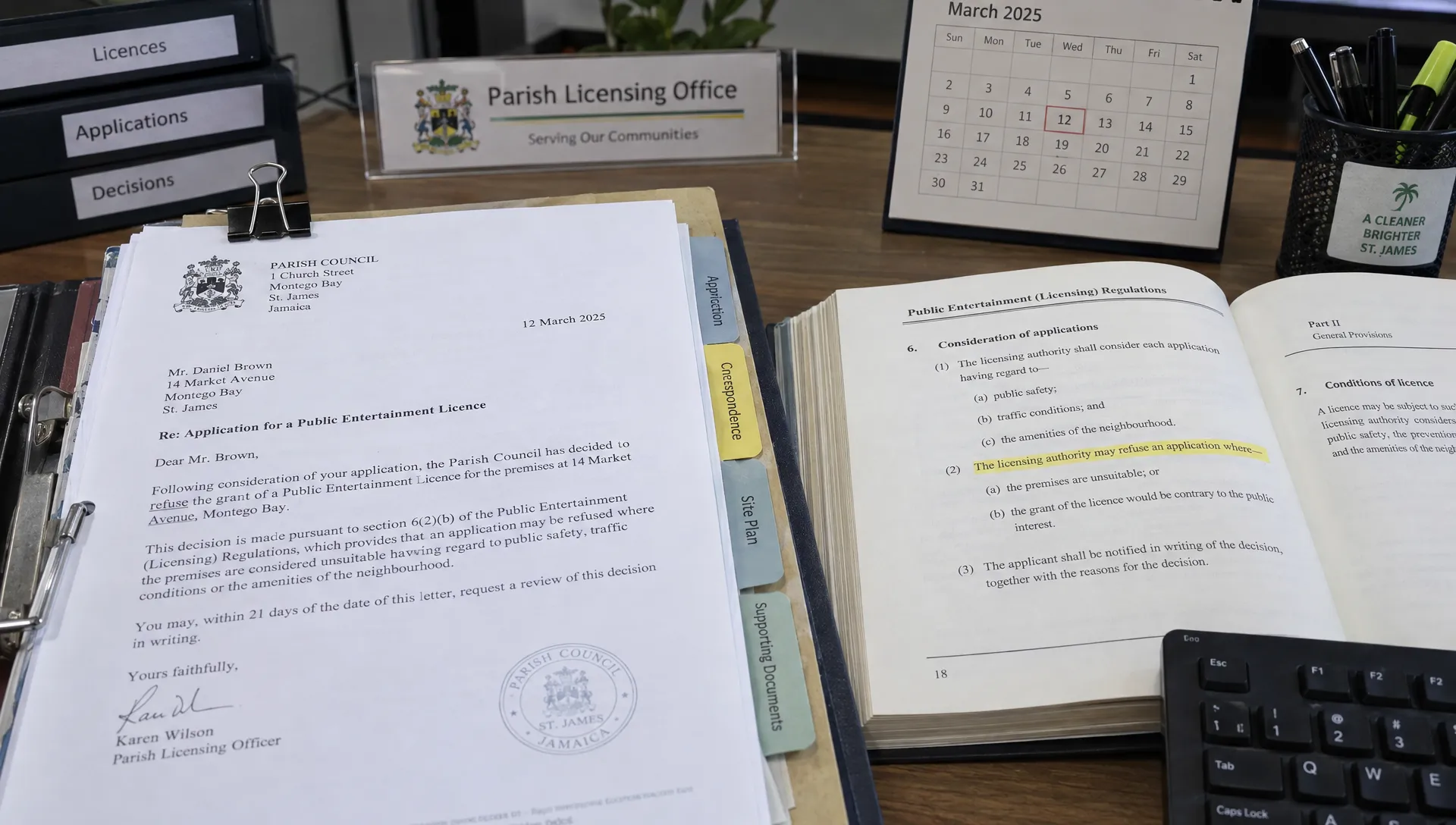
Judicial review in Jamaica allows individuals and businesses to challenge the lawfulness of decisions made by public authorities. A refused licence, a disciplinary ruling or a regulator’s action may have serious consequences, but an unfavourable outcome alone does not establish a legal challenge. The central question is whether the authority acted within its powers, followed a fair process and reached a decision that satisfies the applicable legal standards.
Time matters. Applications for leave must generally be made promptly and within three months after the grounds first arose. Understanding the correct route, preserving evidence and identifying the remedy you need should therefore happen early.
Judicial review in Jamaica versus an appeal
Judicial review is principally concerned with lawfulness, not a fresh assessment of the merits. The Supreme Court examines the legality of the decision-making process and the exercise of public power. It does not ordinarily replace the authority’s decision simply because another outcome seems preferable.
An appeal is different. Its scope depends on the legislation creating it and may allow reconsideration of facts, law or the substantive outcome. Where a statute provides an appeal to a tribunal, minister or court, that route may be the appropriate starting point.
For example, suppose a licensing authority refuses an application. An appeal might permit reconsideration of whether the applicant meets the licensing criteria. Judicial review might instead address whether the authority applied a requirement that the legislation does not contain or denied a required opportunity to respond.
The distinction sits within the wider division between public and private law described in the firm’s overview of Jamaica’s legal system. A contractual dispute with a government entity is not automatically a judicial review matter merely because the government is involved.
Grounds for challenging a public decision
A viable challenge must identify a legal defect and connect it to the evidence. Several grounds can overlap, but listing them without explaining what went wrong is not enough.
Illegality and acting outside statutory powers
A public authority must understand and exercise the powers the law gives it. A decision may be unlawful if the authority misinterprets its governing legislation, acts beyond its jurisdiction or uses a power for an unauthorised purpose.
Other examples include taking irrelevant considerations into account, ignoring matters the law requires it to consider or treating a discretionary policy as an inflexible rule. A policy can guide decisions, but it should not unlawfully replace the discretion Parliament intended the authority to exercise.
The starting point is usually the enabling statute, regulations and any legally applicable procedures. These establish who may decide, what criteria apply and which steps are mandatory.
Procedural unfairness and bias
Fairness may require notice of the case against an affected person and a meaningful opportunity to respond. The necessary procedure depends on the statutory framework, the decision’s consequences and the circumstances.
A disciplinary body, for instance, may act unfairly if it relies on material allegations that the affected person never had an opportunity to address. However, fairness does not always require an oral hearing or a trial-like process.
Actual bias or apparent bias may also justify intervention. Apparent bias concerns whether a fair-minded and informed observer would conclude that there was a real possibility of bias, not merely whether the disappointed applicant distrusts the decision-maker.
Irrationality and unreasonable decision-making
A decision can be challenged where it falls outside the range reasonably open to the authority under the applicable legal standard. This is a demanding ground, not an invitation to argue that the court should prefer the applicant’s commercial or policy judgment.
The court may examine the authority’s reasoning, evidence and statutory purpose when assessing legality. Nevertheless, disagreement over the weight given to competing considerations will not necessarily establish irrationality.
Proportionality may be relevant in particular legal contexts, including rights-based challenges. It should not be assumed to replace the ordinary public-law standards in every case.
Legitimate expectation
A clear representation or an established practice may create a legitimate expectation about how an authority will act. Depending on the circumstances, that expectation may concern a procedure, such as consultation, or a promised benefit.
The precise wording, the authority’s legal powers and any justification for departing from the expectation matter. An informal assurance does not automatically entitle someone to a particular outcome, especially where delivering it would conflict with the law.
Who can bring a challenge?
Under Part 56 of Jamaica’s Civil Procedure Rules, standing turns on having a sufficient interest in the subject matter. Someone directly affected by a decision will often have an identifiable basis for applying, but standing is not confined to that category.
Organisations and public-interest applicants may qualify in appropriate circumstances. Their connection to the issue, representative role and relevant expertise can matter. A general objection to government policy, without a sufficient connection to a reviewable legal issue, is not enough by itself.
The nature of the decision also matters. Judicial review in Jamaica concerns the exercise of public functions, rather than every act performed by an organisation associated with the State. Identifying the statutory power, decision-maker and public-law character of the dispute is part of the initial assessment.
The time limit: prompt action and three months
Part 56 generally requires an application for leave to be made promptly and, in any event, within three months from the date when the grounds first arose. Three months is an outer limit, not permission to wait unnecessarily.
The court can extend time where good reason is shown. However, an extension is discretionary. Delay may also affect whether leave or relief is granted, particularly where intervention would prejudice others or harm good administration.
A complaint, request for reconsideration or negotiation does not automatically stop the judicial review clock. Nor should an applicant assume that the period begins only when an attorney is consulted or the full consequences become apparent.
Identify the decision date, when it was communicated and when the alleged legal defect arose. An attorney should also check whether the governing legislation imposes a different or shorter requirement. If implementation is imminent, advice on interim protection may be needed before the ordinary filing timetable becomes the main concern.
How the court process works
Applications are governed principally by Part 56 of the Civil Procedure Rules. The Supreme Court of Jamaica is the court in which these proceedings are ordinarily brought, subject to the applicable legal framework.
Assess the decision and available alternatives
Before filing, identify the decision being challenged, the legal power used and the outcome sought. Check whether legislation provides an appeal, internal review or another remedy.
An available statutory remedy may need to be used first. Whether it is an adequate alternative, and whether circumstances justify immediate court intervention, require legal assessment. A constitutional claim also has its own requirements and should not be treated as an automatic substitute for an ordinary administrative challenge.
Where practical, correspondence can seek reasons, relevant documents or reconsideration. It may resolve the problem or clarify the authority’s position, but it should not consume the time needed to protect the filing deadline.
Apply for leave
Leave is the permission stage. The applicant must put forward the proposed grounds and supporting evidence, generally through affidavit evidence, so the court can assess whether the challenge should proceed.
In Sharma v Brown-Antoine, the Privy Council described the threshold in terms of an arguable ground with a realistic prospect of success, taking account of potential discretionary barriers. Passing this stage does not mean the decision has been found unlawful.
Timing, standing and alternative remedies may all affect the application. A carefully prepared affidavit should distinguish documented facts from assumptions and identify the legal error rather than merely describe dissatisfaction.
Bring the substantive claim and seek protection if needed
If leave is granted, the applicant must comply with the deadline for issuing the substantive claim and with directions concerning service, evidence and the hearing. Administrative applications generally proceed by fixed date claim form under Part 56.
Leave does not automatically suspend the challenged decision. If implementation could cause serious harm before the hearing, an applicant should expressly consider requesting a stay or other available interim relief. Its availability depends on the circumstances, the public body involved and any statutory restrictions.
At the substantive hearing, the court determines whether the grounds are established and what relief, if any, should follow.

What remedies can the court grant?
The remedy should address the legal defect and the practical problem. The court’s powers do not mean that every successful applicant receives the outcome originally sought.
Remedy | General purpose | Practical limitation |
Quashing order, traditionally called certiorari | Sets aside an unlawful decision | The authority may need to decide the matter again |
Prohibiting order, traditionally called prohibition | Prevents unlawful proceedings or action | Its scope depends on the threatened exercise of power |
Mandatory order, traditionally called mandamus | Requires performance of a public duty | It does not ordinarily dictate how a lawful discretion must be exercised |
Declaration | States the legal position or parties’ rights | Further steps may be needed to give it practical effect |
Stay or other available interim relief | Temporarily protects the position while proceedings continue | It is discretionary and subject to applicable restrictions |
For example, quashing a licensing refusal does not necessarily mean the court grants the licence. The authority may reconsider the application using the correct legal test and a fair procedure.
Damages are not an automatic consequence of successful judicial review. Compensation requires an appropriate legal basis and must be properly claimed. Where the dispute also involves a private-law claim, understanding how civil litigation works in Jamaica helps distinguish the procedures and remedies involved.
Evidence to preserve before seeking advice
A useful case file connects the authority’s legal duties to what actually happened. Preserve original documents, including electronic communications and attachments, rather than relying only on screenshots or a later summary.
Useful material includes:
The decision: The full letter, notice or order, together with evidence of when it was received.
The legal framework: The relevant statute, regulations, published policy and procedural requirements.
The application record: Forms, submissions, supporting documents and requests made by the authority.
The procedural history: Hearing notices, correspondence, meeting notes and opportunities provided to respond.
The practical consequences: Evidence of imminent implementation, business disruption or other harm relevant to interim relief.
Prepare a short chronology with dates and identify any appeal or reconsideration already pursued. Separate what the authority said from what you infer its reasons were.
If reasons or documents are missing, request them promptly where appropriate. However, do not assume that waiting for a response extends the filing period. An attorney can assess how to proceed on the available evidence and whether further material should be sought through the court process.
Costs and the practical value of a challenge
Before pursuing judicial review in Jamaica, consider what a successful order would achieve. A fresh decision may be valuable, but it may also produce the same outcome through a lawful process.
Legal costs, possible exposure to another party’s costs and the commercial effect of delay should form part of the assessment. Costs orders remain subject to the court’s discretion; neither a public-interest purpose nor an application for leave guarantees protection from costs.
The strongest practical assessment combines legal prospects with the remedy sought, urgency, available alternatives and the likelihood that relief will resolve the underlying problem.
Frequently asked questions
Can I challenge a public decision simply because it is unfair to me? An adverse impact alone is not enough. The challenge must identify a recognised legal defect, such as unlawful action, procedural unfairness or irrationality, supported by evidence.
Must I use a statutory appeal first? An available appeal or review mechanism may be the appropriate route. The court may refuse leave where alternative remedies have not been exhausted, so their adequacy and any reason for bypassing them need careful assessment.
Does applying for judicial review stop the decision taking effect? No, filing or obtaining leave does not automatically suspend implementation. A stay or other available interim protection must be considered separately.
Can I apply after three months? The court has power to extend time where good reason is shown, but an extension is not guaranteed. Promptness, prejudice to others and good administration remain relevant.
Will the court make the decision I wanted? Usually, the court addresses legality rather than substituting its preferred outcome. A successful challenge may lead to reconsideration by the original authority.
Get advice before the deadline narrows your options
If a public decision affects your business, professional position or other interests, contact Henlin Gibson Henlin to discuss the decision, relevant documents and potential litigation options. Early advice can help identify the correct procedure and whether urgent protection should be sought.
This article provides general information, not legal advice. The applicable statute, current procedural rules and facts of the particular decision must be checked before taking action.