
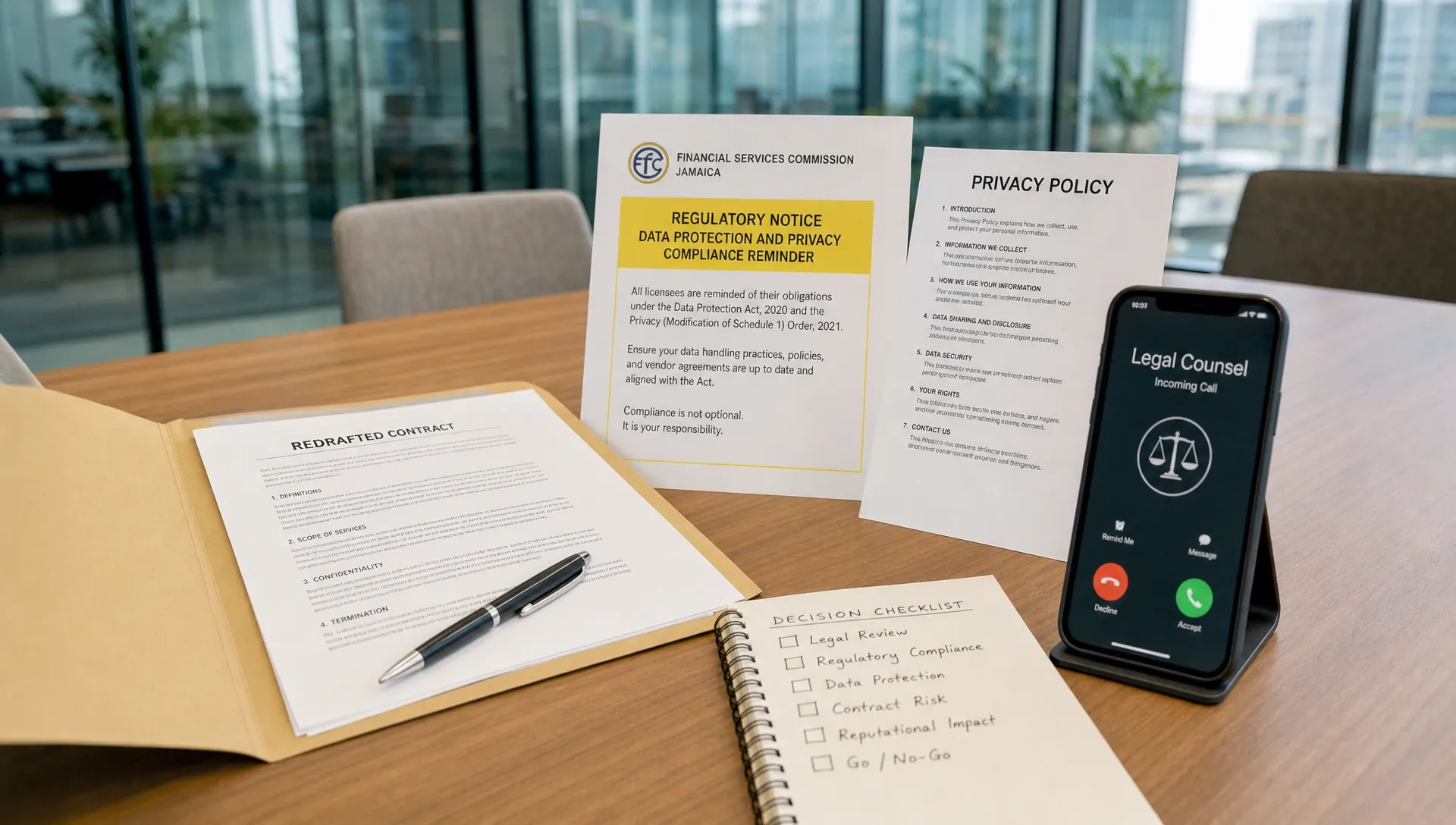
Business rarely waits for a perfectly scheduled legal consultation. A supplier changes a key term hours before signing. A regulator asks for information. A senior employee resigns with confidential material. A customer threatens to post damaging allegations online. A bank, landlord, investor, shipping agent, distributor, or technology vendor wants an immediate answer.
In those moments, the question is not simply, “Do we need a lawyer?” It is, “How quickly can we get practical legal input before this business decision becomes a legal problem?”
That is where law on call services can be valuable. For fast-moving companies in Jamaica and across the Caribbean, having responsive access to legal counsel helps management make decisions with more confidence, better documentation, and fewer avoidable surprises.
This article explains what law on call support can look like, when it is most useful, and how businesses can use it as part of a wider risk management strategy.
What “law on call” means for a business
Law on call does not mean every issue must become a full-scale legal matter. It means your business has a structured way to obtain timely legal guidance when a decision carries risk and delay may be costly.
In practice, this support may involve quick advice on documents, commercial negotiations, compliance questions, employment concerns, threatened disputes, data privacy issues, intellectual property use, or urgent communications. The goal is to help decision-makers understand the legal consequences of their options before they act.
The best use of law on call support is not panic-driven. It is a disciplined decision system. Instead of calling counsel only when a dispute has already escalated, management identifies high-risk moments early and seeks guidance while there is still room to negotiate, correct, pause, preserve evidence, or choose a safer route.
For businesses that want to understand the difference between urgent legal risk and ordinary operational friction, this guide on when to contact legal counsel for an urgent business matter is a useful companion.
Why fast decisions create legal exposure
Speed is often a competitive advantage. Businesses win contracts, secure financing, preserve relationships, and protect market share by acting quickly. But speed also compresses the time available to notice legal issues.
A rushed decision can create exposure in several ways. A contract may be signed without checking termination rights, liability caps, governing law, payment triggers, or dispute resolution clauses. An employer may respond to a workplace incident without preserving fairness, confidentiality, or proper procedure. A company may share customer data with a vendor before confirming privacy obligations. A director may approve a commercial step without considering corporate authority or shareholder expectations.
In Jamaica, commercial decisions may touch multiple areas of law at once, including contract law, employment law, company law, data protection, consumer protection, competition issues, banking arrangements, and litigation risk. A decision that appears operational can quickly become legal if it affects rights, obligations, evidence, reputation, or regulatory compliance.
Law on call services help businesses slow the legal risk without slowing the business itself.
Business decisions that benefit from rapid legal input
Not every decision requires counsel. However, certain situations should raise an internal flag because the cost of getting them wrong can be significant.
Business decision | Why legal input helps | Common risk if ignored |
Signing or amending a major contract | Clarifies obligations, remedies, liability, authority, and dispute terms | Unfavourable terms become binding before the risk is understood |
Responding to a threatened claim | Helps preserve evidence and avoid damaging admissions | Informal replies may weaken the business’s position |
Handling a workplace dispute | Supports fair process, proper documentation, and risk-aware communication | The matter may escalate into a formal claim or reputational issue |
Sharing customer, employee, or supplier data | Checks privacy, consent, security, and vendor obligations | Data protection exposure and loss of trust |
Launching advertising, promotions, or pricing changes | Reviews consumer, competition, and brand risk | Customer complaints, regulatory scrutiny, or misleading statements |
Negotiating cross-border arrangements | Reviews governing law, payment, tax, delivery, sanctions, and enforcement concerns | A foreign contract becomes difficult or expensive to enforce |
Dealing with urgent shipping or logistics issues | Assesses documentation, liability, deadlines, and commercial remedies | Losses increase while rights are missed or evidence disappears |
The value is not only in receiving an answer. It is in asking the right legal question before the business is locked into a course of action.
How law on call support should work in practice
Effective rapid legal support depends on preparation. If the business waits until the final hour and sends incomplete facts, even the best counsel may be limited in what can be assessed quickly.
A practical law on call approach usually has four parts.
Clear intake of the issue
The business should be able to summarise the issue in plain language. What decision must be made? By when? Who is involved? What documents exist? Has anyone already responded? Is there a deadline, hearing date, payment date, delivery date, board meeting, or regulatory timeline?
This first step prevents confusion and helps counsel determine whether the matter is a quick advisory question, a negotiation issue, a compliance concern, or a dispute that may require more formal action.
Fast risk triage
Not all risks are equal. Legal counsel can help separate urgent legal threats from manageable business risk. For example, a minor drafting issue in a low-value contract may not justify delaying a deal. A termination clause, confidentiality obligation, indemnity, data transfer, non-compete provision, or jurisdiction clause may deserve immediate attention.
Good triage helps management decide whether to proceed, pause, renegotiate, escalate internally, preserve evidence, or communicate under legal guidance.
Practical advice tied to business options
Business leaders do not need abstract legal theory in a time-sensitive moment. They need to understand their options and the likely consequences. The advice should help answer questions such as: What can we safely say? What should we avoid saying? What must be documented? What terms should be changed? What is the worst-case scenario? What is the commercial compromise?
The most useful legal advice is practical, proportionate, and connected to the decision in front of the business.
Documentation and follow-through
A fast conversation should still leave a record of the decision path. Where appropriate, management should document the facts considered, the options reviewed, the chosen approach, and any follow-up steps. This can matter later if the decision is questioned by a board, regulator, court, investor, insurer, employee, or commercial counterparty.
Documentation also helps recurring issues become preventable. If the same contract point, HR issue, data concern, or debt recovery problem keeps arising, the business may need a template, policy, training session, or more robust review process.
Information to have ready before calling counsel
The quality of urgent legal advice often depends on the quality of the information provided. Before contacting counsel, gather the essentials where possible.
The key contract, notice, email chain, policy, invoice, demand letter, court document, board paper, or regulatory correspondence.
A short timeline of what happened, including dates, names, deadlines, and any prior commitments.
The decision that must be made now, such as whether to sign, terminate, respond, pay, suspend, disclose, negotiate, or escalate.
The commercial objective, including what the business wants to protect, preserve, recover, avoid, or achieve.
Any internal constraints, such as board approvals, banking covenants, insurance requirements, customer commitments, or operational deadlines.
This preparation allows counsel to focus on the legal issues rather than spending the limited time reconstructing the facts.

Where law on call is especially useful
Fast legal access is most valuable when delay may change the business’s leverage. Several areas stand out for Jamaican and regional companies.
Contract negotiations and urgent amendments
Contracts are often finalised under pressure. A customer wants an immediate concession. A vendor sends revised terms at the last minute. A foreign counterparty insists on its preferred jurisdiction. A lender requires additional security. A distributor asks for exclusivity.
Law on call support can help identify which changes are commercially tolerable and which ones alter the legal risk profile. For international transactions, businesses should be especially careful with governing law, dispute resolution, payment terms, delivery risk, sanctions, tax responsibilities, and enforcement. If your company regularly trades across borders, this article on cross-border contracts highlights clauses worth reviewing before signature.
Dispute prevention and early response
Many disputes become more expensive because the first response was rushed. A business may admit liability unintentionally, threaten action it cannot legally take, destroy or overlook relevant evidence, or miss a procedural deadline.
Early legal input can help frame the response, preserve the record, assess settlement options, and decide whether litigation, arbitration, mediation, or commercial negotiation is the better path.
Employment and workplace decisions
Workplace matters often move quickly because they involve people, morale, confidentiality, and operational continuity. Decisions around suspension, dismissal, redundancy, contractor status, harassment complaints, restrictive covenants, or employee access to company information should be handled carefully.
A quick call before action is taken can help the business maintain fair process and avoid communications that create unnecessary exposure.
Data privacy and cyber incidents
Data privacy concerns are no longer only technology issues. They affect contracts, customer trust, vendor management, employee records, marketing, security, and incident response. If a business suspects unauthorised access, accidental disclosure, or improper use of personal information, the early steps matter.
Legal input can help determine what facts must be gathered, who should be notified internally, what communications should be controlled, and how to align the response with applicable obligations.
Intellectual property and brand protection
Fast-moving businesses often create and share content quickly. Marketing campaigns, software tools, product packaging, designs, trade names, confidential know-how, and online material can all raise intellectual property questions. A short review before launch may help avoid infringement risk or strengthen ownership rights.
Law on call advice may also assist when another party copies brand assets, misuses confidential material, or challenges your right to use a name, design, or commercial work.
Admiralty, shipping, and logistics issues
For businesses connected to shipping, imports, exports, ports, marine services, or cargo, timing can be critical. Documents, notices, delivery records, limitation periods, insurance obligations, and contractual remedies may need urgent attention. Prompt legal advice can help protect rights before commercial options narrow.
How to choose a law on call provider
The right legal partner should understand both urgency and judgment. Speed alone is not enough. A quick answer that misses the commercial context may create more risk than it solves.
When considering legal support for time-sensitive business decisions, look for counsel with relevant experience in commercial disputes, contracts, compliance, data privacy, intellectual property, employment-related risk, and industry-specific matters where necessary. The firm should also be able to communicate clearly with directors, executives, finance teams, HR, operations, and external stakeholders.
Businesses should ask practical questions before urgent issues arise. Who is authorised to request advice? What types of matters should be escalated immediately? What documents should be shared? Who within the business can approve settlement positions, contract changes, or litigation steps? What internal records should be kept?
This is also where preventive planning matters. Law on call services work best when combined with the right legal foundations, including contract templates, compliance policies, governance procedures, employee documents, data protocols, and dispute response plans. For a broader view of early legal support, see these legal services businesses need before problems escalate.
What law on call cannot replace
Law on call support is powerful, but it has limits. Some matters require deeper investigation, formal legal opinions, court filings, board resolutions, regulatory engagement, negotiations, or specialist review. A short call may identify the risk, but it may not resolve the entire issue.
It should also not be used to bypass proper governance. Directors and managers remain responsible for commercial decisions. Legal counsel can explain risks and options, but the business must decide based on its objectives, risk appetite, obligations, and available facts.
The best approach is to use rapid legal advice as an early warning and decision-support tool. If the issue is serious, the matter can then be escalated into a more comprehensive legal strategy.
Building a faster legal decision culture
A business that uses legal support well does not call counsel for every minor issue. It trains its team to recognise high-risk triggers.
Those triggers may include unsigned contracts with major obligations, threats of legal action, termination notices, customer complaints with reputational impact, employee disputes, suspected data incidents, regulatory correspondence, unusual payment terms, cross-border enforcement issues, and any situation where a written response may later be used as evidence.
Over time, law on call services can help management build better internal habits. Teams become more careful with written communications, more consistent with contracts, more aware of compliance obligations, and more prepared for disputes. The result is not a slower business. It is a more resilient one.
Frequently Asked Questions
What are law on call services? Law on call services provide businesses with timely access to legal guidance for urgent or time-sensitive decisions, such as contract negotiations, threatened disputes, compliance questions, employment issues, data privacy concerns, or commercial risk assessments.
Does every urgent business decision require a lawyer? No. Many operational decisions can be handled internally. Legal input is most important when the decision affects rights, obligations, liability, evidence, confidentiality, employees, regulators, customers, intellectual property, or significant financial exposure.
How quickly should a business contact counsel after receiving a legal threat? As soon as practical. Early advice can help preserve evidence, avoid harmful admissions, manage deadlines, and shape a response before the matter escalates.
Can law on call support help with cross-border business? Yes, rapid legal input can be particularly useful for cross-border contracts, payment risk, governing law, dispute resolution, delivery obligations, and enforcement concerns.
Is law on call a substitute for long-term legal planning? No. It is most effective when paired with preventive legal work such as strong contracts, policies, governance systems, compliance reviews, and dispute response procedures.
Make faster decisions with legal risk in view
Fast business decisions should not mean blind legal risk. Whether your company is negotiating a contract, responding to a dispute, managing a data concern, addressing an employment issue, or protecting commercial interests, timely legal guidance can help you act with clarity.
Henlin Gibson Henlin supports businesses with client-focused legal services across commercial litigation, compliance and risk, data privacy, intellectual property, arbitration and mediation, admiralty and shipping, appellate matters, and related areas of business law. If your organisation needs responsive legal support for important decisions, contact Henlin Gibson Henlin to discuss the right next step.