
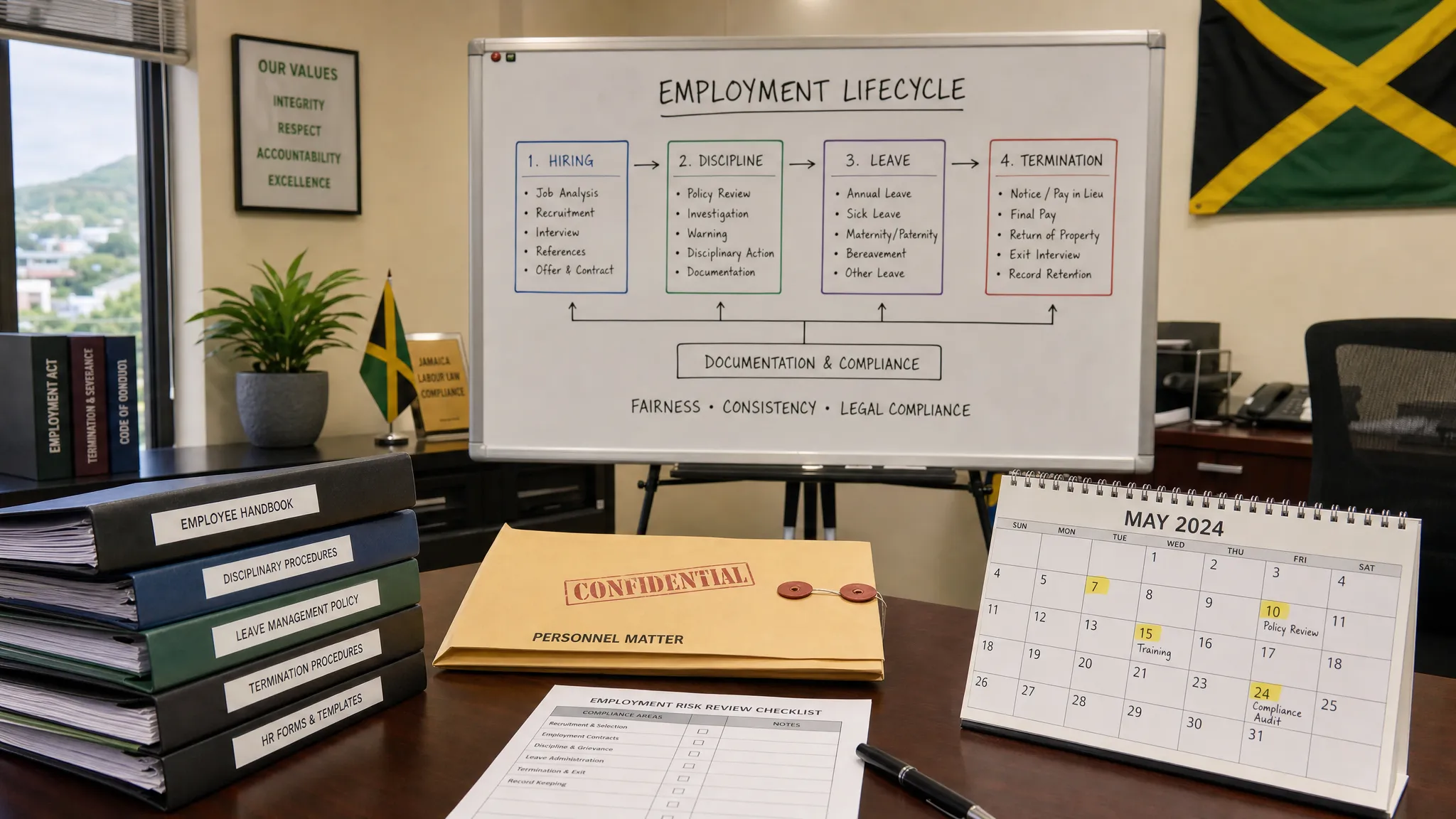
Employment decisions carry legal consequences long before a dismissal letter, redundancy meeting or workplace complaint. For Jamaican employers, good legal employment advice is not just about reacting when a dispute reaches the Ministry of Labour, the Industrial Disputes Tribunal or the courts. It is about building a defensible way to hire, manage, pay, discipline, protect data and end employment relationships.
This guide is general information, not a substitute for advice on your specific facts. Still, it highlights the areas where employers in Jamaica most often need legal judgement before taking action.
Why employment law should be treated as business risk management
Employment law in Jamaica is shaped by statute, common law principles, contracts, workplace policies, collective agreements and industrial relations practice. Key legislation includes the Employment (Termination and Redundancy Payments) Act, the Labour Relations and Industrial Disputes Act, the Holidays with Pay Act, the Minimum Wage Act, the Maternity Leave Act, the Data Protection Act and the Sexual Harassment (Protection and Prevention) Act.
Employers should also monitor official updates from the Ministry of Labour and Social Security and review legislation through Jamaica Laws Online where appropriate.
The practical point is simple: a workplace decision may be commercially sensible but legally risky if it is poorly documented, inconsistently applied or procedurally unfair. In employment disputes, the question is often not only what the employer decided, but how and why the employer got there.
A strong employer process helps answer three core questions:
Was there a lawful basis for the decision?
Was the process fair and consistent?
Is the employer able to prove what happened through records, policies and correspondence?
Start with the true working relationship
One of the most common employment law mistakes is assuming that a written label controls the legal outcome. Calling someone an independent contractor, consultant, freelancer or work-for-hire provider does not automatically make it so.
Jamaican employers should look at the reality of the relationship. Relevant factors may include who controls the work, whether the person can profit or suffer loss, whether they provide their own tools, whether they can work for others, how integrated they are into the business, and whether the arrangement looks like ongoing employment in practice.
Misclassification can create tax, benefits, termination, redundancy and dispute risks. It can also cause problems in regulated industries, outsourced arrangements and cross-border service models. If the role is continuous, supervised, integrated into the business and performed personally, the employer should get advice before treating the worker as a contractor.
For a deeper Jamaica-specific overview, see Henlin Gibson Henlin’s guide to employment law in Jamaica.
Use contracts that match the job, not generic templates
A written employment contract is one of the most important risk management tools an employer has. It should reflect the actual role, pay structure, reporting line, benefits, hours, location, confidentiality obligations and termination terms.
Generic templates often create two problems. First, they may omit Jamaica-specific requirements or practical details. Second, they may include clauses the employer does not understand, cannot enforce or never follows.
Employers should pay particular attention to:
Probation clauses, including duration, evaluation process and notice expectations
Duties and reporting lines, especially for senior staff or regulated roles
Compensation, commissions, allowances and bonus discretion
Confidentiality, intellectual property and return of company property
Data protection, monitoring and acceptable technology use
Disciplinary, grievance and termination procedures
Post-employment restrictions, where genuinely needed and reasonable
Restrictive covenants, such as non-compete or non-solicitation clauses, should be drafted carefully. The employer must usually show a legitimate business interest and reasonable limits in scope, duration and geography. Overbroad restrictions may be difficult to rely on when they are most needed.

Keep workplace policies practical and consistent
Policies are not useful if they sit unread in a staff handbook. They should guide real decisions. Employers should ensure that managers understand the policies they are expected to apply, especially on discipline, grievance handling, harassment, leave, technology use, confidentiality, data protection and remote work.
A policy can help the employer show consistency, but it can also become a liability if ignored. For example, if a disciplinary policy promises written allegations, a response period and an appeal, management should not bypass those steps simply because the matter feels urgent.
The best workplace policies are clear enough for staff to understand and flexible enough to deal with varied facts. They should also be reviewed when the business changes, such as after expansion, restructuring, new technology adoption or a shift to hybrid work.
Pay, leave and statutory obligations must be monitored
Payroll compliance is not just an accounting issue. It is a legal issue that affects trust, employee relations and dispute exposure.
Employers should stay current on minimum wage requirements, applicable wage orders, overtime arrangements, statutory deductions, contributions and leave obligations. This includes vacation leave, public holidays, maternity leave and any contractual benefits the employer has promised.
Because wage rates and administrative requirements may change, businesses should avoid relying on old templates or informal payroll habits. The finance team, HR team and legal advisers should be aligned on the current position.
A useful internal review is to compare what the contract says, what payroll actually does and what managers communicate to employees. Differences between those three can become evidence in a dispute.
Discipline should be fair, documented and proportionate
Disciplinary action is one area where employers often know the facts but mishandle the process. A fair process does not mean the employer cannot act firmly. It means the employer should avoid surprise, bias, inconsistency and unsupported conclusions.
Before imposing discipline, the employer should identify the alleged misconduct or performance issue, gather relevant evidence, give the employee a fair opportunity to respond, consider the explanation and decide on a proportionate outcome. Where policies, contracts or collective agreements provide additional steps, those steps should be followed.
Summary dismissal should be approached cautiously. Serious misconduct may justify urgent action, but employers should still document why the conduct was serious enough to end the relationship without ordinary notice or progressive discipline. Acting quickly is not the same as acting carelessly.
Termination and redundancy need early legal review
Termination is where weak employment practices become expensive. A dismissal may be challenged as wrongful, procedurally unfair, discriminatory, retaliatory or inconsistent with the employer’s own policy. Even where the employer has a valid concern, poor documentation can make the decision harder to defend.
Redundancy should also be handled carefully. A genuine redundancy usually concerns the role or business need, not a disguised performance issue. Employers should define the business rationale, identify the affected roles, apply objective criteria where selection is required and calculate statutory and contractual entitlements accurately.
Workplace situation | Why legal advice helps | Key documents to preserve |
Poor performance | Distinguishes capability issues from misconduct and supports a fair improvement process | Appraisals, warnings, targets, training records |
Misconduct | Helps assess whether discipline, suspension or dismissal is proportionate | Investigation notes, witness statements, policies, correspondence |
Redundancy | Tests whether the redundancy is genuine and payments are properly calculated | Business rationale, role charts, selection criteria, payment calculations |
Probation dismissal | Avoids the mistaken belief that probation means no rights at all | Contract, probation reviews, manager feedback |
Long illness or disability-related absence | Balances operational needs with fairness, benefits and possible accommodation issues | Medical certificates, communications, role requirements |
Senior executive exit | Manages confidentiality, reputation, authority, bonus and restrictive covenant issues | Service agreement, board minutes, settlement correspondence |
Employers should not wait until after the termination meeting to seek advice. By then, the most important decisions may already have been made.
Treat employee data as regulated information
Employee files contain sensitive personal information: identification documents, bank details, tax information, medical records, disciplinary notes, performance reviews, emails, CCTV footage and sometimes biometric data. Under Jamaica’s Data Protection Act, many employers will have obligations as data controllers.
Good employment practice now requires privacy thinking at every stage of the employee lifecycle. Employers should tell staff what data is collected, why it is used, who receives it, how long it is kept and what security measures apply. Monitoring tools, CCTV, email access, device management and cross-border HR platforms should be reviewed carefully.
The Office of the Information Commissioner provides information on Jamaica’s data protection framework. Employers building internal controls may also find value in a broader guide on building a data privacy framework.
Handle harassment and workplace complaints with seriousness
Workplace complaints can escalate quickly when employees believe management is dismissive, conflicted or inconsistent. Complaints involving sexual harassment, bullying, discrimination, victimisation or unsafe conditions should be handled with care.
Employers should have a clear complaint route, protect confidentiality as far as practicable, avoid retaliation and ensure that investigations are handled by appropriate persons. A manager who is personally involved in the dispute should not normally be the only decision-maker.
The legal risk is not limited to the original complaint. Retaliation, mishandled confidentiality, selective discipline or poor communication can create additional exposure. Even when a complaint is not substantiated, the employer should document the process and consider whether workplace training, reporting lines or policies need improvement.
Remote work and cross-border hiring create hidden issues
Many Jamaican businesses now work with employees, contractors, consultants and service providers across parish, regional and international lines. Remote and hybrid work can be commercially useful, but it also creates legal questions.
Employers should clarify where the employee is legally based, what law governs the contract, how working time is monitored, what equipment is provided, how confidential information is protected and whether any tax, immigration or work permit issue arises.
For foreign nationals working in Jamaica, work permit requirements should be considered before the person begins work. For Jamaican employees working abroad, the employer may need advice on local employment, tax and social security rules in the other jurisdiction.
Keep records before there is a dispute
Employers often underestimate the value of ordinary records. In a dispute, a well-kept file may be more persuasive than a manager’s memory.
Employment stage | Records employers should keep | Why it matters |
Recruitment | Job descriptions, interview notes, offer letters, right-to-work checks | Shows the basis of hiring decisions and role expectations |
Onboarding | Signed contract, policy acknowledgements, training records | Proves the employee received key terms and policies |
Performance management | Reviews, goals, feedback emails, support offered | Supports fairness in capability decisions |
Discipline | Allegations, evidence, meeting notes, outcome letters | Demonstrates process, reason and proportionality |
Leave and absence | Applications, approvals, medical certificates, return-to-work notes | Helps manage entitlements and attendance fairly |
Termination | Notice, payment calculations, exit correspondence, property return | Reduces uncertainty and supports compliance |
Recordkeeping should be accurate, secure and proportionate. Employers should avoid casual comments in emails or messaging apps that could later undermine the stated reason for a decision.
When employers should seek legal employment advice
Not every day-to-day management issue requires a lawyer. However, some situations justify early advice because the cost of getting them wrong is high.
Employers should consider legal advice before making decisions involving termination, redundancy, senior staff exits, workplace investigations, union or collective issues, harassment complaints, employee monitoring, cross-border hiring, independent contractor classification, restrictive covenants, sensitive medical information or large-scale policy changes.
The earlier the advice is obtained, the more options the employer usually has. Early advice can help structure the process, correct documentation gaps, reduce escalation and preserve the business relationship where possible.
For a more detailed discussion of timing, see Henlin Gibson Henlin’s article on when to seek legal advice on employment law.
Frequently Asked Questions
Does every employee in Jamaica need a written contract? A written contract is strongly recommended because it records the agreed terms and reduces disputes. Even where terms are partly oral or implied, a written agreement gives both employer and employee clearer expectations.
Can an employer dismiss someone during probation? Probation does not mean the employee has no rights. The contract, applicable law and basic fairness still matter. Employers should document probation reviews and give clear reasons before ending the relationship.
Is an independent contractor agreement enough to avoid employment obligations? No. The legal classification depends on the real working relationship, not only the label in the agreement. If the person works like an employee, the employer may face employment, tax and statutory obligation risks.
What should an employer do before making a role redundant? The employer should confirm the business reason, identify affected roles, consider selection criteria, check contracts and policies, calculate entitlements and plan communications. Legal review is especially important where multiple employees are affected.
Does Jamaica’s Data Protection Act apply to employee records? Employee records often contain personal data, so employers should assess their obligations under the Data Protection Act. Privacy notices, access controls, retention periods and vendor arrangements are important parts of compliance.
When is legal employment advice most urgent? It is most urgent before termination, redundancy, suspension, workplace investigations, harassment complaints, contractor classification decisions, employee monitoring or cross-border hiring. Advice after the fact may be less effective.
Need tailored employment guidance in Jamaica?
Employment law risk is rarely solved by a template alone. The facts, documents, workplace history and business context all matter.
Henlin Gibson Henlin is a leading international law firm in Jamaica with over 15 years of experience providing client-focused legal services. The firm assists clients across areas including compliance and risk law, civil and commercial litigation, data privacy, arbitration and related legal matters.
If your organisation needs practical guidance on employment contracts, workplace policies, investigations, redundancy, termination risk or employee data issues, contact Henlin Gibson Henlin for advice tailored to your circumstances.