
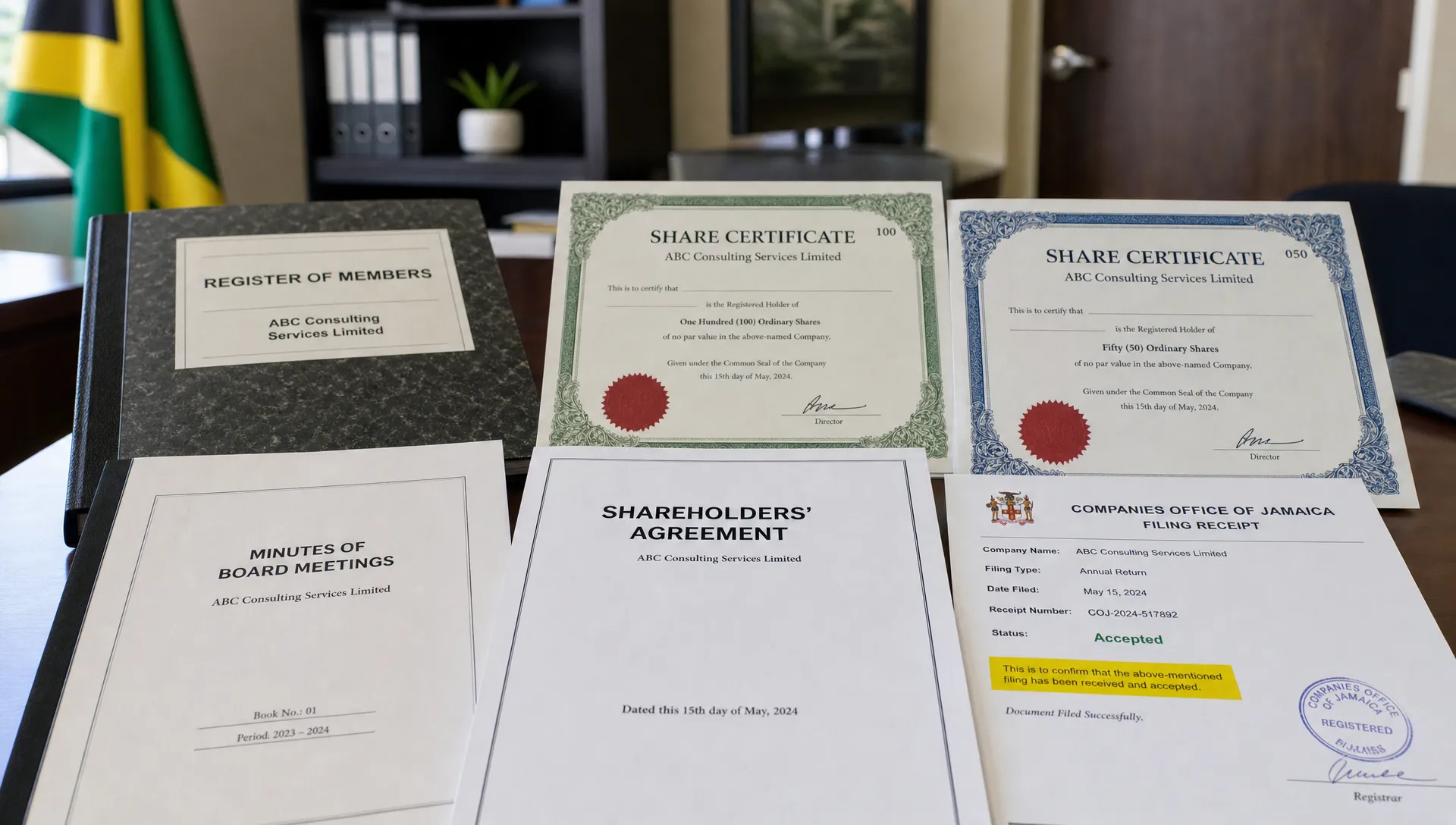
Shareholder disputes are often described as personal, strategic or commercial, but when the matter has to be resolved, the focus quickly turns to records. A shareholder may feel excluded from management. A director may say the board acted properly. A minority owner may suspect that profits have been diverted. In each case, documents usually decide whether the complaint is grounded in enforceable rights, poor communication or conduct that requires legal intervention.
For Jamaican companies, good records are not just administrative housekeeping. They are the evidence that shows who owns what, who had authority to act, how decisions were made and whether money moved through the company properly. When those records are incomplete, inconsistent or controlled by only one side, a shareholder dispute can become harder, more expensive and more disruptive.
This guide explains the records that tend to matter most when shareholders fall out, and how companies, directors and investors can preserve them before positions become entrenched.
Why records matter so much in shareholder disputes
Most shareholder disputes begin with competing narratives. One side may say there was an agreement about dividends, management roles or future share transfers. Another may say no such agreement existed, or that later events changed the position. Courts, arbitrators and mediators cannot resolve those disagreements by sentiment. They look for reliable evidence.
Records help answer four core questions:
Who had legal ownership and voting rights?
What powers did the directors, officers and shareholders actually have?
Were corporate decisions made in the correct way?
Did company funds, assets or opportunities move in a way that breached duties or agreements?
That is why shareholder disputes often overlap with wider commercial litigation risks Jamaican businesses should watch, especially where the conflict affects contracts, financing, employment, intellectual property or the sale of the business.
The earlier the relevant records are identified, the easier it becomes to assess the dispute realistically. A strong file can support negotiation, mediation, arbitration or court proceedings. A weak file may leave both sides arguing from memory, which rarely lowers cost or risk.
Governance records: proving ownership, control and authority
Governance records are usually the starting point. They show the company’s legal structure and the rules that bind shareholders and directors. In a dispute, these documents help determine whether a shareholder has been diluted, excluded, outvoted or treated contrary to agreed procedures.
The most important governance records usually include the company’s articles, incorporation documents, register of members, share certificates, shareholder agreements, board minutes, shareholder resolutions and statutory filings. These records should be checked against each other. A share certificate may say one thing, the register another and the last filed annual return something else. In that situation, the inconsistency itself becomes a key issue.
Record | What it helps prove | Why it matters in a dispute |
Articles of incorporation and company constitution documents | Voting rights, director powers, share classes and procedural rules | They establish the company’s internal rulebook |
Register of members | Legal ownership of shares and dates of entry | It is central to proving who is a shareholder |
Share certificates and share transfer forms | Evidence of issued or transferred shares | They help test whether ownership changes were properly documented |
Shareholder agreement | Special rights, exit terms, deadlock clauses and dispute procedures | It may override assumptions about how the company should be managed |
Board and shareholder minutes | Decisions, objections, approvals and attendance | They show whether decisions were properly made |
Written resolutions | Formal approvals outside meetings | They can confirm consent or reveal procedural gaps |
Companies Office filings | Public-facing corporate status and filed changes | They help verify appointments, returns and structural changes |
A common mistake is to assume that everyone knows the real ownership position because the business has been operating that way for years. In closely held companies, families and founder-led businesses, informal arrangements are common. They may work while relations are good, but they become fragile once trust breaks down.
Financial records: following the money
Financial records often decide whether a shareholder dispute is purely about control or whether it involves deeper concerns such as misappropriation, unfair benefit, breach of duty or improper related-party transactions. These records can also be central where a shareholder wants to exit and the main question is valuation.
Useful financial records include audited or unaudited financial statements, management accounts, general ledgers, bank statements, invoices, receipts, payroll records, dividend records, director loan accounts and tax filings. If the dispute involves a sale, merger or investment round, valuation reports, offer letters, term sheets and due diligence materials may also matter.
In many companies, the most revealing records are not the formal annual statements. They are the working documents beneath them. Bank reconciliations, supplier invoices, expense approvals and accounting entries can show whether money was used for legitimate business purposes or diverted to insiders. They can also show whether the company’s financial position was presented differently to different shareholders.
Financial records are especially important in disputes about dividends. A shareholder may believe profits should have been distributed, but the company may say cash was needed for working capital, debt repayment or expansion. The answer usually depends on the company’s accounts, board discussions and any agreement governing dividend policy.
Communications: proving what was known and agreed
Emails, letters, messaging app threads and meeting notices often explain the context behind formal records. They can show whether shareholders were given notice of meetings, whether objections were raised, whether a director disclosed a conflict or whether an informal agreement was later confirmed in writing.
Communications are particularly useful when one side alleges exclusion. If a shareholder says they were shut out of information, the evidence may include unanswered requests for accounts, meeting invitations sent without adequate notice, messages refusing access or internal emails showing that major decisions were made without consultation.
At the same time, communications must be handled carefully. Screenshots can be incomplete. Forwarded emails can omit attachments. Messaging app exports may lose context if they are not preserved properly. A dispute file should keep the full chain where possible, including dates, recipients, attachments and any replies.
Conduct records: what people actually did
Shareholder disputes are not limited to what documents say. Conduct also matters. Records of conduct help show whether the parties acted consistently with their stated rights and obligations.
For example, if a shareholder claims to have been a director in practice, records may show whether they signed contracts, approved payments, attended board meetings or represented the company to banks, regulators or customers. If another party claims a shareholder abandoned the business, records may show whether they continued contributing capital, working in the company or requesting information.
Conduct records may include signed contracts, bank mandates, access logs, correspondence with customers, regulatory submissions, office access records and approvals within accounting or project management systems. The point is not to collect everything. The point is to identify documents that connect conduct to the legal issues in dispute.
The records that matter most by dispute type
Different disputes require different evidence. A complaint about dilution is not built from the same records as a complaint about diverted revenue. A deadlock dispute depends heavily on decision-making records, while a valuation dispute requires deeper financial and commercial material.
Dispute type | Records likely to matter most | Practical focus |
Share dilution | Share register, allotment records, board approvals, shareholder resolutions and notices | Was the issue of shares authorised and properly recorded? |
Exclusion from management | Board minutes, meeting notices, emails, access records and director appointment documents | Was the shareholder entitled to participate and were they blocked? |
Dividend disagreement | Financial statements, cash flow records, dividend policies, minutes and resolutions | Were profits available and was the decision made properly? |
Misuse of company funds | Bank statements, invoices, ledgers, expense approvals and director loan accounts | Were payments legitimate business expenses or improper benefits? |
Related-party transactions | Contracts, invoices, conflict disclosures, board approvals and valuation evidence | Were insiders dealing fairly with the company? |
Deadlock | Shareholder agreement, articles, voting records, meeting minutes and correspondence | Is there a contractual or statutory route to break the impasse? |
Exit or buyout | Financial statements, valuation reports, offers, forecasts and transaction records | What is the fair value and what date should be used? |
Breach of shareholder agreement | Signed agreement, amendments, notices, waivers and correspondence | Which obligations were binding and were they breached? |
This mapping exercise helps prevent wasted effort. Instead of gathering every file in the company’s possession, the parties can focus on the records that answer the real legal and commercial questions.

Red flags that records may become contested
Shareholder disputes become more difficult when records appear incomplete or have changed after the conflict began. Not every gap proves wrongdoing. Small companies often have imperfect administration. Still, certain patterns should be treated seriously.
Common red flags include unsigned minutes, missing resolutions, unexplained changes in the share register, backdated documents, payments without invoices, large director loan balances, inconsistent financial reports and key communications held only on personal devices. Another concern is selective disclosure, where one shareholder receives financial or operational information that others do not.
A sudden rush to tidy up records after a dispute arises can also create problems. If documents are recreated, corrected or supplemented, the process should be transparent. Quietly replacing records may damage credibility, even where the original intention was to fix an administrative error.
Preserving records before the dispute escalates
Once a shareholder dispute is reasonably anticipated, parties should avoid deleting, altering or selectively preserving records. Preservation is not limited to formal company documents. It also covers emails, messaging apps, cloud folders, accounting systems, laptops, phones and physical files.
A sensible preservation plan starts by identifying who controls relevant records. That may include directors, the company secretary, accountants, auditors, bankers, payroll providers, IT administrators and external advisers. If the company uses cloud accounting or shared drives, access permissions should be reviewed so that records are not lost or overwritten.
Where litigation or arbitration is possible, the structure of the evidence file matters. Chronology, document source and authenticity can become as important as the document itself. For a deeper look at organizing records for formal proceedings, see this practical guide on building a better evidence file for court.
How to build a practical shareholder dispute file
A good dispute file should help a lawyer, mediator, arbitrator or judge understand the story without guessing. It should separate agreed facts from disputed facts and connect each major allegation to documents.
A practical file usually includes:
A chronology of key events, including incorporation, investments, share issues, disputes and major decisions
A list of shareholders, directors and officers with dates of appointment or removal
Copies of constitutional documents, shareholder agreements and amendments
Registers, share certificates, transfer documents and Companies Office filings
Board and shareholder minutes, notices and written resolutions
Financial statements, ledgers, bank records, tax documents and management accounts
Key communications, including requests for information and responses
A short issues list explaining what each side says the dispute is about
The file should not be edited to hide difficult documents. Bad facts do not disappear because they are left out of a bundle. They tend to surface later, at a worse time. A complete file allows legal advisers to assess risk early and develop a strategy that fits the evidence.
Choosing the right route: negotiation, mediation, arbitration or court
Not every shareholder dispute should go straight to court. Some can be resolved through negotiation, especially where the parties still share an interest in keeping the business alive. Mediation can be useful where relationships are strained but a commercial compromise is possible, such as a buyout, governance reset or information access protocol.
Arbitration may be required if the shareholder agreement contains an arbitration clause. It may also be attractive where confidentiality, specialist decision-makers or cross-border enforceability matter. Court proceedings may be necessary where urgent injunctions, company remedies, disclosure orders or binding public determinations are needed.
The records still matter whichever route is chosen. A party with organized records is better placed to negotiate from strength, narrow the issues and avoid overclaiming. If you are weighing procedure and strategy, this guide to choosing between arbitration and litigation explains the practical differences.
What directors should remember
Directors involved in a shareholder dispute must be careful not to treat company records as personal property or tactical leverage. Company documents belong to the company, even if one shareholder or director has physical or digital control of them. Directors should also consider their duties to the company when responding to information requests, approving transactions or changing corporate records during a dispute.
Where a director is also a shareholder, the roles should be kept distinct. A decision that benefits the director as shareholder may still need to be justified as a proper company decision. Minutes, conflict disclosures, approvals and financial support for the decision become essential.
Directors should also avoid informal side communications that contradict formal company actions. If a major decision is being made, the record should show what information was considered, who participated, who objected and what was approved.
Frequently Asked Questions
What is the most important record in a shareholder dispute? The register of members is often central because it helps prove who legally owns shares. That said, the most important record depends on the dispute. A dilution claim may turn on allotment documents, while a misappropriation claim may depend on bank records and ledgers.
Can emails and WhatsApp messages be used in a shareholder dispute? Yes, communications can be relevant if they help prove notice, consent, objections, agreements or knowledge. They should be preserved in full where possible, with dates, participants, attachments and surrounding context.
What if the company’s records are incomplete? Incomplete records do not automatically decide the dispute, but they can create evidential problems. Other documents, such as bank records, accounting files, Companies Office filings, emails and third-party correspondence, may help reconstruct what happened.
Should shareholders request records before taking legal action? In many cases, yes. A focused request can clarify the dispute and may avoid unnecessary proceedings. The request should be specific and should consider the shareholder’s legal rights, the company’s obligations and any confidentiality concerns.
Can a shareholder dispute be resolved without going to court? Many disputes can be resolved through negotiation, mediation or arbitration, depending on the company documents, shareholder agreement and urgency of the issues. Court may still be needed where there is a need for urgent relief, disclosure or binding remedies.
Speak with counsel before the record is lost
Shareholder disputes move quickly once trust breaks down. Records may disappear, memories may shift and business decisions may continue while the dispute is unresolved. Early legal advice can help identify the records that matter, preserve evidence and choose a proportionate route to resolution.
Henlin Gibson Henlin advises on commercial litigation, arbitration, mediation, compliance and related business disputes in Jamaica. If a shareholder conflict is developing, seek guidance before taking steps that could affect your rights, your company’s records or the value of the business.