
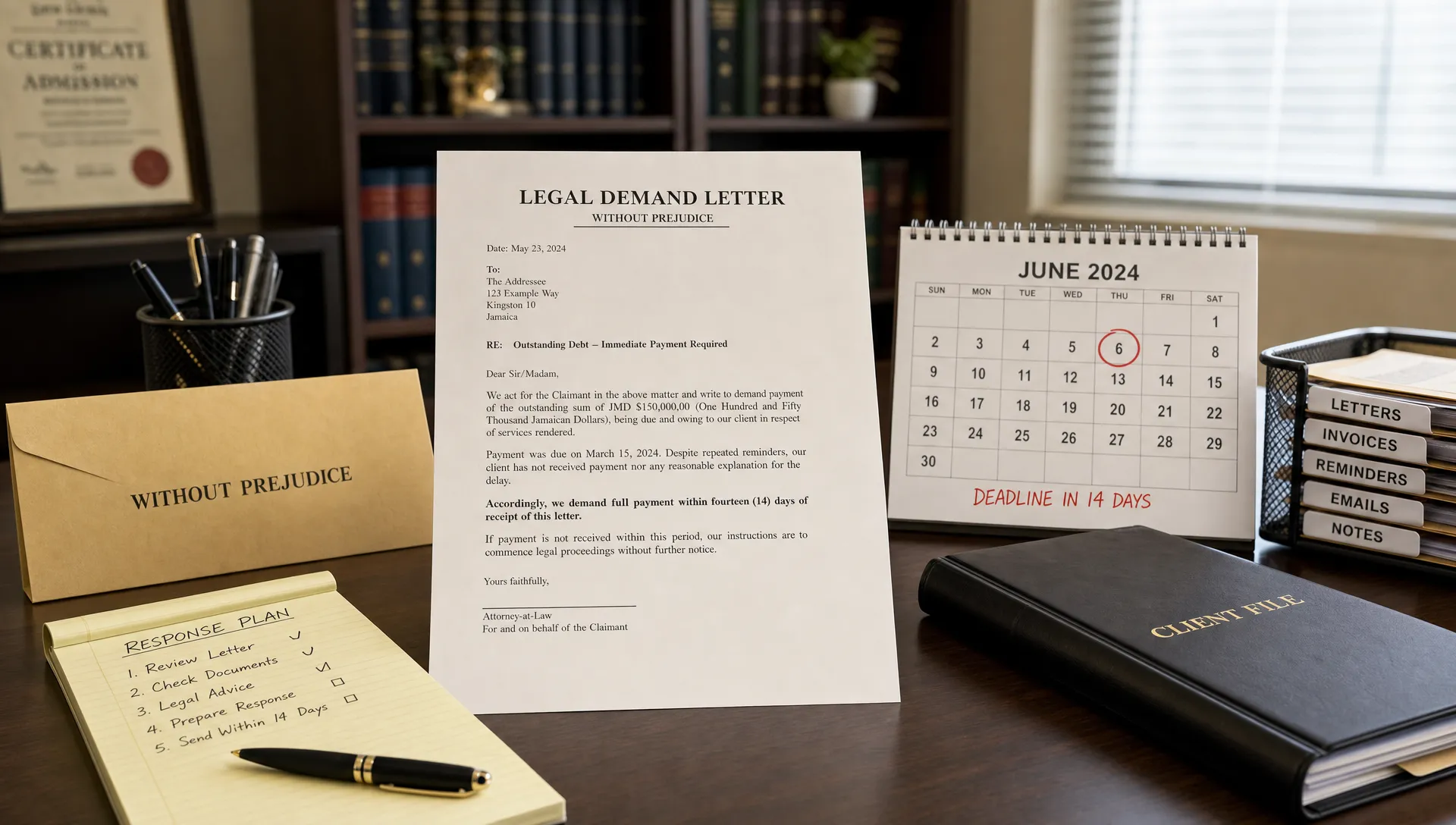
Receiving a legal demand letter can create immediate pressure. It may demand payment, threaten court proceedings, require you to stop certain conduct, ask for documents, or insist that you meet a short deadline. The worst response is usually an emotional one. The second worst is no response at all.
A demand letter is not always the start of a lawsuit, but it is often a sign that a dispute has become serious. Your reply can affect negotiations, your evidence, your insurance position, and any later litigation. This guide explains the practical steps to take after receiving a legal demand letter in Jamaica, whether you are an individual, director, business owner, professional, employer, contractor, or creditor.
This article is general information only and is not a substitute for legal advice on your specific facts.
What a legal demand letter is, and what it is not
A legal demand letter, sometimes called a letter before action, is a written notice asserting a claim and demanding that the recipient do or stop doing something. It may come from an individual, a company, a government body, a lawyer, a debt collector, an insurer, or another authorised representative.
Common demands include payment of a debt, performance of a contract, delivery of goods, return of property, removal of allegedly defamatory statements, cessation of trade mark or copyright use, compensation for alleged negligence, or compliance with employment, data protection, real estate, banking, consumer, or commercial obligations.
A demand letter is usually not a court order. It does not automatically mean that judgment has been entered against you. However, it should be treated seriously because it may be used to show that you were notified of the dispute before formal proceedings began.
Document received | What it usually means | Why it matters |
Demand letter or letter before action | Someone is asserting a claim and asking you to resolve it before filing proceedings | You have a chance to assess, respond, negotiate, or correct misunderstandings |
Claim form, fixed date claim form, or other court document | Court proceedings may already have started | Court deadlines can be strict and should be addressed immediately |
Statutory, regulatory, or enforcement notice | A specific legal or regulatory process may be underway | The consequences may be different from an ordinary private dispute |
Email or informal message threatening legal action | A dispute may be developing, even if the format is informal | Preserve evidence and avoid casual admissions |
If there is any uncertainty about whether the document is merely a demand or an actual court document, get legal advice immediately.
What to do in the first 24 to 48 hours
The first two days are about protecting your position. You do not need to solve the entire dispute instantly, but you should stop the situation from becoming worse.
Record the date and method of receipt: Keep the envelope, courier receipt, email header, WhatsApp message, or other proof showing when and how the letter arrived.
Identify the deadline: Note whether the letter gives you 24 hours, 7 days, 14 days, or another period to respond.
Do not admit liability: Avoid saying you are at fault, promising payment, or accepting the claimant’s version of events before you understand the legal and factual position.
Do not destroy or alter documents: Preserve emails, contracts, invoices, bank records, call logs, photographs, messages, internal memos, and relevant files.
Avoid public commentary: Do not post about the dispute on social media or discuss it casually with third parties.
Check insurance and contracts: Some policies and agreements require prompt notification of claims or threatened claims.
If the deadline is very short, it may be appropriate to send a brief holding response acknowledging receipt and requesting time to review the matter. Even that response should be carefully worded, especially if the demand involves a substantial sum, reputational risk, employment issues, intellectual property, banking litigation, data privacy, or commercial litigation in Jamaica.
Verify who sent the letter and what they are claiming
Before you respond on the merits, confirm that the letter is genuine and that the sender has authority to act. Fraudulent demands, exaggerated threats, and mistaken identity claims do happen.
Look for the name of the claimant, the sender’s contact details, the basis of their authority, the alleged facts, the amount demanded, the remedy requested, and any documents relied on. If payment instructions are included, verify them independently before sending money. Do not rely only on bank details contained in an unexpected email.
A useful demand letter usually answers these questions: Who is making the claim? What exactly are they alleging? When did the issue arise? What law, contract, or obligation do they rely on? What do they want from you? What happens if you do not comply? What evidence supports the demand?
If the letter does not provide enough detail, that may shape your response. You may need to request particulars, supporting documents, calculations, proof of authority, or clarification of the legal basis for the demand.
Build a clear timeline and preserve evidence
Once you understand the allegation, create a factual timeline. This should be concise, chronological, and supported by documents. Include dates of meetings, calls, invoices, payments, deliveries, site visits, complaints, warnings, emails, amendments, and any settlement discussions.
Evidence preservation is especially important because disputes often turn on details that seem minor at first. A single email, contract clause, shipping document, purchase order, bank record, employment warning letter, or data access log can change the legal position.
If you may later need to file a claim or counterclaim, the same preparation becomes important. Henlin Gibson Henlin has also addressed the steps to consider before filing a civil claim in Jamaica, including clarifying the legal basis, preserving evidence, and considering the proper forum.
Different disputes require different evidence. A contractual payment demand may turn on invoices and delivery records. An employment dispute may depend on policies, disciplinary records, emails, and termination documents. An intellectual property dispute may require proof of ownership, dates of use, licences, and marketplace activity. A data protection issue may require access logs, incident reports, privacy notices, and correspondence with affected persons.

Assess the legal and commercial risk before replying
Not every demand letter has legal merit. Some letters overstate the claim, omit relevant facts, or demand more than the law would likely allow. Others are serious and should be resolved quickly. The key is to assess both legal risk and practical risk.
Consider the amount at stake, the strength of the documents, whether the dispute could damage reputation, whether business operations may be disrupted, and whether the matter could escalate to court, arbitration, mediation, regulatory action, or an injunction.
Also review any contract terms that may affect the next step. Many commercial contracts contain notice requirements, dispute resolution clauses, governing law provisions, limitation of liability clauses, indemnities, confidentiality obligations, and arbitration or mediation procedures. Missing these terms can lead to a response that sounds reasonable but weakens your legal position.
Issue to check | Why it matters | Practical next step |
Deadline in the letter | Short deadlines can pressure you into mistakes | Ask whether more time is needed and whether a holding reply is appropriate |
Contract terms | The agreement may set the forum, process, or limits of liability | Review the contract before discussing settlement |
Limitation periods | Timing can affect whether a claim is enforceable | Avoid admissions or part payments without advice |
Insurance cover | Some policies require notice of claims or threatened claims | Notify insurers or brokers promptly where required |
Evidence strength | Documents may confirm, weaken, or defeat the demand | Preserve and organise records before responding |
Reputational exposure | Some disputes involve public allegations or sensitive relationships | Keep communications controlled and confidential |
Choose the right response strategy
There is no universal template for responding to a legal demand letter. A strong response depends on the facts, the law, the relationship between the parties, and your commercial objectives.
Your options may include complying with the demand, rejecting it, making a partial offer, requesting more information, proposing mediation, asserting a counterclaim, notifying an insurer, or asking for more time. In some cases, a carefully drafted response can resolve the dispute without proceedings. In others, it can narrow the issues and prepare the ground for litigation.
Response option | When it may fit | Risk if handled poorly |
Pay or comply in full | The demand is valid, affordable, and supported by evidence | You may fail to obtain a proper release or settlement record |
Deny liability | The claim is factually wrong or legally weak | A hostile denial without evidence may escalate the dispute |
Request particulars | The letter is vague or unsupported | Delay may be misread as avoidance if not communicated properly |
Make a without prejudice offer | Settlement is commercially sensible but liability is disputed | Labels and wording matter, and they should not be used casually |
Propose mediation or arbitration | The relationship matters or the contract requires alternative dispute resolution | The wrong forum or process may waste time and cost |
Notify insurer or indemnifier | The claim may be covered by insurance or another party’s indemnity | Late notice can create coverage problems |
Settlement communications should be drafted with care. Terms such as without prejudice, subject to contract, and full and final settlement can be useful, but they do not magically fix a poorly drafted response. If a settlement is reached, it should clearly identify the parties, the payment or action required, the deadline, whether liability is admitted or denied, confidentiality terms if appropriate, and the scope of the release.
Special considerations for businesses in Jamaica
For a business, a demand letter is not just a legal document. It can affect cash flow, customer relationships, regulatory obligations, staff morale, banking relationships, and board decision making.
Assign one person to coordinate the response, usually with legal input. Tell relevant employees to preserve documents. Avoid multiple staff members speaking separately with the claimant. If the issue involves a customer, supplier, lender, employee, competitor, shipper, data subject, or regulator, ensure the response is consistent with existing contracts and compliance obligations.
Businesses should also consider whether the dispute exposes a deeper issue. A demand letter may reveal weak contract wording, poor record keeping, unclear approval processes, inadequate data protection controls, or unmanaged credit risk. That is why preventive legal support can be valuable before disputes escalate. For a broader business risk perspective, see this discussion of legal services businesses may need before problems escalate.
Common mistakes to avoid after receiving a demand letter
Many disputes become harder to resolve because of what happens after the letter arrives. Avoiding a few common errors can preserve leverage and reduce cost.
Mistake | Why it can hurt you | Better approach |
Ignoring the letter | Silence may encourage the sender to file proceedings | Acknowledge receipt where appropriate and seek advice |
Replying angrily | Emotional language can be quoted later | Keep communications factual and measured |
Admitting fault too early | Admissions can affect negotiation and litigation strategy | Investigate first and use careful wording |
Making a part payment without advice | It may affect legal rights or limitation arguments | Get advice before paying disputed sums |
Deleting messages or documents | It can damage credibility and create evidential problems | Preserve all relevant material |
Letting too many people respond | Inconsistent messages can weaken your position | Centralise communications |
Treating a court document like a demand letter | Court deadlines may already be running | Obtain urgent legal help |
The aim is not to be difficult. The aim is to respond in a way that is accurate, strategic, and proportionate.
What a good response usually includes
A good response is clear, controlled, and tailored. It does not need to be aggressive to be firm. It should show that the matter has been considered seriously and that your position is supported by facts.
A well prepared response often includes these elements:
Acknowledgement of receipt: Confirm that the letter has been received without admitting liability.
Reservation of rights: Make clear that no rights, remedies, or defences are waived.
Clarification of facts: Correct inaccurate statements and identify missing information.
Document requests: Ask for contracts, invoices, calculations, photographs, notices, or other material needed to assess the claim.
Your position: State whether the demand is accepted, denied, or under review.
Proposed next step: Suggest payment terms, a meeting, mediation, further disclosure, or another process if appropriate.
Controlled deadline: If more time is required, give a realistic date for a substantive response.
Do not copy a generic online template without adapting it. Demand letters differ widely across debt recovery, commercial litigation, employment law, consumer rights, intellectual property law, real estate disputes, data protection matters, admiralty and shipping claims, and banking litigation.
When to hire a litigation attorney
You should consider legal advice immediately if the letter threatens court proceedings, demands a significant sum, alleges fraud or dishonesty, involves confidential information, seeks an injunction, raises employment termination issues, concerns intellectual property, relates to regulated data, involves a bank or lender, affects real estate, or has cross-border or shipping implications.
Legal advice is also important if you are unsure whether to respond, whether to settle, whether to counterclaim, or whether the sender’s deadline is reasonable. A litigation attorney can assess the claim, identify defences, preserve evidence, draft a response, negotiate settlement, and prepare for proceedings if necessary. If you want more context on that role, this guide explains what litigation attorneys do and when to hire one.
Early advice often costs less than repairing a damaging admission, missed deadline, or poorly documented settlement.
Frequently Asked Questions
Is a legal demand letter the same as being sued? No. A demand letter usually comes before court proceedings, but it may signal that proceedings are being considered. If you receive a claim form or other court document, treat it as urgent and seek legal advice immediately.
Should I respond to a demand letter if I think the claim is false? Usually, yes. A careful response can deny inaccurate allegations, request evidence, and preserve your rights. Ignoring a false claim may allow the dispute to escalate unnecessarily.
Can I call the person who sent the letter? You can, but it may not be wise without preparation. Spoken statements can be misunderstood or later relied on. For serious disputes, written communication through counsel is often safer.
What if I cannot pay the amount demanded? Do not simply promise payment if you dispute the claim or cannot meet the deadline. You may be able to negotiate a payment plan, request documents, dispute part of the amount, or explore settlement terms.
What does without prejudice mean in a response? It is commonly used for genuine settlement discussions to help prevent those communications from being used as admissions in court. The label should be used correctly and is not a substitute for proper legal advice.
How quickly should I contact a lawyer? Contact a lawyer as soon as possible if the deadline is short, the amount is significant, the matter affects your business or reputation, or there is any chance that court proceedings have already started.
Need help responding to a legal demand letter?
A demand letter is a moment to slow down, assess the facts, and respond strategically. Henlin Gibson Henlin provides client-focused legal services in Jamaica across civil and commercial disputes, arbitration and mediation, compliance and risk, intellectual property, banking litigation, appellate work, and related practice areas.
If you have received a legal demand letter and need to understand your options, consider speaking with Henlin Gibson Henlin before you respond.