
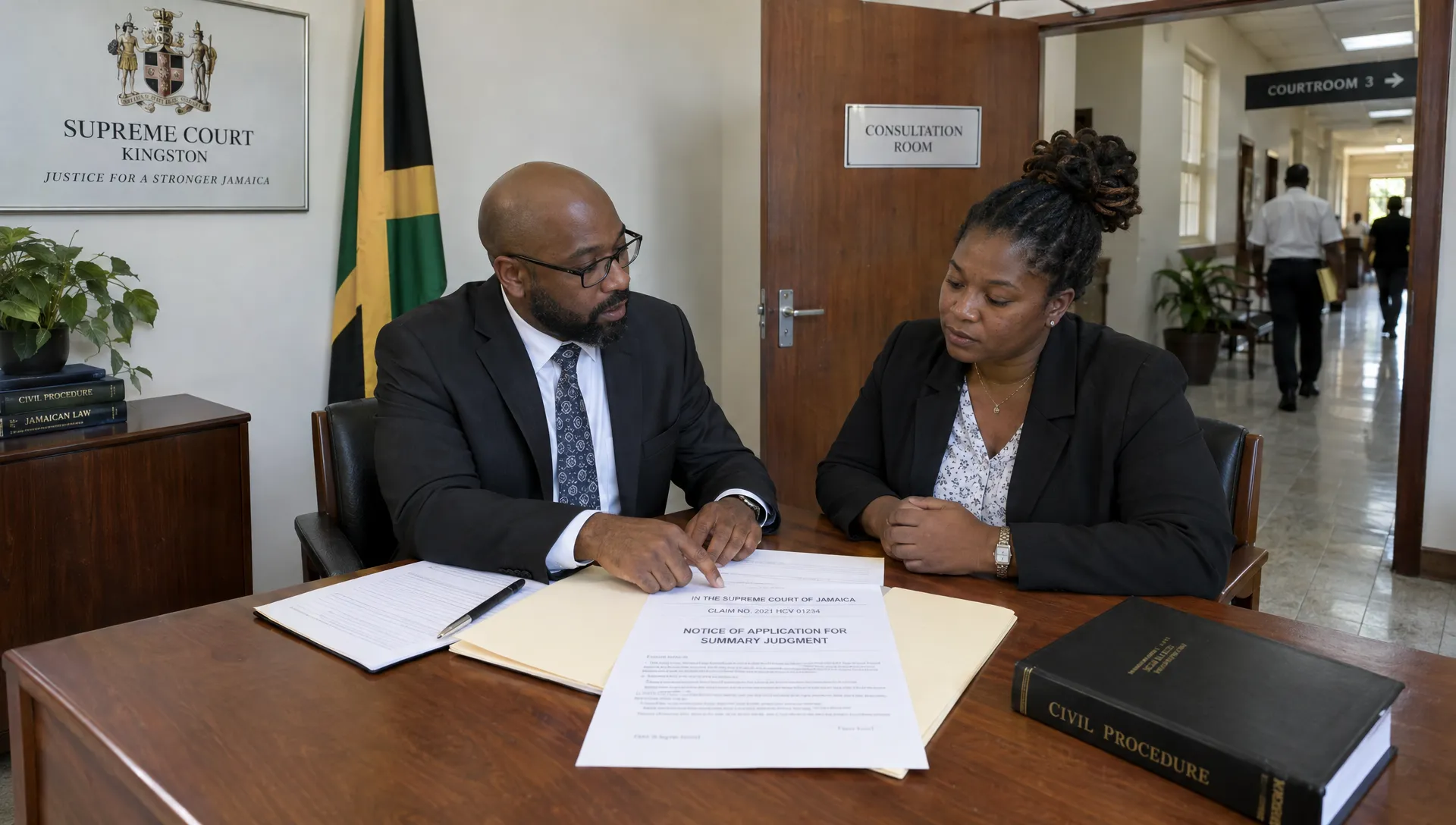
A Jamaican court can grant summary judgment where the applicable rules permit it and a claimant has no real prospect of succeeding on a claim or issue, or a defendant has no real prospect of successfully defending it. The procedure allows the court to resolve a case, or part of it, without a full trial. It does not mean that every apparently strong claim qualifies for an early judgment.
For businesses and individuals involved in litigation, the distinction matters. An unpaid invoice may appear straightforward but conceal a genuine dispute about performance. Equally, filing a defence does not guarantee a trial if that defence has no realistic basis.
This article focuses on civil proceedings in the Supreme Court of Jamaica under the Civil Procedure Rules (CPR). Different procedures may apply in other courts or specialist proceedings.
The legal test for summary judgment in Jamaica
Rule 15.2 of the CPR is the starting point. It permits judgment on a claim or a particular issue where the court considers that the claimant has no real prospect of succeeding, or the defendant has no real prospect of successfully defending.
The procedure is available to both sides. A claimant may seek judgment against an unsustainable defence. A defendant may seek judgment against a claim that has no real prospect of success.
The Privy Council considered the application of Jamaica’s rules in Sagicor Bank Jamaica Limited v Taylor-Wright [2018] UKPC 12. That decision is an important reference when assessing whether the pleaded case and supporting material meet the threshold under Part 15.
The question is not simply which party seems more likely to win. It is whether the opposing claim or defence has a realistic prospect of succeeding.
A real prospect is more than an assertion
A party resisting an application does not have to prove its entire case at the hearing. It must, however, identify a realistic basis on which its claim or defence could succeed.
For example, a debtor’s statement that “the amount is wrong” may carry little weight without an explanation. Identifying a specific payment, producing its receipt and explaining how it affects the balance presents a materially different case.
The applicant must establish the basis for judgment. The respondent’s task is not to demonstrate that victory at trial is certain, but to show why the case should not be disposed of summarily.
The hearing must not become a substitute trial
The court can examine the evidence critically. A factual assertion does not become a genuine trial issue merely because someone puts it in an affidavit.
Nevertheless, an application is not an invitation to conduct a full trial on paper. Where an outcome depends on resolving material conflicts in witness evidence, assessing credibility or examining evidence realistically expected to become available, a trial may be necessary.
The distinction is between a dispute that could affect the result and an unsupported disagreement that does not provide a realistic answer to the case.
Is the procedure available in every civil case?
No. Rule 15.3 contains exclusions, so the type of proceedings must be checked before an application is made. Part 15 should not be treated as a universal route for disposing of every Jamaican court matter.
There are also procedural requirements governing when an application may be made, how it must be served and how supporting and opposing evidence must be provided. A sound argument on the merits does not excuse non-compliance with those requirements.
Filing a defence does not itself prevent an application. The court may still assess whether that defence has a real prospect of success before the case reaches trial.
For context on where an application fits within a claim, understanding how civil litigation works in Jamaica helps distinguish this procedure from disclosure, witness preparation and the eventual trial.
Disputes that may justify an application
The following examples illustrate the assessment. They are not predictions about how a court would decide a particular case.
An unpaid commercial debt
A creditor may have a signed agreement, evidence of delivery, invoices and correspondence acknowledging the outstanding balance. If the debtor identifies no realistic contractual or factual answer, an application may be appropriate.
The position changes if the debtor produces credible evidence of payment, an agreed variation or a legally relevant set-off. The issue is whether that material could support a successful defence, not whether the creditor finds it persuasive.
Before applying, a creditor should also consider the practical questions involved in debt recovery in Jamaica, including whether a judgment is likely to be collectible.
A contract dispute turning on clear documents
Some disputes depend principally on the meaning of a written agreement and undisputed documents. A court may be able to determine a decisive issue without hearing extensive witness evidence.
A difficult legal question does not automatically require a trial. Conversely, a seemingly simple contract may involve material disputes about an oral variation, acceptance of performance or the authority of the person who acted.
The applicant must explain why the issue can properly be resolved on the available material.
A claim facing a decisive legal obstacle
A defendant may seek early judgment where the claim cannot succeed as a matter of law. A limitation defence, for example, may be suitable if the relevant dates and applicable legal rules are clear and not genuinely disputed.
If the parties disagree about when the cause of action arose or whether a recognised exception applies, further examination may be necessary. Calling a claim “out of time” is not enough without establishing the facts and legal basis for that conclusion.
What evidence should support or resist the application?
The evidence should address the disputed issue directly. A large bundle is not necessarily a persuasive one. The court needs a clear explanation connecting the relevant facts to the legal test.
For an applicant, useful material may include:
The governing agreement: The contract, relevant terms and any documented amendments.
Contemporaneous records: Invoices, delivery confirmations, payment records or correspondence showing what happened.
Affidavit evidence: A properly supported account explaining the material facts and identifying the relevant documents.
An explanation of the opposing case: Why the pleaded claim or defence lacks a real prospect of success.
An affidavit should make the basis of its statements clear. Where information comes from records or another person rather than the witness’s direct knowledge, the applicable evidential requirements must be observed.
For a respondent, the strongest approach is to identify the precise issue requiring a trial. Rather than saying that “facts are disputed”, explain which fact is disputed, what supports the alternative account and why it could change the outcome.
If further disclosure is needed, identify the documents or categories sought and their expected relevance. A general hope that something helpful might emerge is different from explaining that identified records could establish a disputed payment or contractual instruction.
How does the application proceed?
An application normally involves a formal notice setting out the relief sought, supporting evidence and legal submissions addressing the relevant rules. The application and evidence must be filed and served in accordance with the CPR and any court directions.
The respondent should check the hearing date and applicable deadlines immediately. Preparing a response may require locating records, taking witness instructions and obtaining advice on the legal issues. Do not assume that the timetable for the main claim also governs the application.
At the hearing, the court considers the claim, defence and relevant evidence against the Part 15 test. The available outcomes depend on the application and the court’s powers. They may include judgment on the whole claim, judgment on a particular issue or refusal of the application with directions for the proceedings to continue.
If liability is resolved but the amount recoverable remains undecided, further proceedings may still be needed to assess damages. An early determination therefore does not always conclude every aspect of the dispute.

How does it differ from default judgment and striking out?
These procedures can all bring proceedings to an early end, but they address different problems.
Procedure | Central question | Practical distinction |
Summary judgment | Does the claim or defence have a real prospect of success? | The court assesses the merits under Part 15 without a full trial. |
Default judgment | Has a party failed to take a required procedural step, such as filing an acknowledgment of service or defence? | Availability depends on the default and the applicable rules. |
Striking out | Does the statement of case or conduct of proceedings justify removal under the relevant rules? | Grounds can include inadequate pleading, abuse of process or procedural non-compliance. |
Summary judgment can be relevant even where the defendant has responded to the proceedings. Default judgment addresses a different situation, and the rules for challenging it are also different.
If judgment has already been entered because of a failure to respond, the appropriate question may instead be how to set aside a default judgment in Jamaica.
An attorney should identify the correct procedural route rather than treating these applications as interchangeable.
The commercial risks of seeking an early judgment
An application may reduce the time and expense of a full trial, particularly where the decisive evidence is clear. It can also narrow the issues and help the parties reassess settlement.
However, an unsuccessful application adds expense and may result in an adverse costs order. It can also require a party to commit to evidence and arguments earlier than it otherwise would.
Before proceeding, assess three matters: whether Part 15 is available, whether the evidence meets its threshold and whether the application makes commercial sense. A strong case is not necessarily a suitable case for this procedure if resolving it requires substantial witness examination.
For a respondent, ignoring the application is especially risky. The hearing may determine substantive rights, not merely organise the next stage of litigation. A timely, evidence-based response is essential.
Finally, obtaining judgment and recovering money are separate matters. Enforcement may require additional steps, and a favourable judgment does not guarantee payment.
Frequently asked questions
Can a defendant apply for summary judgment in Jamaica? Yes. Under rule 15.2, a defendant may seek judgment where the claimant has no real prospect of succeeding on the claim or a particular issue, subject to the applicable exclusions and procedural requirements.
Does any factual disagreement prevent judgment? No. The disagreement must provide a realistic basis for a successful claim or defence. An immaterial dispute or unsupported assertion does not automatically require a trial.
Can the court decide only part of the case? Yes. Rule 15.2 permits judgment on a particular issue as well as a claim. Other issues may remain for determination.
Must the respondent prove that it will win at trial? No. The relevant question is whether there is a real prospect of success. The response should identify the factual or legal basis that makes that prospect realistic.
What happens if the application is refused? The proceedings ordinarily continue, subject to the court’s orders. Refusal does not necessarily mean that the applicant will ultimately lose at trial. Costs and further case-management directions may also need to be addressed.
Obtain advice before applying or responding
The decision to seek or resist an early judgment requires close attention to the pleadings, evidence and applicable procedural rules. The most useful assessment identifies the decisive issue and explains whether it genuinely requires a trial.
Henlin Gibson Henlin provides commercial and civil litigation services in Jamaica. If you are considering an application or have been served with one, seek advice promptly so that the merits, deadlines and costs can be assessed together.
This article provides general information and is not legal advice for a particular dispute.