
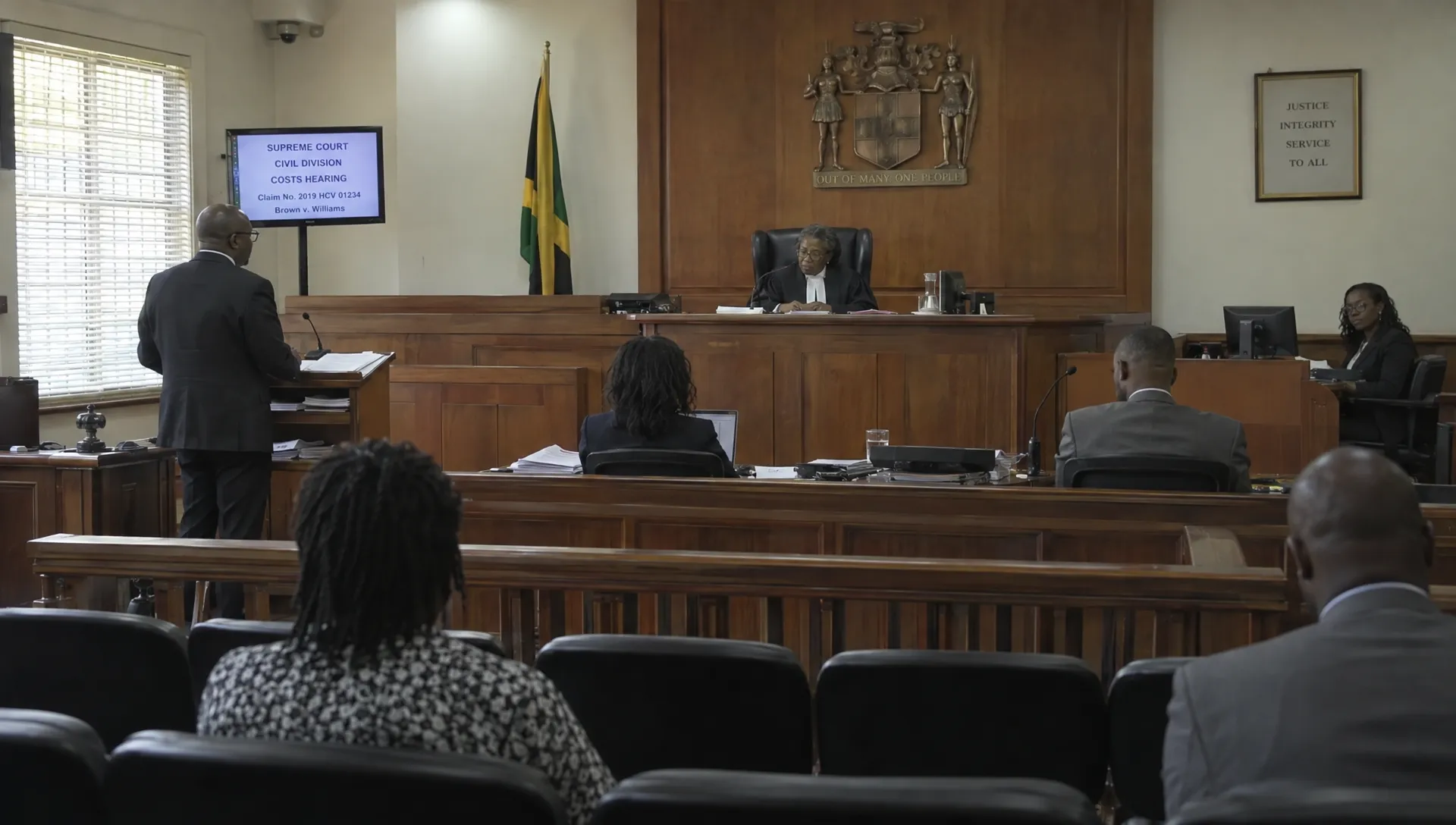
In Jamaica, the usual starting point in an ordinary civil case is that the unsuccessful party pays the successful party’s court-awarded legal costs. That does not mean the loser automatically pays every dollar the winner spent. The court has discretion over whether costs should be paid, by whom and to what extent.
For anyone bringing or defending a claim, two questions therefore matter: what will you owe your own attorney and what might you have to pay, or recover from, the other side? Those amounts can be different.
This guide focuses on ordinary civil litigation, particularly Supreme Court proceedings. Parish Court cases, specialist proceedings and appeals may involve different rules.
The usual rule on legal costs in Jamaica
The expression “costs follow the event” describes the general approach: the successful party will ordinarily receive an order for costs against the unsuccessful party. However, success does not create an automatic entitlement to complete reimbursement.
For Supreme Court civil proceedings, the central framework is found in Parts 64 and 65 of Jamaica’s Civil Procedure Rules, available through the Supreme Court of Jamaica. Part 64 addresses the court’s approach to awarding costs, while Part 65 deals with their quantification.
A costs order can arise after a trial, but it can also follow an application made while the case is still underway. For example, an unsuccessful application may result in a costs order even though the main dispute has not been decided.
The wording of each order matters. Costs might be awarded immediately, left for later determination or made dependent on the eventual outcome of the proceedings.
Your attorney’s bill is different from recoverable costs
Your obligation to pay your attorney generally arises from your engagement agreement. The other party’s obligation arises from a court order or an agreement dealing with costs.
These are separate relationships. A court may allow less than the amount you owe your attorney because not every charge or expense is recoverable from an opponent. The applicable assessment considers what should properly be allowed under the procedural rules, rather than simply adopting your invoice.
For illustration only, suppose your legal bill is J$800,000 and the costs recoverable from the other party are agreed or assessed at J$500,000. You could still bear the J$300,000 difference, subject to your fee arrangement. These figures are not a fee estimate or a prediction of any court award.
Winning the case and recovering your full legal spend are not the same thing.
What can change the court’s decision on costs?
The court considers the circumstances of the proceedings, not just whose name appears beside the final judgment. The outcome remains important, but the parties’ conduct and the way the dispute was handled can affect the order.
Relevant considerations can include:
Mixed success: A party may succeed on the main claim but fail on a substantial counterclaim or separate issue.
Unreasonable conduct: Unnecessary applications, avoidable delay or failure to comply with procedural obligations can influence costs.
The way issues were pursued: The court may consider whether it was reasonable to raise or contest a particular allegation or issue.
Settlement offers: A qualifying offer and the eventual result may affect costs under the applicable rules.
These factors can lead to a reduced award, an order limited to certain stages or issues, or an order requiring an otherwise successful party to pay costs relating to a particular part of the case.
A claimant who obtains some damages should therefore avoid assuming that every aspect of the litigation has been vindicated. Equally, a defendant who defeats most of a claim should not assume that the costs consequences are settled until the court makes its order.
Conduct matters even when the underlying claim is strong
A good substantive case does not excuse poor litigation conduct. Missing deadlines, failing to provide required documents or pursuing an unnecessary hearing can create additional expense for the opponent.
The court may address that expense through a separate costs order. Clients should therefore treat procedural compliance as part of financial risk management, not merely as an administrative concern for their attorneys.
What common costs orders mean
The precise language of an order determines its effect. These expressions commonly arise in civil proceedings:
Wording | General practical meaning |
Costs to the claimant or defendant | The named party is entitled to recover costs covered by the order, subject to determining the amount. |
Costs to be taxed if not agreed | The parties may agree the recoverable amount. If they cannot, it must be determined through the applicable formal process. |
Costs reserved | The court will decide the costs question later. It has not yet awarded those costs to either side. |
No order as to costs | Generally, each party bears its own costs for the matter covered by that order. |
Costs in the case | The costs of that step generally follow the eventual costs outcome in the proceedings. |
An order about one application does not necessarily determine responsibility for the entire case. Several costs orders may accumulate during proceedings, potentially benefiting different parties at different stages.
Ask your attorney to explain both who is liable and which work the order covers. A statement that “we got costs” is not enough to establish the amount recoverable or when payment must be made.
Who pays when a case settles or is withdrawn?
A trial judgment is not the only event that can create costs liability. Settlement and discontinuance require careful attention because the parties may already have incurred substantial expense.
Settlement should expressly address costs
A settlement agreement should say whether the agreed payment includes costs, whether costs will be paid separately or whether each party will bear its own costs. If a separate payment is intended, the agreement should also address how its amount will be determined.
For example, “J$2 million inclusive of costs” has a different financial effect from “J$2 million plus agreed costs”. Leaving the point unresolved can produce another dispute after the substantive claim has been settled.
Formal settlement offers can also carry procedural costs consequences. An informal discussion is not necessarily equivalent to an offer made in accordance with the relevant rules. Your attorney should assess both the offer’s terms and its procedural status before you accept or reject it.
Discontinuing a claim can leave a costs liability
A claimant who discontinues proceedings will generally face liability for the defendant’s costs connected with the discontinued claim, unless the court orders otherwise. The precise position depends on the applicable rules and circumstances.
Withdrawal should therefore be evaluated as a financial decision as well as a legal one. Before discontinuing, obtain advice on existing costs orders, likely additional liability and whether a negotiated resolution can address costs expressly.

How is the amount of recoverable costs decided?
An order awarding costs may establish liability without fixing a dollar amount. The amount can then be agreed between the parties or determined through the procedure required by the rules and the order.
Where formal assessment is necessary, the process is commonly described as taxation of costs. In this context, “taxation” means examining and determining the recoverable costs, not imposing a government tax.
Depending on the applicable rules, recoverable costs may include allowed attorney’s fees and disbursements, such as court filing fees or properly incurred expert expenses. Including an expense in a bill does not guarantee that it will be allowed.
The assessment may require scrutiny of the work performed, the charges claimed and the supporting records. The paying party may dispute particular items. The receiving party should therefore preserve invoices, receipts and other material supporting the claim.
A damages award is separate from a costs award
Damages compensate for the loss established in the substantive case. Costs address the expense of the proceedings. They are not interchangeable.
A judgment might award damages and costs, but the costs figure may remain unresolved after the damages amount is known. Interest, if applicable, raises a further question that should be considered separately under the relevant judgment and rules.
When assessing the value of a result, ask for a clear breakdown of the substantive award, recoverable costs and your remaining legal expenses.
What if the other side does not pay?
A costs order does not guarantee collection. If the paying party fails to comply, enforcement may be necessary, subject to the applicable procedure and any stay of enforcement.
There is also a practical difference between a party who refuses to pay and one who has no accessible assets. A favourable order against an insolvent company may have limited immediate financial value.
Check the payment obligations arising from the order and rules rather than assuming that everything can wait until the main case ends. Likewise, do not assume that bringing an appeal automatically suspends an obligation to pay costs. Whether a stay exists or should be sought requires separate consideration.
Recoverability should be assessed early. The likely legal merits, expected costs and opponent’s ability to satisfy an award all influence whether litigation makes commercial sense.
How to manage your costs exposure before proceeding
Ask your attorney for a written explanation of the fee arrangement and a budget that distinguishes your own expected expenditure from possible liability for the opponent’s costs. A budget is not a guarantee, but it provides a basis for revisiting the strategy as the case develops.
Useful review points include the close of pleadings, disclosure, expert evidence and preparation for trial. At each stage, compare the likely benefit of continuing with the additional expense and settlement options. A careful assessment before filing a civil claim can identify these issues before substantial costs accumulate.
In some cases, a defendant may seek security for costs. This is protection against a potential future costs award, not a finding that the claimant will lose. Understanding what security for costs means for commercial claimants can help a business assess the funding implications of bringing proceedings.
The objective is not simply to predict who will win. It is to understand the likely net financial outcome under realistic scenarios, including partial success, settlement and difficulty enforcing an award.
Frequently asked questions
Does losing a civil case mean paying all of the winner’s legal fees? No. The usual rule favours an award of costs to the successful party, but the court retains discretion. The recoverable amount may be lower than the winner’s actual legal bill.
Can I be ordered to pay costs before the trial? Yes. An interim application can result in its own costs order. Whether payment is required at that stage depends on the order and applicable rules.
If each party bears its own costs, do I still owe my attorney? Generally, yes, according to your engagement agreement. An order that each side bears its own costs does not ordinarily cancel your separate obligation to your attorney.
Can an appeal create another costs liability? Yes. An appeal can generate its own costs order, and the appellate court may also address costs from the proceedings below. Obtain advice on both exposures before deciding to appeal.
This article provides general information, not legal advice on a particular dispute.
Get advice on the financial risk of your case
Before starting, defending or settling a civil claim, understand both your own legal fees and the costs you might pay to the other side. Henlin Gibson Henlin provides civil and commercial litigation services in Jamaica. Discuss your dispute with the firm to obtain advice on the applicable costs rules, settlement terms and practical risks of proceeding.