
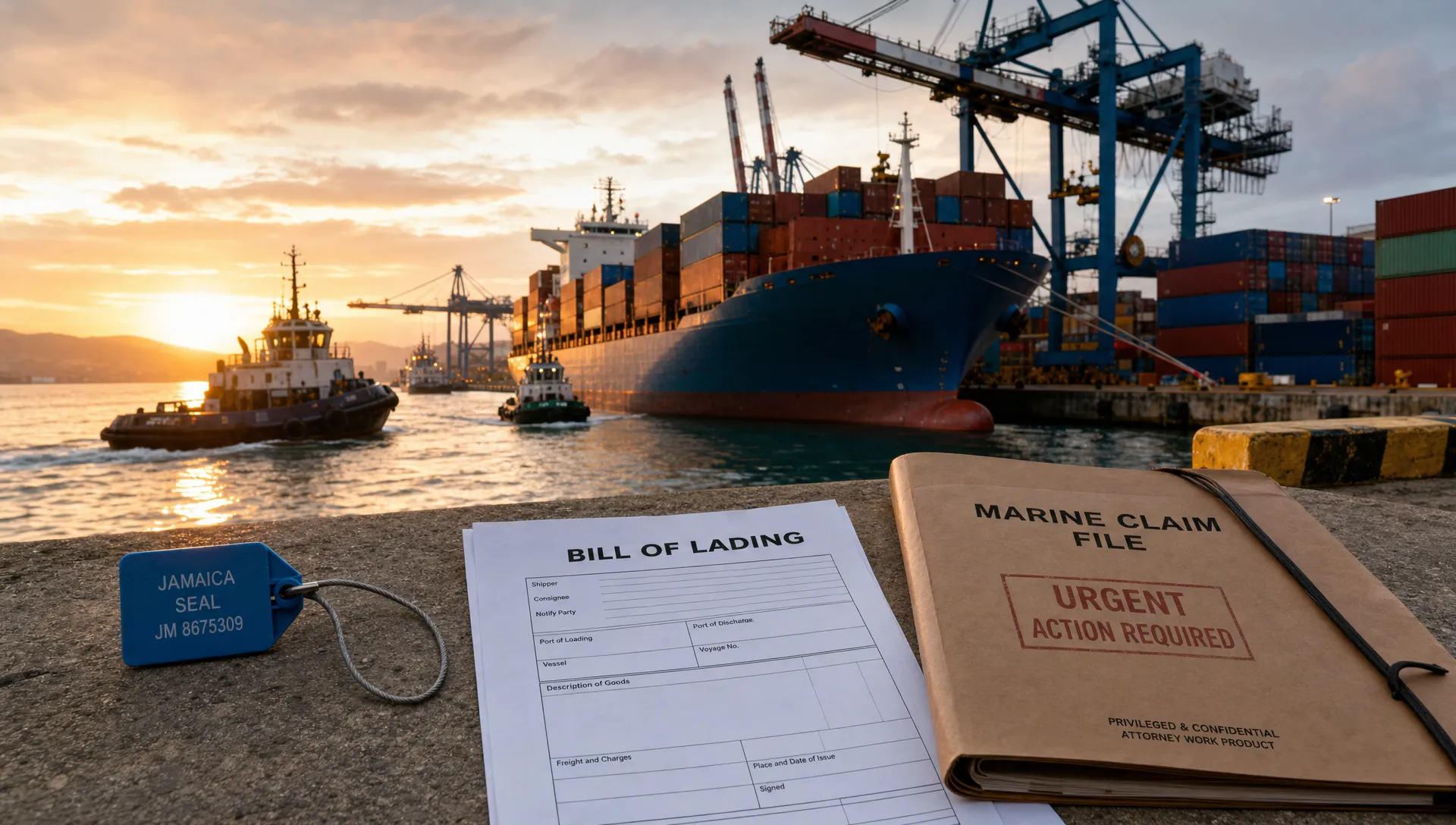
An admiralty claim is not just another commercial dispute with a vessel in the background. In shipping, cargo, freight, port services and vessel finance, timing can change the entire commercial result. A ship may leave Jamaican waters, cargo may be released, evidence may sit with a foreign crew, and the contract may point to arbitration or litigation outside Jamaica.
For Jamaican importers, exporters, ship agents, port service providers, charterers, vessel owners, banks and insurers, the practical question is usually the same: how do we protect our position before the leverage disappears?
This guide explains how admiralty claims in Jamaica typically arise, what businesses should do early, and how to think about litigation, arrest, security, arbitration and settlement in a commercially sensible way.
What is an admiralty claim?
An admiralty claim is a legal claim connected to maritime activity. It may involve a vessel, cargo, freight, bunkers, port charges, crew matters, collision damage, salvage, vessel finance, charterparties, bills of lading, or other shipping-related obligations.
Admiralty matters are different from ordinary commercial claims because the ship itself can sometimes become central to the proceedings. In appropriate cases, a claimant may bring a claim in rem, meaning the claim is directed against the vessel or other maritime property. A claim may also be brought in personam, meaning it is brought against a company or individual, such as a shipowner, charterer, guarantor or contracting counterparty.
That distinction matters. If the vessel is within the jurisdiction and the claim qualifies, arrest or threatened arrest may provide security for the claim. If the ship sails before action is taken, the claimant may be left pursuing a foreign entity with uncertain assets.
For a deeper discussion of the arrest and lien mechanics, see Henlin Gibson Henlin’s guide to shipping law in Jamaica, including vessel arrests, maritime liens and claims strategy.
Common admiralty claims Jamaican businesses may face
Admiralty claims in Jamaica can arise from everyday trade as much as from dramatic marine casualties. A container of damaged goods, an unpaid port service invoice, a disputed charterparty clause or a cargo release error can all become serious legal and financial issues.
Scenario | Typical parties involved | Immediate business priority |
Cargo damage or shortage | Importer, exporter, carrier, freight forwarder, insurer | Preserve evidence, inspect goods, review bill of lading and notice requirements |
Unpaid port, agency or supply charges | Port service provider, ship agent, vessel owner, charterer | Identify the liable party and assess whether security is available |
Charterparty dispute | Owner, charterer, broker, guarantor | Review governing law, arbitration clause, hire, laytime and demurrage provisions |
Collision or allision | Vessel owners, port operator, insurer, cargo interests | Secure incident records, survey damage and notify insurers |
Vessel mortgage or finance dispute | Bank, lender, owner, bareboat charterer | Confirm security documents, registration and enforcement options |
Cargo release or documentation dispute | Carrier, consignee, bank, seller, buyer | Check original documents, payment terms and authority to release |
Bunker or necessaries claim | Supplier, trader, owner, charterer | Determine contracting party, vessel location and available remedies |
The same facts may also create non-admiralty claims, such as breach of contract, negligence, misrepresentation, debt recovery or insurance disputes. The business strategy should therefore consider both maritime remedies and ordinary commercial litigation tools.
Why speed matters in admiralty disputes
Shipping disputes often develop while the commercial situation is still moving. The vessel may be loading, discharging, bunkering, awaiting clearance or preparing to sail. This creates urgency that is not present in many other civil claims.
Delay can affect leverage in at least four ways. First, the ship may depart the jurisdiction. Second, cargo may be released or moved through multiple hands. Third, critical witnesses may be difficult to locate once the crew changes or agents close the file. Fourth, contractual notice periods and time bars may begin running immediately.
Businesses should not assume that a standard debt recovery approach will be enough. In admiralty matters, the first few hours can determine whether the claim is secured, whether evidence is preserved and whether settlement discussions are realistic.
The first steps when an admiralty issue arises
When a maritime dispute appears likely, the goal is not to rush into court at any cost. The goal is to make a clear, evidence-based decision while options remain open.
A practical first response should include:
Identify the vessel, including name, flag, IMO number if available, owner, operator, charterer, port agent and expected sailing time.
Preserve contracts and transport documents, including bills of lading, charterparties, booking notes, invoices, delivery orders, guarantees and emails.
Record the facts while memories are fresh, including dates, times, port movements, cargo condition, payments, conversations and instructions.
Notify insurers, brokers, P&I representatives or other relevant stakeholders where policy terms require prompt notice.
Check jurisdiction, governing law, arbitration clauses, notice requirements and time limits before sending aggressive correspondence.
Consider whether security is needed and whether the vessel or other assets are available in Jamaica.
If the matter may proceed to court, businesses should also review the broader pre-filing considerations that apply to civil claims. Henlin Gibson Henlin’s guide on what to do before filing a civil claim in Jamaica is a useful starting point for evidence preservation, limitation periods and forum choice.
Evidence that can make or break an admiralty claim
Admiralty disputes are document-heavy. Courts, arbitrators, insurers and settlement counterparties will usually look for contemporaneous records rather than after-the-fact explanations. The quality of your file can influence whether the other side takes the claim seriously.
Evidence category | Why it matters |
Bills of lading, sea waybills and delivery orders | Identify cargo rights, contractual terms, parties and release obligations |
Charterparties and fixture recap emails | Establish hire, laytime, demurrage, routing, performance and dispute resolution terms |
Invoices, statements and payment records | Support debt claims and help identify the correct debtor |
Port logs, berth records and agent correspondence | Confirm vessel movements, timing, instructions and operational events |
Survey reports, photographs and sampling records | Prove cargo condition, damage, contamination or shortage |
Crew statements, master’s reports and incident notes | Provide direct evidence of marine casualties or operational failures |
Insurance policies and notifications | Confirm cover, exclusions, deductibles and notice compliance |
Customs, import and export documentation | Link the shipment to commercial transactions and regulatory steps |
Evidence collection must also be handled lawfully. If a file includes personal data about crew, passengers, employees or customers, businesses should consider confidentiality obligations and applicable data protection requirements before circulating documents widely.

Claimant strategy: settlement, security or proceedings?
A business bringing an admiralty claim should begin with the commercial objective. Is the priority to secure payment, stop cargo release, preserve evidence, recover damages, protect a banking position, or avoid reputational harm? The legal route should serve that objective.
Strategy | When it may help | Key risk to manage |
Demand letter with evidence pack | The counterparty is solvent and responsive | Giving notice without securing leverage may allow assets to move |
Negotiated security | Both sides want to avoid vessel arrest or operational disruption | The wording and form of security must be adequate |
In rem proceedings | The vessel is within reach and the claim qualifies | Wrongful or premature steps can create cost exposure |
In personam claim | The target company or guarantor is identifiable and has assets | Enforcement may be difficult if the defendant is abroad |
Arbitration | The contract requires it or parties prefer a private forum | Court assistance may still be needed for urgent security |
Mediation | The relationship has value or facts are disputed but negotiable | It may not protect limitation periods unless managed properly |
Not every claim should start with a dramatic court application. A modest but well-documented unpaid invoice may settle once the correct party is identified and the vessel’s schedule is known. On the other hand, a high-value cargo claim or vessel finance dispute may require urgent steps to prevent the loss of security.
Defending an admiralty claim or vessel arrest threat
Businesses on the receiving end of an admiralty claim should act just as quickly. A vessel arrest, or even a credible threat of arrest, can disrupt schedules, charter commitments, port operations and customer relationships.
The first defence step is to understand the claim with precision. Who is the claimant? What is the legal basis? Is the claim against the owner, charterer, manager, agent or vessel? Does the claimant have the right to proceed in rem, or is the dispute only contractual against another party?
A defendant should also assess whether security can resolve the immediate operational problem without conceding liability. Depending on the circumstances, security may take the form of a guarantee, undertaking, bond, payment into court, insurer-backed letter or another arrangement acceptable to the relevant parties or the court. The form and wording are important because poor security terms can create fresh disputes.
Potential defences may include lack of jurisdiction, wrong party, time bar, contractual exclusion, payment, set-off, absence of authority, defective documentation, or a dispute resolution clause requiring arbitration. These points should be raised carefully and promptly.
Arbitration and mediation in maritime disputes
Many shipping contracts contain arbitration clauses. Charterparties, bills of lading, bunker contracts and international trade agreements often select a foreign seat, foreign law or a specialist maritime arbitration process.
That does not mean Jamaican businesses should ignore local strategy. Even where arbitration is required, local court action may be relevant for urgent interim relief, security, evidence or enforcement. The practical issue is how to coordinate the contractually required forum with the immediate commercial need.
Mediation may also be valuable, particularly where the parties have an ongoing relationship or where delay would damage both sides. A mediated resolution can address payment schedules, cargo release, future business, confidentiality and operational issues that a judgment may not fully solve.
If your contract gives you a choice, Henlin Gibson Henlin’s guide to choosing between arbitration and litigation explains the commercial factors businesses should weigh before committing to either path.
Limitation periods and contractual time bars
One of the most dangerous assumptions in admiralty matters is that there is plenty of time. Maritime contracts often contain short notice periods, claim presentation deadlines and dispute commencement requirements. Bills of lading, charterparties, insurance policies and international trade documents may impose obligations that are much shorter than ordinary commercial expectations.
The applicable time limit depends on the type of claim, the contract, the parties, the governing law and the forum. A cargo claim, collision claim, debt claim, mortgage claim or personal injury claim may each raise different issues. Businesses should therefore check limitation and time bar questions at the beginning, not after negotiations fail.
A settlement discussion does not always stop time from running. If limitation is approaching, the business may need a standstill agreement, protective proceedings or another formal step to preserve its position.
How to reduce admiralty risk before a dispute arises
The best admiralty strategy is often built into the transaction before the vessel arrives. Clear contracts, disciplined records and early legal review can prevent a routine shipping issue from becoming an expensive emergency.
Practical risk controls include:
Use clear written contracts that identify the parties, capacity, governing law, forum, payment terms and authority of agents.
Align bills of lading, sale contracts, letters of credit and insurance documents so that cargo rights and payment obligations do not conflict.
Build notice procedures into internal workflows so cargo damage, shortage and delay issues are reported immediately.
Keep port, agency, delivery and survey records in a searchable format with responsible personnel assigned to each file.
Review arbitration clauses, jurisdiction clauses and security rights before agreeing to standard terms.
Confirm insurance notification requirements and contact details before shipments move.
For Jamaican businesses with frequent maritime exposure, these controls should sit alongside broader contract management, compliance and commercial litigation planning.
Common mistakes businesses should avoid
The most common admiralty mistakes are practical rather than technical. They often happen because the business treats a maritime dispute like an ordinary email complaint or invoice chase.
One mistake is waiting until the vessel has sailed before seeking advice. Another is sending strong allegations before reviewing the contract, which can create unnecessary exposure or alert the counterparty before security options are assessed. Businesses also sometimes pursue the wrong defendant, particularly where owners, charterers, managers, agents and traders all appear in the documents.
A further mistake is failing to preserve evidence. Damaged cargo may be disposed of, packaging may be discarded, survey opportunities may be missed, and informal WhatsApp or email instructions may be lost. In shipping disputes, those details can be decisive.
Finally, businesses should avoid assuming that arbitration, mediation and court proceedings are mutually exclusive. In many maritime disputes, the right strategy may involve more than one process at different stages.
Frequently Asked Questions
What types of businesses are most likely to face admiralty claims in Jamaica? Importers, exporters, shipowners, charterers, port operators, ship agents, freight forwarders, insurers, banks and suppliers to vessels are among the businesses most likely to encounter admiralty claims.
Can a ship be arrested in Jamaica for a commercial debt? It depends on the nature of the debt, the parties, the vessel’s connection to the claim and whether the legal requirements for an in rem claim are met. Businesses should obtain advice before assuming arrest is available.
What should I do if cargo arrives damaged or short? Preserve the cargo and packaging, arrange inspection or survey where appropriate, take photographs, notify insurers and counterparties, and review the bill of lading or carriage contract for notice and time limit requirements.
Does an arbitration clause prevent court action in Jamaica? Not always. An arbitration clause may require the substantive dispute to be arbitrated, but court assistance may still be relevant for urgent relief, security, enforcement or procedural support, depending on the facts and contract.
How quickly should a business seek legal advice in an admiralty matter? As soon as a claim is likely. If a vessel is about to leave port, cargo is about to be released, or a time bar may apply, waiting even a short period can materially affect available remedies.
Final thoughts
Admiralty claims in Jamaica require a mix of commercial judgment and maritime legal strategy. The strongest position is usually built early, when the vessel, documents, cargo, witnesses and negotiating leverage are still within reach.
This article is general information and should not be treated as legal advice for a specific matter. If your business is dealing with unpaid freight, cargo damage, vessel services, charterparty issues, marine finance or urgent security questions, Henlin Gibson Henlin can assist with practical, Jamaica-focused guidance on admiralty and shipping disputes.