
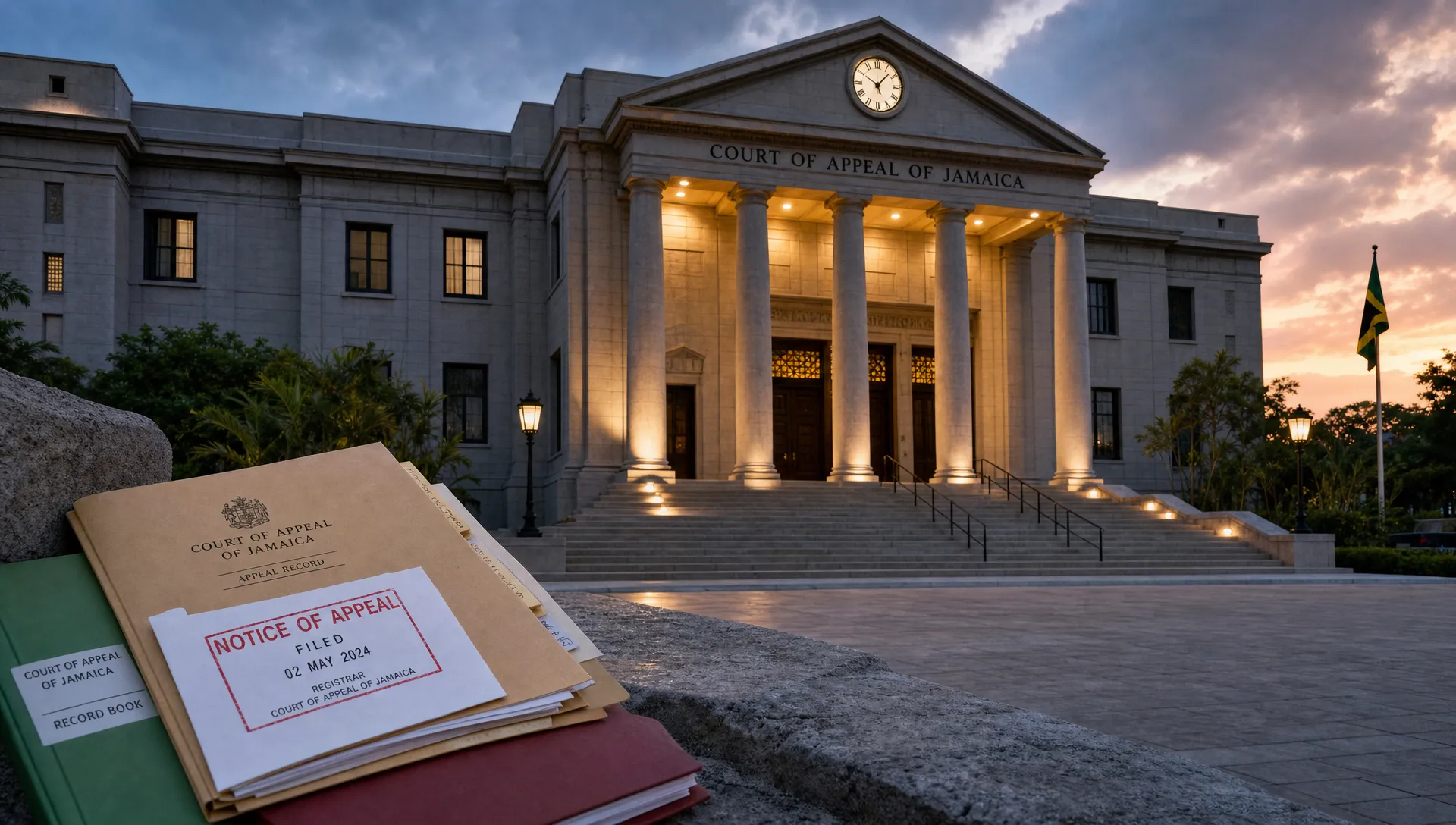
Appeal deadlines in Jamaica can be unforgiving. A party may have strong arguments, a troubling judgment, or a genuine reason for delay, yet still face serious difficulty if the notice of appeal or application for permission is filed late. In appellate work, timing is not an administrative detail. It can determine whether the court will even hear the appeal.
This guide explains common mistakes to avoid after a judgment or order in Jamaica. It is general information only, not legal advice. The correct deadline can depend on the court, the type of order, the statute involved, and whether permission to appeal is required.
Why appeal deadlines in Jamaica require immediate attention
An appeal is not a second trial. It is a structured challenge to a decision, usually based on an alleged error of law, a serious error in the judge’s approach to the facts, procedural unfairness, or an improper exercise of discretion. Because appeals affect finality, the rules impose strict time limits.
Jamaica’s court structure also matters. Appeals may move from the Parish Court to a higher court, from the Supreme Court to the Court of Appeal, or in limited circumstances from the Court of Appeal to the Judicial Committee of the Privy Council. If you need a broader refresher, Henlin Gibson Henlin’s overview of Jamaica’s court system and legal framework explains the hierarchy and the role of precedent.
The practical point is simple: after judgment, do not wait to see how things develop. The appeal clock may already be running.
Common Jamaican appeal time limits to check first
For many civil appeals from the Supreme Court to the Court of Appeal, the Court of Appeal Rules, 2002 make 42 days a critical reference point for final judgments or orders. Interlocutory decisions are commonly subject to a shorter 14-day period. In criminal matters, a notice of appeal or application for leave is commonly required within 14 days of conviction or sentence, depending on what is being challenged.
Those timeframes are not a substitute for legal advice. Some appeals are created by specific statutes and may have their own rules. Administrative, regulatory, employment, tax, consumer, planning, and tribunal-related matters can all involve special procedural requirements.
Situation | Deadline risk to check | Common mistake |
Final civil order in the Supreme Court | Often treated by reference to a 42-day period under the Court of Appeal Rules | Waiting for negotiations, written reasons, or enforcement steps before taking advice |
Interlocutory civil order | Often much shorter, commonly 14 days | Treating a procedural or interim ruling as if it has the same timeline as a final judgment |
Appeal requiring permission or leave | Permission may have to be sought promptly, sometimes first from the court below | Filing as if there is an automatic right of appeal |
Criminal conviction or sentence | Short filing periods commonly apply | Waiting for the transcript before filing a notice or leave application |
Statutory or tribunal appeal | The enabling Act or regulations may set a special deadline | Applying the general civil appeal deadline without checking the statute |
Appeal to the Privy Council | Specialist rules and leave requirements apply | Assuming the same timeline and documents used in the Court of Appeal will be enough |
The safest approach is to identify the applicable rule on day one, then work backwards from the deadline.
Mistake 1: Waiting for the written reasons or sealed order
A common error is assuming that nothing needs to be done until the written judgment, sealed order, or transcript is ready. In some cases, the date of service of the judgment or order is important. In others, the time may be connected to the date the decision was made, pronounced, or otherwise perfected. The answer depends on the relevant rules and the court.
Even where service of the order is relevant, a party should not be passive. Ask for the order, request reasons or transcripts promptly, and preserve a written record of all requests. If the order is delayed, your lawyer may still be able to advise on a protective step, a permission application, or an extension strategy.
The key mistake is treating missing paperwork as a reason to stop the clock. It may not.
Mistake 2: Misidentifying the order as final or interlocutory
The difference between a final order and an interlocutory order can be critical because the deadline may be different. A final order generally resolves the substantive rights of the parties. An interlocutory order is usually made along the way, for example a procedural ruling, interim injunction, case management decision, disclosure order, or refusal of an amendment.
But labels can mislead. An order made before trial may still have final consequences for a claim or defence. A decision that feels decisive may still be interlocutory for appeal purposes. The classification is a legal question, not simply a matter of how important the decision feels to the losing party.
This is one reason parties involved in civil litigation should seek advice quickly after an adverse ruling. If the matter is already contentious, the warning signs discussed in Henlin Gibson Henlin’s article on when to hire attorneys for civil matters in Jamaica are often even more urgent after judgment.
Mistake 3: Assuming you have an appeal as of right
Not every decision can be appealed automatically. Some appeals require permission, also called leave. Permission may be needed because of the nature of the order, the court that made it, or the statute governing the matter.
If leave is required, filing a notice of appeal without addressing permission can create a procedural problem. Conversely, spending too long debating permission internally can cause both the permission deadline and the appeal deadline to become difficult.
Good practice is to ask three questions immediately:
Is there a right of appeal, or is permission required?
If permission is required, should it be requested from the judge who made the decision?
If permission is refused, what is the time limit for renewing the application in the appellate court?
These questions should be answered before the client decides whether the appeal is worth pursuing.
Mistake 4: Confusing filing, service, and later appeal steps
Filing the notice of appeal is only one part of the process. The notice may also need to be served. Other documents, such as the record of appeal, written submissions, skeleton arguments, authorities, transcripts, and bundles, may have their own deadlines or directions.
A litigant who files on time but fails to serve properly may still face objections. A party who files a bare notice but does not prepare the record may cause delay, increase costs, and invite procedural applications from the respondent.
In commercial litigation, this can be especially damaging. A judgment debt, injunction, asset dispute, or shareholder conflict may continue to affect business operations while the appeal is pending. Strong appellate planning therefore starts with the same discipline used to prepare strong trial matters: issue identification, document control, evidence preservation, and procedural planning. Henlin Gibson Henlin’s discussion of how civil litigation teams prepare strong cases is useful background for that broader approach.

Mistake 5: Calculating time casually
Deadline calculation is a technical exercise. Do not assume that a stated number of days means business days. Many court periods are counted as calendar days unless the applicable rule provides otherwise. Weekends, public holidays, registry closures, and filing cut-off times can all affect practical filing strategy.
A careful appeal diary should record more than one date. It should include the date of judgment, the date the order was made, the date the order was served, the date written reasons were received, any deadline for permission, the last date for filing the notice, the last date for service, and any subsequent directions.
The most dangerous habit is counting from memory. Always calculate the deadline from the source document and the governing rule.
Mistake 6: Relying on settlement talks to pause the appeal clock
Parties often discuss settlement after judgment. That can be sensible, especially where the dispute is commercial and both sides want certainty. But settlement discussions do not normally pause court deadlines unless there is a formal order, rule-based extension, or properly documented procedural agreement that the court will recognise.
This creates a trap. A party may spend three weeks negotiating, only to discover that the appeal deadline is close or already missed. The better approach is to run both tracks at the same time. Explore settlement if appropriate, but protect the procedural position.
In some cases, a notice of appeal or permission application may encourage more realistic settlement discussions because both sides understand the appeal is being pursued seriously. In other cases, the costs of appeal may help the parties resolve the matter. Either way, negotiation should not replace deadline management.
Mistake 7: Forgetting that an appeal may not stop enforcement
Filing an appeal does not automatically mean that the judgment or order cannot be enforced. In many civil matters, the successful party may still seek enforcement unless a stay is granted.
This is especially important where the order involves payment of money, delivery of property, possession, injunctions, disclosure obligations, or steps that may be difficult to reverse. If compliance or enforcement would cause serious prejudice, the appellant should take advice on applying for a stay of execution or stay of proceedings.
A stay application is separate from the merits of the appeal. The court may consider factors such as the prospects of the appeal, the risk of injustice to either side, whether damages or repayment would be adequate, and the need to avoid making the appeal pointless. Delay can weaken the application.
Mistake 8: Drafting grounds of appeal as complaints rather than legal errors
A notice of appeal should not simply say that the judge was wrong or that the result was unfair. Grounds of appeal should identify the legal, factual, or procedural error being challenged. They should be concise, structured, and connected to the order the appellant wants the appellate court to make.
Weak grounds often fall into predictable patterns. They reargue every factual dispute, ignore the judge’s discretion, omit the legal test, or complain about credibility findings without showing why appellate intervention is justified.
This matters for deadlines because rushed drafting can create long-term problems. Once filed, grounds may require permission to amend. Poor grounds can also affect an application for extension of time or leave to appeal, because the court may consider whether the proposed appeal has a real prospect of success.
Mistake 9: Treating an extension of time as routine
If a deadline is missed, an extension of time may be possible, but it should never be treated as automatic. Jamaican appellate courts commonly consider factors such as the length of the delay, the reason for the delay, the merits of the proposed appeal, and prejudice to the respondent. Those considerations are often associated with the Court of Appeal’s approach in cases such as Leymon Strachan v The Gleaner Company Ltd and Dudley Stokes.
A good extension application usually needs evidence, not excuses. The applicant should explain what happened, account for the full period of delay, attach the proposed notice or grounds where appropriate, and show why justice requires the extension.
The longer the delay, the more difficult the application may become. A short delay with a strong explanation is different from months of inactivity. The respondent is also entitled to finality, especially where they have taken steps in reliance on the judgment.
What to do immediately after an adverse decision
The first 48 hours after judgment are important. You do not need to have every appellate argument finalised immediately, but you do need a plan.
A practical first response should include the following:
Obtain the judgment, order, reasons, and any notes of the oral ruling as quickly as possible.
Confirm the court, claim number, parties, exact order made, and date of service.
Identify whether the order is final or interlocutory.
Check whether permission or leave to appeal is required.
Calculate the filing deadline and a safer internal deadline several days earlier.
Consider whether a stay is needed to prevent enforcement.
Preserve transcripts, exhibits, pleadings, affidavits, submissions, and correspondence.
Take advice before contacting the other side about extensions, settlement, or enforcement.
For businesses, directors, insurers, lenders, and regulated entities, the internal response should also include a risk assessment. An appeal can affect financial reporting, contractual obligations, licensing, reputation, data handling, employment relations, and ongoing commercial negotiations.
Frequently Asked Questions
How long do I have to appeal a civil judgment in Jamaica? Many civil appeals from the Supreme Court to the Court of Appeal use 42 days as a critical reference point for final judgments or orders, while interlocutory orders are commonly subject to a shorter 14-day period. The exact deadline depends on the applicable rules, the order, service, and whether permission is required.
Can I appeal after the deadline has passed? You may be able to apply for an extension of time, but it is discretionary. The court will usually want a proper explanation for the delay, evidence supporting the application, and some indication that the proposed appeal has merit.
Does filing an appeal stop the judgment from being enforced? Not necessarily. In many civil cases, enforcement can continue unless a stay is granted. If enforcement would cause serious harm or make the appeal ineffective, take urgent advice on a stay application.
Should I wait for the transcript before appealing? Usually, you should not wait passively for the transcript if a deadline is running. Request the transcript or reasons promptly, but also get advice on whether a notice, permission application, or protective step must be filed before the transcript is ready.
What is the biggest appeal deadline mistake? The biggest mistake is assuming the deadline is obvious. Appeal time limits can change depending on the court, type of order, statute, and permission requirement. Always calculate the deadline from the governing rule and source documents.
Protect your appellate position early
Appeal deadlines in Jamaica reward preparation and punish delay. If you receive an adverse judgment or order, the safest next step is to get prompt advice on the correct deadline, the need for permission, the strength of the proposed grounds, and whether a stay is required.
Henlin Gibson Henlin provides client-focused legal services in Jamaica, including appellate work, civil litigation, commercial litigation, arbitration and mediation, and related risk advice. If a decision may need to be challenged, contact Henlin Gibson Henlin early so the procedural position can be assessed before time becomes the main issue.