
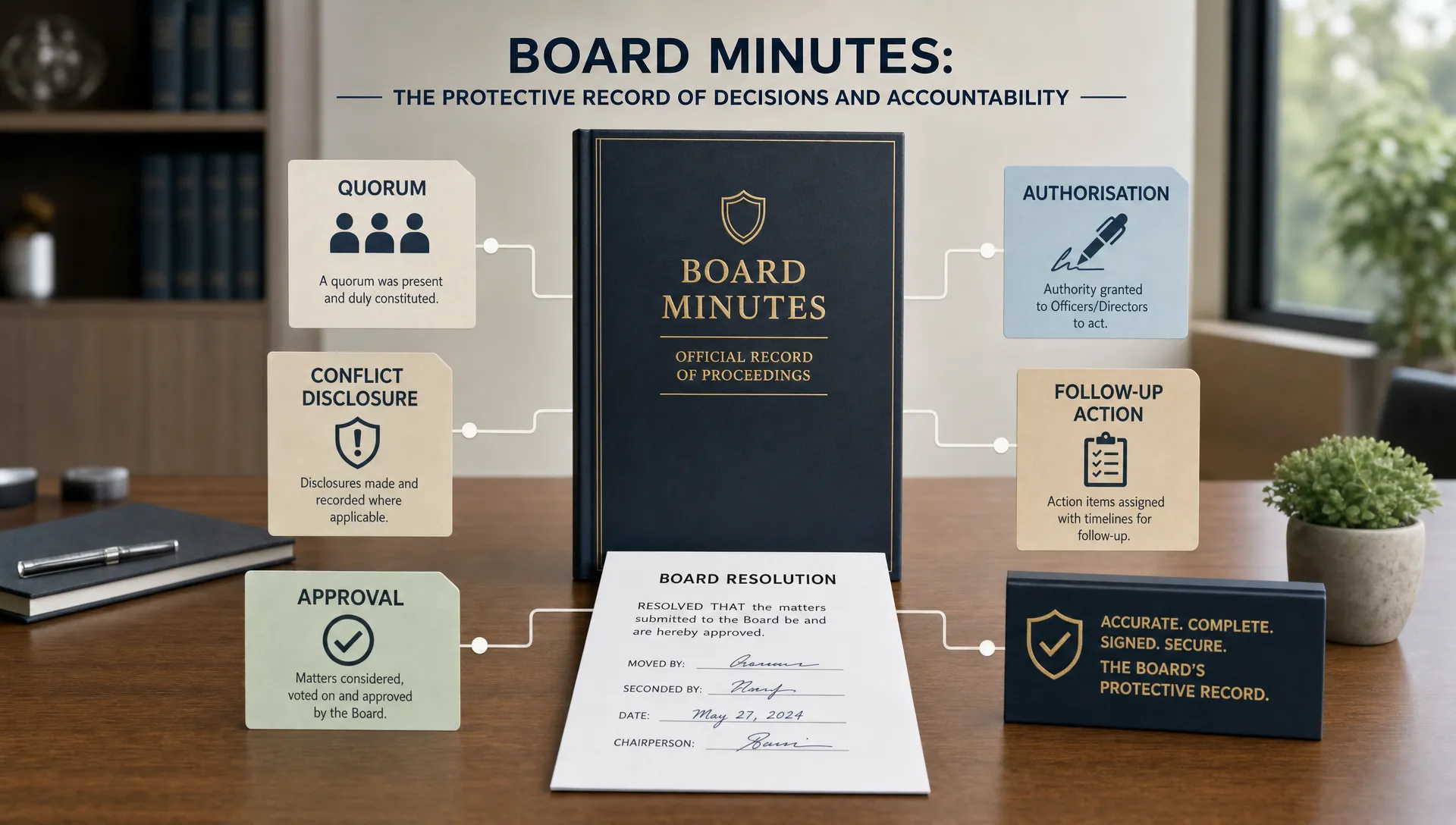
Board minutes are often treated as routine paperwork, something to be drafted after the real business has already happened. For Jamaican companies, that is a mistake. When a decision is later questioned by a shareholder, lender, regulator, employee or court, the minutes may become the clearest evidence of what the directors knew, what they considered and what they actually approved.
Good minutes do not make a bad decision good. They also do not remove the need for proper legal, accounting or tax advice. What they can do is show that the board acted with authority, followed a fair process, considered the right information and reached a decision for a legitimate company purpose.
For directors, company secretaries, founders and in-house teams, the goal is not to create long transcripts. The goal is to create a reliable corporate record that helps protect the company and the people responsible for governing it.
Why board minutes matter for Jamaican companies
A Jamaican company acts through its directors, officers and properly authorised representatives. Contracts are signed, loans are approved, disputes are settled, employees are hired or dismissed and assets are bought or sold because someone within the company has authority to act. Board minutes help prove that authority.
They are also part of the wider governance record. The Companies Office of Jamaica deals with formal company registration and filing information, but many of the most important governance decisions are evidenced internally. If the company cannot locate clear minutes, it may struggle to show who approved a transaction, whether a quorum was present or whether a director with a conflict declared it.
Minutes can matter in several practical situations:
A bank asks for evidence that a borrowing facility or security document was properly approved.
A shareholder alleges that directors acted without authority or favoured one shareholder over another.
A buyer conducting due diligence wants to confirm that major contracts, asset sales or share issuances were validly approved.
A director faces allegations of breach of duty and needs to show that the board considered relevant risks.
A regulator or counterparty asks how the company handled compliance, data protection or competition law concerns.
This is why minutes should be viewed as risk management, not administration. In disputes involving ownership or control, corporate records can become decisive. The same is true in shareholder claims, where the records that matter most in shareholder disputes often include minutes, resolutions, registers, notices and written communications.
What protective board minutes should contain
Protective minutes answer the questions a future reader is likely to ask. Was the meeting properly called? Who attended? Was there a quorum? What documents did the board review? Were conflicts declared? What did the board decide? Who was authorised to act?
The minutes should be objective. They should not read like advocacy for one side of a disagreement, nor should they hide serious issues that the board actually discussed. A useful test is whether an independent director, auditor, investor, lender or judge could read the minutes two years later and understand the process that led to the decision.
Minute element | What to record | Why it helps protect the company |
Meeting details | Date, time, place or virtual platform and meeting type | Shows when and how the board met |
Attendance | Directors present, apologies, invitees and the chair | Confirms participation and identifies non-directors |
Notice and quorum | Confirmation that proper notice was given or waived and that quorum was present | Supports the validity of decisions |
Documents considered | Board papers, financials, legal advice summaries, proposals or reports tabled | Shows decisions were informed |
Conflicts of interest | Declarations made, recusals and whether conflicted directors abstained | Reduces challenge risk in related-party matters |
Discussion summary | Main factors considered, risks raised and alternatives reviewed | Shows the board exercised judgment |
Resolutions | Exact decisions approved, rejected or deferred | Creates clear authority |
Authorisations | Persons authorised to sign, negotiate, file or implement | Helps banks, counterparties and officers rely on the approval |
Follow-up actions | Responsibility, deadlines and reporting back | Shows the board retained oversight |
The most useful minutes are specific without becoming bloated. For example, instead of saying “the board discussed the loan”, better minutes might state that the board reviewed the proposed facility letter, considered the repayment schedule, discussed the impact on cash flow and authorised two named officers to negotiate final terms within defined limits.
The right level of detail: not a transcript, not a rubber stamp
Minutes should not record every sentence spoken in the room. Verbatim minutes often create confusion because they preserve incomplete thoughts, negotiating positions and comments taken out of context. They can also chill frank discussion among directors.
At the same time, minutes that merely say “approved after discussion” may be too thin for serious decisions. If the company is later challenged, that phrase may not show what the board considered or why the decision was reasonable at the time.
A balanced approach records the essence of the discussion. It identifies the main issues, the material risks, the information relied on and the decision reached. Where directors disagree, the minutes should fairly record the disagreement and any abstention or dissent. That does not weaken the minutes. It often strengthens them by showing that the board engaged with the issue rather than simply rubber-stamping management’s recommendation.
For high-value or high-risk decisions, directors should assume that the minutes may one day be read by someone who was not in the room. That reader should be able to see a logical chain from information, to discussion, to decision.
Decisions that deserve extra care in the minutes
Not every agenda item needs the same level of detail. Approving routine operational matters will usually require less detail than approving a related-party transaction, major financing, litigation settlement or restructuring.
Board minutes should be especially careful where the decision involves directors’ duties, conflicts, company solvency, regulatory obligations or significant financial exposure. Jamaican directors should be alert to personal risk where they act outside authority, misuse company assets or ignore warning signs. For a broader discussion of these issues, see this guide on what directors should know about personal liability.
Examples of decisions that usually deserve stronger minutes include:
Borrowing money, granting security or approving guarantees.
Entering contracts with directors, shareholders, affiliates or connected parties.
Selling major assets or buying another business.
Issuing shares, changing ownership rights or approving shareholder arrangements.
Declaring dividends or making distributions where cash flow is tight.
Starting, settling or defending significant litigation.
Responding to regulatory concerns, data incidents or compliance failures.
Approving redundancies, senior executive terminations or sensitive employment decisions.
Adopting policies on competition law, intellectual property, trade secrets or data protection.
If a company later seeks investment, financing or a sale, these minutes may become part of legal due diligence. Buyers and lenders often want to see whether key decisions were properly approved and whether there are hidden governance issues. That is one reason strong minute-keeping fits naturally with legal due diligence before buying a Jamaican business, where authority, records and compliance can affect price, risk allocation and deal certainty.

A practical board minute structure
A consistent structure makes minutes easier to draft, approve and rely on later. It also helps directors focus on the matters that actually need a record.
A practical format for Jamaican companies can include the following sections:
Company and meeting heading: State the company name, type of meeting, date, time and location or virtual platform.
Attendance and quorum: List directors present, directors absent, invitees and confirmation that the meeting was properly constituted.
Chair and secretary: Identify who chaired the meeting and who took the minutes.
Declarations of interest: Record whether any director declared an interest and how the board handled it.
Approval of prior minutes: Note whether previous minutes were approved and whether amendments were made.
Matters arising: Capture updates on action items from previous meetings.
Agenda items and papers: Summarise each substantive item, the documents reviewed and the core discussion.
Resolutions and authorisations: Record exact approvals and who is authorised to implement them.
Close of meeting: Record the time of closure and, if applicable, the date of the next meeting.
The resolution wording should be clear enough to stand on its own. If the board approves a contract, identify the contract. If the board authorises a person to sign, name the person or office. If authority is limited by amount, time or condition, state the limit.
For example, “The board approved the execution of the lease” may not be enough if the company has several leases under negotiation. Better wording would identify the premises, counterparty, key date and authorised signatories.
Handling conflicts of interest properly
Conflicts are one of the most common reasons board decisions are challenged. A conflict does not always mean the company cannot proceed, but it does mean the process must be handled carefully.
Where a director has a personal interest in a transaction, a connection to the counterparty or another duty that may conflict with the company’s interests, the minutes should record the declaration. They should also record whether the director left the meeting, abstained from voting or participated in limited discussion with the board’s permission.
The minutes should not be vague. “A conflict was discussed” is weaker than “Mr X declared that he is a director of the proposed supplier. Mr X left the meeting for the board’s deliberation and did not vote on the resolution.”
This level of detail helps show that the board recognised the issue and took steps to preserve independent decision-making. It is especially important in family-owned companies, closely held businesses and companies where directors also act as shareholders, managers, landlords, suppliers or lenders.
Protecting privilege and sensitive information
Boards often discuss legal advice, litigation strategy, regulatory risk and internal investigations. Minutes need to show that advice was considered, but they should be drafted carefully so that the company does not unnecessarily expose privileged or sensitive material.
A common approach is to record that legal advice was received and considered, identify the broad topic and state the resulting decision without reproducing the advice in detail. The legal memorandum or opinion should be handled according to legal advice and document retention protocols. Circulation should be limited to those who need access.
This is also relevant for data protection. Under Jamaica’s data protection framework, organisations that process personal data must take governance and compliance seriously. Where the board considers a data incident, vendor risk or privacy compliance programme, the minutes should show that the issue was escalated and considered. The Office of the Information Commissioner is a useful public source for information on Jamaica’s data protection regime.
Sensitive commercial information also deserves care. If board papers contain trade secrets, pricing strategy, customer lists or acquisition plans, minutes should avoid unnecessary detail while still recording the substance of the decision. Access controls, secure storage and careful circulation are part of the protection.
Approval, signing and storage of minutes
Minutes protect a company only if they are accurate, approved and available when needed. A draft sitting in someone’s inbox for months is less useful than a signed record in the company’s minute book or secure corporate records system.
The company should have a routine for preparing draft minutes soon after each meeting, circulating them for review, approving them and storing the final version. Directors should review minutes while the discussion is still fresh. If amendments are needed, they should be made transparently rather than through informal edits that leave uncertainty about the approved version.
Good practice | Practical benefit |
Draft minutes promptly after the meeting | Reduces errors and memory gaps |
Mark drafts clearly as drafts | Avoids confusion over what has been approved |
Approve minutes at the next board meeting or through an authorised process | Creates a reliable final record |
Have the chair or authorised person sign the final minutes | Supports authenticity |
Keep minutes with resolutions, board papers and registers where appropriate | Makes the governance record complete |
Control access to sensitive records | Protects privilege and confidential information |
Back up digital records securely | Reduces loss from staff turnover, cyber incidents or office disruption |
Companies should also think about informal decision-making. In many businesses, directors discuss urgent matters by email, phone or messaging apps. If the company’s governing documents and applicable law allow a written resolution or other process, use it properly. If an urgent decision is taken informally, it should be ratified or recorded through the appropriate corporate process as soon as possible.
Common minute-keeping mistakes that increase risk
Some weaknesses appear again and again in corporate disputes. They are usually avoidable.
The first is missing minutes. If a major transaction was approved but there is no record, the company may have to rely on witness recollection, emails or conduct. That is a weaker position than a properly approved resolution.
The second is generic minutes. A file full of identical wording can suggest that directors were not paying attention to the specific decision before them. Copy-and-paste drafting is efficient, but it should not erase the substance of the meeting.
Other common mistakes include:
Failing to record quorum or notice.
Listing attendees incorrectly.
Omitting conflicts of interest.
Recording conclusions without the key factors considered.
Attaching sensitive legal advice too widely.
Failing to identify who is authorised to sign documents.
Leaving draft minutes unapproved for long periods.
Keeping board minutes, shareholder minutes and management notes mixed together without clear labels.
Another mistake is over-correction. Some boards sanitise minutes so heavily that the record becomes implausible. If there was a serious concern about solvency, litigation exposure, regulatory compliance or a conflicted transaction, the minutes should not pretend the issue did not exist. A fair record of the issue and the board’s response is usually more protective than silence.
Board minutes as part of a stronger governance culture
Minutes work best when they sit within a wider governance system. The board should receive proper papers in advance, use an agenda, distinguish between management updates and board approvals, track action items and keep corporate records in an organised way.
For growing Jamaican companies, this discipline can make a material difference. It supports bank financing, investor confidence, dispute prevention and regulatory readiness. It can also help founders move from informal decision-making to a more mature corporate structure without losing speed.
For established companies, better minutes can reduce risk during expansion, restructuring, acquisitions, shareholder changes or cross-border transactions. As the business becomes more complex, the quality of the governance record becomes more important.
Frequently Asked Questions
Are board minutes legally required for Jamaican companies? Jamaican companies are expected to maintain proper corporate records, and minutes are a core part of evidencing board and shareholder decisions. The precise requirements can depend on the company, its articles and the nature of the decision, so specific advice should be obtained where the issue is material.
Should board minutes record everything directors say? No. Minutes should not usually be a transcript. They should objectively record the main issues discussed, documents considered, decisions made, votes, conflicts and authorisations.
Can board minutes protect directors from personal liability? Minutes cannot protect directors who act unlawfully or improperly, but they can help show that directors acted with authority, considered relevant information and exercised judgment in good faith.
How soon should minutes be prepared? Draft minutes should be prepared as soon as practical after the meeting, then reviewed and approved through the company’s normal process. Delays increase the risk of mistakes and disputes over what occurred.
Should legal advice be copied into the minutes? Usually, minutes should record that legal advice was received and considered without reproducing privileged advice in detail. Sensitive legal material should be handled carefully and circulated only where appropriate.
What if directors make decisions by email or WhatsApp? Informal communications should not replace proper corporate approvals. If a decision is made urgently, the company should use an authorised written resolution process or ratify and record the decision properly as soon as possible.
Strengthen your company’s governance record
Clear board minutes help Jamaican companies prove authority, manage disputes and show that directors took their responsibilities seriously. They are a small discipline with large protective value.
If your company is reviewing its governance records, preparing for a transaction or dealing with a board or shareholder dispute, Henlin Gibson Henlin can assist with corporate law, commercial litigation and risk-focused legal services in Jamaica. To discuss support for your company, contact Henlin Gibson Henlin.